Cost-Effectiveness Studies in Diabetes-Related Foot Ulceration: To Model or Not to Model, That Is the Question
Abstract
Foot ulcers and amputations are common in patients with chronic limb-threatening ischemia. To reduce the burden of these complications, insight into interventions that help increase quality of life and/or decrease costs is needed. Such insight can be obtained from health-economic studies. Unfortunately, primary health-economic studies in the field of diabetes-related foot disease are scarce. As an alternative, health-economic modeling studies are performed; however, these come with challenges that are not always addressed.
The aim of this paper is to showcase potential shortcomings in health-economic modeling studies in diabetes-related foot disease and provide the reader with the knowledge to better assess and understand those studies. Pitfalls in modeling costs, clinical effectiveness, and quality of life are discussed, and examples to showcase these pitfalls are provided, along with 16 questions readers can ask themselves to help in the assessment of modeling studies.
We hope that this paper will motivate researchers to perform primary health-economic studies and improve their health-economic modeling when such a design remains needed, and help readers better assess those studies when published.
J CRIT LIMB ISCHEM 2026:6(3):E102-E106. doi: 10.25270/jcli/CLIG-2600006
Key words: chronic limb-threatening ischemia, diabetes-related foot disease, health-economic studies
Introduction
Foot ulcers and amputations are common in patients with diabetes-related foot disease and/or chronic limb-threatening ischemia (CLTI).1 These ulcers and amputations cause a large burden for patients in the loss of quality of life, and for society in associated health care costs.2,3 To reduce this burden, insight into interventions that help increase quality of life and/or decrease costs is needed. Such insights can be obtained from health-economic studies. Unfortunately, primary health-economic studies (where data are prospectively collected in participants) in the field of diabetes-related foot disease are scarce. As an alternative, health-economic modeling studies are performed. However, these come with challenges that are not always met.4
While Markov modeling in health-economic studies is a valid and widely used method with clear practical benefits over having to prospectively collect all data, there are some important drawbacks. These drawbacks are universal, but some are especially important in the field of diabetes-related foot ulceration. Health-economic studies are a combination of either prospectively collected data or assumptions based on existing data from other studies related to costs, clinical effectiveness, and quality of life outcomes;5 all 3 will be discussed here. The aim of this paper is to showcase potential shortcomings in health-economic modeling studies in diabetes-related foot disease, and to provide the reader with the knowledge to better assess and understand those studies.
Costs
Costs in healthcare are nonlinear, and this also applies to the treatment of foot ulcers in diabetes. The mean cost for 1 episode of care for 1 foot ulcer has been shown to be around €10,000 (US $11,523).3,6,7 However, all studies show large variations around this mean. These differences are caused by various factors:
- A foot ulcer can be superficial and small or deep and large; while both are defined as a “foot ulcer”, the differences in treatment costs are large (for example, the Eurodiale study showed mean treatment costs of €4500 [US $5185] for ulcers without infection or ischemia, €9500 [US $10,947) for those with either infection or ischemia, and €17,000 [US $19,590] for those with both infection and ischemia).8
- Hospitalization and amputation may be required during treatment after a foot ulcer develops, which have major effects on costs. Hospitalization (without amputation) costs already exceed costs of almost all other aspects of foot ulcer treatments, and hospitalization with amputation is even more costly. For example, when an amputation is needed in the treatment of a foot ulcer, cost increases from €10,000 (US $11,523) per episode to more than €25,000 (US $28,808) per episode, without considering the costs after amputation, such as prosthesis prescription and extensive rehabilitation.3
- Indirect costs are also important but not always included. For example, most patients with a foot ulcer are age 65 and older, and retired or unemployed. A smaller but still significant population is in the workforce; this population may be growing in numbers, with epidemiologic studies showing an increase in incidence of foot disease in younger men.9 When a person is unable to work because of a foot ulcer, costs related to productivity loss can easily surpass thousands of Euros.7 Furthermore, productivity losses are just one type of indirect costs, which may include family or caregivers’ productivity losses, time and expenses, and out-of-pocket expenses. The large extent of these indirect costs was recently shown in a 2025 report on CLTI.10
These 3 factors show why reliably modeling the costs of foot ulcer treatment is extremely difficult: baseline ulcer characteristics have an impact on outcomes but are often unknown in modeling studies, hospitalization and amputation are elective choices in treatment that are hard to predict, and most modeling studies exclude societal costs (such as productivity loss) to avoid the uncertainty, thereby simplifying their models and missing important cost-related factors (Example 1).
Example 1: Simplified modeling
In a large randomized controlled study (RCT), a sucrose octasulfate dressing was shown to be effective in wound healing in patients with a neuroischemic ulcer compared to a neutral dressing.11 To further make the case for this dressing, no fewer than 3 health-economic modeling studies were sponsored by the manufacturer for the German, French, and Vietnamese health care systems.12-14 This dressing is recommended for specific hard-to-heal ulcers (noninfected neuroischemic diabetes-related foot ulcers only), but in the modeling beyond the RCT, ulcer characteristics were simplified or excluded. Furthermore, hospitalization without amputation (a treatment approximately 4 times more frequent compared to hospitalization with amputation15) was not included in the models, and neither were societal costs. Such simplified modeling fails to capture the complexity of real-life patient care, and conclusions should therefore be interpreted with caution.
Clinical Effectiveness
In modeling studies, 2 types of clinical effectiveness are seen: assumed or known from a randomized controlled trial (RCT). A pitfall when assuming clinical effectiveness is an overly optimistic assumption, such as those outlined in Examples 2 and 3. To avoid this, many modeling studies use data from an RCT. While that may include various metrics relevant for cost calculations, RCTs do not inherently capture all treatments. For example, emergency department presentation, hospitalization (without amputation), and amputation are not automatically captured within an RCT. Unless all treatment parameters are prospectively included in the trial design, using data from an existing RCT still requires making (inherently uncertain) assumptions about clinical outcomes.
Examples 2 and 3: Overly positive clinical effectiveness
Temperature monitoring is an intervention that is recommended in international guidelines to help prevent foot ulcer recurrence. Based on a meta-analysis of 5 randomized controlled trials (RCTs), risk ratio is estimated at 0.51.16 However, that ratio was driven by older and high risk-of-bias RCTs. When only recent and low or moderate risk-of-bias RCTs are included, the risk ratio is estimated at 0.75.16 Despite these findings, a cost-effectiveness modeling study used a relative risk of 0.53 to show that a temperature-monitoring product costing US $1500 (€1302) would be cost-effective.17 If more reliable and contemporary clinical effectiveness numbers would have been used in the modeling, the conclusion would probably be the opposite.18
Another intervention included in international ulcer prevention guidelines is nerve decompression.19 However, this intervention is recommended against, given the potential risks and no convincing evidence of effectiveness.20 In a modeling study,21 the authors assumed an enormous effect size of 96% (from 0.022-0.0008) in ulcer prevention, despite not having data from a prospective study where the intervention is compared with a control group to make such assumptions. Subsequently concluding that the intervention is cost-effective hinges on this unrealistic assumption.
Quality of Life
Studies have consistently shown that people with a diabetes-related foot ulcer have a reduced quality of life compared to those who have never had one and compared to those who have healed from a foot ulcer.22 These findings have formed the fundamental basis for many modeling studies. However, surprisingly few RCTs have actually measured quality of life prospectively. Of 4 prospective health-economic studies identified, 2 (50%) found quality-of-life effectiveness to be different from the hypothesis (Examples 4 and 5).
Examples 4 and 5: Unexpected quality-of-life findings
In the DIATEMP randomized controlled trial (RCT), the effect of foot temperature monitoring on ulcer prevention was investigated.23 As hypothesized, the intervention group showed significantly fewer foot ulcers. As people without a foot ulcer have a higher quality of life compared to those with a foot ulcer, it was hypothesized that this reduction in ulcer recurrence would be accompanied by an increase in quality of life. Unexpectedly, the opposite was found: the intervention group had lower quality of life compared to usual care.7 Various explanations are discussed by the authors, and it cannot be ruled out that this unexpected finding is an exception that other studies will not replicate.
In the CODIFI RCT, the effect of tissue swap vs biopsy in infected foot ulcers was investigated.24 The primary clinical outcome showed no effect: healing percentages of 45.3% vs 44.6%. With no difference in clinical effect, one would assume no difference in quality of life. Unexpectedly, the analyses showed that quality of life was significantly lower in those who underwent biopsy.25 As with Example 4, the message here is not to provide an explanation for this somewhat puzzling finding; this is a finding from a single RCT that others may not replicate, but it is about the consequences this has for health-economic modeling.
Regardless of the findings in Examples 4 and 5 being an exception or not, one can learn from both examples that this would not have been known had quality of life not been measured prospectively. Therefore, when modeling quality of life, less plausible scenarios should also be considered, or threshold scenarios to determine the boundaries of cost-effectiveness. Reality is more complex than a simple model can capture.
Additionally, the differences in quality of life between the various states (eg, noninfected, infected, hospitalized without amputation, minor amputation, major amputation) vary widely between and within studies.7,26,27 These uncertainties showcase that effectiveness on quality of life should preferably be prospectively measured. If modeled, it should be done with caution, taking different scenarios into account.
To Model or Not to Model?
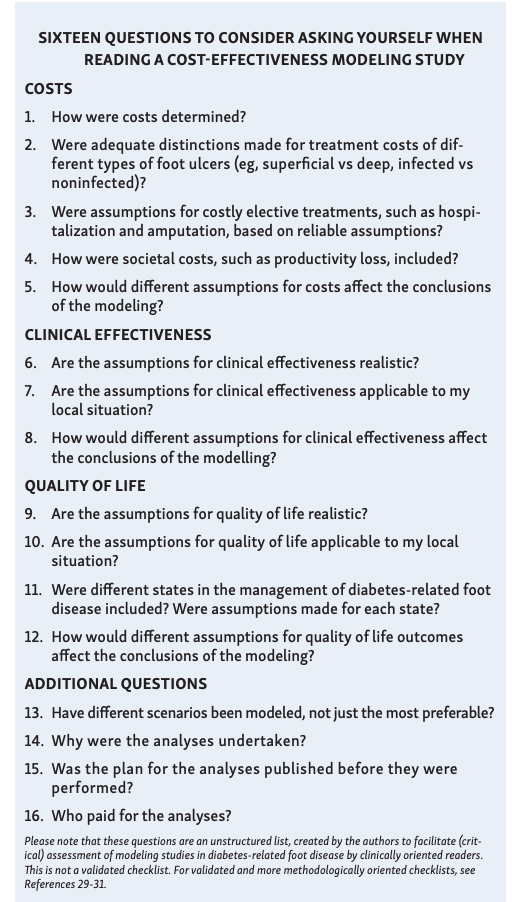
Where possible, in our opinion the answer to the Shakespearean question is “not to model” but to measure prospectively in a primary study. Setting up a prospective health-economic study reduces bias, reduces the uncertainty related to the myriad factors that play a role in the treatment outcomes of diabetes-related foot ulcers, and provides the benefits of prospective registration.28 However, modeling studies may still be helpful, for example, when prospective data collection is impossible, when performed adjunctive to such data collection, when performed with multiple scenarios (including those less plausible), or when performed as hypothesis-generating. If you do come across such a study, it can be suggested to consider asking yourself some of the 16 questions specified in the Figure. For more extensive critical appraisal, we suggest readers familiarize themselves with available tools, such as those from NICE29 and the Joanna Briggs Institute,30 or with any of the reporting tools available on the Equator Network.31
Conclusion
Health-economic studies are an important tool in the assessment of the effectiveness and implementation of interventions in the management of diabetes-related foot disease. However, this disease is characterized by large variations between patients, treatments, and outcomes, along with large uncertainty in estimates of costs and effects. Primary studies are therefore preferred over modeling studies when assessing the cost-effectiveness of interventions in this field. When modeling studies are performed, readers should remain critical and carefully assess all assumptions before conclusions on cost-effectiveness can be accepted. It is our hope that this paper will motivate researchers to perform primary health-economic studies, improve their health-economic modeling when such a design remains needed, and help readers to better assess those studies when published.
Affiliations and Disclosures
Jaap J. van Netten, PhD, and Sicco A. Bus, PhD, MSc, are from the Department of Rehabilitation Medicine, Amsterdam UMC, University of Amsterdam, Amsterdam, the Netherlands, and Amsterdam Movement Sciences, Rehabilitation & Development, Amsterdam, the Netherlands. Marcel G. W. Dijkgraaf, PhD, is from the Department of Epidemiology and Data Science, Amsterdam UMC, University of Amsterdam, Amsterdam, the Netherlands, and Amsterdam Public Health, Methodology, Amsterdam, the Netherlands.
The authors acknowledge funding from the Dutch Medical Research Council (grants 837002508, 853001116, and 10310012310009) for prospective health-economic RCTs in diabetes-related foot disease. The funder had no influence nor authority over the current publication. Jaap J. van Netten is the guarantor of this work.
Manuscript accepted July 13, 2026.
Address for correspondence: Jaap J. van Netten, PhD, Department of Rehabilitation Medicine, Amsterdam UMC, University of Amsterdam, Meibergdreef 9, 1105 AZ Amsterdam, the Netherlands. Email: j.j.vannetten@amsterdamumc.nl
References
1. Armstrong DG, Tan T, Boulton AJM, Bus SA. Diabetic foot ulcers: a review. JAMA. 2023;330(1):62-75. doi:10.1001/jama.2023.10578
2. Zhang Y, Lazzarini PA, McPhail SM, van Netten JJ, Armstrong DG, Pacella RE. Global disability burdens of diabetes-related lower-extremity complications in 1990 and 2016. Diabetes Care. 2020;43(5):964-974. doi:10.2337/dc19-1614
3. Petrakis I, Kyriopoulos IJ, Ginis A, Athanasakis K. Losing a foot versus losing a dollar; a systematic review of cost studies in diabetic foot complications. Expert Rev Pharmacoecon Outcomes Res. 2017;17(2):165-180. doi:10.1080/14737167.2017.1305891
4. Sampson CJ, Wrightson T. Model registration: a call to action. Pharmacoecon Open. 2017;1(2):73-77. doi:10.1007/s41669-017-0019-2
5. Nederland Z. Guideline for economic evaluations in healthcare [in Dutch]. Published 2021. https://www.zorginstituutnederland.nl/publicaties/publicatie/2016/02/29/richtlijn-voor-het-uitvoeren-van-economische-evaluaties-in-de-gezondheidszorg
6. Rinkel WD, Luiten J, van Dongen J, et al. In-hospital costs of diabetic foot disease treated by a multidisciplinary foot team. Diabetes Res Clin Pract. 2017;132:68-78. doi:10.1016/j.diabres.2017.07.029
7. van Netten JJ, Aan De Stegge WB, Dijkgraaf MGW, Bus SA. Cost-effectiveness of temperature monitoring to help prevent foot ulcer recurrence in people with diabetes: a multicenter randomized controlled trial. Diabetes Metab Res Rev. 2024;40(4):e3805. doi:10.1002/dmrr.3805
8. Prompers L, Huijberts M, Schaper N, et al. Resource utilisation and costs associated with the treatment of diabetic foot ulcers. Prospective data from the Eurodiale Study. Diabetologia. 2008;51(10):1826-1834. doi:10.1007/s00125-008-1089-6
9. Morton JI, Lazzarini PA, Shaw JE, Magliano DJ. Trends in the Incidence of hospitalization for major diabetes-related complications in people with type 1 and type 2 diabetes in Australia, 2010-2019. Diabetes Care. 2022;45(4):789-797. doi:10.2337/dc21–2268
10. Tsotra F, van den Berg JC, Dolan F, et al. Economic Evaluation of Early Intervention in Chronic Limb-Threatening Ischaemia (CLTI). The WiFOR Institute. Published 2025. https://www.wifor.com/en/download/economic-evaluation-of-early-intervention-in-chronic-limb-threatening-ischaemia-clti/
11. Edmonds M, Lázaro-Martínez JL, Alfayate-García JM, et al. Sucrose octasulfate dressing versus control dressing in patients with neuroischaemic diabetic foot ulcers (Explorer): an international, multicentre, double-blind, randomised, controlled trial. Lancet Diabetes Endocrinol. 2018;6(3):186-196. doi:10.1016/S2213-8587(17)30438-2
12. Lobmann R, Augustin M, Lawall H, et al. Cost-effectiveness of TLC-sucrose octasulfate versus control dressings in the treatment of diabetic foot ulcers. J Wound Care. 2019;28(12):808-816. doi:10.12968/jowc.2019.28.12.808
13. Maunoury F, Oury A, Fortin S, Thomassin L, Bohbot S; Explorer Study. Cost-effectiveness of TLC-NOSF dressings versus neutral dressings for the treatment of diabetic foot ulcers in France. PLoS One. 2021;16(1):e0245652. doi:10.1371/journal.pone.0245652
14. Kieu TTM, Nguyen CM, Le HM, Truong KQ, Boucley I, Bohbot S. TLC-NOSF dressings versus standard of care for the treatment of diabetic foot ulcers in Vietnam: an economic evaluation. J Wound Care. 2025;34(9):692-703. doi: 10.12968/jowc.2025.0187
15. Lazzarini PA, Cramb SM, Golledge J, Morton JI, Magliano DJ, van Netten JJ. Global trends in the incidence of hospital admissions for diabetes-related foot disease and amputations: a review of national rates in the 21st century. Diabetologia. 2023;66(2):267-287. doi:10.1007/s00125-022-05845-9
16. Golledge J, Fernando ME, Alahakoon C, et al. Efficacy of at home monitoring of foot temperature for risk reduction of diabetes-related foot ulcer: a meta-analysis. Diabetes Metab Res Rev. 2022:38(6):e3549. doi:10.1002/dmrr.3549
17. Brooks E, Burns M, Ma R, Scholten HJ, Becker S. Remote diabetic foot temperature monitoring for early detection of diabetic foot ulcers: a cost-effectiveness analysis. Clinicoecon Outcomes Res. 2021;13:873-881. doi:10.2147/CEOR.S322424
18. van Netten JJ, Dijkgraaf MGW, Bus SA. Response to: Remote diabetic foot temperature monitoring for early detection of diabetic foot ulcers: a cost-effectiveness analysis [letter]. Clinicoecon Outcomes Res. 2022;14:49-50. doi:10.2147/CEOR.S354729
19. Bus SA, Sacco ICN, Monteiro-Soares M, et al. Guidelines on the prevention of foot ulcers in persons with diabetes (IWGDF 2023 update). Diabetes Metab Res Rev. 2024;40(3):e3651. doi:10.1002/dmrr.3651
20. van Netten JJ, Raspovic A, Lavery LA, et al. Prevention of foot ulcers people with diabetes at risk of ulceration: a systematic review and meta-analysis. Diabetes Metab Res Rev. 2024;40(3):e3652. doi:10.1002/dmrr.3652
21. Rinkel WD, Franks B, Birnie E, Castro Cabezas M, Coert JH. Cost-effectiveness of lower extremity nerve decompression surgery in the prevention of ulcers and amputations: a Markov analysis. Plast Reconstr Surg. 2021;148(5):1135-1145. doi:10.1097/prs.0000000000008440
22. Khunkaew S, Fernandez R, Sim J. Health-related quality of life among adults living with diabetic foot ulcers: a meta-analysis. Qual Life Res. 2019;28(6):1413-1427. doi:10.1007/s11136-018-2082-2
23. Bus SA, Aan de Stegge WB, van Baal JG, Busch-Westbroek TE, Nollet F, van Netten JJ. Effectiveness of at-home skin temperature monitoring in reducing the incidence of foot ulcer recurrence in people with diabetes: a multicenter randomized controlled trial (DIATEMP). BMJ Open Diabetes Res Care. 2021;9(1): e002392. doi:10.1136/bmjdrc-2021-002392
24. Nelson EA, Brown ST, Everett CC, et al. CODIFI2: randomised controlled trial to compare clinical and cost-effectiveness of swabs versus tissue sampling to inform management of infected diabetic foot ulcers. Diabet Med. 2025;42(5):e70009. doi:10.1111/dme.70009
25. Bojke C, Konwea H, Nelson EA, et al; CODIFI2 Investigators. Cost-effectiveness of swab versus tissue sampling for infected diabetic foot ulcers from the CODIFI2 randomised controlled trial. Diabet Med. 2025;42(5):e15492. doi:10.1111/dme.15492
26. Byrnes J, Ward L, Jensen S, et al. Health-related quality of life in people with different diabetes-related foot ulcer health states: a cross-sectional study of healed, non-infected, infected, hospitalised and amputated ulcer states. Diabetes Res Clin Pract. 2024;207:111061. doi:10.1016/j.diabres.2023.111061
27. Siersma V, Thorsen H, Holstein PE, et al. Importance of factors determining the low health-related quality of life in people presenting with a diabetic foot ulcer: the Eurodiale study. Diabet Med. 2013;30(11):1382-1387. doi:10.1111/dme.12254
28. van Netten JJ, Dijkgraaf MGW, Bus SA. Publication bias and confirmation bias in health-economic studies in diabetes-related foot disease? Diab Med. 2026:e70425. doi:10.1111/dme.70425
29. National Insitute for Health and Care Excellence. NICE technology appraisal and highly specialised technologies guidance: the manual. Published 2022. Updated 2026. https://www.nice.org.uk/process/pmg36/chapter/economic-evaluation-2
30. Joanna Briggs Institute. The Joanna Briggs Institute Critical Appraisal tools for use in JBI Systematic Reviews. Checklist for Economic Evaluations. Published 2017. Accessed July 3, 2026. https://jbi.global/sites/default/files/2019-05/JBI_Critical_Appraisal-Checklist_for_Economic_Evaluations2017_0.pdf
31. Equator Network. Economic evaluations. Accessed July 3, 2026. https://www.equator-network.org/?post_type=eq_guidelines&eq_guidelines_study_design=economic-evaluations&eq_guidelines_clinical_specialty=0&eq_guidelines_report_section=0&s=+