Beyond the OR: Lessons Learned From a Unique Approach to Medical Missions
Drawing on their experience with a medical mission in Ghana, the authors examine how patient selection, local partnerships, postoperative planning, and adaptability shape reconstructive foot and ankle care in resource-limited settings.
Key Takeaways
- Sustainable medical missions extend beyond short-term surgical volume, requiring collaboration with local clinicians, continuity of care, and investment in long-term healthcare capacity.
- Treatment planning must account for the patient’s pathology as well as available implants, rehabilitation services, wound care, follow-up support, and home environment.
- Complex presentations and limited supplies may require intraoperative and perioperative adaptability, underscoring the value of thorough preparation and resource assessment before surgery.
Medical missions are often viewed through the lens of the procedures performed during a brief volunteer trip. We often observe a common perception of surgical teams traveling to underserved communities, completing a series of operations, and returning home, leaving local providers to manage the remainder of patient care. While this model may exist in some settings, we feel it does not accurately define impactful global surgery.
Medical missions are often viewed through the lens of the procedures performed during a brief volunteer trip. We often observe a common perception of surgical teams traveling to underserved communities, completing a series of operations, and returning home, leaving local providers to manage the remainder of patient care. While this model may exist in some settings, we feel it does not accurately define impactful global surgery.
In our experience, successful medical missions begin long before the first incision and continue long after the visiting surgeons depart. We find that careful patient selection, multidisciplinary planning, postoperative rehabilitation, continuity of care, and strong partnerships with local healthcare professionals are equally—if not more—important than the operations themselves. Rather than measuring success solely by the number of procedures completed during a single week, we feel that meaningful global surgery should be evaluated by its ability to strengthen healthcare systems, expand local capacity, and improve patient outcomes long after the visiting team has returned home.
Our assessment is formed by experience with the goals and paradigm established by The Helper Medical Missions, founded by Chrisbel Dafeamekpor, DPM, FACFAS. Inspired by the unmet need for reconstructive surgery in his native Ghana, a vision to create sustainable partnerships centered on education, continuity of care, and improving long-term patient outcomes. In reality, that entails multidisciplinary collaboration between podiatric surgeons, orthopedic physicians, residents, wound care specialists, orthotists, nurses, industry partners, and local healthcare professionals. Equally important, the mission is designed to continue long after the visiting team returns home.
Global Surgery Begins Long Before the First Incision
For every patient who enters the operating room, we know months of preparation has already taken place. Outreach efforts across Ghana identify and refer patients with complex lower extremity deformities, neglected trauma, chronic infections, and congenital conditions. Clinical examinations, radiographs, and laboratory studies help determine which patients would benefit most from surgical intervention.
Planning extends far beyond selecting surgical candidates. Each case requires careful coordination between the visiting team and local healthcare professionals to ensure that postoperative wound care, rehabilitation, and long-term follow-up are possible and planned for after surgery. Guidance for operative decisions involves not only the pathology, but also the resources available to support recovery.
Preparation also involves assembling the equipment necessary to perform complex reconstructive procedures. Volunteers and supporters transport implants, external fixation components, surgical instruments, power equipment, and portable fluoroscopy. Every item requires careful planning, packing, and coordination before the first patient even arrives. We find this system to be a vital component of assuring that long-term patient outcomes remain the core focus.
A Week with The Helper Medical Missions
The mission began with an in-person screening clinic at New Crystal Hospital, where patients traveled from across Ghana seeking evaluation for complex lower extremity conditions. Following clinical examinations, imaging, and multidisciplinary discussion, surgical candidate selection took place based not only on the complexity of their pathology but also on their ability to safely recover with local postoperative support and available surgical implants.
Over the following 4 days, the team performed more than 20 reconstructive foot and ankle procedures. Many of the pathologies evaluated by the team were deformities rarely encountered in the United States. Patients frequently presented with residual musculoskeletal complications of sickle cell crises, neglected clubfoot, post-polio contractures, and long-term sequelae of untreated or inadequately treated infections.
A Rare Case Example
A 17-year-old female with sickle cell disease presented with chronic left medial tibial pain and a prominent osseous lesion along the tibial shaft after sustaining a crisis episode. Radiographs demonstrated a well-circumscribed osseous defect with surrounding sclerotic margins involving the medial cortex of the tibial shaft, consistent with chronic osseous remodeling following infarction. The patient underwent surgical resection of the osseous bridge to alleviate symptoms. Intraoperatively, the bone was found to be of good quality with no signs of abscess.
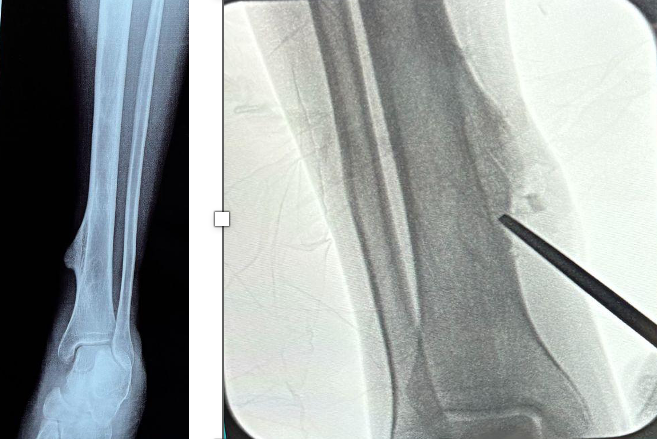
Sickle cell disease is highly prevalent in sub-Saharan Africa because of its genetic distribution and persistent limitations in healthcare access, early diagnosis, and disease management.1 Patients with sickle cell disease commonly develop musculoskeletal complications secondary to recurrent vaso-occlusive crises, which can result in bone infarction involving the long bones. On radiographic imaging, subacute and chronic bone infarcts typically appear as patchy areas of sclerosis or lesions with well-defined sclerotic margins.2 Understanding clinical and radiographic findings of sickle cell pathology can help clinicians differentiate between infarct and osteomyelitis. Sending a specimen for culture or pathology is not always possible in this setting due to cost and length of time until results become available. Thus, in this case, the team felt confident in their intraoperative findings and chose to forgo this type of testing. A local support team member facilitated postop care, and the patient is currently doing well.
Addressing a Clubfoot Deformity
Many pediatric patients presented during the screening clinic with toe walking and concern for clubfoot deformity. On physical examination, these deformities were reducible but demonstrated the early development of cavovarus alignment. For these patients, we performed open Z-lengthening of the Achilles tendon, followed by immobilization in a posterior splint with the ankle maintained in a neutral position. In contrast, several adult patients presented with neglected clubfoot deformities that required osseous reconstructive procedures to correct the established cavovarus deformity. Clubfoot remains underrecognized and undertreated within the healthcare system in Ghana, contributing to delayed presentation and more complex deformities. Approximately 30% of children with clubfoot in Ghana are not diagnosed until after 1 year of age.3 Early recognition and intervention with the Ponseti method have been shown to provide the highest likelihood of successful correction while minimizing the risk of residual or neglected deformity later in childhood and adolescence.3
The Lingering Effects of Poliomyelitis
Routine vaccination has played a critical role in the near eradication of poliomyelitis worldwide. According to the Centers for Disease Control and Prevention (CDC), the last reported case of wild poliovirus in the United States occurred in 1979.4 In Ghana, the last confirmed case of wild poliovirus was reported in 2008.5 Despite successful vaccination efforts, many adults continue to live with the long-term musculoskeletal sequelae of prior poliomyelitis.
Several adult patients evaluated during this mission presented with residual lower extremity deformities secondary to previous poliomyelitis, including equinus contractures, cavovarus deformities, and rigid muscle imbalance that significantly impaired ambulation. This created difficulty with ambulation and the need for lower extremity bracing. Surgical management was individualized according to the severity of deformity, residual muscle function, and patient goals.
Procedures included combinations of soft tissue releases, tendon balancing, and osseous reconstruction to restore alignment, improve gait mechanics, and maximize functional mobility. Although poliomyelitis has been eliminated in much of the world through widespread immunization, post-polio deformities continue to represent a significant source of lifelong disability in many low- and middle-income countries, underscoring the ongoing need for reconstructive orthopedic care in these regions.
Optimizing Patient Outcomes in Areas with Limited Resources
Spinal anesthesia is an often-utilized anesthetic technique for lower extremity orthopedic procedures in many resource-limited settings because it avoids the need for general anesthesia, mechanical ventilation, and the associated postoperative monitoring, thereby reducing overall healthcare costs. Despite these advantages, spinal anesthesia is not without complications. One recognized postoperative complication is postoperative urinary retention (POUR), defined as an inability to urinate after surgery or remaining volume in the bladder after a void.6 This can result in significant patient discomfort, bladder overdistention, and delayed recovery if not promptly recognized and treated.
During our medical mission, a 14-year-old male underwent lower extremity deformity correction with application of a Taylor Spatial Frame under spinal anesthesia. In the immediate postoperative period, he developed acute urinary retention, with inability to void causing severe suprapubic pain and physical distress. Management was complicated by the absence of appropriately sized pediatric urinary catheters, which were unavailable both within the hospital and at nearby pharmacies. Utilizing the present resources, a nasogastric (NG) tube successfully decompressed the bladder.
This case highlights the challenges of delivering agile perioperative care in resource-limited settings, where even basic supplies may be unavailable. Careful preoperative planning should include ensuring the availability of pediatric urinary catheters and Foley catheters when pediatric surgical patients are anticipated. Additionally, close postoperative monitoring of urinary output in the post-anesthesia care unit (PACU) and early recognition of POUR may help prevent unnecessary patient discomfort and reduce the risk of bladder injury. Simple logistical preparation can substantially improve perioperative safety in low-resource environments.
Concluding Thoughts
The biggest lesson from this trip that we feel can be applied to podiatric surgeons and physicians in the United States is the importance of understanding a patient’s home environment and ensuring that appropriate postoperative resources are available before determining a treatment plan. A successful surgical outcome depends on more than the procedure itself; it also requires consideration of a patient’s ability to access follow-up care, obtain medications and supplies, maintain weight-bearing restrictions, and receive assistance during recovery.
© 2026 HMP Global. All Rights Reserved.
Any views and opinions expressed are those of the author(s) and/or participants and do not necessarily reflect the views, policy, or position of Podiatry Today or HMP Global, their employees, and affiliates.