Applying DecisionDx®-Melanoma Test Results Across the Cutaneous Melanoma Care Pathway to Improve Clinical Decision-Making

For dermatologists managing patients with invasive cutaneous melanoma (CM), determining the appropriate intensity of treatment and follow-up can be challenging. Current National Comprehensive Cancer Network recommendations are based on American Joint Committee on Cancer (AJCC) staging, which incorporates clinical and pathological factors such as Breslow thickness and sentinel lymph node (SLN) status.1 However, patients with the same AJCC stage can experience markedly different outcomes, creating the potential for some patients to receive more intensive management than necessary and others to receive less intensive management than their risk may warrant. Additional tools that provide a more personalized and accurate assessment of molecular risk can help clinicians make more informed, risk-aligned management recommendations for their patients with CM.
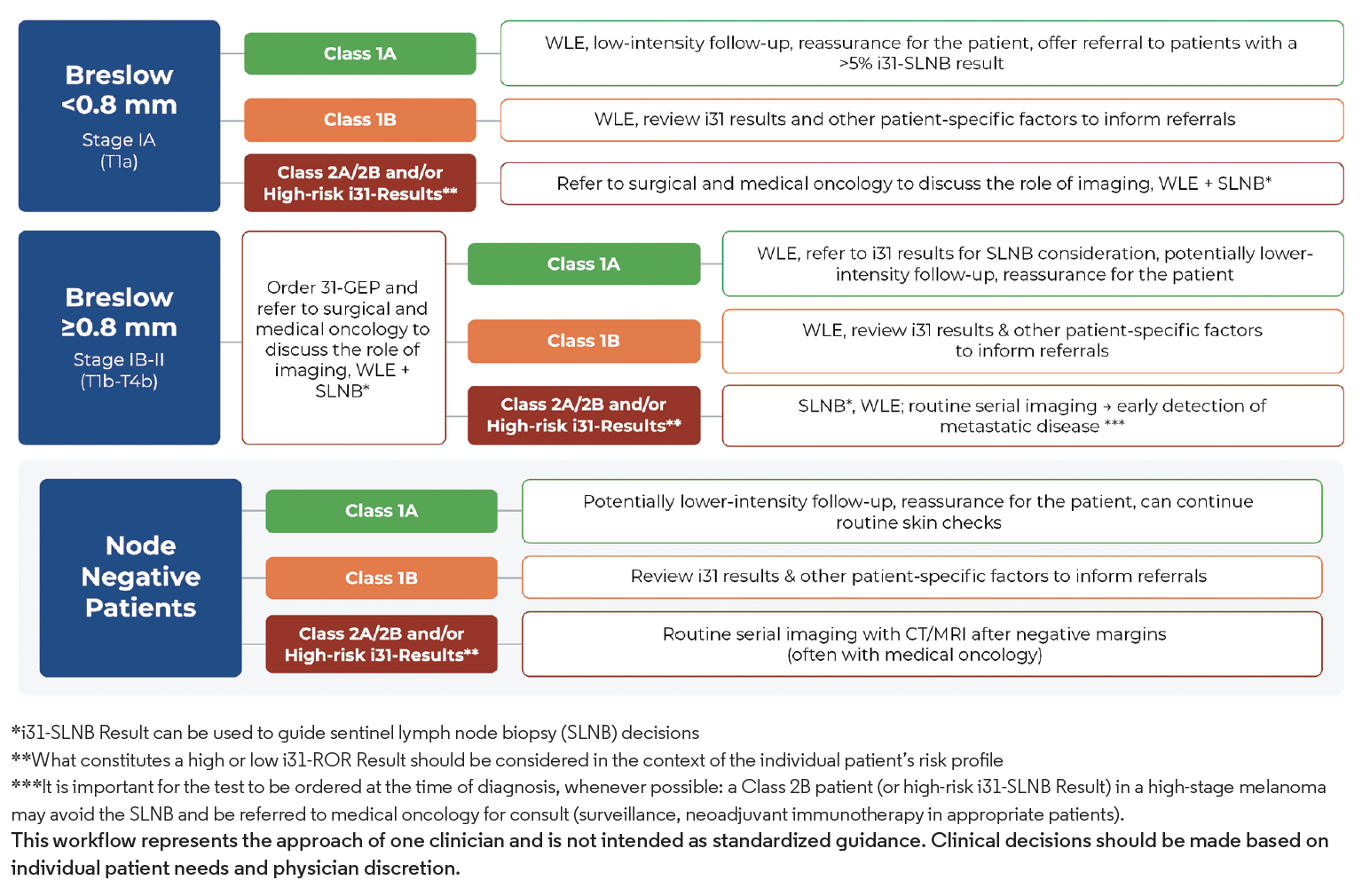
The DecisionDx-Melanoma (31-gene expression profile, 31-GEP) test addresses this need by providing a GEP Class result designed to stratify patients into 1 of 4 risk categories: low (Class 1A), intermediate (Class 1B or 2A), or high (Class 2B) risk of recurrence, metastasis, and mortality. Importantly, the test also integrates the independently validated 31-GEP result with select clinicopathological information into the i31-SLNB (sentinel lymph node biopsy) result, which provides a patient-specific predicted risk of SLN positivity to help guide SLNB decisions.2 In my practice, I use these results within a DecisionDx-Melanoma–guided workflow to inform SLNB, follow-up, and referral recommendations based on each patient’s individual risk profile (Figure).
Patients With Tumors < 0.8 mm
Patients with thin tumors (< 0.8 mm, T1a tumors) are generally considered to be at low risk for poor outcomes and are not routinely considered for SLNB unless there are additional high-risk factors (e.g., elevated mitotic rate, transected base) that may warrant concern regarding the adequacy of microstaging in capturing tumor risk. Studies have shown that patients with a less than 5% predicted risk by DecisionDx-Melanoma’s i31-SLNB have low rates of SLN positivity, indicating that the test can accurately identify a low-risk population who may safely forgo SLNB, reducing the risk of procedure-related complications and health care-related costs.2-4 In a recent prospective study, the observed SLN positivity rate was 2.6% among all patients with a predicted risk of less than 5% by the i31-SLNB and only 1.8% among those with T1a high risk–T2a tumors being considered for SLNB.5 These patients with thin melanomas may be appropriately managed without SLNB and which may benefit from referral for further evaluation and discussion of the procedure.
Patients With Tumors ≥ 0.8 mm
Guidelines recommend clinicians discuss and/or offer SLNB for patients with tumors ≥ 0.8 mm. For this group of patients with higher risk based on tumor depth, DecisionDx-Melanoma can offer personalized tumor risk information that guides multidisciplinary management of patients with CM. Those with a low-risk Class findings support the use of the DecisionDx-Melanoma test to provide dermatologists with greater confidence in recommending wide local excision (WLE) and low-intensity follow-up to patients with < 0.8 mm tumors and an i31-SLNB predicted risk of < 5%. Conversely, those with < 0.8 mm tumors and an i31-SLNB predicted risk of > 5% may benefit from referral to surgical and medical oncology to discuss WLE with SLNB. Indeed, in the same prospective study, those with > 10% predicted risk by i31-SLNB had SLN positivity rates more than 8 times as high as those with < 5% risk (21.4% positivity rate).5 For dermatologists, the DecisionDx- Melanoma i31-SLNB result can help clarify which patients with thin melanomas may be appropriately managed without SLNB and which may benefit from referral for further evaluation and discussion of the procedure.
Patients With Tumors ≥ 0.8 mm
Guidelines recommend clinicians discuss and/or offer SLNB for patients with tumors ≥ 0.8 mm. For this group of patients with higher risk based on tumor depth, DecisionDx-Melanoma can offer personalized tumor risk information that guides multidisciplinary management of patients with CM. Those with a low-risk Class result and < 5% predicted SLN positivity risk by the i31-SLNB may be candidates for less intensive follow-up and surveillance when considered alongside other clinical factors. However, those with higher-risk DecisionDx-Melanoma results (Class 1B and higher) may benefit from increased management, including multidisciplinary referrals to surgical oncology for SLNB, radiation oncology for imaging surveillance to identify recurrence and metastasis earlier, and medical oncology for consideration of additional treatment such as immunotherapy.
Patients With Node-Negative Disease
Similarly, although patients without nodal disease are generally considered to be at lower risk, this is an extremely heterogeneous population: Some patients have 5-year survival rates exceeding 95%, while others have lower survival than certain node-positive cohorts.6 DecisionDx-Melanoma can provide greater clarity for node-negative patients, particularly when the test is ordered at the time of diagnosis to direct risk-appropriate multidisciplinary referrals that may improve care. Patients with a low-risk Class 1A test result can more confidently continue with routine clinical followup, while those with intermediate-risk (Class 1B/2A) or high-risk (Class 2B) results may be referred for surveillance imaging and consultation with medical oncology to discuss treatment options.
The DecisionDx-Melanoma test can be performed using a patient’s original tumor biopsy, providing clinical utility in guiding a full spectrum of clinical and surveillance management decisions that dermatologists discuss with their patients with CM (Figure). Further, numerous studies have demonstrated that including DecisionDx-Melanoma with AJCC staging is more accurate than staging alone, and DecisionDx-Melanoma is more accurate than online nomograms using only clinical and pathological factors, as well as other GEP-based tests, including CP-GEP.2,3,7-9
DecisionDx-Melanoma test results can provide clinicians with more confidence in recommending lower intensity management for patients with early-stage disease. Conversely, DecisionDxMelanoma can identify patients at higher risk for recurrence, metastasis, or death than suggested by their stage, and these patients may benefit from escalated surveillance and referral to oncology specialties. Evidence also confirms that using the DecisionDx-Melanoma test results to guide surveillance management decisions identified more recurrences, earlier, and improved overall survival.10,11 The DecisionDx-Melanoma test has been validated in more than 50 peer-reviewed publications comprising more than 10,000 patients—the largest evidence base for any GEP prognostic melanoma test.12-14 DecisionDx-Melanoma informs SLNB, surveillance imaging, follow-up frequency, and treatment management decisions to help clinicians provide personalized, risk-guided care, and is the only GEP test associated with improved patient outcomes.10,11,15
References
- Swetter S, Johnson D, Albertini M, Barker C, Bateni S. NCCN Clinical Practice Guidelines in Oncology (NCCN Guidelines) for Cutaneous Melanoma V1.2026. Published online 2026.
- Whitman ED, Koshenkov VP, Gastman BR, et al. Integrating 31-gene expression profiling with clinicopathologic features to optimize cutaneous melanoma sentinel lymph node Metastasis prediction. JCO Precis Oncol. 2021;5:1466-1479. doi:10.1200/PO.21.00162
- Guenther JM, Ward A, Martin BJ, et al. A prospective, multicenter analysis of the integrated 31-gene expression profile test for sentinel lymph node biopsy (i31-GEP for SLNB) test demonstrates reduced number of unnecessary SLNBs in patients with cutaneous melanoma. World J Surg Oncol. 2025;23(1):5. doi:10.1186/s12957-024-03640-x
- Guenther JM, Ward A, Martin BJ, et al. A prospective, multicenter analysis of recurrence-free survival after sentinel lymph node biopsy decisions influenced by the 31-GEP. Cancer Med. 2025;14(7):e70839. doi:10.1002/cam4.70839
- Beard T, Guenther JM, Leong SP, et al. The integrated 31-gene expression profile test identifies low-risk patients with cutaneous melanoma who can forego the SLNB procedure: results from a prospective, multicenter trial. Future Oncol. 2026;22(8):933-938. doi:10.1080/14796694.2026.2640227
- Lee R, Mandala M, Long GV, et al. Adjuvant therapy for stage II melanoma: the need for further studies. Eur J Cancer. 2023;189:112914. doi:10.1016/j. ejca.2023.05.003
- Zakria D, Brownstone N, Rigel D. The integrated 31-gene expression profile (i31GEP) test for cutaneous melanoma outperforms a clinicopathologic-only nomogram at identifying patients who can forego sentinel lymph node biopsy. SKIN. 2022;6(6):463-473. doi:10.25251/skin.6.6.3
- Podlipnik S, Martin BJ, Morgan-Linnell SK, et al. The 31-gene expression profile test outperforms AJCC in stratifying risk of recurrence in patients with stage I cutaneous melanoma. Cancers (Basel). 2024;16(2):287. doi:10.3390/cancers16020287
- Prieto PA, Ferris LK, Guenther JM. Comparing two gene expression profile tests to standard of care for identifying patients with cutaneous melanoma at low risk of sentinel lymph node positivity. Cancer Diagn Progn. 2025;5(3):261-267. doi:10.21873/cdp.10438
- Williams A, Hamilton O, Likar C, Thomay A, Garland-Kledzik M. The benefit of positron emission tomography/computed tomography In stage I and stage II melanomas with high-risk DecisionDX-Melanoma scores. Am Surg. 2022;88(7):1446-1451. doi:10.1177/00031348221081760
- Dhillon S, Duarte-Bateman D, Fowler G, et al. Routine imaging guided by a 31-gene expression profile assay results in earlier detection of melanoma with decreased metastatic tumor burden compared to patients without surveillance imaging studies. Arch Dermatol Res. 2023;315(8):2295-2302. doi:10.1007/s00403023-02613-6
- Durgham RA, Nassar SI, Gun R, Nguyen SA, Asarkar AA, Nathan CAO. The prognostic value of the 31-gene expression profile test in cutaneous melanoma: a systematic review and meta-analysis. Cancers (Basel). 2024;16(21):3714. doi:10.3390/ cancers16213714
- Bailey CN, Martin BJ, Petkov VI, et al. 31-gene expression profile testing in cutaneous melanoma and survival outcomes in a population-based analysis: a SEER collaboration. JCO Precis Oncol. 2023;7:e2300044. doi:10.1200/PO.23.00044
- Greenhaw BN, Covington KR, Kurley SJ, et al. Molecular risk prediction in cutaneous melanoma: a meta-analysis of the 31-gene expression profile prognostic test in 1,479 patients. J Am Acad Dermatol. 2020;83(3):745-753. doi:10.1016/j. jaad.2020.03.053
- Yamamoto M, Sickle-Santanello B, Beard T, et al. The 31-gene expression profile test informs sentinel lymph node biopsy decisions in patients with cutaneous melanoma: results of a prospective, multicenter study. Curr Med Res Opin. 2023;39(3):417-423. doi:10.1080/03007995.2023.2165813