Extreme Limb Salvage Facilitated by Patient Advocacy, Multidisciplinary Care, and a Novel Stabilized Hypochlorous Acid Wound Therapy
Key Summary
- A 70-year-old woman with advanced chronic limb-threatening ischemia (CLTI), multiple prior vascular interventions, and dehiscence in 3 postoperative wounds underwent revascularization after declining above-knee amputation.
- After staged endovascular revascularization, inpatient debridement, antibiotics, hyperbaric oxygen therapy, and negative-pressure wound therapy, outpatient care with stabilized hypochlorous acid (Spectricept) corresponded with groin wound closure by 60 days, great toe wound closure by 51 days, below-knee wound closure by 180 days, 90% ankle wound closure by 340 days, and independent ambulation by 10 months.
- The authors conclude that patient advocacy, multidisciplinary care, and stabilized hypochlorous acid may support limb salvage in complex CLTI. Limitations include a single uncontrolled case, potential conflicts of interest, and the need for larger randomized studies before broader conclusions.
© 2026 HMP Global. All Rights Reserved.
Any views and opinions expressed are those of the author(s) and/or participants and do not necessarily reflect the views, policy, or position of Vascular Disease Management or HMP Global, their employees, and affiliates.
VASCULAR DISEASE MANAGEMENT. 2026;23(7):E99-E112.
Abstract
Background: Chronic limb-threatening ischemia (CLTI) remains associated with high mortality, rising amputation rates, and persistent disparities in care. Despite advances in revascularization and wound management, outcomes have plateaued, and a substantial proportion of amputations continue to occur without prior angiography or revascularization attempts. Patient advocacy organizations such as the Global PAD Association increasingly play a role in connecting patients with advanced limb salvage centers. This case report describes an extreme limb salvage outcome facilitated by patient advocacy, multidisciplinary care, and the introduction of a novel, stabilized hypochlorous acid (HOCl) wound cleanser. Methods: A 70-year-old woman with severe peripheral arterial disease, a history of multiple vascular interventions, and dehiscence in 3 large postoperative wounds was referred to a multidisciplinary limb salvage center after declining above-knee amputation recommended by multiple clinicians. Diagnostic computed tomography angiography (CTA) and staged endovascular revascularization were performed, followed by inpatient advanced wound care including debridement, antibiotics, hyperbaric oxygen therapy (HBOT), and negative-pressure wound therapy with installation. After discharge, outpatient wound management incorporated Spectricept (Spectrum Antimicrobials), a stabilized HOCl formulation with tri-ion chemistry, applied daily in conjunction with standard dressings and intermittent HBOT. Results: CTA revealed 95% to 100% stenosis of the left external iliac, common femoral, superficial femoral, and pulmonary arteries with no tibial runoff. Staged endovascular interventions restored inflow and established straight-line flow to the proximal anterior tibial artery with a collateral perfusion to the foot. During hospitalization, the wounds improved modestly with less than 30% in-hospital reduction. Transition to outpatient care and the initiation of Spectricept accelerated wound healing; complete closure of the groin wound occurred by 60 days, the wound below the knee within 180 days, and the new great toe wound by 51 days. The large peri-ankle wound achieved 90% closure by 340 days. The patient regained independent ambulation by 10 months. Conclusion: This case demonstrates that even with profoundly complex CLTI presentations, successful salvage can be achieved when patient advocacy, multidisciplinary expertise, and advanced wound care technologies converge. Early high-quality imaging and revascularization were essential, while the introduction of stabilized Spectricept HOCl corresponded with rapid improvements in wound symptoms, wound bioburden control, and healing trajectory. Stabilized HOCl formations may present a meaningful addition to the contemporary CLTI limb salvage toolbox. Further clinician studies are warranted.
Introduction
The severity of the clinical and economic costs of critical limb ischemia (CLI) and the role of disparities were previously reported over 20 years ago by the multidisciplinary authors of this case report.1,2 CLI was even declared an epidemic by the authors.1 Hirsh et al followed suit 8 years later, declaring peripheral arterial disease (PAD) a global pandemic.3 Chronic limb-threatening ischemia (CLTI) has now been accepted as the term representing the terminal end-stage of CLI with imminently threatening tissue loss and potential amputation.4
Despite 2 decades of continued progress in CLTI treatment, including innovation, research, devices, revascularization techniques, guidelines, societies, and a few CLTI trials, the overall improvement in clinical outcomes has been sparse, with minimal incremental improvements at best.4-8 Initially, amputation rates in the United States declined from 2000 to 2010 but have trended upward over the last decade.4-8
Today, the 1- and 5-year mortality rates remain essentially unchanged at 24% and 60%, respectively.5,6 Likewise, the CLTI metrics regarding amputations have also remained unchanged, with 73% of primary amputations still being performed without angiography, and 51% have no revascularization attempts.9-11 Primary amputations continue to be the first-choice treatment for approximately 20% of all patients with CLTI.9,10 Abu et al reported in 2015 that as many as 85% of amputations due to CLTI could be avoided.12 Reported 2-year limb salvage rates of 70% to 85% following revascularization highlight the need for innovative strategies to reduce major amputations, increase timely angiographic evaluation and revascularization, and improve referral to specialized limb salvage centers, where these procedures have demonstrated favorable outcomes.8,13-18
Notable progress has been made and reported identifying improved outcomes in patients with CLTI treated by a multidisciplinary, dedicated limb salvage team.15-18 These outcomes include higher amputation-free survival, lower amputation rates, lower mortality, and improved wound healing.15-18 A literature search for "patient advocacy" related to CLTI reporting found few reports and primarily focused on second opinions and referrals to advanced centers providing "no-option” CLTI care.19-21
Bisdas et al and Secemsky el al report evidence of improved outcomes in advanced CLTI cases where amputations were recommended but second opinion referrals resulted in limb salvage and improved outcomes.19,20 Bjork et al introduced patient-centered, evidence-based CLTI research to improve outcomes in advanced CLTI cases.21 The CLI Global Society specifically includes patient advocacy in their mission to prevent amputations through education and awareness.4
We present a case of successful extreme limb salvage facilitated by patient advocacy, a multidisciplinary limb salvage team, and a novel and innovative limb salvage wound care treatment with Spectricept (Spectrum Antimicrobials), a tri-ion stabilized hypochlorous acid (HOCl). Spectricept recently received FDA 510(k) medical device clearance as a wound cleanser and wound wash. See the Discussion for further Spectricept details.
Case Report
The patient, a 70-year-old Black woman, was non-smoking, hypertensive, hyperlipidemic, and non-diabetic with over a decade history of severe PAD. She had prior bilateral iliac and superficial femoral artery (SFA) percutaneous transluminal angioplasty (PTA) and stenting. She had over a dozen open vascular surgeries on the left leg and a right axillary-to-femoral artery bypass graft that was patent to her asymptomatic right lower extremity. On April 10, 2025, she underwent a limb salvage open vascular surgery procedure in central Louisiana for severe Rutherford 4 nocturnal vascular rest pain. This resulted in wide exposure of the left common femoral artery (CFA), popliteal artery (PA), below-the-knee (BTK), and posterior tibial artery for a planned femoral-to-tibial bypass that was aborted at that time due to severe calcification of the tibial vessel. A popliteal endarterectomy was performed, and all 3 surgical wounds were closed primarily. She had no history of left-leg surgically placed prosthetic graft material.
Over the next week, all 3 wounds dehisced and became infected, necessitating advanced wound care, minimal debridement due to ischemia, and I.V. antibiotics. An above-knee amputation (AKA) was strongly recommended by all physicians, but the patient declined. Following an internet search, the patient’s daughter contacted the Global PAD Association (GPAD) via its Leg Saver Hotline (1-833-PAD LEGS). The GPAD has developed a series of regional limb salvage specialists and limb salvage centers of excellence for second opinions or transfer of care for more complex or no-option patients with CLTI facing amputation. The authors were contacted by GPAD, and the patient was subsequently transferred for further limb salvage evaluation and care. See the Discussion for further GPAD details.
The patient was admitted 1-month post-surgery to Lafayette General Hospital (LGH) in Lafayette, Louisiana. Comprehensive, complex limb salvage care was provided by an experienced multidisciplinary limb salvage team including peripheral vascular specialists of the Cardiovascular Institute of the South and the Louisiana Cardiovascular and Limb Salvage Center of Excellence. Advanced limb salvage wound care physicians and podiatrists filled out the multidisciplinary limb salvage team. On May 12, 2025, an abdominal computed tomography angiography with runoff was performed, identifying the patient’s current vascular status and revealing a patent right axillary-CFA bypass. The left leg revealed diffuse 95% to 100% stenosis of the left external iliac artery (EIA), left CFA, left SFA, and left PA, with no readily identifiable arterial flow BTK. It was decided that the patient could still benefit from left lower extremity inflow revascularization. She had no clinical signs of sepsis or renal dysfunction, and she had dry gangrenous wound edges with no digital wounds.
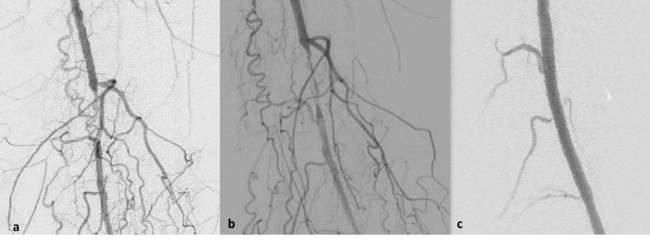
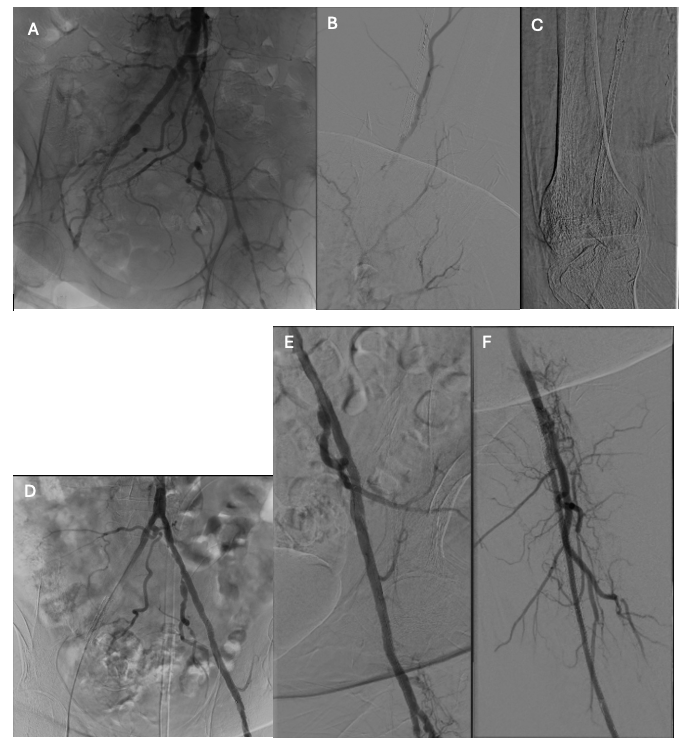
The following day the patient underwent a complex endovascular interventional procedure that included left brachial artery access with laser atherectomy and PTA of the left ElA, CFA, SFA, PA, and anterior tibial artery (ATA) (Figure 1 A-C). A single stent was placed in the ElA, and a drug-eluting balloon was used in the CFA (Figure 1 D-I). The patient became combative toward the end of the procedure, but adequate flow had been established in all treated vessels. The procedure was terminated with greatly improved inflow and a plan for an early relook angiogram with potential further stenting within 48 to 72 hours via a right CFA approach, which was identified as appropriate for vascular access.
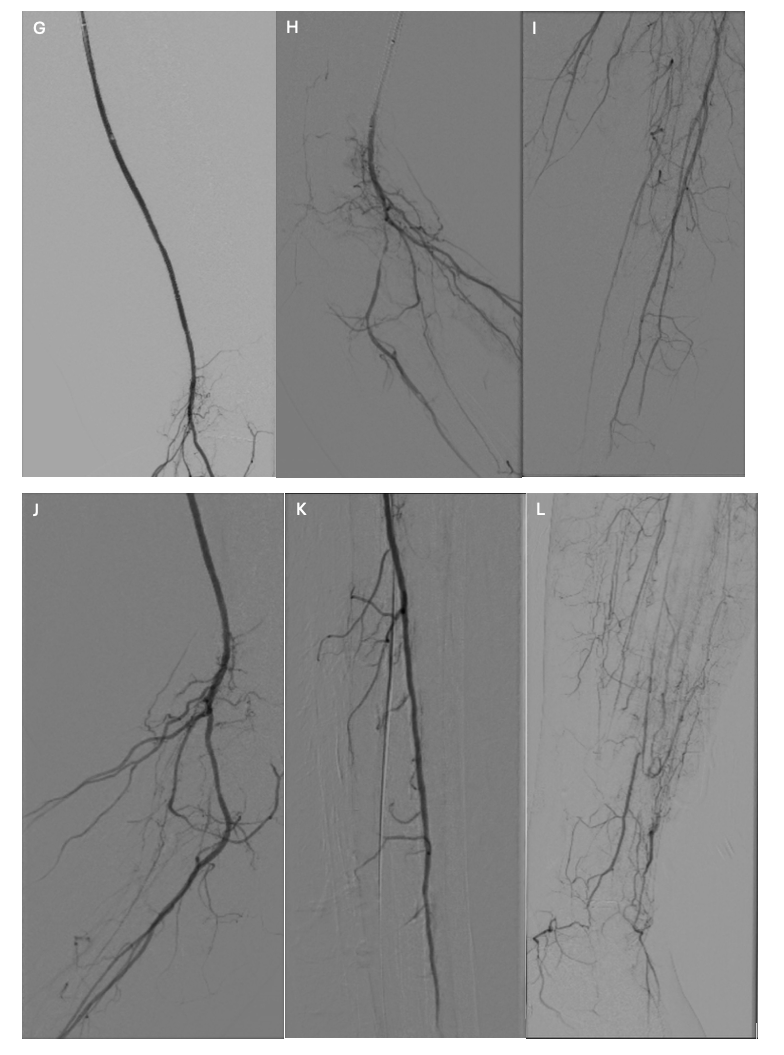
Seventy-two hours later, the patient underwent a relook left leg angiogram, which revealed excellent flow in the previously treated vessels with a single area of dissection and 90% stenosis at the mid-SFA level, which was treated successfully with a single SFA stent. The result now included significantly improved left EIA, CFA, SFA, PA, ATA, and collateral outflow to the foot (Figure 1 J-L). Over the next 3 weeks after revascularization, the patient remained hospitalized and underwent major and minor wound debridement and given appropriate I.V. antibiotics for multiple bacterial wound infections, including methicillin-resistant Staphylococcus aureus and Pseudomonas. Additional advanced wound care, including 10 hyperbaric oxygen therapy (HBOT) treatments and negative-pressure wound vac including the Veraflo irrigation system (Solventum) for 12 days with a first-generation generic HOCl (Vasche, Urgo Medical North America) as an irrigant. The Veraflo irrigation system with negative-pressure wound therapy was first reported in 2016, with multiple follow-up reports confirming improved outcomes in large open wounds.22-25 There has been no consensus regarding the optimal irrigation fluid.
Each of the 3 large wounds initially responded adequately, and clinically the patient remained revascularized and nonseptic. At 3 weeks, the groin and BTK wound had granulated only sparsely and closed approximately 30%. The massive lower calf/ankle wound remained widely open with poor granulation. Again, an AKA was strongly considered by the current wound caregivers, but family and patient declined and opted for discharge home and continuing advanced wound care, including HBOT, as an outpatient.
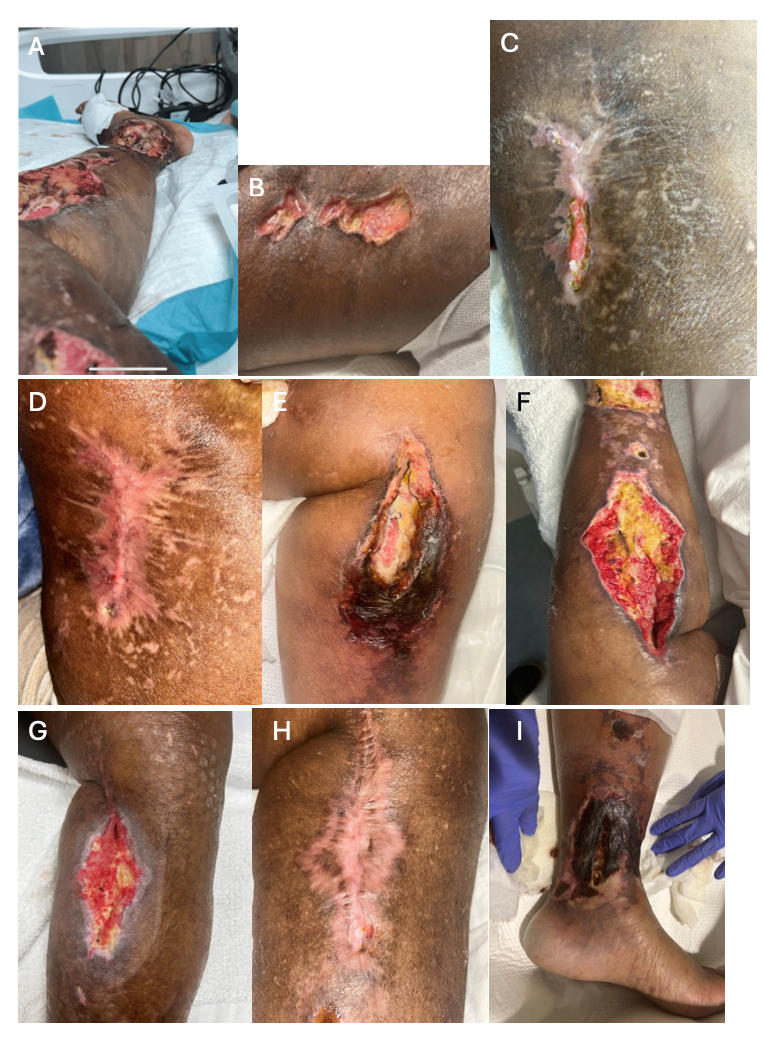
Twenty-one days post admission to LGH and approximately 7-8 weeks post-surgery, the patient was discharged home. On June 2, 2025, she was enrolled as an outpatient at the Opelousas General Hospital (OGH) Advanced Outpatient Wound Care Center nearer her home in central Louisiana. Between June 2 and June 18, 2025, she underwent 15 HBOT treatments (6 days/week protocol), with daily dressing changes and debridement as needed. Each wound also had a standard wound vac placed with an every-other-day change due to significant exudate. The 3 large index wound sizes at the OGH Advanced Outpatient Wound Care Center were as follows:
- Left groin = 9.9 x 4.2 × 0.5 cm2
- Left knee = 14.7 x 10.1 x 3.9 cm2
- Left ankle = 11.5 x 14.4 x 2.2 cm2
See Figure 2 A-O for a comprehensive sequence of wound appearance over the entire course of limb salvage.
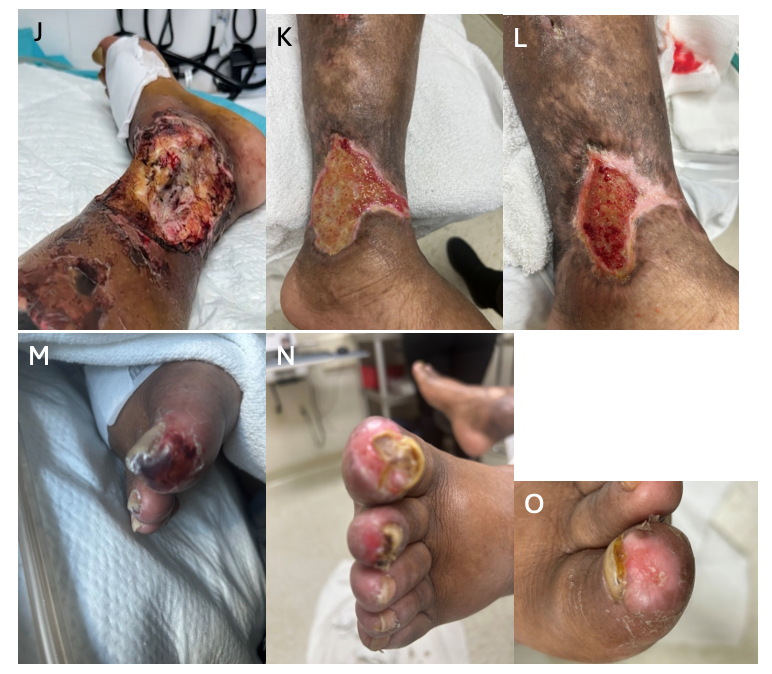
On June 10, 2025, the patient developed a new left great toe tip wound that was 2.0 x 1.5 x 0.1 cm. This wound closed at 51 days, with the primary wound care being 10 to 15 sprays of Spectricept to the wound with a 15-minute spray dwell time and twice-daily plain gauze dressing changes with minimal debridement.
Over the next 3 months, the patient underwent tapering of HBOT and advanced wound care visits once a week. She had a total of 15 HBOT treatments over that time and 10 days of standard wound vac treatment. At 3 months, 2 of 3 large complex wounds and the great toe would achieve complete closure as follows:
- Left groin, 60 days
- Left knee, 180 days
- Left great toe wound, 51 days
- Left ankle 90% closed, 340 days
Integral to this case success was the introduction and liberal use of a novel stabilized HOCl wound care innovation, Spectricept. It became the foundation of the patient’s wound care and dressing changes from her first day of outpatient treatment until closure of 3 of her 4 wounds (peri-ankle wound closure 90%). Spectricept was not available in the LGH in-house formulary but was available for outpatient use at the OGH Advanced Outpatient Wound Care Center under a postmarket wound protocol study in which several authors and the OGH Advanced Outpatient Wound Care Center were participants. From day 1 as an outpatient, all wounds were copiously treated with Spectricept during each wound care visit, and the patient and family continued Spectricept spray and simple dressing changes at home once a day initially when daily HBOT treatments occurred (15 total), then twice daily at home when HBOT stopped. The family provided all wound care at home.
Spectricept is a clear, odorless liquid delivered to the wound by spray from an 8-ounce non-glass container. We recommended between 10 and 15 sprays for each wound segment, allowing the spray to soak in the wound for 10 to 15 minutes and proceeding to spray-soak an additional gauze, as needed, and placing it on the wound bed and covering it as a dressing with dry gauze and a simple cover dressing. No other wound care product was used. It quickly became apparent to the patient, her family, and the physicians and wound care specialists that the addition of Spectricept to her care facilitated marked improvement in her clinical symptoms, wound appearance, and overall wound care. The patient and her family voiced that the Spectricept experience improved and significantly decreased pain (especially with dressing changes) and dramatically decreased the odor associated with large wounds while simplifying home dressing changes. The wounds’ exudate rapidly decreased, less infection was experienced, and granulation proceeded rapidly.
Discussion
Fifteen months after her index open vascular surgery procedure and massive wound dehiscence, the patient is fully mobile and ambulatory on her own. The role of the patient and her family's advocacy by seeking second opinions cannot be underscored enough in this case and was the first cornerstone of securing her ultimate extreme limb salvage success.
Global PAD Association
GPAD is a 501(c)(3) nonprofit patient advocacy organization that was founded in 2019.26-30 Today, there are over 13,000 patients and contacts in their network, and they have been credited with 1300 limbs saved.26-31 GPAD is on the frontlines with patients, providing comprehensive personalized education, high-touch advocacy, help with preparing for appointments with critical questions to ask to maximize their time, no-cost follow-up, and remote lifestyle modification services, including dietary programs and smoking cessation support, when none are available locally.26-30 GPAD also provides a walking app for claudicants or those recovering from CLTI events to improve walking distance and recovery.29-32 GPAD has collected patient-reported data that has been presented at the VIVA Leaders Forum in April 2024 and has subsequently been cited in other peer-reviewed literature.32
Clinicians managing patients with CLTI and failed prior revascularization, refractory wounds, or complex anatomy who have failed or exhausted local treatment options may engage GPAD directly as a referral and future navigation resource in complex CLTI patients facing poor outcomes. Geographic variations in vascular care intensity are also directly associated with high amputation rates and, unfortunately, the areas with the least intensive vascular care carry the highest burden of limb loss.32,33 The Leg Saver Hotline is available at 1-833-PAD LEGS and PADhelp.org.
Hypochlorous acid
HOCl is a naturally occurring weak acid produced endogenously in the human body by neutrophils and phagocytes during the process of pathogen eradication.34-37 Natural HOCl has been found to exert wide broad-spectrum antimicrobial efficacy by oxidation, chlorination, and deproteinization of the nucleic acids, lipids, and proteins of the pathogen while exhibiting low cytotoxicity in human cells.34-38 These HOCl characteristics potentially allow and promote disruption of the pathogen cell walls, enzymes, and biological wound bioburdens or slough debris. Additional mechanisms of action exhibited by HOCl that provide potential clinical benefits in humans include stimulation of angiogenesis and promotion of anti-inflammatory and antihistamine effects by downgrading mast cell degradation and release of cytokines.38-42 In addition, HOCl has been shown to decrease exotoxins and matrix metalloproteinases along with downgrading leukotrienes, therefore potentially decreasing pruritus.38-43
HOCl was first described in 1834 by French chemist Antoine Jerome Ballard, but only in the last 2 decades have attempts been made to create a stabilized and viable generic HOCl providing enhanced clinical benefits to wound care patients.36,37,44 Generic HOCl available today include Puracyn Plus Wound and Skin Cleanser (Innovacyn, Inc), PureWash HOCl Wound Cleanser (Medline Industries), and Vashe Wound Solution (Urgo Medical North America). Despite the wide availability, all generic HOCl preparations remain unstable, with significant clinical limitations including rapid degeneration and consumption with early deactivation due to heat, pH shifts, air/oxygen exposure, light/UV exposure, organic compounds, and inorganic ions and contaminants.45-49 These generic HOCl limitations potentially result in rapid loss of microbicidal efficiency and a short clinical half-life and shelf life.47-49
Spectricept with tri-ion formulation
Spectricept with tri-ion formulation is a novel, recently patented and FDA 510(k) cleared stabilized HOCl formulation with the addition of trace ion salts, copper chloride (Cu2+), zinc chloride (Zn2+), and ferric chloride (Fe3+).50-52 It received FDA clearance on April 21, 2025 (K243875) as a skin and wound cleanser with indications for use "for cleansing, irrigating, moistening, debridement, and removal of foreign material, including debris from wounds, and dermal lesions, including stage I-IV pressure ulcers, stasis ulcers, diabetic ulcers, post-surgical wounds, superficial second-degree burns, abrasions, minor irritations of the skin, diabetic foot ulcers, ingrown toenails, grafted/donor sites and exit sites”.53 These ions are functionally stabilizers and preservatives that are not primarily antimicrobial in the wound.50-52,54 The ions are designed to perform as a protective, shield-like scaffold intended to enhance and improve the clinical benefits of Spectricept and therefore may clinically improve upon many of the limitations of generic HOCl.50-52,54 The theoretical function of the ions is to prolong the useful clinical life of the HOCl component in the wound, therefore overcoming multiple generic HOCl limitations.54-57 Additional theoretical advantages of the tri-ion formula include superior pathogen eradication, prevention of horizontal gene transfer, and minimization of the development of antibiotic resistance.49,58-61
The Zn2+, Cu2+, and Fe3+ tri-ion platform further stabilizes the Spectricept HOCl formulation and improves clinical performance by modulating the redox environment, mitigating contaminant effects, and discarding potential impurities that are known to break down HOCl.62-64 These tri-ion attributes potentially improve the clinical real-world performance of Spectricept, especially in heavily exudative and contaminated wounds. Uniquely, trace levels of these metal ions provide complementary multitarget antimicrobial and antipathogenic activities capitalizing on multiple known metal ion synergistic antimicrobial effects.56,65,66 Zn2+ inhibits metabolism and quorum sensing while disrupting organic wound bioburdens. Cu2+ propels reactive oxygen species (ROS) via Fenton-like reactions and facilitates membrane/DNA damage.59,67,68 The clinical sum of these unique tri-ion effects results in an overall increasing bacterial and pathogen cell membrane permeability and disruption, ROS augmentation, increased bioburden disruption, and reduction of risk for the development of antibiotic or drug resistance.49,56-61 The overall synergistic effects of the Spectricept tri-ion formulation, therefore, address and improve on the multiple clinical limitations of generic HOCl, potentially including early deactivation when generic HOCl encounters serum, blood, bodily fluids, and wound exudation.33,37,47 Theoretically, Spectricept potentially could provide enhanced pathogen-cidal activity, enhanced organic bioburden disruption, and antibiotic drug resistance prevention when compared to generic HOCl preparations while maintaining minimal to no cytotoxicity to human cells.51,58,59,63,69
Limitations
This single case report is limited by its size and lack of a control group; therefore, the results should not be utilized to represent a generalization of results or observations in this specific case to a broader population without future validation. This precludes a direct causation and effect association regardless of the close temporal occurrence of the case treatment and resulting favorable outcome. The multidisciplinary care team approach and multimodal therapies used in this case also impede a direct causation prediction between a single treatment and a single effect.
This complex single case report with a novel innovation also presents other potential sources of bias and limitations. Two of the four authors of this case report are shareholders of Spectrum Antimicrobials, the creators of the Spectricept tri-ion formulation. All authors contributed to the case by actively treating the patient, designing the case, accumulating and interpretating the data, and preparing the manuscript. To mitigate potential bias, all data interpretations were reached by a consensus of all authors. Spectrum Antimicrobials provided no funding or contributions related to the preparation or submission of this case report.
Another prominent potential limitation of this case report analysis and interpretation includes a dependence on recent non-peer-reviewed data availability in the literature. Similarly, due to the emerging nature of this innovation, a reliance on proprietary data and non-peer-reviewed references was required, adding additional potential for bias. Therefore, due to the emerging nature and the biases noted, the authors advise caution in drawing definitive cause-and-effect and broad generalizations as a conclusion from this single case report. The authors recommend future large-scale controlled randomized trials and further independent work and studies to validate and replicate the potential future clinical benefits of patient advocacy, multidisciplinary care, and the role of Spectricept tri-ion treatment in providing improved outcomes and amputation rates in CLTI limb salvage care.
Conclusion
This case report highlights several unique needs and opportunities that should be noted and utilized by all providers treating complex CLTI patients with a goal to improve upon current stagnant outcomes. First, patient advocacy for advanced extreme limb salvage must be readily recognized, accepted, enhanced, and applied with much more vigor than in the past. Patient advocacy escalation represents a new opportunity to improve CLTI outcomes and increase limb salvage capabilities. Second, we must continue to support the growth of multidisciplinary limb salvage teams and centers that have solidly proven they can deliver improved outcomes in even the most advanced cases facing amputation.12,19,20 The success in this case required the patient and family to reach a resource where advanced comprehensive limb salvage care and vascular expertise could be given in a critically timely manner. The role of patient advocacy for limb salvage and second opinions must be fostered if we are to reduce amputations on a wide population level.
Finally, advanced CLTI device and technique treatments evolved rapidly in the late 1990s to 2020, building an impressive contemporary CLTI toolbox. Unfortunately, significant device advancements have tapered off, with fewer novel devices or techniques being reported. A similar or analogous situation has also occurred in the field of wound care limb salvage, especially in complex wounds that involve severe infection and heavy exudative bioburdens. There have been very few, if any, significant breakthrough treatments in wound care and infectious disease management in the last decade. The pivotal use of stabilized Spectricept with tri-ion formulation in this case corresponded precisely with the rapid development of infection control, granulation formation, and wound healing in this case. During the discussion, multiple reports were cited that were supportive of the potential clinical advantages that Spectricept has over generic HOCl. Spectricept legitimately represents an opportunity to bolster and enhance our contemporary CLTI toolbox.70 The authors contend that as an innovative tool, Spectricept with tri-ion stabilization potentially could be as major a breakthrough in limb salvage as any previous endovascular device-related tool, including wires, balloons, stents, atherectomy catheters, or procedural techniques. Theoretically, Spectricept may have the potential to significantly decrease both the clinical and economic costs of treating all wounds and decreasing amputations in the CLTI patient population. Future randomized trials and studies are warranted for the validation of the potential role of Spectricept in limb salvage wound care and the much broader patient population experiencing an infectious disease. n
Affiliations and Disclosures
David E. Allie, MD, is from the Louisiana Cardiothoracic and Vascular Center of Excellence, Lafayette, Louisiana; Kerry Thibodeaux, MD, is from the Opelousas Advanced Wound Care Center, Opelousas, Louisiana; Amit Amin, MD, is from the Cardiovascular Institute of the South, Lafayette, Louisiana; and Kym McNicholas is from the Global PAD Association, Mill Valley, California.
Dr Allie and Dr Amin are shareholders in Spectrum Antimicrobials, Inc. The remaining authors report no financial relationships or conflicts of interest regarding the content herein.
Manuscript accepted July 6, 2026.
Address for correspondence: David E. Allie, MD, Louisiana Cardiothoracic and Vascular Center of Excellence, 901 Wilson St., Lafayette, LA 70503. Email: David.allie@cv-limbsalvage.com
References
1. Allie DE, Hebert CJ, Lirtzman MD, et al. Critical limb ischemia: a global epidemic. A critical analysis of current treatment unmasks the clinical and economical costs of CLI. EuroIntervention. 2005;1(1)75-84.
2. Allie DE, Walker CM. Critical limb ischemia (CLI) and amputations: a global healthcare problem with a racial disparity in outcomes. Journal of the Association of Black Cardiologists. 2007;May/June:7-19.
3. Hirsch AT, Duval S. The global pandemic of peripheral artery disease. Lancet. 2013;382(9901):1312-1314. doi:10.1016/S0140-6736(13)61576-7
4. About CLI Global Society. CLI Global Society. https://cliglobalsociety.org/about
5. Mustapha JA, Katzen BT, Neville RF, et al. Determinants of long-term outcomes and costs in the management of critical limb ischemia: a population-based cohort study. J Am Heart Assoc. 2018;7(16):e6009724. doi:10.1161/JAHA.118.009724
6. Mustapha JA, Katzen BT, Neville RF, et al. Disease burden and clinical outcomes following initial diagnosis of critical limb ischemia in the Medicare population. JACC Cardiovasc Interv. 2018;11(10):1011-1012. doi:10.1016/j.jcin.2017.12.012
7. Conte MS, Bradbury AW, Kolh P, et al; GVG Writing Group. Global vascular guidelines on the management of chronic limb-threatening ischemia. J Vasc Surg. 2019;69(6S):3S-125S.e40. doi:10.1016/j.jvs.2019.02.016
8. Almasri J, Adusumalli J, Asi N, et al. A systematic review and meta-analysis of revascularization outcomes of infrainguinal chronic limb-threatening ischemia. J Vasc Surg. 2018;68(2):624-633. doi:10.1016/ j.jvs.2018.01.066
9. Henry AJ, Hevelone ND, Belkin M, Nguyen LL. Socioeconomic and hospital-related predictors of amputation for critical limb ischemia. J Vasc Surg. 2011;53(2):330-339.e1. doi:10.1016/j.jvs.2010.08.077
10. Goodney PP, Travis LL, Nallamothu BK, et al. Variation in the use of lower extremity vascular procedures for critical limb ischemia. Circ Cardiovasc Qual Outcomes. 2012;5(1):94-102. doi:10.1161/CIRCOUTCOMES.111.962233
11. Mathlouthi A, Elsayed N, Al-Nouri O, Farber A, Malas MB. Outcomes of endovascular-first versus bypass-first approach for patients with chronic limb-threatening ischemia using a Medicare-linked database. Ann Vasc Surg. 2022;85:119-124. doi:10.1016/j.avsg.2022.03.040
12. Abu Dabrh AM, Steffen MW, Undavalli C, et al. The natural history of untreated severe or critical limb ischemia. J Vasc Surg. 2015;62(6):1642-1651.e3. doi:10.1016/j.jvs.2015.07.065
13. Farber A, Menard MT, Conte MS, et al; BEST-CLI Investigators. Surgery or endovascular therapy for chronic limb-threatening ischemia. N Engl J Med. 2022;387(25):2305-2316. doi:10.1056/NEJMoa2207899
14. Menard MT, Farber A, Assmann SF, et al. Design and rationale of the best endovascular versus best surgical therapy for patients with critical limb ischemia (BEST-CLI) trial. J Am Heart Assoc. 2016;5(7):e003219. doi:10.1161/JAHA.116.003219
15. Chung J, Modrall JG, Ahn C, Lavery LA, Valentine RJ. Multidisciplinary care improves amputation-free survival in patients with chronic critical limb ischemia. J Vasc Surg. 2015;61(1):162-169. doi:10.1016/j.jvs.2014.05.101
16. Wolf H, Singh N. Using multidisciplinary teams to improve outcomes for treating chronic-limb threatening ischemia. Ann Vasc Surg. 2024;107:37-42. doi:10.1016/j.avsg.2023.11.055
17. Kawaji Q, Martinson J, Husain S, et al. Multidisciplinary limb salvage care is associated with decreased mortality without increasing revascularization in major amputations. J Vasc Surg. 2025;82(4):1438-1447.e1. doi:10.1016/j.jvs.2025.04.005
18. Gabel J, Bianchi C, Possagnoli I, et al. Multidisciplinary approach achieves limb salvage without revascularization in patients with mild to moderate ischemia and tissue loss. J Vasc Surg. 2020;71(6):2073-2080.e1. doi:10.1016/ j.jVS.2019.07.103
19. Bisdas T, Patelis N, Argyrakopoulou G, et al. Limb salvage in patients with severe critical limb ischemia (CLI) after referral for a second opinion to a dedicated CLI center. Int J Low Extrem Wounds. 2022;21(2):174-181. doi:10.1177/1534734620933069
20. Secemsky EA, Armstrong EJ, Chandra V, et al. Contemporary chronic limb-threatening ischemia care in the United States: a vascular leaders forum. J Soc Cardiovasc Angiogr Interv. 2025;4(12):104013. doi:10.1016/j.jscai.2025.104013
21. Bjork I, Weissler H, Herath T, et al. Engaging patients and their caregivers in research to improve evidence-based, patient-centered and equitable care for chronic limb-threatening ischemia and advanced peripheral artery disease. JVS Vasc Insights. 2025;3:100222. doi:10.1016/j.jvsvi.2025.100222
22. Matthews MR, Fernandez LG, Ferrari LS. V.A.C. Veraflo Cleanse Choice™ dressing use in the treatment of acute care surgical wounds. Dialogues in Wound Management. 2020. https://dialoguesinwoundmanagement.com/v-a-c-veraflo-cleanse-choice-dressing-use-in-the-treatment-of-acute-care-surgical-wounds
23. Delapena S, Fernández LG, Foster KN, Matthews MR. Negative pressure wound therapy with instillation and dwell time for the management of complex wounds: a case series. Wounds. 2020;32(12):E96-E100.
24. Téot L, Boissiere F, Fluieraru S. Novel foam dressing using negative pressure wound therapy with installation to remove thick exudate. Int Wound J. 2017;14(5):842-848. doi:10.1111/iwj.12719
25. Kim PJ, Attinger CE, Oliver N, et al. Comparison of outcomes for normal saline and an antiseptic solution for negative-pressure wound therapy with instillation. Plast Reconstr Surg. 2015;136(5):657e-664e. doi:10.1097| PRS.0000000000001709
26. Global Pad Association. https://www.padhelp.org
27. Global PAD Association. Amputations as PAD treatment [Facebook poll]. March 7, 2024. https://www.padsupportgroup.com
28. Global PAD Association. PAD diagnosis [Facebook poll]. April 19, 2021. https://www.facebook.com/groups/peripheralarterialdisease/permalink/4507709705910699
29. Global PAD Association. PAD treatment for intermittent claudicants vs. CLI [Facebook poll]. March 13, 2023. https://www.facebook.com/groups/peripheralarterialdisease/permalink/5158163030865360
30. McNicholas K. What you say docs must know. PADdy’s Post. 2021;IV:7-8. https://www.facebook.com/groups/peripheralarterialdisease/permalink/42245469123789
31. Global PAD Association. I have to do a presentation for doctors on why people with PAD fall through the cracks [Facebook poll]. November 23, 2023. https://www.facebook.com/groups/peripheralarterialdisease/permalink/7581125865235719
32. McNicholas K. Outside looking in: how are US vascular clinicians viewed by the non-clinician? [Invited Talk]. VIVA Leaders Forum; April 12, 2024. https://www.viva-foundation.org
33. Goodney PP, Holman K, Henke PK, et al. Regional intensity of vascular care and lower extremity amputation rates. J Vasc Surg. 2013;57(6):1471-1479, 1480.e1-3; discussion 1479-1480. doi:10.1016/j.jvs.2012.11.068
34. Wang L, Bassiri M, Najafi R, et al. Hypochlorous acid as a potential wound care agent: part I. Stabilized hypochlorous acid: a component of the inorganic armamentarium of innate immunity. J Burns Wounds. 2007; 6:e5.
35. Robson MC, Payne WG, Ko F, et al. Hypochlorous acid as a potential wound care agent: part II. Stabilized hypochlorous acid: its role in decreasing tissue bacterial bioburden and overcoming the inhibition of infection on wound healing. J Burns Wounds. 2007;6:e6.
36. McDonnell GM, Hansen J. Block’s Disinfection, Sterilization, and Preservation, 6th ed. Wolters Kluwer; 2020.
37. Block MS, Rowan BG. Hypochlorous acid: a review. J Oral Maxillofac Surg. 2020;78(9):1461-1466. doi:10.1016/j.joms.2020.06.029
38. Curieses Andrés CM, Pérez de la Lastra JM, Andrés Juan C, Plou FJ, Pérez-Lebeña E. Hypochlorous acid chemistry in mammalian cells—influence on infection and role in various pathologies. Int J Mol Sci. 2022;23(18):10735. doi:10.3390/isms231810735
39. Medina-Tamayo J, Sánchez-Miranda E, Ballez-Tapia H, et al. Super-oxidized solution inhibits IgE-antigen-induced degranulation and cytokine release in mast cells. Int Immunopharmacol. 2007;7(8):1013-1024. doi:10.1016/j.intimp.2007.03.005
40. Fukuyama T, Martel BC, Linder KE, Ehling S, Ganchingco JR, Bäumer W. Hypochlorous acid is antipruritic and anti-inflammatory in a mouse model of atopic dermatitis. Clin Exp Allergy. 2018;48(1):78-88. doi:10.1111/ cea.13045
41. Del Rosso JQ, Bhatia N. Status report on topical hypochlorous acid: clinical relevance of specific formulations, potential modes of action, and study outcomes. J Clin Aesthet Dermatol. 2018;11(11):36-39.
42. Irawan DM, Lesmana R, Sahiratmadja E. Hypochlorous acid for wound healing in diabetic rats: effect on MMP-9 and histology. Clin Cosmet Investig Dermatol. 2024;17:1603-1612. doi:10.2147 CCID.S468494
43. Pelgrift RY, Friedman AJ. Topical hypochlorous acid (HOCl) as a potential treatment of pruritus. Curr Derm Rep. 2013;2:181-190. doi:10.1007/s13671-013-0052-z
44. Natarelli N, Nong Y, Maloh J,Sivamani R. Hypochlorous acid: applications in dermatology. Journal of Integrative Dermatology. 2022;1(1). doi:10.64550/joid.1d4y5r09
45. Nagamatsu Y, Nagamatsu H, Ikeda H, Shimizu H. Microbicidal effect and storage stability of neutral HOCl-containing aqueous gels with different thickening/gelling agents. Dent Mater J. 2021;40(6):1309-1319. doi:10.4012/dmj.2020-454
46. Rossi-Fedele G, Guastalli AR, Doğramacı EJ, Steier L, De Figueiredo JAP. Influence of pH changes on chlorine-containing endodontic irrigating solutions. Int Endod J. 201144(9):792-799. 1013-1024. doi:10.1111/j.1365-2591.2011.01911.x
47. Ishihara M, Murakami K, Fukuda K. et al. Stability of weakly acidic hypochlorous acid solution with microbicidal activity. Biocontrol Sci. 2017:22(4):223-227. doi:10.4265/bio.22.223
48. Hypochlorous acid: trends in shelf-life extension techniques. Eureka by patsnap. August 4, 2025. https://eureka.patsnap.com/report-trends-in-shelf-life-extension-techniques-for-hypochlorous-acid
49. Alshahrani F, Elgujja A, Elgujja A, Alamoudi A, Asiri S, Alzaid I. Issues surrounding the stability of hypochlorous acid as a surface disinfectant. Preprints. Preprint posted online April 15, 2024. doi:10.20944/preprints202404.0954.v1
50. Spectricept™. Spectricept CARE+. https://spectriceptcare.com/pages/spectricept
51. Spectrum Antimicrobials. https://spectrumantimicrobials.com/clinical-management
52. Otter J, Abadioru O, Sasson M, et al. Evaluation of a novel hypochlorous acid based hand hygiene product with sporicidal activity in an inpatient ward setting. Preprints. Preprint posted online January 9, 2024. doi:10.20944/preprints202401.0628.v1
53. FDA 510(k) clearance for Spectricept Skin and Wound Cleanser (K243875). U.S. Food & Drug Administration. April 21, 2025. https://www.accessdata.fda.gov/cdrh_docs/pdf24/K243875.pdf
54. Stafford SL, Bokil N, Acharo M, et al. Metal ions in macrophage antimicrobial pathways: emerging roles for zinc and copper. Biosci Rep. 2013:33(4):e00049. doi:10.1042/BSR20130014
55. Ganga S, Kothari P, Kumar M, Biswas S. Copper-zinc metal complex exhibiting bactericidal and antibiofilm activity by membrane damage and quorum sensing inhibition. Journal of Environmental Chemical Engineering. 2024;12:112889. doi:10.1016/j.jece.2024.112889
56. Garza-Cervantes JA, Chávez-Reyes A, Castillo EC, et al. Synergistic antimicrobial effects of silver/transition-metal combinatorial treatments. Sci Rep. 2017;7(1):903. doi:10.1038/s41598-017-01017-7
57. Raja FNS, Worthington T, Martin RA. The antimicrobial efficacy of copper, cobalt, zinc and silver nanoparticles: alone and in combination. Biomed Mater. 2023;18(4). doi:10.1088/1748-605X/acd03f
58. Ekhlas D, Soro AB, Leonard FC, Manzanilla EG, Burgess CM. Examining the impact of zinc on horizontal gene transfer in Enterobacterales. Sci Rep. 2022;12:20503. doi:10.1038/S41598-022-23690-z
59. Warnes SL, Highmore CJ, Keevil CW. Horizontal transfer of antibiotic resistance genes on abiotic touch surfaces: implications for public health. mBio. 2012;3(6):e00489-12. doi:10.1128/mBio.00489-12
60. Turner RJ, Smilh AB, Jones CD, et al. Exploring antimicrobial interactions between metal ions and quaternary ammonium compounds toward synergistic metallo-antimicrobial formulations. Microbiol Spectr. 2024;12(10):e0104724. doi:1128/spectrum.01047-24
61. Crane JK, Cheema MB, Olyer MA, Sutton MD. Zinc blockade of SOS response inhibits horizontal transfer of antibiotic resistance genes in enteric bacteria. Front Cell Infect Microbiol. 2018;8:410. doi:10.3389/fcimb.2018.00410
62. Giles NM, Watts AB, Giles GI, Fry FH, Littlechild JA, Jacob C. Metal and redox modulation of cysteine protein function. Chem Biol. 2003;10(8):677-693. doi:10.1016/s1074-5521(03)00174-1
63. Jomova K, Alomar SY, Valko R, Nepovimova E, Kuca K, Valko M. The role of redox-active iron, copper, manganese, and redox-inactive zinc in toxicity, oxidative stress, and human diseases. EXCLI J. 2025;24:880-954. doi:10.17179/Excli2025-8449
64. Li X, Cao Z, Chen M, Wang S. Redox signaling and homeostasis. Oral Science and Homeostatic Medicine. 2005;1. doi:10.26599/OSHM.2025.9610003
65. Tomić SL, Vuković JS. Antimicrobial activity of silver, copper, and zinc ions/poly (acrylate/itaconic acid) hydrogel matrices. Inorganics.10(3):38. doi:10.3390/inorganics10030038
66. Donaghy C, Javellana JG, Hong Y, Djoko K, Angeles-Boza AM. The synergy between zinc and antimicrobial peptides: an insight into unique bioinorganic interactions. Molecules. 2023;28(5):2156. doi:10.3390/ molecules28052156
67. Imlay JA. Pathways of oxidative damage. Annu Rev Microbiol. 2003;57:395-418. doi:10.1146/annurev.micro.57.030502.090938
68. Kohanski MA, Dwyer DJ, Hayete B, Lawrence CA, Collins JJ. A common mechanism of cellular death induced by bacterial antibiotics. Cell. 2007;130(5):797-810. doi:10.1016/j.cell.2007.06.049
69. Burian EA, Sabah L, Kirketerp-Møller K, Gundersen G, Ågren MS. Effect of stabilized hypochlorous acid on re-epithelialization and bacterial bioburden in acute wounds: a randomized controlled trial in healthy volunteers. Acta Derm Venereol. 2022;31:102:adv00727. doi:10.2340/actadv.v102.1624
70. Allie DE, Patlola R, Ingraldi A, Hebert CJ, Walker CM. The contemporary CLI toolbox. Endovascular Today. March 2009:37-50. https://assets.bmctoday.net/evtoday/pdfs/EVT0309_05.pdf