A New Approach to Crossing and Preparing Complex Peripheral Chronic Total Occlusions

Cardiovascular Institute of the South, Houma, Louisiana
A Thursday morning session at the Amputation Prevention Symposium highlighted the evolving role of dedicated chronic total occlusion (CTO) crossing technology in the treatment of complex femoropopliteal peripheral arterial disease (PAD). Pradeep K. Nair, MD, FACC, FSCAI, presented the clinical rationale, engineering design, pivotal clinical data, and early real-world experience with the Santreva-ATK Endovascular Revascularization Catheter (AngioSafe), a novel device designed to combine wire-free CTO crossing with simultaneous vessel preparation in a single step.
The presentation began by emphasizing the persistent challenge of CTO of peripheral arteries, which is encountered in nearly 40% of symptomatic PAD patients referred for angiography. The inability to cross the lesion is a primary cause of procedural failure, including the failure to penetrate the proximal cap or advance a guidewire across the occluded segment. Procedure complications include perforation (2%-5%), flow-limiting dissections, distal embolization, loss of collateral, arteriovenous fistula, and equipment entrapment. Given the high prevalence of CTOs among patients undergoing lower extremity angiography, Dr Nair noted that advanced CTO crossing techniques have become an essential component of contemporary PAD intervention.
The Santreva-ATK catheter was presented as a fundamentally different approach that is designed to facilitate wire-free intraluminal crossing of peripheral CTOs and combines CTO crossing with atheroplasty, where rotational angular momentum laterally displaces the punctured plaque and compresses the plaque without stretching the vessel wall. Device design features, including a high tip load, large crossing profile for visibility, centering system, and ergonomic handle, were highlighted as contributing to precise operator control during lesion crossing.
Clinical evidence focused on the prospective, single-arm, multicenter RESTOR-1 pivotal study, which enrolled patients with long femoropopliteal CTOs, many with severe calcification and multiple cardiovascular comorbidities. The study achieved its primary endpoint with 90% technical success in guidewire placement into the distal true lumen while reporting no device-related major adverse events through 30 days. Intravascular ultrasound demonstrated exclusively intraplaque crossing in 80% of evaluated cases, and the catheter produced 59% luminal gain during vessel preparation. Patients also experienced significant improvements in Rutherford classification and pain scores at 30 days, supporting both procedural success and early clinical benefit.
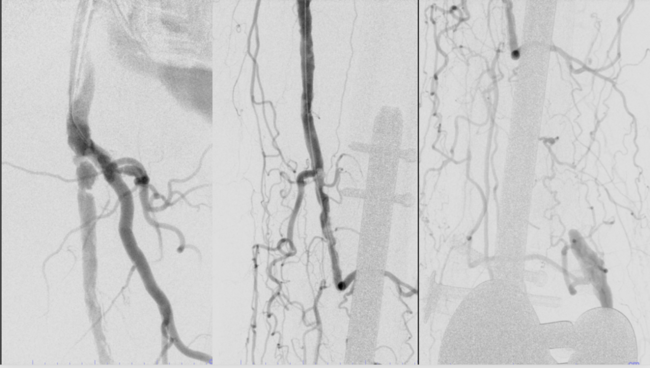
Dr Nair complemented the clinical trial data with several real-world cases illustrating successful treatment of complex femoropopliteal CTOs in patients presenting with chronic limb-threatening ischemia, disabling claudication, and heavily calcified disease. These examples demonstrated successful channel formation followed by standard endovascular therapy, reinforcing the device's ability to facilitate subsequent balloon angioplasty and drug-coated balloon treatment after lesion preparation.
By combining wire-free intraplaque crossing with simultaneous vessel preparation, Santreva-ATK seeks to simplify CTO recanalization while preserving vessel integrity and enabling definitive endovascular treatment with a favorable early safety profile. The RESTOR-1 findings and initial real-world experience suggest that this approach may expand treatment options for patients with long, heavily calcified femoropopliteal CTOs.