Artificial Intelligence in Podiatry: Augmenting Surgical Decision-Making and Practice Workflow
In this episode, Dr. David Yeager shares practical insights on how AI is being used today—and where it may take foot and ankle surgery next.
Key Takeaways
- AI is already improving patient communication by allowing surgeons to visually simulate post-operative outcomes, particularly in bunion correction.
- Surgical planning is becoming more data-driven, with AI offering templated corrections and enhanced reproducibility.
- AI functions best as an augmentative tool, not a replacement for clinical judgment or surgical experience. Adoption barriers remain, particularly around patient perception and the need for clinician-led education.
Transcript
Please note: This content is a direct transcript, capturing the authentic conversation without edits. Some language may reflect the flow of live discussion rather than polished text.
Jennifer Spector, DPM: AI is already changing how we practice medicine, but what does that actually look like in podiatric surgery? Welcome back to Podiatry Today Podcasts where we bring you practical insights and real world perspectives from leaders shaping foot and ankle care. I'm Dr. Jennifer Spector, Associate Editorial Director for Podiatry Today. And today I'm joined by Dr. David Yeager for a conversation on how artificial intelligence is beginning to influence surgical decision-making, workflow, and patient outcomes in our field. If you're interested in where technology is taking podiatry and how it may impact your practice, this is an episode you won't want to miss. But before we dive in, don't forget to follow the podcast on your favorite platforms and leave us a quick review. It really does help us bring more of these conversations to you.
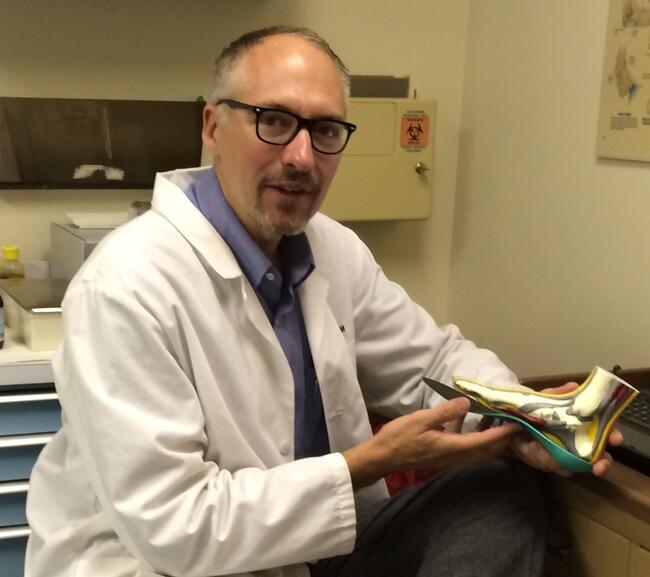
Today's episode is recorded in partnership with the American Society of Podiatric Surgeons, and let's introduce you to our guest today. Dr. Yeager is the Chief of Staff and Chief of Surgery at Morrison Community Hospital in Morrison, Illinois. He's dual board certified by the American Board of Foot and Ankle Surgery and is a past chair of the American Society of Podiatric Surgeons and a fellow of the American College of Foot and Ankle Surgeons. He served on the board of the American Podiatric Medical Association and as president of the Illinois Podiatric Medical Association. In addition, he's a former residency director and remains actively involved in mentoring and educating the next generation of podiatric physicians, giving him a unique perspective on this topic. Let's get into it. Welcome, Dr. Yeager.
David Yeager, DPM: Thank you, Dr. Spector, and thank you for inviting me. I think this is a topic that's on everyone's minds, and I think it's going to have a great conversation that everyone's going to be really interested in.
Jennifer Spector, DPM: I agree, because I think we all have noticed that AI is everywhere right now. But from a podiatric surgery standpoint, where do you feel it's actually adding value, say, in preoperative planning or other areas of foot and ankle surgery?
David Yeager, DPM: You know, that's a great question. I think it touches our lives, especially from a podiatric standpoint and surgical planning, in the efficiency that actually I can convey to the patients what exactly what's going to happen. A prime example, if a patient comes in and they have a big bunion that really requires a Lapidus type of procedure, I can actually send the weight-bearing x-rays to a webpage. The engineers will take a look at it, then send the corrected bunion post-surgery back to me. And what's really cool about it is I can show the patient in live time, "This is what your bunion looks like now." And then after we correct it, this is what it's going to look like through AI technology. And what's interesting is I would say probably 90% of the time patients are like, "Oh wow, you use AI or oh wow, this is so cool that you can show me what it's going to look like.”
And I think from an AI perspective and from a podiatric practice perspective, it's really cool because I can show them, they can take the images with them and from a marketing standpoint of my practice, they do the marketing for me and it's free, right? So that's even better. And I think also from an AI standpoint and what's really, really cool is that the reproducibility of every bunion in terms of AI is phenomenal. And in fact, it's going to get to the point where I start to enter my weightbearing x-rays and it'll spit it back out and then it starts to form an algorithm like he needs X number of degrees of frontal plane deformity correction. He wants it with the IM angle of this and what have you. And I think most of the time with these engineers, they're shooting for like a zero or even like a one degree IM angle.
Obviously we know from surgeon standpoint that's really unattainable, right? But it actually shows patients, wow, I've gone from a really bad bunion and a space between the first and second mets to now more of a physiologically more appealing cosmetically. And we don't do cosmetic bunions, but cosmetically appealing foot and through AI, I just think it's a phenomenal, phenomenal tool for our patients and for surgeons as well.
Jennifer Spector, DPM: The visual value is certainly something that's very interesting. And I'm curious, even outside of the patient benefit, do you feel AI might be changing the way we interpret imaging for surgical planning, especially in complex reconstructions? Do you think this might be able to help improve outcomes?
David Yeager, DPM: I really do. And I think there's the conundrum and that's where the rubber hits the road, right? Do we rely entirely on AI or as we as surgeons go quote unquote old school and we determine? But that's where the best of both worlds happen with AI, right? I mean, the AI says, and they look at just facts, right? I mean, it's obvious. When it comes back to you, they do not count the holistic picture of the body and the foot and different conditions in terms of availability of bone or what have you. It encompasses the entire body. I mean, AI is just looking at that specific part. However, it will give us a good template to say, "Oh yeah, I never thought about that doing that osteotomy in that orientation or something to that effect." And I think what's nice, it's the best of both worlds in terms of the culmination of AI plus an experienced surgeon that will do these cases.
I think it's really the best of both worlds for patients for patient outcome and really getting these patients back to where they want to be because that's really our main goal as foot and ankle specialists.
Jennifer Spector, DPM: Absolutely. It seems like it would be more of an augmentative tool than any type of replacement or change in that respect. It just seems like it's another feedback loop of good data that surgeons can use as part of their overall decision making.
David Yeager, DPM: Correct. And they can choose to use it or they don't have to use it. I mean, that's what's nice about it. And I've been in practice now over 20 years and it's interesting because I remember in school cutting out the bunion or cutting out the first met and then correcting it over and measuring the angle and doing all those things manually with our copies of our feet. And now how cool is that that we can just do it through AI, through the webpages that these engineers have devised for? So it's really cool. I mean, it's kicking it old school, yet it's cutting edge, which is really cool.
Jennifer Spector, DPM: It's a really neat hybrid scenario to consider for sure. So for someone who is interested in at least learning more about this, for the average podiatrist, what do you think integrating AI into pre-op planning would realistically look like? Is this a standalone tool? Is this something that integrates into EMR or what does it look like in real life?
David Yeager, DPM: Yeah, I think it's really actually both. EMR can, and some of the systems out there, I know in our system that we can actually download images into the patient's chart, which is pretty cool. And I think the culmination of those two will actually enable the surgeon to have the ability to do that. So it's really great. I mean, it's an awesome opportunity for patients to be able to see what's really going on and to be able to do it.
Jennifer Spector, DPM: Do you feel like there's any barriers to adoption here that might be a challenge to overcome?
David Yeager, DPM: I think it's perception of AI in the community. I do have some patients that, when I mention, I'm going to do your bunionectomy through AI, and I don't mean this derogatorily. I mean, it's usually kind of the older population where they don't quite understand how AI is going to influence what's going on. And so it's a bit of an opportunity for the surgeon to educate our patients and general population how it can be changing how we look at orthopedic surgery and foot and ankle surgery.
Jennifer Spector, DPM: No, that makes a lot of sense. And I think a lot of it really does come down to opportunities for education as you spoke about before and really explaining to the patient how this is being used and how the benefit is there for them. So that's really interesting to consider.
David Yeager, DPM: Yeah. And what's cool about it is that really some of the surgeons perhaps out there, maybe they're doing something or some of the younger practitioners, they're doing these surgical cases that perhaps they are missing out some of the key anatomical points that they might be missing. And through AI, whether we're talking about the core or whether we're talking about certain other things that maybe the, I don't want to say the inexperienced surgeon might overlook, but it gives us an opportunity to have a holistic kind of thorough evaluation of the deformity.
Jennifer Spector, DPM: No, absolutely. And you've already spoken about this a little bit, but I'd love to hear your take on this. As we start incorporating more of AI-driven data or AI-driven recommendations in our surgical planning, how do you feel surgeons should frame this with respect to clinical judgment or liability? Is there a line where you feel like AI should stop and surgical decision, human surgeon decision making takes over? Is there sort of a balance that you feel needs to be negotiated there?
David Yeager, DPM: Yeah, that's actually probably the best question you've asked, Dr. Spector, for the simple reason that do we solely rely on what a computer's giving us or do we as surgeons ... And of course, I've been in practice 20 years now, I don't think a computer could do half as good as what I do. Now, I'm probably wrong on that, right? But I think that the combination of utilizing an experienced surgeon through and AI is an opportunity for success for the patient. Now, I don't think by any means that surgeons should rely entirely on AI, but it's been my experience, and I've probably done over 70 AI bunions, Lapidus bunions, where it gets to the point where it's such a streamlined process now that, and I'll just take the Lapidus procedure, for example, that can be kind of a difficult procedure for one surgeon to do with one scrub tech, right?
Because getting that triplane correction, et cetera, what have you, now with this AI driven technology where it's almost like a total ankle where the cutting jigs are coming already preformed for this patient with the amount of frontal plane correction, IM angle, et cetera, where it streamslines the process of a surgery that could take hour, hour and a half to now 35 to 40 minutes and they're done. And I think it's just a phenomenal opportunity for these surgeons because from my perspective, if you have a busy practice and you want to add another bunion to the end of the day and you're not exhausted and you haven't worked on the hour and a half Lapidus and you've done one in 35 to 40 minutes, that enables you as a hospital where I work to add another case on. And from an economical standpoint, that's huge for my hospital.
And so I think it's an opportunity for more cases, more reproducible cases, more incidents of non-unions to be incredibly less because we're taking the fudge factor out. Now, before anything comes out to me though, it has to be approved by me before anything happens. And so I have the final decision, I have the final responsibility of approving the AI procedure that we're going to do. And so it's a tool, right? It's not the absolute. And I think that that's where people need to understand, and especially surgeons need to understand that this is a tool to augment our practice, not solely rely on it.
Jennifer Spector, DPM: I think you hit the nail on the head right there that this seems like it's an emerging tool, that additional feedback loop, that augmented assistance, but there's really no substitute for good surgical decision making by the surgeon themselves.
David Yeager, DPM: 100%.
Jennifer Spector, DPM: So as we start to wrap up our conversation today, what one thing would you really like listeners to take away from our chat?
David Yeager, DPM: I think that the one thing that I would like is number ... Well, it's tough because we talked a lot of things that I think are important, but I think that don't be afraid of AI. It's coming, it's going to be integrated in your practice, whether it's an AI driven practice or whether you're having your progress notes, AI driven, which my hospital is experimenting with that we're going to enact, or whether it's surgical planning. Don't be afraid to utilize ... This is a tool. You hit it right on the head. It's a tool. It's not an absolute. And so if they could just leave one thing is just don't be afraid of AI. Utilize this tool to your benefit and have control of it. Don't let it control you.
Jennifer Spector, DPM: Absolutely. And Dr. Yeager, thank you so much for joining me today. This has really been an insightful discussion on where AI may be headed in podiatric surgery and what it means for clinical practice.
David Yeager, DPM: Well, thank you, Dr. Spector. And I'd be available for anybody, comments, concerns, that they want to reach out. I'd love to have further discussion because I just think that we're at the tip of the iceberg of this.
Jennifer Spector, DPM: Absolutely. I think we're going to have to invite you back to keep the conversation going.
David Yeager, DPM: I'd love that. I'd love that. Let's do it at maybe a year or so or whatever and see how we've gone from now to then.
Jennifer Spector, DPM: That would be amazing. So stay tuned for that. And for our listeners, if you found this conversation valuable, be sure to follow us so that you don't miss upcoming and past episodes. And we'd really appreciate it if you took a moment to leave a quick rating or review. It does help more clinicians like you find the show, but you can also find more clinical insights, articles, and multimedia content, as always, at podiatrytoday.com. Thanks again for listening, and we'll see you next time.
Dr. Yeager discloses he is a consultant for DePuy Synthes.
 Published in partnership with the American Society of Podiatric Surgeons.
© 2026 HMP Global. All Rights Reserved.
Any views and opinions expressed are those of the author(s) and/or participants and do not necessarily reflect the views, policy, or position of Podiatry Today or HMP Global, their employees, and affiliates.