The New Reality of Limb Salvage in Community Practice
Limb salvage is often associated with major academic medical centers, but much of the work happens in community-based practices where clinicians must coordinate complex care with limited resources. In this episode of the Podiatry Today Podcast, Dr. Timothy Miller explores the realities of multidisciplinary limb preservation, the challenges that threaten success, and why long-term patient engagement is critical to preventing amputation.
Key Takeaways
1. Community podiatrists are often the first line of defense in limb salvage. While academic centers play a vital role in complex care, community-based practitioners frequently identify and manage limb-threatening conditions earlier because they can provide more immediate access to care. Effective limb preservation depends on building strong relationships with vascular surgery, infectious disease, endocrinology, primary care, imaging centers, and other specialists to create a coordinated treatment network.
2. Patient engagement and social support are often the determining factors in success. Even the best multidisciplinary care plans can fail if patients lack transportation, family support, financial resources, or the ability to follow treatment recommendations. Dr. Miller emphasizes that patients are essential members of the limb salvage team, and addressing social determinants of health is just as important as managing wounds and infections.
3. Limb salvage is a lifelong commitment, not a single clinical episode. Healing an ulcer is only the beginning. Long-term success requires ongoing surveillance, preventive care, offloading strategies, custom bracing or orthotics, and continued management of underlying comorbidities to reduce the risk of recurrence and new ulcerations.
Please note: This content is a direct transcript, capturing the authentic conversation without edits. Some language may reflect the flow of live discussion rather than polished text.
Transcript
Jennifer Spector, DPM: Welcome back again to Podiatry Today Podcasts. I'm Dr. Jennifer Spector, the Associate Editorial Director of Podiatry Today. And today we're going to talk about limb salvage and the new reality of this in community practice. It's often associated with large academic centers and highly specialized teams, but the reality is a lot of this critical work is happening every day in community-based practices. Today we're going to dive into what limb salvage actually looks like outside of that academic setting, what works, what breaks down, and what podiatrists need to understand to improve outcomes in real world environments. I'm joined again today by Dr. Timothy Miller, board certified fellowship trained podiatrist and co-owner of Sunshine Ankle and Foot Experts in Orlando, Florida. He's a leader within ACFAS, ABFAS, and in the Florida Podiatric Medical Association, and he plays an active role in resident training and professional advocacy for medical legal education.
In this episode, we'll unpack these realities of multidisciplinary coordination, common causes of failure in limb preservation efforts, and what clinicians may underestimate about the long-term care that these patients require. Welcome back, Dr. Miller.
Timothy Miller, DPM: Thank you so much, Dr. Spector. I appreciate being back here and I love the forum, I love the episodes, and I love the knowledge that we're able to spread with these podcasts.
Jennifer Spector, DPM: Well, we're so excited to have you back again with this topic, and I do think this is something that so many of our colleagues are experiencing on a day-to-day basis, but bringing this knowledge together in this way can hopefully help them advance the work that they're doing. So when people hear limb salvage, they may think about large academic centers. What from your experience does limb salvage really look like in a community-based practice like yours?
Timothy Miller, DPM: We do think of limb salvage and academic centers. We have one of my mentors, Dr. John Steinberg, he's a part of MedStar. He does a lot of limb salvage there. We have a lot of big names in limb salvage in our profession that are associated with these academic centers. But what I see is a lot of those large academic centers aren't in communities. They're part of major cities, they're part of major hospital networks, but out in local communities, the first line of defense for a limb salvage are community practices. And more often than not, if patients who are in need of limb salvage are trying to get an appointment for evaluation, they may not be able to get in right away or maybe a long period of time before they're able to get into these large academic centers, which is why these community-based practices more often than not can get patients in on an earlier timeline and get them the care that they need as quickly as possible.
Jennifer Spector, DPM: That is incredibly true. And we all know the benefits of a multidisciplinary approach to limb preservation, but from your experience, what does effective coordination with teams like vascular, say wound care centers or hospital teams look like from your end of the care continuum and where do you feel like it breaks down for community-based providers?
Timothy Miller, DPM: I wish I could show you here now. So my speed dial consists of my wife and then our vascular surgeon, infectious disease, endocrinologist, primary care, all the ones that we have a good relationship with. And what I've realized at being a community practice and being someone who is seeing patients with a wound for ... And these patients have never seen anybody ever for their feet. They're coming in because they notice blood in their sock or they notice an odor coming from their foot and they may not have seen a doctor in the past three, four, five, six years. So they're coming in and I'm the first person they're seeing. And that's when I take this team approach. I truly believe a medicine is a team approach. And now I'm becoming the quarterback of that team and I have to direct where the offense is going.
So I'm directing them to endocrinology to manage comorbidities they may have along with primary care. I'm discussing with the vascular surgeon, I'm getting vascular testing and have them being fully evaluated. I'm taking cultures and sending those results to infectious disease and seeing what antibiotics are needed and whether IV versus oral. I'm ordering imaging on advanced imaging, not just x-rays, MRIs, CT scans. And I have the local imaging place, again, on one of my speed dials that I can call them and say, "I need this patient to get in ASAP." Because sometimes the hospitals, when you're in a community, the hospitals are overburdened because people will automatically go there first and ER waits are 12 plus hours that they're sitting there. They're not getting the attention they need. And a lot of times these patients will leave the emergency room and call my office and say, "Hey, I need to be seen. Something's going on. Can I come in?" And then I'll be the one that takes over that.
So the coordination of care is incredibly important and trying as physicians of the lower extremity and limb salvage specialists trying to coordinate that care is something that's critically important. Now, where the breakdown comes, the breakdown comes, number one, if their other providers may not be as open or may not have the schedule as open to see these patients. I don't see that as much now, especially because of the relationships that are built. And if you're a new provider in an area and you work on those relationships, they will help you significantly in the long run. Where I see the breakdown is on the patient, unfortunately, because if patients have ulcerations or they have significant infections, more often than not, there may be some compliance issue that if they haven't seen a doctor non-compliant, or if they do have a wound and they were told by a doctor to keep off of it or they haven't been listening and they have been walking on it, where you can go to great lengths to help these patients get the testing they need and get the appointments that they need, but they still have to show up.
And this is where communication with these patients is key. Taking this holistic approach to patient care, discussing do they have transportation to get to these appointments? Do they have money to afford their copays? Do they have family members at the house or somebody at their apartment or wherever they live to help with bandage changes if they can't bend down and do it? Are they able to afford food, nutritious food to help with their healing process? So there's a lot of factors that you need to take in that can be overwhelming for newer practitioners or practitioners who may be a part of a larger academic setting, used to having all those resources right down the hall and then go to a community setting where it's not readily available, but that's where it takes time to establish that network and then come up with those questions that need to be asked of these patients to make sure that you as the provider are providing exactly what they need in order to advance their care.
Jennifer Spector, DPM: And their care really is when we involve a multidisciplinary team and that we have complex challenges that you're helping to navigate, it occurs to me that that patient is actually part of that multidisciplinary team.
Timothy Miller, DPM: Absolutely.
Jennifer Spector, DPM: And they need to be on that team in the same way that everybody else is too.
Timothy Miller, DPM: I always say that I'm the quarterback, but they're the playmaker. They're the ones that by what they tell me, that's what my actions are going to dictate. So they need to make sure that they're making the right plays and helping me helping them as much as possible.
Jennifer Spector, DPM: That's a great analogy. Since we have to really acknowledge at this point how complex and involved effective care may be for these patients, what type of support structures in a community setting have you found really helpful in advancing this type of plan forward?
Timothy Miller, DPM: I think the biggest support structure that patients can have are family members or close friends, relatives that can support them at home where these patients may not be able to get out and go grocery shopping or may have difficulty getting up to answering the door. So for example, if I'm ordering nursing services to come to the house and for a bandage change, but the patient can't get up to open the door, then that nurse can't come in and they're not getting the dressing change that they need. So figuring out their support structure, what they have at home or what they have at their disposal and then trying to fill in those gap needs. How can we fill in those gap needs? Number one, getting the primary care on board to help coordinate with social work. I think social work is such an underutilized part of the medical profession, especially when it comes to us because those social workers can help support the patient and get them access to things they may not have talking about ride availability, talking about access to nutritious food, talking about having somebody do wellness checks instead of just calling 911 all the time, scheduling wellness checks into supporting what the patient needs.
Also, what I think is incredibly important is having the patient be able to contact their providers. If something goes wrong and something goes south, they need the support of us to be able to contact and get advice. That's why a lot of doctors have 24-hour service, but those services need to be answered and making sure that your teammates, the vascular infectious disease, primary, endocrinology, anybody you can think of that they are on board with that and they're able to support the patient in multiple ways. So it's not just at home support, it's healthcare support by the team that we form.
Jennifer Spector, DPM: And as we start to wrap up this episode today, what do you feel that podiatrists may consistently underestimate about this type of longitudinal care?
Timothy Miller, DPM: I think they underestimate the longitudinality. Is that even a word? The longitudinalness—
Jennifer Spector, DPM: Works for me.
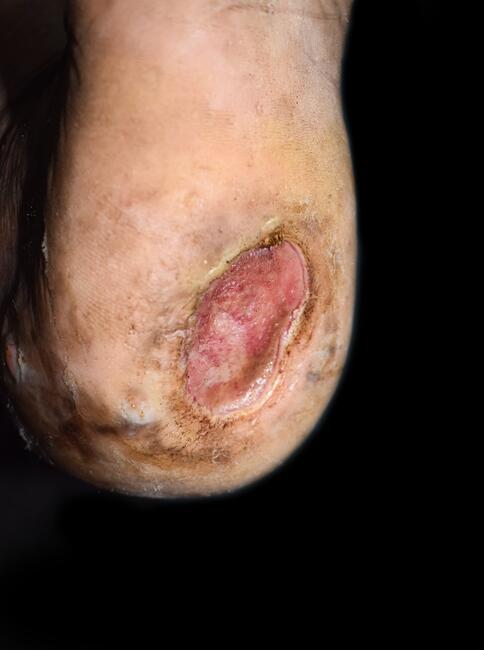
Timothy Miller, DPM: —of what it entails these patients, when you are performing limb salvage on them, it is limb salvage for life and they may come to you with an ulcer and you help heal that ulcer, but you're not out of the woods. It is now the preventative care and that management of those areas along with their comorbidities to prevent that ulcer coming back. These are lifelong patients. And unfortunately, more often than not, I mean, I'm sure we've all seen the study by Dr. Armstrong that if patients have an ulceration on one foot, they are a higher chance of getting ulcerations on other parts of their body. So you may heal the left foot submit fifth, but all of a sudden now they have a right calcaneal wound that they're dealing with. So that's why it's so important that you are speaking with these patients on a regular basis, seeing them every month, month and a half, whatever your protocol is and making sure that you are employing and obtaining those protective offloading devices that these patients need, supportive shoes, bracing, orthotics, whatever you deem necessary, it's something that is important.
And that's where my next speed dial person is my orthotist who I work with to help make braces and help make offloading shoes and inserts because that's just as important. The preventative care to me is almost even more important than when you heal these patients because if they heal it, you get that submet one ulcer healed and the last thing you want to see on your schedule is two weeks later that patient's name coming up and that appointment line saying wound has returned. That's when your heart sinks, that's when you start to feel like you fail the patient, but that's where it's so important that the offloading devices that can be provided are really employed and really modified as things progress over time.
Jennifer Spector, DPM: Absolutely. And as we've heard today, success in limb salvage isn't just about the technical skill, it's about coordination, persistence, and understanding about the longitudinal nature of that care. Identifying where breakdowns occur and addressing them proactively can really make a meaningful difference in patient outcomes. Dr. Miller, thank you again for sharing your perspective and for the work that you're doing to support both patients and the broader podiatric community.
Timothy Miller, DPM: It is my absolute pleasure, Dr. Spector. I thoroughly enjoy it and I appreciate all what you do for our profession and what you do for patient care. Keep going. Don't stop.
Jennifer Spector, DPM: Well, we will keep going and we want to thank our audience too for tuning in today. Be sure to subscribe for future episodes and don't forget to share this conversation with colleagues who might be navigating these same challenges in practice. We'll see you next time.
© 2026 HMP Global. All Rights Reserved.
Any views and opinions expressed are those of the author(s) and/or participants and do not necessarily reflect the views, policy, or position of Podiatry Today or HMP Global, their employees, and affiliates.