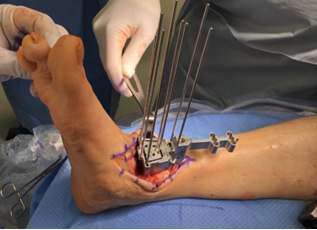
Total Ankle Arthroplasty: Component Sizing and Implant Survivorship
In a retrospective study of 173 total ankle arthroplasties, talar component downsizing was not significantly associated with revision risk. The researchers also examined whether polyethylene thickness and preoperative coronal alignment were associated with subsequent outcomes.
Key Takeaways
-
Talar components were downsized in 115 of 173 ankles (66.5%), with no statistically significant association between downsizing and revision.
-
Polyethylene components measuring 7 mm or less were associated with more reoperations than components measuring at least 8 mm, but only 12 ankles were in the thinner-component group.
-
Implant survivorship was 86.9% at a mean follow-up of 4.1 years; the retrospective findings do not establish that a sizing choice caused a difference in outcomes.
How talar component size and polyethylene thickness relate to total ankle arthroplasty (TAA) longevity remains uncertain. Schwab and colleagues examined these questions in a level III retrospective cohort study of 173 TAA procedures.1 They recorded talar downsizing status, tibial and talar component sizes, initial polyethylene thickness, and comorbidities. Their outcomes included revision or polyethylene exchange; they also assessed the relationship between polyethylene thickness and preoperative tibiotalar angle.1
Surgeons used a downsized talar component in 115 ankles (66.5%). Although the downsized group had a lower estimated likelihood of revision, the difference was not statistically significant (odds ratio [OR], 0.66; P = .36). The study therefore did not demonstrate a survivorship benefit from talar downsizing. The authors note that potential biomechanical advantages, including effects on edge loading and alignment, still require investigation to determine whether they improve clinical outcomes.1
The polyethylene finding warrants attention, with an important qualification. Among the 12 ankles with a component measuring 7 mm or less, the reported reoperation rate was 33.3%, compared with 19.3% for components measuring at least 8 mm (reported OR, 3.05; P = .04). This was an association in a small subgroup, rather than evidence that polyethylene thickness itself caused the difference. The abstract reports this result as reoperation, so it should not be presented as a difference in revision rates specifically.1
Mean preoperative coronal alignment was 0.98° valgus, with no observed correlation between deformity and polyethylene thickness (r = −0.01; P = .90). Hindfoot fusion was also not significantly associated with revision risk (P = .07). Overall implant survivorship was 86.9% at a mean clinical follow-up of 4.1 years.1 For podiatric surgeons, the study adds outcome data to component-sizing decisions while leaving the proposed benefit of talar downsizing unresolved.
Reference
-
Schwab A, Cook H, Ramdass R, Nowak J, Strand G. Association of Component Sizing on Total Ankle Arthroplasty Survivorship. J Foot Ankle Surg. 2026 Sep 12:S1067-2516(26)00305-4. doi: 10.1053/j.jfas.2026.09.005. Epub ahead of print. PMID: 42731751.
© 2026 HMP Global. All Rights Reserved.
Any views and opinions expressed are those of the author(s) and/or participants and do not necessarily reflect the views, policy, or position of Podiatry Today or HMP Global, their employees, and affiliates.