Total Ankle Arthroplasty With Concomitant Reconstruction: When to Choose Single-Stage vs Staged Surgery
This review examines when single-stage reconstruction may offer an efficient approach—and when deformity severity, rehabilitation demands, or surgical risk make staged reconstruction the better strategy.
Key Takeaways
- Patient and deformity characteristics should drive surgical sequencing. Single-stage reconstruction is generally well suited to mild-to-moderate, flexible deformity and adjunctive procedures compatible with early mobilization, whereas severe or rigid deformity and more complex reconstruction may favor staging.
- Postoperative rehabilitation is a critical consideration. Procedures requiring prolonged immobilization—such as hindfoot fusion, multiple midfoot arthrodeses, or supramalleolar osteotomy—can conflict with the early ankle motion desired after TAA, making staged reconstruction advantageous in selected patients.
- Staging may reduce risk in particularly complex cases. Evidence highlighted in the review suggests that simultaneous TAA and hindfoot arthrodesis can carry higher rates of reoperation, infection, and wound complications, supporting staged correction when hindfoot fusion is required.
Total ankle arthroplasty (TAA) has become an increasingly accepted treatment for end-stage ankle arthritis over the past 2 decades.1 Improvements in implant design, instrumentation, preoperative planning, and surgical technique have expanded the indications for TAA, allowing surgeons to offer a reliable alternative to ankle arthrodesis that provides durable pain relief while preserving ankle motion.2
Despite these advances, successful TAA requires more than accurate positioning of the prosthetic components. Many patients present with concomitant deformity involving the ankle, hindfoot, midfoot, and/or forefoot, while proximal deformities involving the tibia, knee, or hip may also contribute to abnormal limb mechanics and persistent symptoms. If surgeons do not recognize and appropriately address these abnormalities, residual malalignment, ligamentous insufficiency, or soft tissue imbalance may result in eccentric polyethylene wear, edge loading, osteolysis, component loosening, and premature implant failure.3,4
Correction of concomitant deformity frequently requires adjunctive procedures, including forefoot and hindfoot osteotomies, ligament reconstruction, tendon balancing, and selective arthrodesis.5-6 Once a surgeon identifies the necessary additional procedures, an important surgical decision is whether to perform them simultaneously with TAA or separated into 2 or more operations. Single-stage reconstruction offers the potential advantages of 1 anesthetic exposure, a single rehabilitation period, lower cumulative cost, and earlier return to function. Conversely, staged reconstruction may allow for gradual deformity correction, optimization of the soft tissue envelope, separation of competing postoperative rehabilitation protocols, and reduction of technical complexity in selected patients.7
The purpose of this review is to examine the considerations involved in single-stage and staged reconstruction during TAA and to provide a practical framework for selecting the appropriate strategy based on deformity characteristics, patient factors, anticipated rehabilitation demands, and surgical complexity.
Principles of Surgical Planning
The decision to perform concomitant reconstruction during TAA begins with a comprehensive evaluation of the entire lower extremity. The surgeon should determine whether deformity is intra-articular or extra-articular and identify the location of the center of rotation of angulation (CORA) when applicable. Proximal deformities involving the hip, knee, or tibia may alter the mechanical axis and should be evaluated before undertaking isolated ankle reconstruction. Similarly, deformity of the hindfoot, midfoot, or forefoot may compromise the position and function of the ankle prosthesis if the foot cannot provide a stable, plantigrade foundation. In our observation, the general principle of working proximal-to-distal in foot and ankle deformity correction would be over benefit more broadly applied to the entire lower extremity. Addressing proximal deformity first helps ensure distal deformity is corrected within the proper mechanical axis, thereby potentially contributing to optimizing long-term outcomes.
Weight-bearing radiographs remain the foundation of preoperative evaluation. Computed tomography (CT), particularly weight-bearing CT when available, can provide additional information regarding 3-dimensional deformity, bone loss, cystic changes, adjacent joint pathology, and the relationship between the ankle and hindfoot. Patient-specific instrumentation, custom implants, and other advanced planning technologies may further assist with correction in selected complex cases.8
Preoperative planning should also account for the soft tissue envelope and the anticipated postoperative rehabilitation requirements of each procedure. The surgeon must consider ligamentous stability, tendon balance, skin and soft tissue quality, bone stock, patient comorbidities, and the expected duration of non-weight-bearing or immobilization associated with the planned reconstruction. The experience and comfort of the surgical team with the proposed procedures are also considerations.
The ultimate goal is to restore a stable, plantigrade, and biomechanically balanced extremity while optimizing the position and function of the ankle prosthesis. Whether one best achieves this objective through a single operation or a staged reconstruction depends on the interaction between the deformity, the required adjunctive procedures, the patient's biology and rehabilitation needs, and the surgeon's ability to safely and predictably perform the reconstruction.
Single-Stage Reconstruction
For many patients undergoing TAA, simultaneous correction of concomitant deformity provides an efficient and effective treatment strategy. The primary advantages of a single-stage approach include a single anesthetic exposure, one recovery period, reduced cumulative time away from work and daily activities, and avoidance of the physiologic and psychological burden of multiple operations. Given that TAA patients are often younger and in their working years compared to patients undergoing hip or knee arthroplasty, avoiding 2 separate episodes of disability may carry meaningful socioeconomic benefits. Our group previously demonstrated that the mean return to manual labor is over 3 months after ankle arthroplasty, regardless of concomitant procedures.10
Patient Selection. Patients with mild-to-moderate, flexible deformities are particularly well suited for simultaneous reconstruction. Common adjunctive procedures performed safely during primary TAA include lateral ligament reconstruction, gastrocnemius recession, medializing calcaneal osteotomy, Cotton osteotomy, first tarsometatarsal or first metatarsophalangeal arthrodesis, and forefoot reconstruction including Weil osteotomies and hammertoe correction.7 Straightforward revision TAA without extensive bone loss may also be considered in experienced centers.
Beyond logistical considerations, multiple operations impose a significant psychological burden. Anxiety and depression have been shown to increase while patients await surgery and improve only following definitive treatment.10 Factors that increase vulnerability to poorer outcomes include pre-existing psychiatric history, inability to work during recovery periods, low social support, financial insecurity, and older age with comorbidities.11 When specifically examining psychological factors in ankle surgery, patients with higher preoperative anxiety and depression scores had significantly worse clinical outcomes and higher complication rates after both TAA and ankle arthrodesis, regardless of surgical technique.12 While surgeons often focus on technical aspects of reconstruction, minimizing repeated surgical episodes may represent an important yet underappreciated benefit of simultaneous correction.
Intraoperative Considerations. From a technical standpoint, single-stage reconstruction allows deformity correction to take place around the definitive prosthesis.6 Trial components permit real-time assessment of coronal and sagittal alignment, while ligament balancing and osteotomies can be adjusted according to implant position. This dynamic assessment may improve overall limb alignment while avoiding the uncertainty of reconstructing the foot and ankle in the absence of the final prosthesis.
Several studies support the safety of this approach. Simultaneous ancillary procedures performed using contemporary techniques, including patient-specific instrumentation, have demonstrated maintenance of postoperative implant congruity without increased short-term complication rates compared with isolated TAA.8 Similarly, adjunctive procedures performed through separate incisions have not been associated with higher rates of wound complications when meticulous soft tissue handling is employed.13
Single-stage reconstruction also offers practical intraoperative advantages. Deformity correction is performed before scar formation develops, avoiding the challenges of reoperating through previously dissected tissue planes. The operating surgeon remains familiar with the deformity throughout the procedure, eliminating the need to reassess a complex reconstruction months later. In experienced hands, multiple surgical teams or assistants may perform portions of the reconstruction simultaneously, improving operative efficiency and reducing cumulative operating room utilization.14
Nevertheless, simultaneous reconstruction is not appropriate for every patient. Increasing operative time, greater physiologic stress, additional surgical exposures, and surgeon fatigue may contribute to higher rates of wound complications in more extensive reconstructions.15 As deformity severity increases, the complexity of balancing osseous correction, soft tissue tension, and implant positioning rises considerably. Successful single-stage reconstruction therefore depends not only on patient selection but also on surgeon experience, operative efficiency, and thoughtful preoperative planning.
Staged Reconstruction
Although many deformities can be addressed successfully during TAA, staged reconstruction remains an important strategy for selected patients. Rather than representing a failure of surgical planning, staging may reduce overall risk by allowing gradual correction, optimizing the soft tissue envelope, and separating procedures with competing rehabilitation goals.
Deformity Severity. Historically, coronal plane deformity exceeding 10-15° was considered a relative contraindication to TAA. Contemporary surgical techniques have expanded these indications considerably, with surgeons now taking on deformities >20° when appropriate adjunctive procedures are performed without significant increases in complication rates.16-17 Nevertheless, severe valgus deformities remain particularly challenging because of associated ligament insufficiency, peritalar instability, and the often flexible nature of progressive collapsing foot deformity.
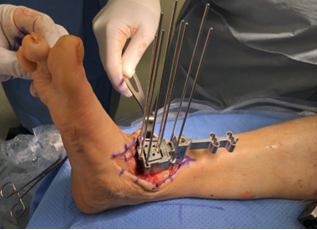
As deformity severity increases, the likelihood of requiring supramalleolar osteotomy, hindfoot fusion, midfoot or forefoot reconstruction, tendon balancing, or extensive ligament reconstruction also increases. Careful identification of the CORA and determination of whether deformity is intra-articular or extra-articular should guide operative planning. In select patients, temporary pinning of the ankle in neutral alignment or intra-articular placement of a cement spacer can maintain alignment while allowing soft tissue balancing or foot reconstruction before definitive arthroplasty.18
Extra-articular deformities involving the tibia, limb length discrepancy, or proximal malalignment frequently require staged correction, as these abnormalities cannot be reliably corrected through periarticular procedures performed during TAA alone. Day and colleagues reported on 8 patients who underwent staged limb deformity correction via circular frame or intramedullary nail followed by TAA, with significant improvements across all Patient Reported Outcomes Measurement Information System (PROMIS) and Limb Deformity – Modified Scoliosis Research Society (LD-SRS) domains and minimal complications.19 These proximal deformities cannot be adequately addressed through periarticular procedures alone and require correction before prosthesis implantation. Moreover, Steele and colleagues found 96% union rates of concomitant fibula and/or tibia osteotomies at the time of TAA.20
Competing Rehabilitation Protocols. One of the most important yet often overlooked considerations when deciding whether to stage reconstruction is the conflict between postoperative rehabilitation protocols. Although TAA is primarily a pain-relieving procedure, preservation of motion remains one of its principal advantages over ankle arthrodesis. Early ankle mobilization following incision healing is critical to minimize capsular adhesions, fibrosis, and postoperative stiffness. Consequently, many surgeons aim to initiate range-of-motion exercises and progressive weight-bearing as early as safely possible.21
In contrast, hindfoot fusion, multiple midfoot arthrodeses, supramalleolar osteotomy, and certain tendon or ligamentous reconstructions often require prolonged periods of protected immobilization or non-weight-bearing to maximize union rates. Combining these procedures with TAA forces the surgeon to choose between protecting the reconstruction and optimizing ankle motion. When prolonged immobilization is anticipated, staging adjunctive procedures before TAA can provide superior conditions for both bony healing and subsequent rehabilitation.
Risk Management. Staged reconstruction also plays an important role in risk mitigation. Patients with suspected or confirmed infection should undergo eradication of infection before prosthesis implantation whenever possible.22 Likewise, substantial retained hardware, extensive tibial or talar cysts requiring structural bone grafting, avascular necrosis, compromised soft tissues, or severe bone loss may be more safely managed through sequential procedures.
Gradual deformity correction may also reduce soft tissue tension, improve wound healing, and facilitate more predictable implant positioning in severe deformity. Although staging exposes patients to repeated anesthesia, additional surgical recovery, increased cost, and the risks inherent to multiple procedures (thromboembolism, infection, bone demineralization, and patient fatigue), some surgeons may feel that these disadvantages may be outweighed by the reduced technical complexity and improved biological environment achieved before definitive TAA.
Current evidence particularly supports staged reconstruction when hindfoot arthrodesis is required. Simultaneous TAA and hindfoot arthrodesis carried significantly higher rates of reoperation (13.8% vs. 5.2%, P < .001), infection (12.6% vs. 5.9%, P = .011), wound complications, and emergency department visits compared to matched controls, whereas patients with prior staged arthrodesis showed no increased risk relative to controls (reoperation 5.1% vs. 4.7%, P = .787).23 Teehan and team confirmed that TAR with ipsilateral hindfoot fusion was associated with a higher revision rate (10.2% vs. 2.6%, P = .038) and worse absolute PROMIS scores, though rates of achieving meaningful clinical improvement (MCID) were largely similar between groups.24 These findings suggest that the combination of hindfoot fusion and TAR may overwhelm the soft tissue envelope and healing capacity of the ankle, making staged correction preferable for this specific subset.
Practical Decision-Making
The decision between simultaneous and staged reconstruction should not be dictated solely by the number of adjunctive procedures required. Rather, it should incorporate deformity severity, anticipated rehabilitation, soft tissue quality, patient medical comorbidities, surgeon experience, and procedural complexity.
Single-stage reconstruction is generally favored for primary or straightforward revision TAA with mild-to-moderate, flexible deformity and adjunctive procedures compatible with early mobilization, such as lateral ankle ligament stabilization, deltoid release, gastrocnemius recession, calcaneal osteotomy, midfoot osteotomy (Cotton), and forefoot osteotomies.
Conversely, staged reconstruction is strongly considered for severe or rigid deformity, extra-articular tibial malalignment, progressive collapsing foot deformity requiring extensive correction, hindfoot arthrodesis, infection, significant retained hardware, large talar cysts requiring structural grafting, avascular necrosis, or any reconstruction expected to require prolonged postoperative immobilization.
Concluding Thoughts
Neither simultaneous nor staged reconstruction is universally superior. Rather, each represents an important tool within the reconstructive armamentarium of the foot and ankle surgeon. Evidence supports excellent outcomes with single-stage correction for many periarticular osteotomies and soft tissue balancing procedures while highlighting specific scenarios, particularly hindfoot arthrodesis, extra-articular deformity correction, and complex revision in which staging may reduce complications and optimize outcomes.
Ultimately, successful TAA depends less on the number of operations performed than on meticulous preoperative planning, restoration of a stable plantigrade extremity, preservation of the soft tissue envelope, and thoughtful sequencing of reconstructive procedures. An individualized approach that balances deformity severity, biological healing, rehabilitation demands, and surgeon expertise remains the cornerstone of achieving durable implant survivorship and improved patient function.
Michael J. Radcliffe, DPM, AACFAS is a fellowship-trained foot and ankle surgeon in Houston, TX.
Ramez Sakkab, DPM, AACFAS is a fellowship-trained foot and ankle surgeon in Sacramento, CA.
The authors have no non-financial or commercial, proprietary, or financial interest in the products or companies described in the manuscript. The author(s) did not receive grants or a consultant honorarium to conduct the study, write the manuscript or otherwise assist in the development of the above-mentioned manuscript. They disclose the use of artificial intelligence only for grammatical editing of the submitted manuscript.
References
1. Karzon AL, Kadakia RJ, Coleman MM, Bariteau JT, Labib SA. The rise of total ankle arthroplasty use: a database analysis describing case volumes and incidence trends in the United States between 2009 and 2019. Foot Ankle Int. 2022;43(11):1501-10.
2. Li T, Zhao L, Liu Y, et al.. Total ankle replacement versus ankle fusion for end-stage ankle arthritis: A meta-analysis. J Orthop Surg. 2024;32(1):10225536241244825.
3. Lee GW, Wang SH, Lee KB. Comparison of intermediate to long-term outcomes of total ankle arthroplasty in ankles with preoperative varus, valgus, and neutral alignment. J Bone Joint Surg Am. 2018;100(10):835-842. doi:10.2106/JBJS.17.00703.
4. Allport J, Ramaskandhan J, Alkhreisat M, Siddique MS. Patient-reported outcome measures and radiological outcomes in mobile-bearing total ankle arthroplasty with varus or valgus deformity. Foot Ankle Int. 2021;42(2):176-182. doi:10.1177/1071100720949852.
5. Lopez R, Herbel C, Shi GG, Haupt ET. Association of adjunctive procedures, patient demographics, or intraoperative factors and the risk of complications or reoperation following total ankle arthroplasty or ankle arthrodesis. Foot Ankle Orthop. 2025;10(2):24730114251329051.
6. Choi WJ, Kim BS, Lee JW. Preoperative planning and surgical technique: how do i balance my ankle? Foot Ankle Int. 2012;33(3):244-9. doi:10.3113/FAI.2012.0244.
7. Duelfer KA, McAlister JE. Appropriate staging techniques in total ankle reconstruction. Foot Ankle Surg Tech Reports Cases. 2023;3(1):100268.
8. Togher CJ, Golding SL, Ferrise TD, et al. Effects of patient-specific instrumentation and ancillary surgery performed in conjunction with total ankle implant arthroplasty: postoperative radiographic findings. J Foot Ankle Surg. 2022;61(4):739-747. doi:10.1053/j.jfas.2021.11.007.
9. Radcliffe MJ, Sakkab R, Trevare J, McAlister JE. Return to work after total ankle replacement. J Foot Ankle Surg. 2026;65(3):80.e1-80.e4. doi: 10.1053/j.jfas.2025.12.001. Epub 2025 Dec 8. PMID: 41371486.
10. Gagliardi AR, Yip CY, Irish J, et al. The psychological burden of waiting for procedures and patient‐centred strategies that could support the mental health of wait‐listed patients and caregivers during the COVID‐19 pandemic: A scoping review. Health Expectations. 2021;24(3):978-90.
11. Davison R, Daniel JP, Idarraga AJ, et al. Depression following operative treatments for Achilles ruptures and ankle fractures. Foot Ankle Int. 2021;42(12):1579-83.
© 2026 HMP Global. All Rights Reserved.
Any views and opinions expressed are those of the author(s) and/or participants and do not necessarily reflect the views, policy, or position of Podiatry Today or HMP Global, their employees, and affiliates.