Predictable Cost of Care Working Group Highlights AI-Driven Advances in Oncology Economic Modeling
Key Takeaways:
- At Clinical Pathways Congress (CPC) 2026, the Predictable Cost of Care (PCOC) Working Group shared progress from its third year of developing a standardized economic model to estimate treatment-related costs beyond drug acquisition.
- The working group explored artificial intelligence (AI) to simplify model implementation, allowing stakeholders to compare oncology regimens and examine individual cost components, including administration, adverse event management, and monitoring.
- Future priorities include establishing governance and data maintenance processes, expanding access to the model, and evaluating opportunities to compare predicted treatment costs with real-world expenditures.
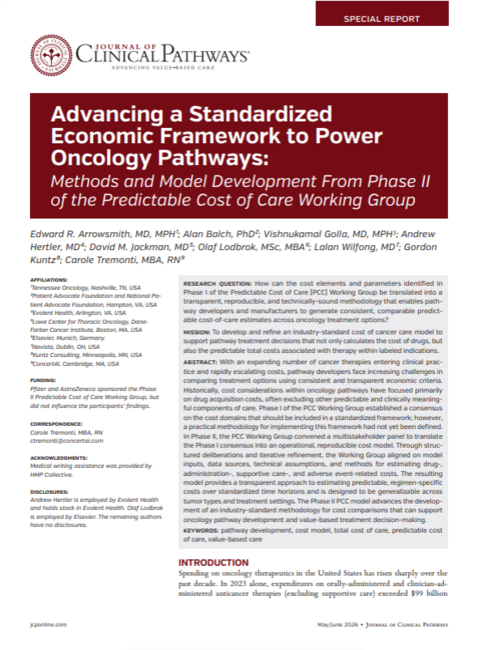
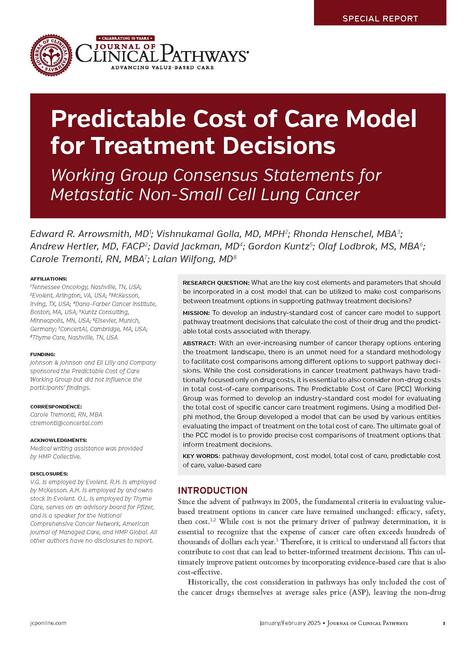
The Predictable Cost of Care (PCOC) Working Group presented updates on its efforts to develop a standardized approach to estimating oncology treatment costs at Clinical Pathways Congress (CPC) 2026, highlighting advancements in model usability, artificial intelligence (AI) integration, and potential applications for clinical pathway decision-making.
During the session, Gordon Kuntz, president of Kuntz Consulting, and Carole Tremonti, RN, MBA, vice president of CancerLinQ at ConcertAI, discussed the working group's progress over 3 years and outlined plans to make its economic model more accessible to oncology stakeholders.
Developing a Standardized Approach to Treatment Costs
The PCOC Working Group was established to address limitations in traditional approaches to evaluating the financial implications of oncology treatments.
Although clinical pathway committees routinely consider efficacy, safety, and cost when prioritizing treatment regimens, drug acquisition costs alone do not capture the broader financial burden associated with delivering care.
The working group brought together clinicians, payers, pathway developers, pharmaceutical manufacturers, and patient representatives to develop a standardized model that incorporates predictable treatment-related expenditures.
During its first year, the group focused on defining which costs should be included.
Rather than attempting to estimate the total cost of care retrospectively, the model was designed to predict costs associated with a specific treatment regimen before therapy begins.
These estimates include drug acquisition, administration, and adverse event management while excluding unrelated medical events and diagnostic workup costs.
In its second year, the group developed the model's structure and identified publicly available data sources, including Medicare payment information, to support consistent cost calculations.
Particular attention was given to grade 3 and 4 adverse events, which frequently require medical management and can contribute substantially to treatment-related expenditures.
AI Integration Improves Model Accessibility
During the third year, the working group shifted its focus toward testing the model in clinical practice and improving usability.
Initial feedback from pathway developers and clinicians indicated that manually completing the model was time-consuming and difficult for users unfamiliar with its structure.
To address these challenges, Tremonti explored using Claude, an AI tool, to simplify model implementation and generate economic comparisons.
The AI-supported approach produced cost analyses within minutes and allowed users to modify assumptions, ask follow-up questions, and explore alternative treatment scenarios.
The tool also separated individual cost components, enabling stakeholders to better understand differences between regimens rather than relying exclusively on a single total cost estimate.
The model was shared with clinicians and pathway developers for evaluation, including representatives from Evolent and Dana-Farber Cancer Institute.
According to the presenters, feedback suggested that AI-supported analysis could make the model more practical for use during pathway committee discussions.
Expanding Applications Across Oncology Stakeholders
The working group initially envisioned pharmaceutical manufacturers completing the economic model and submitting standardized reports for use by pathway developers and other stakeholders.
However, AI integration introduced opportunities for users to conduct analyses independently.
Potential users include oncology practices, pathway committees, payers, self-funded employers, and pharmaceutical manufacturers.
The model can compare multiple treatment regimens and display differences in drug acquisition, administration, adverse event management, follow-up care, and other predictable expenditures.
Kuntz emphasized that the model is intended to complement, rather than replace, established pathway decision-making processes.
Clinical efficacy, safety, and patient preferences remain central considerations when evaluating treatment options.
However, when regimens have comparable clinical profiles, additional economic information may help stakeholders understand differences in expected treatment-related spending.
The presenters also noted that pharmaceutical manufacturers may use the model internally to evaluate the economic implications of their therapies and indications.
Drug Acquisition Costs Remain a Major Economic Driver
Another important finding from the working group's testing involved the relative contribution of drug acquisition costs to overall treatment expenditures.
Earlier discussions had suggested that medications might account for approximately 60% of treatment costs, with the remaining expenditures attributable to services such as testing, imaging, administration, and adverse event management.
However, the regimens evaluated during model testing demonstrated that drug acquisition could represent a larger proportion of spending than initially anticipated.
Kuntz noted that oncology practices have made considerable progress in reducing avoidable hospitalizations, unnecessary testing, and other potentially preventable expenditures.
Nevertheless, practices have limited control over drug acquisition prices, particularly as increasingly specialized and high-cost therapies enter clinical practice.
The model may help stakeholders identify which components contribute substantially to overall treatment costs and distinguish expenditures that may be influenced by care delivery improvements from those driven primarily by medication pricing.
Future Priorities Include Real-World Validation and Governance
Looking ahead, the working group plans to explore opportunities to compare predicted treatment costs with actual expenditures observed in routine clinical practice.
Such comparisons could help identify differences between clinical trial-based estimates and real-world outcomes, including variation associated with patient characteristics, comorbidities, and treatment delivery.
The group also intends to establish governance and maintenance processes to ensure that model inputs remain current and consistent.
Potential priorities include annual reviews of underlying cost data and scheduled updates incorporating Medicare fee schedules and average sales price information.
The presenters emphasized that consistent data updates would allow stakeholders to compare analyses using standardized assumptions.
Additional efforts will focus on making the model more broadly accessible.
The working group has explored potential applications with the National Comprehensive Cancer Network and is considering opportunities to integrate the model into existing oncology data platforms.
Tremonti also described preliminary discussions with product, engineering, and data science teams about potentially making the model available through CancerLinQ.
These possibilities remain under evaluation, and no formal implementation plans were announced.
Implications for Oncology Clinical Pathways
The PCOC Working Group's progress highlights the growing importance of incorporating comprehensive economic evidence into oncology clinical pathway development.
By estimating predictable costs beyond drug acquisition and presenting those costs in a standardized format, the model could provide pathway committees with additional information to support treatment prioritization.
AI-supported implementation may also reduce the operational burden associated with economic modeling, potentially expanding access to organizations without dedicated health economics resources.
However, continued validation, transparent assumptions, and regular data updates will be necessary to support reliable implementation.
As the working group advances toward broader deployment, its efforts may help establish a more consistent framework for evaluating the economic implications of oncology treatment decisions.
Conclusion
At CPC 2026, the PCOC Working Group demonstrated progress toward a more accessible and standardized approach to estimating oncology treatment-related costs.
The integration of AI, expanded stakeholder testing, and plans for real-world validation represent important developments in the group's efforts to support more informed clinical pathway decisions.
Future work will focus on refining the model, maintaining its underlying data, and identifying opportunities for broader implementation across oncology care settings.
Reference
Kuntz G, Tremonti C. Predictable Cost of Care Working Group. Session presented at: Clinical Pathways Congress; 2026; Boston, MA.