A shortened 10-day venetoclax regimen combined with decitabine delivers comparable remission rates with fewer infections in older patients with newly diagnosed acute myeloid leukemia (AML).
A shortened 10-day venetoclax regimen combined with decitabine delivers comparable remission rates with fewer infections in older patients with newly diagnosed acute myeloid leukemia (AML).
A fractionated schedule of gemtuzumab ozogamicin resulted in improved overall survival and a greater reduction in measurable residual disease among older patients with acute myeloid leukemia, compared to single-dose gemtuzumab ozogamicin.
A fractionated schedule of gemtuzumab ozogamicin resulted in improved overall survival and a greater reduction in measurable residual disease among older patients with acute myeloid leukemia, compared to single-dose gemtuzumab ozogamicin.
Amer Zeidan, MD, discusses gaps in the current treatment options for patients with MDS and the methods he uses to treat this patient population, particularly those who are not eligible for bone marrow transplants and are higher risk.
Amer Zeidan, MD, discusses gaps in the current treatment options for patients with MDS and the methods he uses to treat this patient population, particularly those who are not eligible for bone marrow transplants and are higher risk.
Jan Bewersdorf, MD, discusses study findings suggesting that liposomal cytarabine-daunorubicin may not be a cost-effective for the treatment of older patients with AML under current pricing.
Jan Bewersdorf, MD, discusses study findings suggesting that liposomal cytarabine-daunorubicin may not be a cost-effective for the treatment of older patients with AML under current pricing.
True or False: Integrated palliative and oncology care for patients with acute myeloid leukemia improves quality of life, psychological stress, and end of life care.
True or False: Integrated palliative and oncology care for patients with acute myeloid leukemia improves quality of life, psychological stress, and end of life care.
True or False: First-line enasidenib demonstrates worse efficacy in the real-world setting than in clinical trials for the treatment of relapsed/refractory IDH2-mutated AML.
True or False: First-line enasidenib demonstrates worse efficacy in the real-world setting than in clinical trials for the treatment of relapsed/refractory IDH2-mutated AML.
Amer Zeidan, MBBS, MHS, discusses results from a retrospective study examining FLT3 testing trends, treatment patterns, and overall survival in relapsed/refractory AML.
Amer Zeidan, MBBS, MHS, discusses results from a retrospective study examining FLT3 testing trends, treatment patterns, and overall survival in relapsed/refractory AML.
Integrated palliative and oncology care for patients with AML improves QoL, psychological stress, and end-of-life care, and researchers recommend it as a new standard of care.
Integrated palliative and oncology care for patients with AML improves QoL, psychological stress, and end-of-life care, and researchers recommend it as a new standard of care.
Andrew Klink, PhD, MPH, discusses results from a real-world cohort study confirming the effectiveness of enasidenib for relapsed/refractory AML outside the trial setting.
Andrew Klink, PhD, MPH, discusses results from a real-world cohort study confirming the effectiveness of enasidenib for relapsed/refractory AML outside the trial setting.
Amer Zeidan, MD, discusses gaps in the current treatment options for patients with MDS and the methods he uses to treat this patient population, particularly those who are not eligible for bone marrow transplants and are higher risk.
Amer Zeidan, MD, discusses gaps in the current treatment options for patients with MDS and the methods he uses to treat this patient population, particularly those who are not eligible for bone marrow transplants and are higher risk.
Jan Bewersdorf, MD, discusses study findings suggesting that liposomal cytarabine-daunorubicin may not be a cost-effective for the treatment of older patients with AML under current pricing.
Jan Bewersdorf, MD, discusses study findings suggesting that liposomal cytarabine-daunorubicin may not be a cost-effective for the treatment of older patients with AML under current pricing.
Amer Zeidan, MBBS, MHS, discusses results from a retrospective study examining FLT3 testing trends, treatment patterns, and overall survival in relapsed/refractory AML.
Amer Zeidan, MBBS, MHS, discusses results from a retrospective study examining FLT3 testing trends, treatment patterns, and overall survival in relapsed/refractory AML.
Andrew Klink, PhD, MPH, discusses results from a real-world cohort study confirming the effectiveness of enasidenib for relapsed/refractory AML outside the trial setting.
Andrew Klink, PhD, MPH, discusses results from a real-world cohort study confirming the effectiveness of enasidenib for relapsed/refractory AML outside the trial setting.
William J. Cardarelli, PharmD, is an experienced pharmacy administrator for more than 20 years, with a large breadth of experience in cost containment and resource allocation in the managed care arena. He has held...
William J. Cardarelli, PharmD, is an experienced pharmacy administrator for more than 20 years, with a large breadth of experience in cost containment and resource allocation in the managed care arena. He has held...
In this interview, Joe DePinto discusses the growing adoption of cell and gene therapy in oncology care, focusing on tools and challenges providers, payers, and policymakers should be aware of when working to expand utilization among cancer...
In this interview, Joe DePinto discusses the growing adoption of cell and gene therapy in oncology care, focusing on tools and challenges providers, payers, and policymakers should be aware of when working to expand utilization among cancer...
In this interview, Upal Basu Roy, PhD, MPH, discusses current challenges in treating non–small cell lung cancer (NSCLC) and explains how clinical pathways should evolve to focus on patient needs and experiences.
In this interview, Upal Basu Roy, PhD, MPH, discusses current challenges in treating non–small cell lung cancer (NSCLC) and explains how clinical pathways should evolve to focus on patient needs and experiences.
Rob Helton explores how intelligent medical records and integrated clinical decision support can streamline community oncology workflows, improve clinical pathway adherence, and reduce barriers to precision medicine.
Rob Helton explores how intelligent medical records and integrated clinical decision support can streamline community oncology workflows, improve clinical pathway adherence, and reduce barriers to precision medicine.
In this interview, Upal Basu Roy, PhD, MPH, discusses improvements in the treatment landscape of non–small cell lung cancer (NSCLC) as well as ongoing research aimed at further enhancing disease management.
In this interview, Upal Basu Roy, PhD, MPH, discusses improvements in the treatment landscape of non–small cell lung cancer (NSCLC) as well as ongoing research aimed at further enhancing disease management.
Gary L. Simmons, DO, MSHA, discusses Virginia Oncology Associates’ experience delivering CAR T-cell therapy in the community and how community-based programs can expand patient access while supporting safe delivery, care coordination, and...
Gary L. Simmons, DO, MSHA, discusses Virginia Oncology Associates’ experience delivering CAR T-cell therapy in the community and how community-based programs can expand patient access while supporting safe delivery, care coordination, and...
In this interview, Nikki Martin, MA, discusses the benefits of comprehensive biomarker testing for patients with newly diagnosed non–small cell lung cancer (NSCLC), explaining how it can streamline decision-making processes, improve clinical...
In this interview, Nikki Martin, MA, discusses the benefits of comprehensive biomarker testing for patients with newly diagnosed non–small cell lung cancer (NSCLC), explaining how it can streamline decision-making processes, improve clinical...
A guest expert discusses evolving approaches to managing treatment resistance in non-small cell lung cancer, barriers to equitable precision oncology, and emerging targeted therapies that may shape future treatment strategies.
A guest expert discusses evolving approaches to managing treatment resistance in non-small cell lung cancer, barriers to equitable precision oncology, and emerging targeted therapies that may shape future treatment strategies.
In this interview, Kelsey Pan, MD, MPH, discusses how biomarker testing and emerging targeted therapies are reshaping treatment selection, resistance management, and precision oncology in advanced non–small cell lung cancer (NSCLC).
In this interview, Kelsey Pan, MD, MPH, discusses how biomarker testing and emerging targeted therapies are reshaping treatment selection, resistance management, and precision oncology in advanced non–small cell lung cancer (NSCLC).
Clinical Pathways Congress 2026 will bring together oncology leaders to explore practical strategies for using technology to build smarter, more responsive clinical pathways that improve care delivery.
Clinical Pathways Congress 2026 will bring together oncology leaders to explore practical strategies for using technology to build smarter, more responsive clinical pathways that improve care delivery.
Paolo Strati, MD, discusses how findings from the ZUMA-14 trial could shape the future of dual-targeting CAR T-cell therapy, treatment sequencing, and minimal residual disease monitoring in relapsed or refractory large B-cell lymphoma.
Paolo Strati, MD, discusses how findings from the ZUMA-14 trial could shape the future of dual-targeting CAR T-cell therapy, treatment sequencing, and minimal residual disease monitoring in relapsed or refractory large B-cell lymphoma.
A shortened 10-day venetoclax regimen combined with decitabine delivers comparable remission rates with fewer infections in older patients with newly diagnosed acute myeloid leukemia (AML).
A shortened 10-day venetoclax regimen combined with decitabine delivers comparable remission rates with fewer infections in older patients with newly diagnosed acute myeloid leukemia (AML).
A fractionated schedule of gemtuzumab ozogamicin resulted in improved overall survival and a greater reduction in measurable residual disease among older patients with acute myeloid leukemia, compared to single-dose gemtuzumab ozogamicin.
A fractionated schedule of gemtuzumab ozogamicin resulted in improved overall survival and a greater reduction in measurable residual disease among older patients with acute myeloid leukemia, compared to single-dose gemtuzumab ozogamicin.
Integrated palliative and oncology care for patients with AML improves QoL, psychological stress, and end-of-life care, and researchers recommend it as a new standard of care.
Integrated palliative and oncology care for patients with AML improves QoL, psychological stress, and end-of-life care, and researchers recommend it as a new standard of care.
Results from a real-world study confirm the effectiveness of first-line enasidenib therapy for patients with relapsed/refractory IDH2-mutated AML outside of the trial setting.
Results from a real-world study confirm the effectiveness of first-line enasidenib therapy for patients with relapsed/refractory IDH2-mutated AML outside of the trial setting.
A nationwide study found that insurance restrictions and high out-of-pocket costs prevent many patients with blood cancers from filling prescribed oral anticancer medications, even after insurer approval.
A nationwide study found that insurance restrictions and high out-of-pocket costs prevent many patients with blood cancers from filling prescribed oral anticancer medications, even after insurer approval.
In the Enhancing Oncology Model (EOM) Lung Patient Pilot program, nurse outreach was associated with reduced emergency care utilization and health care spending among patients with metastatic lung cancer.
In the Enhancing Oncology Model (EOM) Lung Patient Pilot program, nurse outreach was associated with reduced emergency care utilization and health care spending among patients with metastatic lung cancer.
Protocol 2 of the MYLUNG study found that improvements in biomarker testing rates increased rates of targeted first-line therapies among patients with metastatic non–small cell lung cancer (mNSCLC), illustrating how biomarker testing can...
Protocol 2 of the MYLUNG study found that improvements in biomarker testing rates increased rates of targeted first-line therapies among patients with metastatic non–small cell lung cancer (mNSCLC), illustrating how biomarker testing can...
A study found that comprehensive molecular profiling was associated with improved survival and reduced health care utilization among patients with non–small cell lung cancer (NSCLC), yet fewer than 1 in 15 patients underwent testing.
A study found that comprehensive molecular profiling was associated with improved survival and reduced health care utilization among patients with non–small cell lung cancer (NSCLC), yet fewer than 1 in 15 patients underwent testing.
At the National Comprehensive Cancer Network 2026 Annual Congress: Hematologic Malignancies, panelists discussed innovations in treating relapsed or refractory multiple myeloma and strategies to improve disease management.
At the National Comprehensive Cancer Network 2026 Annual Congress: Hematologic Malignancies, panelists discussed innovations in treating relapsed or refractory multiple myeloma and strategies to improve disease management.
Jenna Moran, MSN, FNP-BC, outlined strategies for managing tyrosine kinase inhibitor–related toxicities in patients with chronic myeloid leukemia during a session at the National Comprehensive Cancer Network 2026 Annual Congress.
Jenna Moran, MSN, FNP-BC, outlined strategies for managing tyrosine kinase inhibitor–related toxicities in patients with chronic myeloid leukemia during a session at the National Comprehensive Cancer Network 2026 Annual Congress.
At the National Comprehensive Cancer Network 2026 Annual Congress: Hematologic Malignancies, Vivian G. Oehler, MD, shared insights on de-escalating tyrosine kinase inhibitor (TKI) therapy among patients with chronic myeloid leukemia (CML)...
At the National Comprehensive Cancer Network 2026 Annual Congress: Hematologic Malignancies, Vivian G. Oehler, MD, shared insights on de-escalating tyrosine kinase inhibitor (TKI) therapy among patients with chronic myeloid leukemia (CML)...
Researchers found that the presence of anemia is likely to increase the risk of mortality and acute myeloid leukemia (AML) transformation among patients with myelofibrosis, indicating anemia as a potential prognostic marker.
Researchers found that the presence of anemia is likely to increase the risk of mortality and acute myeloid leukemia (AML) transformation among patients with myelofibrosis, indicating anemia as a potential prognostic marker.
Researchers found that providing financial assistance for cancer patients with unmet social needs was associated with improvements in radiotherapy completion, indicating a potential strategy to promote health equity and reduce care gaps.
Researchers found that providing financial assistance for cancer patients with unmet social needs was associated with improvements in radiotherapy completion, indicating a potential strategy to promote health equity and reduce care gaps.
Researchers found that testing for molecular biomarkers in patients with endometrial cancer is associated with prolonged survival and lower incremental costs than no testing, illustrating the importance of molecular classification in...
Researchers found that testing for molecular biomarkers in patients with endometrial cancer is associated with prolonged survival and lower incremental costs than no testing, illustrating the importance of molecular classification in...
True or False: Integrated palliative and oncology care for patients with acute myeloid leukemia improves quality of life, psychological stress, and end of life care.
True or False: Integrated palliative and oncology care for patients with acute myeloid leukemia improves quality of life, psychological stress, and end of life care.
True or False: First-line enasidenib demonstrates worse efficacy in the real-world setting than in clinical trials for the treatment of relapsed/refractory IDH2-mutated AML.
True or False: First-line enasidenib demonstrates worse efficacy in the real-world setting than in clinical trials for the treatment of relapsed/refractory IDH2-mutated AML.
True or False: The Rural Health Transformation Program, announced by CMS under the Working Families Tax Cuts Act, will allocate $50 billion beginning in fiscal year 2026, with funding distributed evenly across all states regardless of...
True or False: The Rural Health Transformation Program, announced by CMS under the Working Families Tax Cuts Act, will allocate $50 billion beginning in fiscal year 2026, with funding distributed evenly across all states regardless of...
The National Comprehensive Cancer Network (NCCN) Guidelines Navigator is a new interactive digital platform that delivers evidence-based oncology recommendations and is currently available for all 88 NCCN guideline sets.
The National Comprehensive Cancer Network (NCCN) Guidelines Navigator is a new interactive digital platform that delivers evidence-based oncology recommendations and is currently available for all 88 NCCN guideline sets.
Between 2018 and 2023, which of the following trends was observed in the delivery of specialty palliative care (PC) among Medicare beneficiaries with poor-prognosis cancers?
Between 2018 and 2023, which of the following trends was observed in the delivery of specialty palliative care (PC) among Medicare beneficiaries with poor-prognosis cancers?
Learn more about how clinical pathways are helping multidisciplinary teams standardize cancer care, reduce costs, and improve outcomes—and why aligning them with evidence-based guidelines is essential in today’s value-based healthcare...
Learn more about how clinical pathways are helping multidisciplinary teams standardize cancer care, reduce costs, and improve outcomes—and why aligning them with evidence-based guidelines is essential in today’s value-based healthcare...
Indication
SARCLISA (isatuximab-irfc) is indicated:
In combination with carfilzomib and dexamethasone, for the treatment of adult patients with relapsed or refractory multiple myeloma who have received 1 to 3 prior lines of...
Indication
SARCLISA (isatuximab-irfc) is indicated:
In combination with carfilzomib and dexamethasone, for the treatment of adult patients with relapsed or refractory multiple myeloma who have received 1 to 3 prior lines of...
True or False: Medicaid beneficiaries with advanced non-small cell lung cancer were less likely to receive biomarker testing and biomarker-driven therapies compared to those with commercial insurance.
True or False: Medicaid beneficiaries with advanced non-small cell lung cancer were less likely to receive biomarker testing and biomarker-driven therapies compared to those with commercial insurance.
True or False: Among daratumumab, lenalidomide, and dexamethasone triple therapy (DRd); bortezomib and lenalidomide plus dexamethasone triple therapy (VRd); and Rd, the most cost-effective treatment regimen in patients with newly diagnosed...
True or False: Among daratumumab, lenalidomide, and dexamethasone triple therapy (DRd); bortezomib and lenalidomide plus dexamethasone triple therapy (VRd); and Rd, the most cost-effective treatment regimen in patients with newly diagnosed...
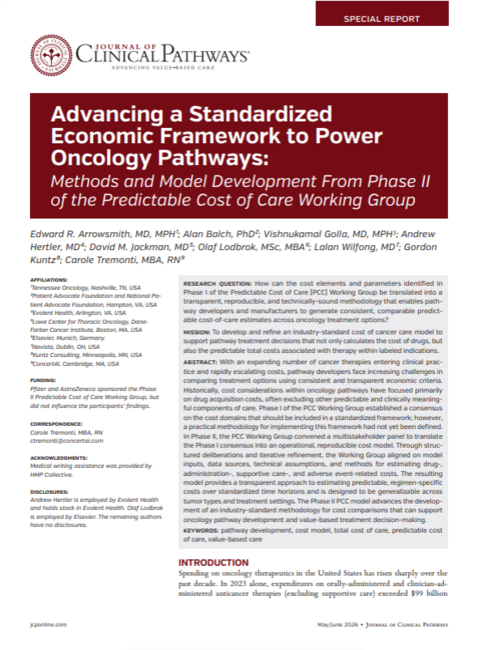
Edward Arrowsmith, MD; Alan J. Balch, PhD, MSc; Vishnukamal Golla, MD, MPH; Andrew Hertler, MD, FACP; David Jackman, MD; Olaf Lodbrok, MS, MBA; Lalan Wilfong, MD; Gordon Kuntz; Carole Tremonti, RN, MBA
As cancer therapies expand and costs rise, oncology pathway developers need consistent, transparent methods to compare treatment options beyond drug acquisition costs. Building on Phase I’s consensus on relevant cost domains, the Phase II PCC...
As cancer therapies expand and costs rise, oncology pathway developers need consistent, transparent methods to compare treatment options beyond drug acquisition costs. Building on Phase I’s consensus on relevant cost domains, the Phase II PCC...
Edward Arrowsmith, MD; Vishnukamal Golla, MD, MPH; Rhonda Henschel, MBA; Andrew Hertler, MD, FACP; David Jackman, MD; Gordon Kuntz; Olaf Lodbrok, MS, MBA; Carole Tremonti, RN, MBA; Lalan Wilfong, MD
The Predictable Cost of Care Working Group developed a model that can be used by various entities evaluating the impact of treatment on the total cost of care.
The Predictable Cost of Care Working Group developed a model that can be used by various entities evaluating the impact of treatment on the total cost of care.
Robin T. Zon, MD, FACP, FASCO; Gordon Kuntz; Winston Wong, PharmD
The Journal of Clinical Pathways convened the 2021 Care Pathways Working Group to identify and reconcile the different pathway drivers for each stakeholder now and five years into the future, creating a framework tool based on oncology care...
The Journal of Clinical Pathways convened the 2021 Care Pathways Working Group to identify and reconcile the different pathway drivers for each stakeholder now and five years into the future, creating a framework tool based on oncology care...