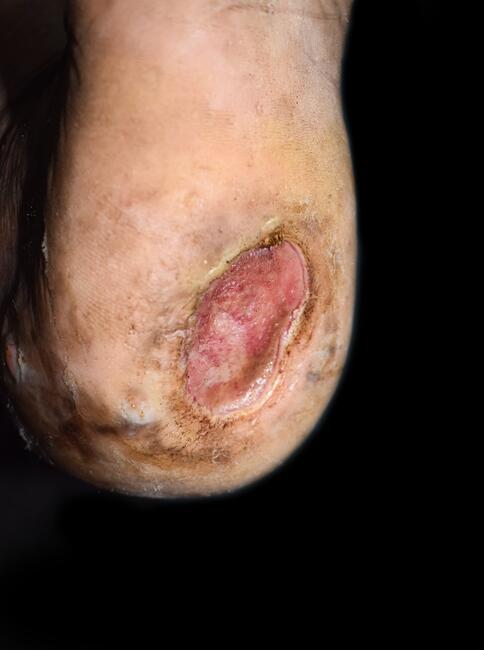
After a Diabetes-Related Amputation, Who Owns the Other Leg?
After a diabetes-related lower-extremity amputation, the remaining limb faces a substantial risk of ulceration and amputation—but often lacks structured follow-up. This Clinician Commentary contends that the initial amputation should trigger coordinated, long-term surveillance focused on preserving the contralateral limb.
Key Takeaways
- Patients with diabetes remain at substantial risk for contralateral ulceration and amputation after an initial lower-extremity amputation.
- Persistent neuropathy and peripheral arterial disease, compounded by altered gait and increased loading, place the remaining limb under continued stress.
- The initial amputation should initiate a defined surveillance pathway with clear responsibility for monitoring and protecting the contralateral limb.
The operation is over. The patient survived. Everyone moves on. Who is watching the other leg?
In more than 40 years of participating in diabetic limb preservation, this is the failure that still bothers me most. We commit enormous resources to the limb we are losing—the vascular workup, the OR, the inpatient stay, rehab, the prosthetic fitting—but so little to the limb the patient is still standing on.
The numbers are not subtle. Roughly 1 in 10 people who undergo an amputation for diabetes will lose the other leg to a major amputation within 5 years1—more if you count every level—and that rate has not measurably improved across more than 2 decades of published data.2 Meanwhile, the remaining foot ulcerates faster than a foot that never lost anything: 75% at 5 years, compared with 60% in patients who avoided amputation.3 The single greatest risk factor for a diabetic foot ulcer is having already had one.4
None of this should surprise us. The same neuropathy is still there. The same arterial disease is still there. And now that foot is carrying more load, through an altered gait, in a body that has just been through major surgery.
So, we should stop treating the second amputation as bad luck. It is a predictable potential event, with a 5-year runway, in a patient the health system has already identified as highest risk—by performing undergoing the first amputation.
What I feel changes when one sees it that way:
- The day of an amputation should open a surveillance pathway for the remaining limb, not close a case.
- One doesn’t have to go hunting for the highest-risk patients. They are already in a practice’s your post-op records.
- In my observation, rehabilitation often measures how well someone walks, but not often enough does it measure what they are walking on.
A question for those in wound care, vascular surgery, rehabilitation, prosthetics, or population health: in your system, who owns the remaining limb, and how?
Dr. Hinkes is the former Chief of Podiatry Services and Chair of the Preservation Amputation Care and Treatment Program at the Nashville, TN Veterans Affairs Medical Center.
He has no non-financial or commercial, proprietary, or financial interest in the products or companies described in the manuscript. The author(s) did not receive grants or a consultant honorarium to conduct the study, write the manuscript or otherwise assist in the development of the above manuscript.
References
1. Glaser JD, Bensley RP, Hurks R, et al. Fate of the contralateral limb after lower extremity amputation. J Vasc Surg. 2013 Dec;58(6):1571-1577.e1. doi: 10.1016/j.jvs.2013.06.055. Epub 2013 Aug 3. PMID: 23921246; PMCID: PMC3844063.
2. Liu R, Petersen BJ, Rothenberg GM, Armstrong DG. Lower extremity reamputation in people with diabetes: a systematic review and meta-analysis. BMJ Open Diabetes Res Care. 2021 Jun;9(1):e002325. doi: 10.1136/bmjdrc-2021-002325. PMID: 34112651; PMCID: PMC8194332.
3. Rathnayake A, Saboo A, Malabu UH, Falhammar H. Lower extremity amputations and long-term outcomes in diabetic foot ulcers: A systematic review. World J Diabetes. 2020 Sep 15;11(9):391-399. doi: 10.4239/wjd.v11.i9.391. PMID: 32994867; PMCID: PMC7503503.
4. Izumi Y, Satterfield K, Lee S, Harkless LB. Risk of reamputation in diabetic patients stratified by limb and level of amputation: a 10-year observation. Diabetes Care. 2006 Mar;29(3):566-70. doi: 10.2337/diacare.29.03.06.dc05-1992. PMID: 16505507.
© 2026 HMP Global. All Rights Reserved.
Any views and opinions expressed are those of the author(s) and/or participants and do not necessarily reflect the views, policy, or position of Podiatry Today or HMP Global, their employees, and affiliates.