Minimally Invasive Haglund’s Deformity Surgery: What You Need to Know
Key Takeaways
1. Ultra-MIS techniques can reduce wound complications
Transitioning from large open incisions to percutaneous portal approaches has virtually eliminated wound-related complications for this guest, addressing one of the primary limitations of traditional Haglund’s surgery.
2. Tendon preservation can enable earlier weight-bearing and faster recovery
By maintaining up to ~80% of the native Achilles tendon attachment, this guest shares his experience with safely accelerating postoperative protocols, with some patients weight-bearing as early as 10 days postop.
3. MIS may expands surgical candidacy and improve patient experience
Shorter operative times, reduced soft tissue disruption, and lower morbidity could make surgery feasible for patients who may have previously deferred intervention due to comorbidities or recovery concerns.
This program is supported by Aztron Medtech. The sponsor did not influence the content. All content was developed independently, and the views expressed are those of the speakers based on their clinical experience.
Transcript
Please note: This content is a direct transcript, capturing the authentic conversation without edits. Some language may reflect the flow of live discussion rather than polished text.
Jennifer Spector, DPM
Haglund's deformity has long been a challenging condition for foot and ankle surgeons, but the way we approach it surgically is continuing to evolve. Welcome back to Podiatry Today Podcasts where we bring you practical insights and real world perspectives from leaders in foot and ankle medicine and surgery. I'm Dr. Jennifer Spector, Associate Editorial Director for Podiatry Today. And today I'm joined by Dr. Scott Carrington for a discussion on minimally invasive, and even ultra minimally invasive, approaches to Haglund's surgery. Dr. Carrington is a fellowship-trained foot and ankle surgeon with Emplify Health in Lacrosse, Wisconsin, and he's a fellow of the American College of Foot and Ankle Surgeons where he serves as a committee member. In our chat today, we'll explore how surgical techniques have progressed over time, what these smaller incision approaches look like in practice, and what they may mean for outcomes like wound healing, recovery, and patient satisfaction.
This episode is supported by Aztron MedTech, but as always, the content and opinions expressed are those of our guests. Stay tuned for a message from Aztron. Dr. Carrington, thanks so much for joining us today.
Scott Carrington, DPM:
You bet. Thanks for having me.
Jennifer Spector, DPM:
Absolutely. So let's start by setting the stage. Could you walk us through how surgical management for Haglund's deformity has evolved from traditional open approaches to the minimally invasive techniques available today?
Scott Carrington, DPM:
So as a resident, early on in training, it was always one of my favorite procedures. The procedure itself was fun when we would do these detach-reattach Achilles … and it was always a very satisfactory procedure as a resident, but it was very invasive. And what you find is, when you get out and start practicing on your own, some of the procedures that you like, you've now seen in follow-up. And that's what I was seeing in follow-up. It's a very difficult procedure for some patients to recover from. One, because of the incisional approach, the detach-reattaching tendon and the weightbearing, non-weightbearing period that they have. And so as I started practicing more and more, I looked at ways that we can approach this in a more efficient manner that makes recovery quicker and makes our outcomes better.
So what we've gone to over the past, I don't know, I think this has been an evolution in my practice over the past four to five years - how do we approach these smaller? And so I started with smaller incisions, those that have historically seen the big “S” incision that we used to do for Haglund’s. It was a good exposure. So then I stopped doing the “S” type incision and we went to a smaller vertical incision, which still gave good exposure, but I still had some wound going complications on some of these patients. And therefore I kept the non-weightbearing longer because it wasn't so much a management of the tendon to get back to walking. It's “is the incision ready to walk?” And so, we abandoned the vertical incisions and we started doing portal holes for burr incisions, and we really do not see wound-driven complication with those small portals.
And it's really translated to quicker recovery, better outcomes, less invasive procedures, and we just really had some good outcomes in our own clinics because of this.
Jennifer Spector, DPM:
So those burr-size incisions that you're talking about, is that what you would refer to as perhaps more of an ultra MIS focus?
Scott Carrington, DPM:
Yeah, great question. So when I first mentioned going to a minimally invasive approach, it was changing from our big lazy “S” incision to a small vertical incision. So that was my first attempt on MIS surgery. And we were making this procedure through a one-to-two inch, one and a half inch incision, which is pretty small, even with our vertical incisions. But again, it was still a limiting factor in some of our patients. And so now we have progressed to this ultra MIS, if that's how we want to term it, where this procedure is now done through three percutaneous holes and we are throwing three stitches essentially to close these portals for working and debriding other tendons.
Jennifer Spector, DPM:
Wow. Do you feel that this may improve precision or are there any impacts on specific techniques like how you place your sutures as a result of this?
Scott Carrington, DPM:
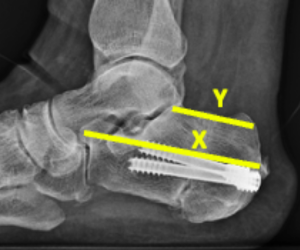
I don't think it's so much how we place our sutures. It's just the approach of debriding both the Haglund’s deformity, and the ability to also debride the intratendinous calcification while preserving most of the native attachment of the tendon. And that's where we've seen the outcomes have really changed in terms of getting patients weightbearing earlier, is we are preserving the attachment of the Achilles, almost 80% of the native attachment of the Achilles tendon is preserved. And so that allows us to walk them almost immediately.
Jennifer Spector, DPM:
We'll pause here for an additional message from Aztron MedTech. We'll be right back.
COMMERCIAL BREAK
Aztron Medtech is advancing minimally invasive solutions for Haglund's deformity and Achilles tendon repair. Using incisions under one centimeter, this approach is designed to minimize soft tissue disruption and help reduce wound complications in posterior heel surgery.
Aztron is currently offering complimentary hands-on training labs focused on Haglund's procedures. To learn more or request a spot, don't forget to click the link in the episode transcript on podiatrytoday.com. https://forms.gle/FLF1YWr7LwqaUDs46
Jennifer Spector, DPM:
Now, let's return to our discussion. Are there any other interesting technical components to this approach that you found over time?
Scott Carrington, DPM:
The technical components are learning to use a burr. It's not a direct visualization anymore as it used to be. The Haglund’s traditional approach is very, very maximal exposure, so you see everything. It's a great way to learn the Haglund’s approach. And so, you have to learn the technique of doing this, utilizing fluoroscopy. So a lot of it is feel, both feel of the burr, feel of what it sounds like once the bone feel of the trajectory that we're placing that burr, all the while constantly taking fluoroscopic images to ensure you're debriding the proper area. So there's a technical component to it, but it has not prolonged our surgery time. If anything, it's shortened it because closure takes about two minutes to close.
Jennifer Spector, DPM:
Well, that's definitely a big difference. And one of those key advantages that a lot of people talk about with MIS is the reduced risk of wound complications. What's your experience been in terms of wound healing and overall surgical morbidity compared to open Haglund’s procedures?
Scott Carrington, DPM:
Yeah, the wound complications are the reason I started looking at minimum invasive approaches. Again, the limitation to a patient returning activity was the wound. And a lot of the patients that we see that have haglins deformity have other comorbidities. And so it's difficult to say, or I'm going to make a really big incision on an area that has a high risk of dehiscence, just anatomically, but now we're doing it in a patient that maybe has a difficulty non-weight bearing, has other comorbidities that we're worried about, both detaching the Achilles on those patients, but also making a large incision. And so now that we're approaching it with the thought that, well, almost anyone can heal three percutaneous incisions. Wound complications have been nonexistent in our clinic since we started to switch into that ultra-MIS approach.
Jennifer Spector, DPM:
What have you noticed as far as recovery, pain, return to activity of that whole postop process with these minimally invasive Haglund’s procedures?
Scott Carrington, DPM:
So again, the first reason we looked at this was wound complications. And then our secondary outcomes of what we were seeing is, all right, we're not worried about the wound anymore, but because the approach we're utilizing is preserving most of the attached tendon, I'm not concerned about weightbearing them earlier either. So we are seeing less postoperative pain, I think largely because the incisional portals are smaller, but also the patient's ability to weight-bear fairly quickly. When I first started doing the ultra MIS, I was still following my tradition of protocol because I just didn't know. It is three weeks of non-weightbearing, three weeks in a boot, six weeks to shoes. And most recently, we've had patients over the last couple of weeks that we have pushed it and they were weightbearing in 10 days. I still think we could maybe push that further, and it's yet to be determined.
I'm still somewhat protective of it. But 10-day weight-bearing in a boot, patients are pretty comfortable because the tendon is the largely intact, even though we reinforce it with some suture anchors, it's still largely intact. And so I feel like because of the biological attachment of the tendon not being disrupted, they're walking right away and the pain is less.
Jennifer Spector, DPM:
Well, we hear a lot about the right surgery for the right patient at the right time. From your experience, are there any important features of the patient selection process that might contribute to success here?
Scott Carrington, DPM:
That's a great question because one of the challenges we faced with Haglund’s deformity, these are some of the patients, the body habitus. They were bigger patients and you were putting them in a prone position, and it was a significant recovery to detach or detach a patient that had high weight-bearing demands. And so some of those patients would thought maybe there's better things to do and we would just kick the can down the road and not offer that procedure because of the risk that we're worried about. And so when we worry about the complications that can come from the patient being proned under anesthesia with comorbidities, we now have them supine and a procedure that takes 20 minutes. And so a lot of those risks and concerns you had before are nonexistent.
Jennifer Spector, DPM:
Well, as we start to wrap up the episode today, Dr. Carrington, what do you hope the audience will take away from this examination of MIS approaches to Haglund's deformity?
Scott Carrington, DPM:
The trend in foot and ankle surgery right now is minimally invasive, and I didn't drink the Kool-Aid, and I still don't drink the Kool-Aid on everything. I still think there are approaches that we need to open, but when we look at an approach that truly can improve outcomes, both in decreasing risk of wound complications, but also quicker return to activity, less weakening of the posterior muscle group, which also prolongs recovery process, this is when we look at these approaches and saying, minimally invasive is a great option for a procedure that still needs to be done.
Jennifer Spector, DPM:
Absolutely. And thank you so much for sharing your insights with us today. This was a really valuable look into how these minimally invasive techniques are continuing to shape how we approach this type of deformity.
Scott Carrington, DPM:
I bet. Yeah. No, this is, again, changing things in our clinic and patients when were sent to me as second opinions because no one wanted to get an open, now we've got an option to do so.
Jennifer Spector, DPM:
And more options for this pathology is absolutely what's needed. And for our listeners, if you found this discussion helpful, be sure to follow Podiatry Today Podcasts so you don't miss future episodes, and we'd appreciate it if you took a moment to leave a quick rating or review. It helps us reach more clinicians who are looking for practical and surgical insights like this. You can also find more foot and ankle surgical content, including articles and multimedia at podiatrytoday.com. A quick thank you again to Aztron MedTech for supporting this episode, and thanks for listening. We will see you next time.
Disclosure: Dr. Carrington discloses that he is a consultant for Aztron Medtech.
© 2026 HMP Global. All Rights Reserved.
Any views and opinions expressed are those of the author(s) and/or participants and do not necessarily reflect the views, policy, or position of Podiatry Today or HMP Global, their employees, and affiliates.