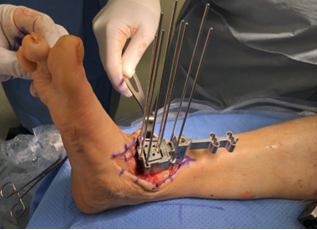
Anterior and Lateral Transfibular Approaches Offer Advantages and Tradeoffs in TAA
Key Takeaways
- Total ankle arthroplasty (TAA): Review concludes both anterior and lateral transfibular approaches provide predictable outcomes and preserve motion; approach selection should be individualized based on patient anatomy, deformity, soft tissues, implant requirements, and surgeon expertise.
- Approach-specific tradeoffs: Anterior approach is widely compatible with implant systems but has the highest wound complication risk, particularly with compromised anterior soft tissues or vascular disease. Lateral transfibular approach offers extensile exposure, deformity correction, and preserved anterior skin perfusion but involves greater technical complexity and bony morbidity.
- Clinical implications: Successful TAA depends on patient selection, meticulous technique, soft-tissue management, and alignment accuracy, rather than the surgical approach alone; standardized reporting may further refine evidence-based approach selection.
A new review of total ankle arthroplasty (TAA) techniques concludes that anterior and lateral TAA approaches can provide predictable outcomes and preserve motion for end-stage ankle arthritis.1
The review, published in the Journal of Bone and Joint Surgery Open Access, emphasizes the importance of appropriately matching surgical approaches to factors such as patient anatomy, deformity, soft-tissue considerations, implant requirements, and surgeon expertise.1 Authors note TAA has evolved from an “implant-limited procedure to a technique-sensitive operation,” stressing that selecting a surgical approach is key in determining soft-tissue complications, deformity correction, and alignment accuracy.
As the authors note, anterior and lateral transfibular approaches each have specific advantages and tradeoffs as far as visualization, angiosome preservation, deformity correction, and technical complexity.1 Anterior approaches are the most widely used and are compatible with most implant systems but the review notes they have the highest risk of wound complications, particularly in patients with compromised anterior soft tissues or vascular disease.
The review says the lateral transfibular approach provides extensile exposure, corrects coronal-plane deformities and preserves anterior skin perfusion.1 However, reviewers note a disadvantage of more bony morbidity and higher technical demands connected to fibular osteotomy and fixation. In addition, the transfibular approach includes constrained revision options as the authors say failed lateral systems frequently require revision through an anterior approach using alternative implants.
Ultimately, authors note surgeons’ approach should be individualized and strategy-driven, saying “successful outcomes depend less on the chosen corridor than on patient selection, meticulous technique, soft-tissue management, and alignment accuracy.”1 The review notes having standardized reporting and approach-stratified outcome data can help refine evidence-based guidance for TAA approach selection.
Reference
1. Hershfeld B, Krish P, Smith P, et al. Total ankle arthroplasty: a comparative review of surgical approaches and outcomes. JB JS Open Access. 2026;11(2):e26.00019. Published 2026 Jun 15. doi:10.2106/JBJS.OA.26.00019
© 2026 HMP Global. All Rights Reserved.
Any views and opinions expressed are those of the author(s) and/or participants and do not necessarily reflect the views, policy, or position of Podiatry Today or HMP Global, their employees, and affiliates.