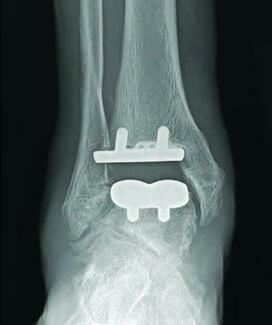
Total Ankle Replacement Study Compares Anterior vs Lateral Approaches: Similar Complication Rates, Different Reoperation Patterns
New research suggests that while anterior and lateral transfibular approaches to total ankle replacement (TAR) produce comparable early complication rates and hospital stays, the lateral approach may be associated with longer operative times and a greater reoperation burden.
Key Takeaways
- Overall complication rates were similar between anterior and lateral transfibular TAR approaches, at approximately 31% in both groups.
- Lateral transfibular TAR required significantly longer operative times and demonstrated a higher, more variable reoperation burden.
- Adjunctive procedures were common, with Achilles tendon lengthening performed more frequently in anterior approach cases.
Comparable Early Outcomes, Different Surgical Profiles
A retrospective cohort study published in the Journal of Foot & Ankle Surgery compared perioperative outcomes and reoperation patterns between direct anterior and lateral transfibular approaches for primary total ankle replacement (TAR). Investigators reviewed 188 consecutive TAR procedures performed at a single institution between 2016 and 2021, including 120 anterior and 68 lateral cases.1
As utilization of TAR continues to expand, understanding how surgical approach influences outcomes remains an important consideration for foot and ankle surgeons. While both techniques are widely used, comparative data remain limited.
Length of Stay and Complication Rates Were Similar
Researchers found no significant differences in early postoperative recovery metrics between the two groups. Mean hospital length of stay was 3.56 days in the anterior cohort and 3.67 days in the lateral cohort, a difference that did not reach statistical significance.1
Likewise, overall complication rates were nearly identical, occurring in 31.67% of anterior procedures and 30.88% of lateral procedures. These findings suggest that both approaches can achieve comparable short-term safety profiles in appropriately selected patients.1
Lateral Approach Associated with Longer Procedures and More Reoperations
The most notable differences emerged in operative efficiency and reoperation burden. Procedures performed through the lateral transfibular approach required significantly more operative time, averaging 139 minutes compared with 115 minutes for anterior TAR.1
In addition, the lateral cohort demonstrated a substantially higher and more heterogeneous reoperation burden. Investigators reported 0.730 reoperations per patient in the lateral group versus 0.096 reoperations per patient in the anterior group. The authors caution that this finding may be influenced by differences in case complexity and the use of concomitant procedures rather than the surgical approach alone.1
Role of Adjunctive Procedures
Adjunctive procedures were frequently performed across both cohorts, underscoring the complexity of ankle reconstruction in patients undergoing TAR. Achilles tendon lengthening was significantly more common in the anterior group, occurring in nearly 62% of cases compared with 47% of lateral procedures.1
Clinical Perspective
Although exploratory in nature, the study provides useful insight into the tradeoffs associated with two commonly used TAR approaches. For foot and ankle surgeons, the findings suggest that surgical approach selection may have less impact on early complications and hospital stay than on operative workflow and subsequent reoperation patterns. Prospective studies are necessary to determine whether the observed differences are attributable to the approach itself or to underlying patient and procedural factors.1
Reference
- Di Ponte M, Caravelli S, Viotto M, et al. Comparison of anterior and lateral approaches for total ankle replacement: a retrospective cohort study. J Foot Ankle Surg. Published online May 26, 2026. doi:10.1053/j.jfas.2026.05.017.
© 2026 HMP Global. All Rights Reserved.
Any views and opinions expressed are those of the author(s) and/or participants and do not necessarily reflect the views, policy, or position of Podiatry Today or HMP Global, their employees, and affiliates.