The Urology Prostate Cancer Note: A Tool to Enhance the Use of the Prostate Cancer Clinical Pathways
Abstract
Within the US Department of Veterans Affairs (VA), prostate cancer is the most commonly diagnosed noncutaneous malignancy. The Prostate Cancer Clinical Pathways (PCCP) were established to equip providers with the expertise needed to treat all veterans with prostate cancer at a subject matter expert level. Since the launch of the PCCP in February 2021, there has been variability in provider documentation of PCCP use across the VA health care system. To increase the use of PCCP, a collaboration was formed between the National Surgery Office and the National Oncology Program to develop a Urology Prostate Cancer Note (UPCN). The UPCN serves as a standardized clinical note for urologists who incorporate PCCP. At the initial visit, PCCP are used to document the cancer diagnosis, staging, and treatment plan. They are subsequently documented only when the staging or treatment plan changes, or both. Since the UPCN deployment, 8570 notes have been written; however, the PCCP were documented in only 6671 of these notes. The UPCN accounted for approximately 16% of the total prostate cancer pathway documentation, including 17% on-pathway PCCP documentation and 9% off-pathway PCCP documentation. Combined use by oncology and urology staff showed that 14% of treatments were off-pathway and 86% were onpathway. Therefore, on-pathway treatment exceeding the goal of 80% compliance with the prostate cancer treatments outlined in the PCCP.
Background
As evidence-based cancer treatment is constantly evolving, delays in implementation and variability in treatment for veterans are well documented.1 Prostate cancer is the most prevalent noncutaneous malignancy diagnosis within the US Department of Veterans Affairs (VA).1 The VA Clinical Pathways (CP) are decision support tools that can help bridge that gap by translating published evidence into process flow maps to help guide treatment decisions.1 CPs help make patient care more consistent, enable clinicians to practice at the top of their license, and empower sites of care to deliver safer, more cost-effective therapy with better patient outcomes.2 VA CPs recommend a standard treatment based on efficacy, toxicity, and cost. VA CPs are developed by interdisciplinary subject matter expert groups and approved by medical oncology, radiation oncology, surgery, pathology, and pharmacy national program offices.1 The Prostate Cancer Clinical Pathways (PCCP) flow maps were initially developed February 2021. National Prostate Cancer Note templates were created and made available to all VA providers as of July 2022 but have primarily been used by medical oncologists.
Use of VA CPs in the VA health care system varies widely. As noted by Michael Goodman, MD, a medical oncologist with the VA (email, November 12, 2025), several factors contribute to inconsistent adoption, including: 1) workflow and logistical challenges (eg, difficulty for providers in locating and identifying the appropriate pathway templates in the electronic medical record); 2) resource constraints (eg, insufficient time for providers to identify and complete the pathway documentation or note due to competing responsibilities); 3) reduced awareness among new providers and rotating fellows; and 4) absence of significant incentives (eg, no reward system for providers to use the pathways).
Methods
To improve use and documentation of PCCP by urologists and radiation oncologists, a national team of VA experts, including urologists, a medical oncologist, and a National Oncology Program (NOP) informatics nurse, convened regularly to create a standardized Urology Prostate Cancer Note (UPCN) for the Computerized Patient Record System (CPRS), the electronic medical record used by approximately 90% of VA medical facilities. The UPCN was created in alignment with the VHA directives outlined in the Cleland Dole Act.3 Furthermore, the American Society of Clinical Oncology endorses the use of CPs in oncology.4
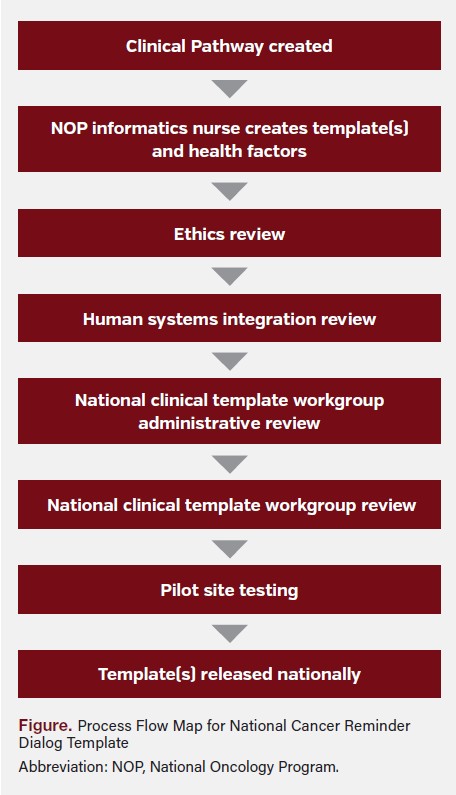 The UPCN was developed by modifying a national note template created for medical oncologists. The team’s urologists and medical oncologist created the content and structure of the note, with the intentional incorporation of the PCCP. The NOP informatics nurse formatted the note, created health factors linked to specific data points for data mining, and then directed the UPCN through the formal VA note publication process. The paradigm for this process is outlined in the Figure.
The UPCN was deployed and installed at all VA CPRS sites with a urology program by September 6, 2024. Implementation of the UPCN was targeted at both the informatics and oncology communities. The main objective of the UPCN implementation was to measure and improve prostate cancer care within the VA health care system. The NOP informatics nurse educated the VA informatics community about the national deployment, installation, and use of the note. The informatics staff were responsible for local implementation, including interfacing with the local clinical and provider workforce, primarily urologists and radiation oncologists. The National Surgery Office presented the UPCN note to the Veterans Integrated Service Network Chief Surgical Consultants on a national call, who then made local chiefs of surgery aware of the UPCN.
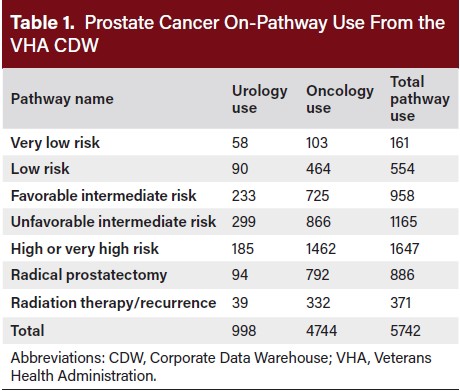 We sought to describe the implementation efforts and assess adoption of the UPCN by urologists and radiation oncologists by examining how its key components were used before and after implementation. Health factors for prostate cancer staging and treatment modalities were tracked and collected in an NOP dashboard, with a goal of 80% compliance with the treatment outlined in the VA PCCP.
CPRS data are stored within the Veterans Health Administration (VHA) Corporate Data Warehouse (CDW). Microsoft Structured Query Language (SQL) Server Management Studio software was used for data mining of the CDW.5,6 The health factor use was calculated with an original SQL code written by the NOP informatics nurse. The date range for the SQL report was July 1, 2022 (date the PCCP were published) through August 20, 2026.
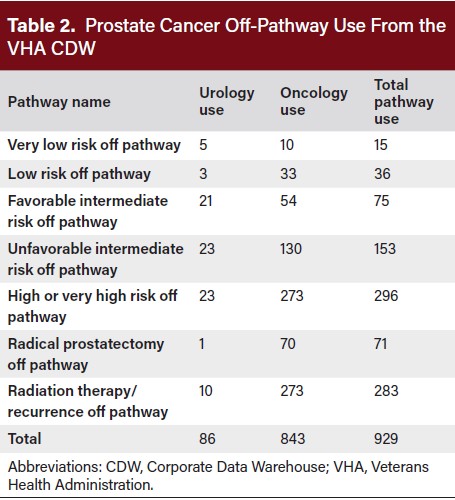 Prostate cancer health factors documented when the UPCN was written were captured as “Urology Usage.” Prostate cancer health factors documented outside of the UPCN were captured as “Oncology Usage” and were documented through either the medical oncology prostate cancer templated clinic notes or the shared templates file in the electronic medical record (Table 1, Table 2, Table 3).
Results
At the initial visit, PCCP documentation captures the cancer diagnosis, staging, and treatment plan, with additional documentation completed when staging or treatment changes occur. Following the implementation of UPCN, 8570 notes have been written, of which 6671 included PCCP documentation.
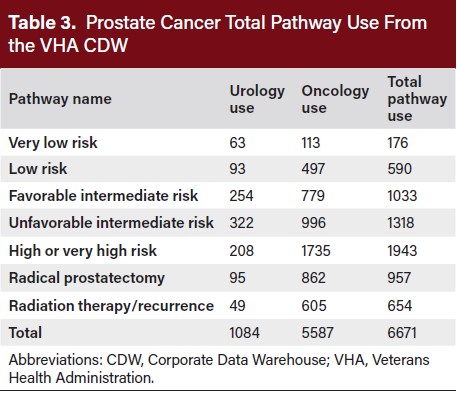 Overall, the UPCN represented 16% of the total PCCP documentation (Table 3), including 17% of on-pathway PCCP documentation (Table 1) and 9% of off-pathway PCCP documentation.
Across oncology and urology documentation, 86% of treatments were on-pathway and 14% were off-pathway. The proportion of on-pathway treatments therefore exceeded the goal of 80% compliance with prostate cancer treatments outlined in the PCCP.6
Conclusion
The UPCN is one approach to increase PCCP use. The UPCN is advantageous as it helps standardize documentation and prostate cancer care across the VA health care system. Although the UPCN has increased PCCP use, additional methods are needed to address the barriers associated with their adoption and maximize the use of cancer CPs throughout the VA.
To improve adoption, the National Surgery Office should provide quarterly educational sessions for urologists and identify urology champions to increase adoption and use.
Key Takeaways
- The VA developed a standardized UPCN to improve use and documentation of PCCP among urologists and radiation oncologists.
- Since deployment, 8570 UPCNs have been written, with PCCP documented 6671 times.
- Overall, 86% of documented treatments were onpathway, exceeding the VA’s 80% compliance goal; additional strategies are needed to further improve pathway adoption.
Clinical Pathway Category: Infrastructure & Innovation
This study advances the infrastructure & innovation category by demonstrating how a standardized electronic clinical note can integrate evidence-based prostate cancer pathways into routine workflows. By supporting pathway adoption and consistent documentation, the tool strengthens oncology infrastructure and promotes standardized care delivery.
Author Information
Authors: Sarah Neveills, PhD, MS, RN1; Michael Goodman, MD2; Jeremy Shelton, MD, MSHS3
Affiliations: 1Veterans Health Administration; 2VA Hospital Salisbury, Salisbury, NC; 3Salt Lake City VA, UT
Address correspondence to:
Sarah Neveills, PhD, MS, RN
Email: sarah.neveills@va.gov
Disclosures: The authors declare no relevant financial relationships. The views expressed in this article are those of the authors and do not necessarily reflect the position or policy of the US Department of Veterans Affairs or the US government.
Contributions: Sarah Neveills, Michael Goodman, and Jeremy Shelton formatted and compiled the manuscript. Sarah Neveills created the SQL code for data mining in the methods section. Sarah Neveills completed the data mining. All authors read and approved of the final manuscript.
Funders: National Oncology Program, Specialty Care Program Office, Department of Veterans Affairs, Washington, DC.
Data Availability: The data underlying this article will be shared on reasonable request to the corresponding author.
Institutional Clearance: Institutional approval granted by Dr Michael Kelley, executive director, National Oncology Program.
Prior Presentation: The findings of this study were presented at the Association of VA Hematology/Oncology (AVAHO) Conference, September 2025.
Acknowledgements: The VA Prostate Cancer Pathways Workgroup: Dr Michael G. Chang; Dr Matthew Cooperberg; Dr Isla Garraway; Dr Michael Kelley; Dr Stacy Loeb; Dr Jeffrey A. Jones; Dr Mark D. Sawyer; and Lisa M. Hall.
References
- Clinical pathways. VA National Oncology Program. Accessed November 25, 2025. https://www.cancer.va.gov/CANCER/clinical-pathways.html
- Clinical Content at the Point of Care: Insights from the 2023 Becker’s-Flatiron Oncology Leader Survey. Beckers Healthcare. 2023. Accessed October 6, 2025. https://assets.asccommunications.com/whitepapers/flatiron-wp-september-2023.pdf
- Joseph Maxwell Cleland and Robert Joseph Dole Memorial Veterans Benefits and Health Care Improvement Act of 2022. Pub L No. 117-328, div U, 136 Stat 4459 (2022). Accessed October 6, 2025. https://www.congress.gov/117/bills/hr2617/BILLS-117hr2617enr.pdf
- Chiang AC, Ellis P, Zon R. Perspectives on the use of clinical pathways in oncology care. Am Soc Clin Oncol Educ Book. 2017;(37):155-159. doi:10.1200/edbk_175533
- SQL Server Management Studio. Version 19, Preview 3. Microsoft Corporation. 2022. https://www.microsoft.com/en-us/sql-server/sql-server-2019
- US Department of Veterans Affairs. Corporate Data Warehouse for VA Data. Accessed August 20, 2026. Internal database.