Evaluating the Impact of EHR-Supported Tools and Workflows on Broad Panel Testing Rates for Patients With Metastatic Prostate Cancer in a Community Urology Practice
Abstract
This pilot study evaluated an electronic health record (EHR)-supported, guidelines-based care pathway designed to improve broad panel genetic testing among patients with metastatic prostate cancer (mPC) in a community urology practice. The intervention combined systematic identification of living patients with mPC diagnosed within the previous 12 months and workflow enhancements to facilitate ordering of germline and tumor-based next-generation sequencing. Over the 3-month pilot period, broad panel testing rates increased from 33.5% at baseline to 47.0%, 51.2%, and 49.0% at months 1, 2, and 3, respectively, representing statistically significant improvements relative to baseline. Despite growth in the overall mPC population, the gap between eligible and tested patients narrowed during the study period. Germline testing accounted for most testing orders. Feedback from study personnel indicated that analytics-supported patient identification and standardized workflows were feasible, practical, and helpful for integrating testing into routine care. Participants also noted that integration of clinical decision support tools within the EHR would be valuable for sustaining long-term use. Overall, the findings suggest that an EHR-supported, guideline-based care pathway can feasibly increase broad panel testing rates in community urology settings and may help improve adherence to testing recommendations for patients with mPC.
Introduction
With more than 313 000 newly diagnosed cases of prostate cancer per year, the American Cancer Society estimates that approximately 1 in 8 men will have a prostate cancer diagnosis in their lifetime.1 The National Comprehensive Cancer Network Clinical Practice Guidelines in Oncology, Philadelphia Prostate Cancer Consensus Conference 2019, American Urological Association, American Society for Radiation Oncology, and Society of Urologic Oncology guidelines recommend tumor testing for patients with metastatic prostate cancer (mPC).2-6 Tumor testing may also be considered earlier for individuals with high-risk or very-high-risk localized prostate cancer, those with significant family history of cancer, or those with known hereditary cancer syndromes.2,3 Tumor testing is critical in this patient population, as data show that approximately 89% of metastatic castration-resistant prostate cancer (mCRPC) tumors contain a potentially actionable mutation, with about 9% occurring in the germline.2,7 In mCRPC, clinically actionable alterations are observed in an estimated 23% of patients, approximately 10% to 12% of whom have germline pathogenic variants.2,8
Broad panel molecular testing, a type of multigene testing, is recommended for patients with mPC to inform treatment decisions, particularly when considering precision therapies, such as poly (ADP-ribose) polymerase inhibitors.2 Despite guideline-based recommendations for genetic testing in patients with mPC, testing rates remain suboptimal, with 1 study reporting mPC 1-year testing rates as low as 10.1% among White commercially insured individuals and 7.2% in Black commercially insured individuals.9 Another study reported that while next-generation sequencing (NGS) homologous recombination repair (HRR) testing rates increased in the US from 2013 to 2022, testing rates remained relatively low, with only about 1 in 4 treated mCRPC patients being tested for HRR alterations in 2022, years after the integration of genetic testing into clinical guidelines.10 Despite strong guideline support, routine implementation of broad panel testing for prostate cancer remains hindered by logistical challenges, including fragmented workflows, limited staff familiarity with testing criteria and processes, cost and payer coverage, genetic education, and interpretation of test results.11 These operational hurdles highlight the need for tools and workflow-integrated interventions to support consistent, guideline-based testing in real-world environments.
Arkansas Urology (AU) is a community-based urology practice network comprising 19 physicians and 21 advanced practice providers (APPs) who care for more than 130 000 patients annually across 14 facilities. Patients with mPC are managed primarily within AU and the AU Prostate Cancer Center, with referral to medical oncology typically reserved for patients presenting with extensive metastatic disease or those pursuing chemotherapy. Broad panel testing may be ordered by both urologists and APPs, including APP leadership in urologic oncology services. To improve genetic test ordering for patients identified with mPC within AU, the study team implemented an electronic health record (EHR)–based intervention and conducted a 3-month pilot to monitor performance on broad panel testing rates of these patients.
Methods
A 5-person study team comprising 2 urologists, 2 research staff, and 1 analytics support resource conducted the pilot implementation. The study team reviewed 3 guidelines-based resources (see Supplemental Resources): a broad panel genetic testing data pull guide, an EHR clinical decision support tool, and an implementation roadmap. The team’s goals were to (1) evaluate AU’s broad panel testing rates at baseline and follow-up intervals, and (2) implement an EHR-based intervention to improve adherence to guidelines-based prostate cancer pathways.12 The team developed a protocol that was reviewed and approved by the Institutional Review Board. The endpoints for the pilot were as follows:
- Feasibility of the implementation of the guidelines-based care pathway leveraging the tools and resources as measured by qualitative feedback on work effort, EHR compatibility, time to deployment, acceptability/applicability, and opportunities for tool optimization.
- Impact of the intervention on the rate of broad panel test ordering for patients with mPC, leveraging quantitative data, including the number of patients with an mPC diagnosis and number of broad panel tests ordered Upon review of the guidelines-based prostate cancer pathway, 12 the AU study team aligned with a 2-tiered intervention to evaluate and improve broad panel testing rates: (1) to establish a system-wide process for identifying patients with mPC who had or had not received genetic testing; and (2) to improve ease of genetic test ordering within the EHR for eligible individuals.
Identifying Patients With mPC and Rate of Broad Panel Testing
Upon conducting an initial readiness assessment, the AU study team identified the data sources needed to calculate the broad panel testing rates: the EHR and genetic testing portals. Leveraging the EHR-integrated PPS analytics platform (PPS Analytics uses EHR data to help practices identify and engage patients) and guidelines-based resources, the team was then able to build a report to identify the total number of living patients diagnosed with mPC in the past 12 months by applying the following criteria:
- Aged 18 years or older, and
- Date of prostate cancer diagnosis per the International Classification of Diseases-10 code C61 within 12 months of data pull, and
- M1 cancer stage, per the American Joint Committee on Cancer.
The number of total living patients with mPC who had received broad panel testing within the past 12 months was determined by the following criteria (in addition to the above):
- Record of genetic testing order placed (all tests except Guardant and Tempus) per PPS analytics platform, an analytical platform which captures Current Procedural Terminology (CPT) code (81445, 81479) and testing portal information, or
- Record of somatic testing order placed (Guardant and Tempus only) per PPS analytics platform, which captures CPT code (0326U, 0419U) and testing portal information.
AU classifies genomic testing in 2 categories: (1) genetic testing, which captures germline tests ordered; and (2) somatic testing, which captures tumor-based NGS tests.
Leveraging this information, the following lists were generated:
- Living patients who have been diagnosed with mPC in the past 12 months
- Living patients who have been diagnosed with mPC in the past 12 months who had a broad panel test ordered
- Living patients who have been diagnosed with mPC in the past 12 months who have not received a broad panel test
The broad panel testing rate was calculated by dividing the total number of living patients with mPC who had broad panel testing orders within the past 12 months by the total living patients with mPC in the past 12 months. The broad panel testing gap was defined as the total living patients with mPC in the past 12 months who had not received mPC test orders within the past 12 months.
The guidelines-based prostate cancer pathway was implemented into practice in October 2024. The 12-month broad panel testing rates and gaps were calculated at baseline (October 7, 2023-2024), follow-up period 1 (November 7, 2023-2024), follow-up period 2 (December 7, 2023-2024), and follow-up period 3 ( January 7, 2024-2025).
Improving Ease of Genetic Test Ordering for Eligible Individuals Within the HER
A series of steps were taken at the pilot site to improve testing rates for patients in need of genetic testing. Face-to-face discussions were conducted between health care providers and patients or among team members to ensure direct communication on testing eligibility and need. Electronic reminders were sent to clinicians to improve adherence to testing protocols and guidelines. Finally, multidisciplinary tumor board meetings were held for specialists to discuss complex cancer cases as needed. Documentation in the EHR was completed for patients who needed genetic testing ordered or had genetic testing completed.
Statistical Analysis
Broad panel testing rates were calculated as the proportion of eligible patients with mPC who had documented broad panel testing within the prior 12 months. Absolute percentage-point improvement was calculated as the difference between followup and baseline testing rates. The percentage of change from baseline was calculated using the following formula:
Percentage Change From Baseline (%) =
[(Follow-up Rate−Baseline Rate)/ Baseline Rate] × 100
Testing rates at each follow-up interval were compared with baseline using a 2-proportion Z-test. Statistical significance was defined as a 2-sided P value < .05. In addition, 95% confidence intervals (CIs) were calculated for the absolute difference in testing rates between baseline and each follow-up assessment using the standard error of the difference in independent proportions.
Refining Tools and Resources
Following the 3-month pilot, external research support personnel interviewed the study team about the implementation experience, perceptions regarding feasibility of the care pathway and associated tools/resources, and hypotheses on factors that may have affected broad panel testing results over time.
Results
Feasibility
The feasibility of the tools was demonstrated by the completion of the pilot and the team’s ability to reference and apply the tools as needed throughout the implementation period. Postimplementation interviews of key study personnel indicated that the implementation roadmap served as a helpful reference document to orient clinicians and staff to recommend workflows for incorporating guidelines-based germline and somatic testing into routine practice. The data pull guide was viewed as useful for clarifying steps for extracting testing rate metrics; however, the study team reported relying heavily on the PPS Analytics platform for data pull support. The EHR clinical decision support tool was acknowledged as a valuable future state solution to standardize ordering and prompts with clinical workflows, but the study team noted that integration into the practice’s EHR would be necessary to optimize usability, effectiveness, and future adoption.
Impact
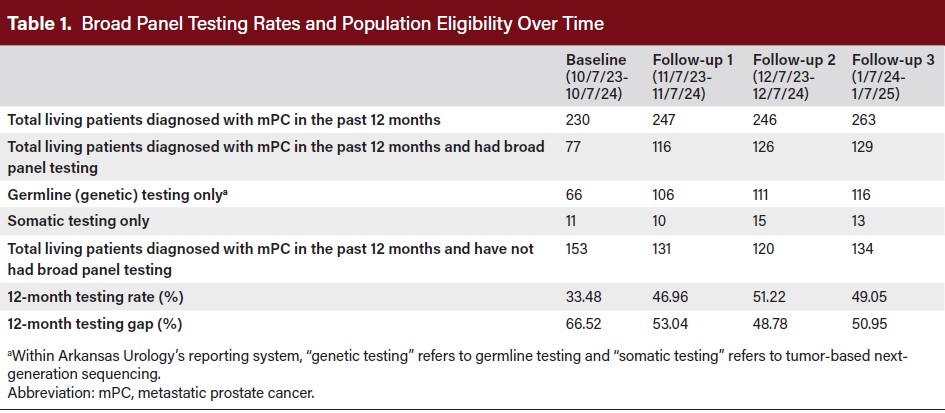
Over the course of the 3-month pilot, the number of total living patients with mPC in the past 12 months increased from 230 to 263, and the testing gap of patients in need of genetic testing decreased from 153 to 134. Table 1 and the Figure demonstrate the change in pilot performance over time. Germline (genetic) testing represented most broad panel testing orders throughout the pilot period, whereas somatic testing comprised a smaller proportion of testing orders at all time points.
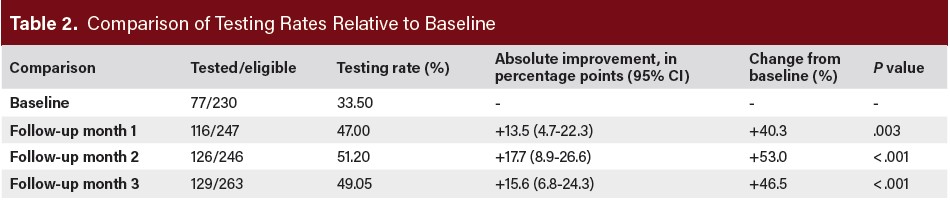
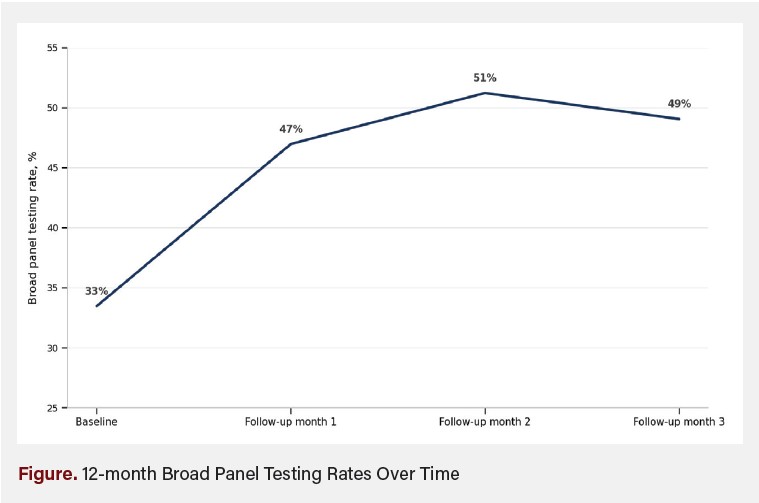 Compared with baseline, broad panel testing rates improved significantly at all follow-up assessments (Table 2). Testing rates increased from 33.5% at baseline to 47.0% at follow-up month 1, representing an absolute increase of 13.5 percentage points (95% CI, 4.7-22.3) and a 40.3% increase from baseline (P = .003). The highest testing rate was observed at follow-up month 2 (51.2%), corresponding to an absolute increase of 17.7 percentage points (95% CI, 8.9-26.6) and a 53.0% increase from baseline (P < .001). Although testing rates declined slightly at follow-up month 3 (49.0%), performance remained significantly higher than baseline, with an absolute increase of 15.6 percentage points (95% CI, 6.8-24.3) and a 46.5% increase from baseline (P < .001).
Discussion
Testing rates for patients with mPC increased from baseline through follow-up month 2, but a modest decline in testing rate occurred in follow-up month 3. Testing performance remained significantly improved relative to baseline throughout the study period. Broad panel testing rates increased by as much as 17.7 percentage points at follow-up month 2 (95% CI, 8.9-26.6), representing a 53.0% increase from baseline. Improvements were observed as early as follow-up month 1, with an absolute increase of 13.5 percentage points (95% CI, 4.7-22.3), and remained elevated at follow-up month 3, with testing rates up by 15.6 percentage points from baseline (95% CI, 6.8-24.3). Notably, the CIs for all follow-up assessments excluded zero, supporting the consistency of the observed improvement despite variation in the underlying patient population over time. These findings suggest that the intervention was associated with meaningful short-term improvements in guideline-concordant broad panel testing. However, several factors could have affected the broad panel testing rate, including clinician awareness/experience, patient financial considerations and timing, and the nature of the intervention itself.
Clinician Awareness and Experience
Although the pilot tools provided foundational guidance, familiarity with testing eligibility criteria and ordering workflows may have varied. During the pilot, there was limited reinforcement of the broad panel testing resources, which may have reduced confidence in when and how to integrate testing into routine care.
Patient Financial Considerations and Timing
Because the pilot was conducted between October 2024 and January 2025, it is possible that the insurance fiscal year (ending in December) may have influenced patients’ decisions to undergo broad panel testing. Patients may have been more willing to consent to genetic test ordering in November and December when they likely had reached their insurance deductibles, whereas patients seen in January may have deferred testing because deductible requirements had reset.
Intervention Design Considerations
Another important consideration is the nature of the intervention itself. The pilot primarily relied on workflow-based strategies, including analytics-supported patient identification, clinician reminders, multidisciplinary case discussions, and documentation within existing clinical workflows. Although EHR-supported tools were used to facilitate implementation, the pilot did not include fully integrated clinical decision support functionality embedded within the EHR. As a result, the impact of more automated point-of-care decision support approaches on testing rates could not be evaluated. Future efforts may explore whether greater integration of clinical decision support within routine clinical workflows improves the sustainability and consistency of guideline-concordant broad panel testing over time.
Study Limitations
Several limitations should be considered when interpreting these findings. First, reasons for lack of broad panel testing among patients who remained untested during the pilot were not systematically evaluated. As a result, the remaining testing gap should not be assumed to represent a population uniformly eligible for or interested in testing. Patients may not have undergone testing for a variety of reasons, including clinical considerations, patient preference, financial concerns, loss to follow-up, or other factors that were not captured as part of this quality improvement initiative. Consequently, the true actionable testing gap may differ from the number of patients identified through the analytics-based reporting process. Future studies should consider incorporating chart review or structured documentation of barriers to testing to better characterize opportunities for intervention and workflow improvement.
In addition, the patient identification approach did not specifically exclude individuals who may have transitioned to hospice or comfort-focused care. As a result, some patients included in the population-level gap may not have been appropriate candidates for broad panel testing, potentially resulting in an overestimation of the eligible population. Future analyses may benefit from incorporating clinical status and treatment intent when assessing testing eligibility.
Broad panel testing rates were evaluated using data available through the practice EHR, PPS Analytics platform, and associated testing portals. As a result, testing performed outside of these data sources may not have been captured. Patients who underwent germline or somatic testing through external providers, institutions, or laboratories could therefore have been misclassified as untested, potentially resulting in an overestimation of the testing gap. Future studies may benefit from incorporating additional sources of testing history when feasible.
Additionally, testing rates were calculated using a rolling 12-month cohort, resulting in changes to both the numerator and denominator at each follow-up assessment. Consequently, observed changes in testing rates may reflect both the impact of the intervention and turnover within the underlying patient population over time. Because patient-level data were not available for analysis, a fixed-cohort sensitivity analysis could not be performed.
 Finally, germline (genetic) testing accounted for most documented testing orders during the pilot period, whereas relatively few somatic testing orders were recorded. The factors contributing to differences in germline and somatic testing were not evaluated as part of this pilot and warrant further investigation. Additionally, the reporting structure used for this analysis did not distinguish patients who received both germline and somatic testing. Future studies may explore provider ordering patterns, operational barriers, and data capture processes related to different testing modalities.
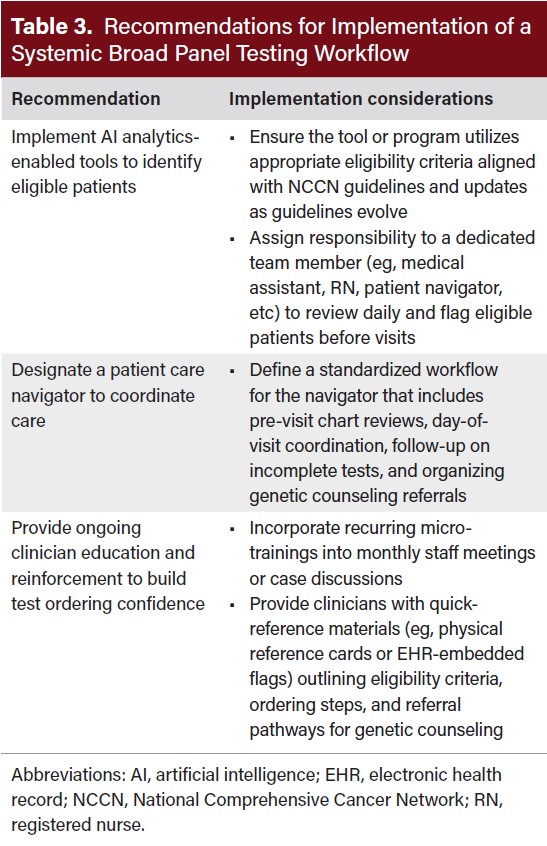
Recommendations for other institutions seeking opportunities to improve their broad panel testing rates for patients with mPC and overcome operational barriers are outlined in Table 3. These recommendations should be interpreted within the context of the study setting: AU is a large communitybased urology practice with dedicated analytics resources and established operational infrastructure. Practices with fewer personnel or technological resources may need to adapt these recommendations based on local workflows, staffing models, and available technology.
Conclusion
Broad panel molecular testing is a critical component to providing optimal care for patients with mPC. In this communitybased urology practice, implementation of EHR-supported tools and workflows was feasible and associated with shortterm improvements in broad panel testing rates. These findings suggest that analytics-supported patient identification, workflow standardization, and clinician engagement may improve adherence to guideline-recommended molecular testing in real-world practice settings. Institutions interested in seeking opportunities to improve their broad panel testing rates may consider EHR-based interventions to aid in the identification of eligible patients, ordering of tests, and monitoring of testing rates over time. Evaluating current broad panel testing rates for patients with mPC is an essential first step to starting the quality improvement journey.
This article has supplementary material, which can be accessed here.
Key Takeaways
- An EHR-supported, guidelines-based care pathway was implemented to improve broad panel germline and somatic testing among patients with mPC in a community urology practice.
- Testing rates increased from 33.5% at baseline to 51.2% at month 2 and remained significantly higher at 49.0% at month 3.
- Analytics-supported patient identification, standardized workflows, and clinician engagement may improve adherence to guideline-recommended molecular testing.
Clinical Pathway Category: Infrastructure & Innovation
This article aligns with the infrastructure & innovation category by examining how EHR data infrastructure, analytics tools, and standardized workflows can be leveraged to support implementation of guideline‑concordant broad panel testing for metastatic prostate cancer in a community urology practice. The study emphasizes practical, scalable approaches to patient identification, measurement of testing gaps, and workflow integration, offering insights into how existing clinical infrastructure can be used to improve consistency and quality of oncology care delivery in real‑world settings.
Author Information
Authors: Jeffrey Marotte, MD1; Katie O’Brien, BS1; Stacy McDonnel, BS1; Urmi Bapat, MD2; Joyce LaMori, MHS, MBA2; Kristi Cohn, MHA3; Phoebe Socha, BS3; Ralph Jonathan Henderson, MD1
Affiliations: 1Arkansas Urology, Little Rock, AR; 2Johnson & Johnson Innovative Medicine, Titusville, NJ; 3Petauri Kinect, New York, NY
Address correspondence to:
Phoebe Socha
Phone: 603-851-0135
Email: phoebe.socha@petauri.com
Disclosures: U.B. and J.L. are employees of Johnson & Johnson. K.C. and P.S. are employees of Petauri Kinect. R.J.H. is the former president of LUGPA and received honoraria from Johnson & Johnson, Myriad, Pfizer, and AstraZeneca for work unrelated to this manuscript.
Funders: This work was financially supported by Johnson & Johnson Innovative Medicine.
Acknowledgements: The authors would like to thank Radha Pachpor for her assistance with the statistical analysis and interpretation of the study data. Her expertise and support were greatly appreciated and contributed to the development of this manuscript.
References
- Key statistics for prostate cancer. American Cancer Society. Updated January 13, 2026. Accessed March 13, 2026. https://www.cancer.org/cancer/types/prostate-cancer/about/key-statistics.html
- Referenced with permission from the NCCN Clinical Practice Guidelines in Oncology (NCCN Guidelines®) for Prostate Cancer V.2.2026. © National Comprehensive Cancer Network, Inc. 2025. All rights reserved. Accessed October 29, 2025. To view the most recent and complete version of the guideline, go online to NCCN.org.
- Giri VN, Knudsen KE, Kelly WK, et al. Implementation of germline testing for prostate cancer: Philadelphia Prostate Cancer Consensus Conference 2019. J Clin Oncol. 2020;38(24):2798-2811. doi:10.1200/JCO.20.00046
- Eastham JA, Auffenberg GB, Barocas DA, et al. Clinically localized prostate cancer: AUA/ASTRO guideline, part I: introduction, risk assessment, staging, and risk-based management. J Urol. 2022;208(1):10-18. doi:10.1097/JU.0000000000002757
- Referenced with permission from the NCCN Clinical Practice Guidelines in Oncology (NCCN Guidelines®) for Genetic/Familial High-Risk Assessment: Breast, Ovarian, Pancreatic, and Prostate V.2.2026. © National Comprehensive Cancer Network, Inc. 2025. All rights reserved. Accessed October 29, 2025. To view the most recent and complete version of the guideline, go online to NCCN.org.
- Lowrance W, Dreicer R, Jarrard DF, et al. Updates to advanced prostate cancer: AUA/SUO guideline (2023). J Urol. 2023;209(6):1082-1090. doi:10.1097/JU.0000000000003452
- Abida W, Armenia J, Gopalan A, et al. Prospective genomic profiling of prostate cancer across disease states reveals germline and somatic alterations that may affect clinical decision making. JCO Precis Oncol. 2017;1:1-16. doi:10.1200/PO.17.00029
- De Sarkar N, Patton RD, Doebley AL, et al. Nucleosome patterns in circulating tumor DNA reveal transcriptional regulation of advanced prostate cancer phenotypes. Cancer Discov. 2023;13(3):632-653. doi:10.1158/2159-8290.CD-22-0692
- Shevach JW, Candelieri-Surette D, Lynch JA, et al. Racial differences in germline genetic testing completion among males with pancreatic, breast, or metastatic prostate cancers. J Natl Compr Canc Netw. 2024;22(4):237-243. doi:10.6004/jnccn.2023.7105
- Bilen MA, Khilfeh I, Rossi C, et al. Homologous recombination repair testing patterns and outcomes in mCRPC by alteration status and race. Clinicoecon Outcomes Res. 2024;16:657-674. doi:10.2147/CEOR.S468680
- Henderson RJ, Bailey RA, Khilfeh I, Reilly J, Svoboda K, Waterhouse D. Integrating broad panel somatic and germline testing in prostate cancer care. JU Open Plus. 2024;2(12):e00127. doi:10.1097/JU9.0000000000000240