Clearing Up Confusion About Cannabis Therapeutics
Clinicians Remain Concerned About Recommending Use
Twenty-nine states and Washington, D.C. currently allow medical cannabis, but concern about the consequences of recommending its use still runs high among practitioners.
“There’s a lot of misapprehension about what it involves and what potential risks a provider is taking—even in a state where cannabis is allowed as a medicine,” said Maria Mangini, PhD, FNP-BC.
But Dr. Mangini, director of the Family Nurse Practitioner Program at Holy Names University, Oakland, California, doesn’t even consider this confusion the biggest roadblock to widespread adoption of cannabis therapeutics.
“Prescribers don’t want to suggest or recommend a medicine about which they have no clinical training,” she said. “The research environment has been severely constricted by prohibition. We’re about 40 years behind where we should be in terms of understanding the way cannabis can be used as a medicine. Some of that information just isn’t available yet.”
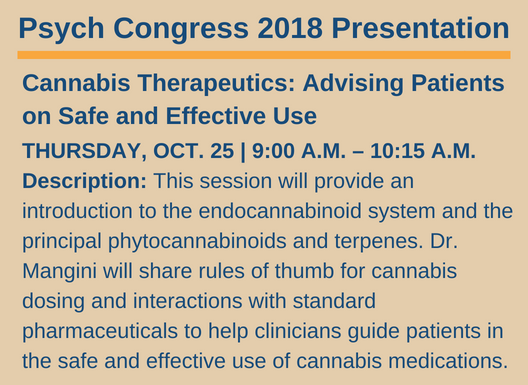 To help clinicians catch up, Dr. Mangini will present “Cannabis Therapeutics: Advising Patients on Safe and Effective Use” at the upcoming Psych Congress. She has 35 years of experience in family practice and women’s health, including 24 years with the primary care practice of Frank Lucido, MD, a pioneer of the medical cannabis movement. Their practice led the way to implementation of California’s Compassionate Use Act of 1996, one of the first medical cannabis laws in the country.
Dr. Mangini estimates the practice has advised several thousand medical cannabis patients over the years. Patients get relief with cannabis from a wide variety of problems, such as pain, insomnia, migraines, and muscle spasms. Calling cannabis a “very safe and effective medicine,” she will share what she has learned from decades of clinical experience, starting with a basic review of cannabis’ physiologic aspects.
The talk will educate prescribers on medical cannabis topics such as drug interactions, genetic polymorphisms, safety practices, and the importance of proper dosing, Dr. Mangini said.
Also Coming up at Psych Congress 2018:
Using Comedy to Confront Mental Illness and Its Public Stigma
Looking at Depression Through an Evolutionary Lens
Future Opportunities in the Treatment of Schizophrenia
She alluded to the high-profile 2014 New York Times column by Maureen Dowd, who wrote about how she overdosed on a pot candy bar in Colorado. “As my paranoia deepened, I became convinced that I had died and no one was telling me,” the Pulitzer Prize winner penned at the time.
Words like this sent many people into a panic about the potential harms of cannabis, Dr. Mangini said. “You can easily get into trouble with orally administered cannabis if you don’t understand how much difference there is between inhalation and oral ingestion.”
(Continued on Page 2)
[pagebreak]
(Page 2 of 2)
Also during Dr. Mangini’s Psych Congress session, she will review terpenes, the group of substances that gives different cannabis cultivars their smell. She gave the example of linalool, a terpene present in many cannabis plants as well as lavender, which people have used as a sedative in aromatherapy applications for generations. “Cannabis plants high in linalool might be good to help people sleep or relax,” she said.
Along with the exact effects of terpenes, other areas need further investigation, she said. For example, relative to the general paucity of cannabis research, much is known about tetrahydrocannabinol (THC), the cannabinoid that causes the euphoria felt by cannabis users. Yet, about 8 other major cannabinoids potentially could be included in therapeutics.
Dr. Mangini also plans to discuss concerns she frequently hears from patients. Senior citizens, in particular, often worry that cannabis use will become a gateway to drug addiction, and patients always ask about the safety of cannabidiol (CBD) oil extracted from hemp plants.
Register now for Psych Congress 2018, taking place Oct. 25-28 in Orlando, Fla.
For the latter, the answer doesn’t come easily. Minimal control of added ingredients and questionable growing practices make it difficult for her to recommend CBD oil, she said. “Hemp is used for bioremediation—they plant it at Superfund sites, and it’s not a food crop, so they can spray it with anything.”
Patients also want to discuss vaping, a popular and convenient way to reap the benefits of cannabis. Dr. Mangini, who prefers to recommend tinctures or edibles, remains conservative about endorsing the vaporization of cannabis concentrates. The impact of additives that may be in concentrates or chemicals that may be added to enhance the flow of the concentrate toward the heat source aren’t well-studied and may have unwanted effects.
“Even for those who feel knowledgeable about cannabis, there is still a lot to be learned,” she said.
—Mike Bederka