Late-Onset “Clip Opening While Locked” of a Mitraclip G5 XTW With Recurrence of Mitral Regurgitation
© 2026 HMP Global. All Rights Reserved.
Any views and opinions expressed are those of the author(s) and/or participants and do not necessarily reflect the views, policy, or position of the Journal of Invasive Cardiology or HMP Global, their employees, and affiliates.
J INVASIVE CARDIOL 2026. doi:10.25270/jic/26.00325. Epub November 19, 2026.
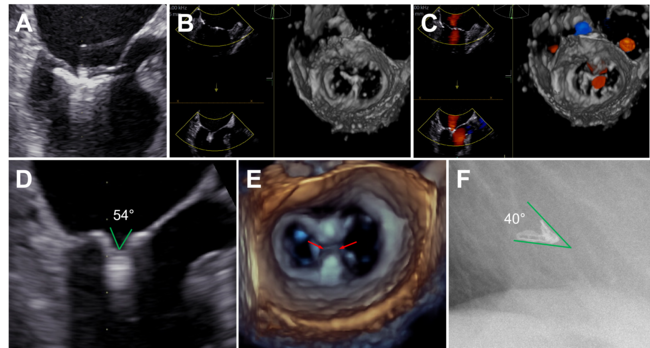
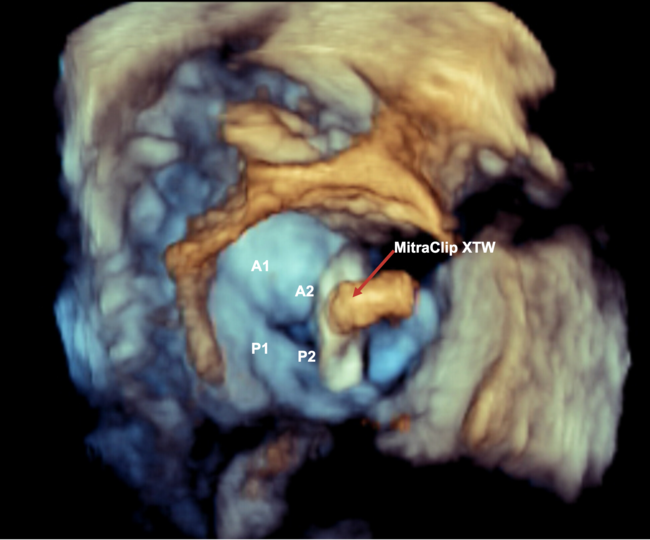
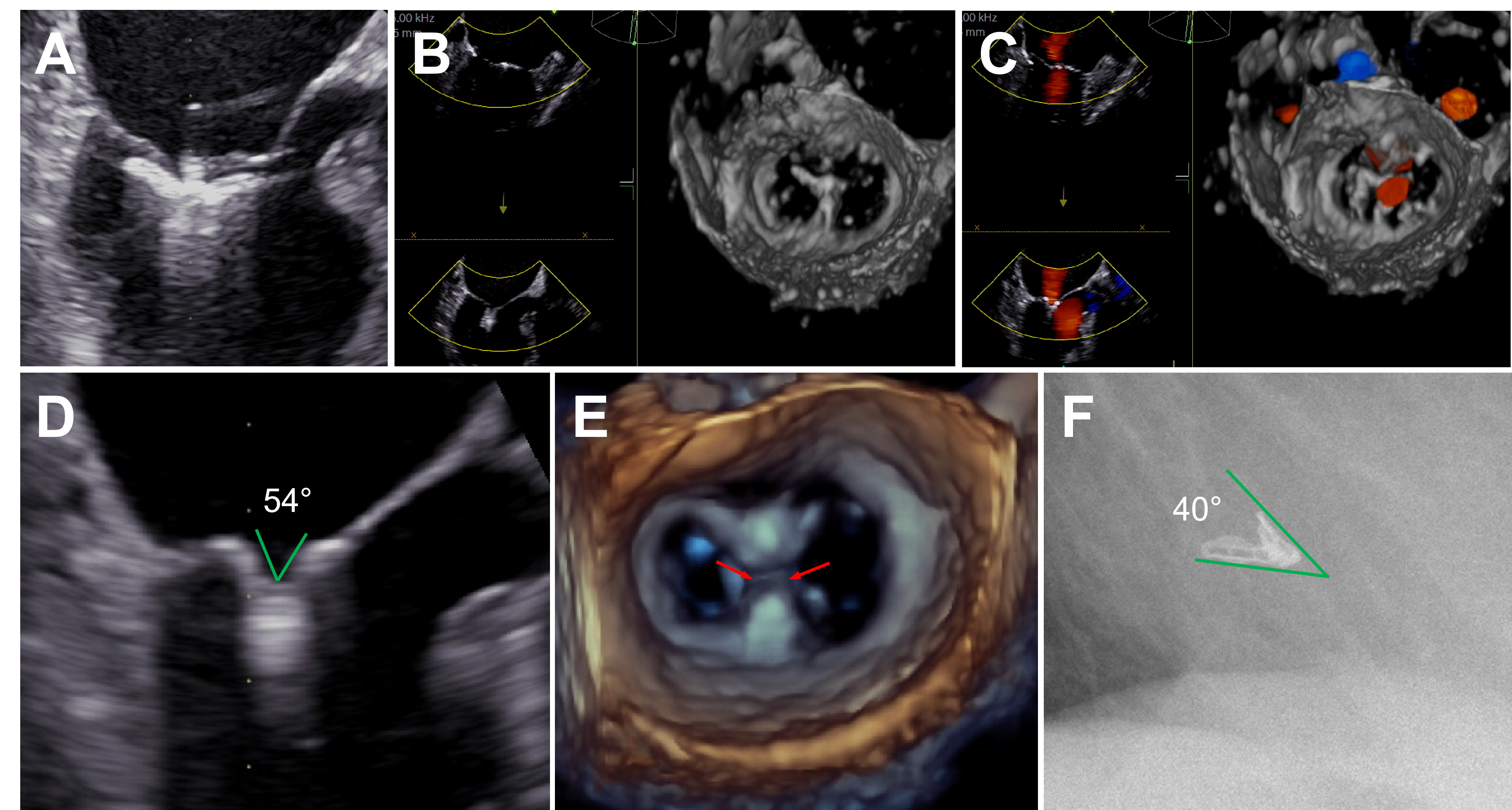
A 78-year-old woman was admitted to the hospital electively for transcatheter edge-to-edge repair (TEER) because of symptomatic (New York Heart Association functional class III) severe atrial secondary mitral regurgitation (MR) (Video 1). TEER was performed with a MitraClip G5 XTW (Abbott) in the central A2/P2 position with deep leaflet insertion (Figure A, Video 2), and there was significant reduction of the MR after final release of the MitraClip (Figure B and C, Video 3). Transthoracic echocardiography on day 2 following TEER confirmed a good result without any abnormalities.
Three months later, the asymptomatic patient was referred again for further evaluation of a recurrence of moderate MR. Transesophageal echocardiography (Figure D and E [arrows]) and chest X-ray (Figure F) revealed an opening of the clip up to 40° to 54° (Video 4), with moderate MR originating centrally from the clip (Video 5). Leaflet detachment was not found.
In view of the absence of symptoms and the good left ventricular function with sustained reduction in pulmonary artery pressure, we decided to proceed with a further conservative approach of guideline-directed medical therapy.
“Clip opening while locked” occurring immediately after MitraClip G4 deployment has been described only twice in the literature; it has also been described after a longer period following MitraClip TEER,1,2 as shown here. In contrast to a single-leaflet detachment, which is usually caused by insufficient leaflet insertion or inadequate leaflet grasping, the underlying mechanism of “clip opening while locked” is unknown; however, it has been suggested that the nature and mobility of the valve leaflets and the characteristics of the MitraClip G4 and G5 devices may be involved.2
Affiliations and Disclosures
Christof Burgdorf, MD; Eugenios Kekes, MD; Denise Härter, MD; Bjoern Andrew Remppis, MD; Ulrich Schäfer, MD
From the Department of Cardiology, Heart and Vascular Centre Bad Bevensen, Germany.
Disclosures: The authors report no financial relationships or conflicts of interest regarding the content herein.
Consent statement: The authors confirm that informed consent was obtained from the patient for the case report described in the manuscript and to the publication thereof, including any and all images.
Address for correspondence: Christof Burgdorf, MD, Department of Cardiology, Heart and Vascular Centre Bad Bevensen, Römstedter Straße 25, Bad Bevensen 29549, Germany. Email: c.burgdorf@hgz-bb.de
References
1. Yashige M, Zen K, Yamano T, Matoba S. Critical clip opening while locked: a rare phenomenon after transcatheter edge-to-edge mitral valve repair. Eur Heart J Case Rep. 2024;8(4):ytae148. doi:10.1093/ehjcr/ytae148
2. Matsuzoe H, Mizutani K, Onishi NS, et al. Clip opening while locked after transcatheter edge-to-edge mitral valve repair with different onset times: a case series. Eur Heart J Case Rep. 2024;8(7):ytae322. doi:10.1093/ehjcr/ytae322