Five-Year Clinical Outcomes Comparing the Amulet Vs WATCHMAN FLX for Left Atrial Appendage Closure in Patients With Atrial Fibrillation
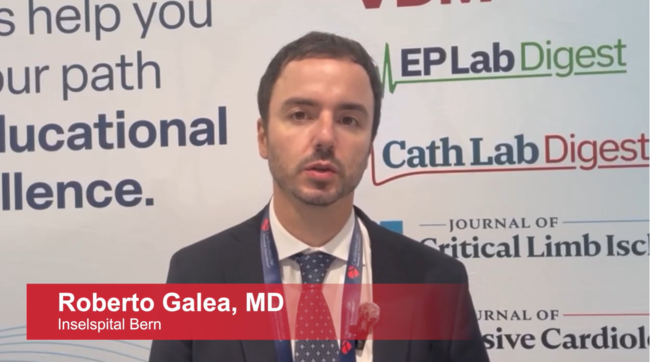
In this interview from TCT 2026, Dr Roberto Galea discusses findings from his SWISS-APERO abstract, reporting a numerical trend toward fewer composite ischemic events with Amulet compared with WATCHMAN left atrial appendage closure devices at 5 years, driven mainly by cardiovascular death. He discusses anatomical considerations for device selection and emphasizes that the 221-patient trial was not powered to establish definitive differences in clinical outcomes.
Could you please provide a quick review of your trial, including the differences from the prior Amulet-IDE trial?
Thanks for the opportunity. The SWISS-APERO trial is a multicenter randomized clinical trial, investigator initiated, that was performed between 2018 and 2021 at 8 European centers. The sponsor was the University Hospital of Bern and it was partially supported by a research grant from Abbott.
The study randomized patients with a clinical indication for left atrial appendage closure (LAAC) to receive either Amulet or WATCHMAN FLX. The results that we presented at this conference, TCT 2026, are the 5-year clinical outcomes. The study randomized 221 patients between June 2018 and May 2021. The patients had high bleeding risk and had LA morphology suitable for both devices and without LA thrombus.
This study and the design is quite different from the previous Amulet-IDE for 2 main reasons: the first one is that in the WATCHMAN group only WATCHMAN FLX—at least for 80% of the cases—patients randomized to WATCHMAN received the WATCHMAN FLX, and the WATCHMAN 2.5 was limited just to the first 20% of patients. The other difference is that the antithrombotic therapy between the 2 study groups was identical, whereas we know that the oral anticoagulation prevailed in the WATCHMAN arm in the Amulet-IDE trial as compared to the Amulet group.
Are you seeing anything from your studies that indicate that certain patients may be better suited to one device over another, Amulet or WATCHMAN, or is this more of a case of what is available at your institution?
This is a good question. Actually, I still don't see any clinical predictor, at least related to the clinical characteristics of the patient, that suggests one device is better than the other one. We still have some anatomy that better fits Amulet, such as an LAA lobed with a proximal side lobe that cannot be well sealed by a single-closure system like in the WATCHMAN device. On the other hand, we know also that in LAA with a pyramidal shape, the lobe of the Amulet (not the new Amulet that has a different structure, but the traditional Amulet) still struggles to adapt to a pyramidal shape that you can find in selected cases.
Have these results changed your views of these devices, or is it what you expected to find?
What we observed in the five years clinical outcomes of the SWISS-APERO showed us a trend toward a lower rate of composite ischemic outcomes in the Amulet as compared to a WATCHMAN group; this numerical difference was driven mostly by cardiovascular death. The reason and the mechanism of why we found this difference is still unclear. We tried to test several potential factors as device-related thrombus (DRT) or possible DRT or peridevice leak as predictors of this ischemic outcome but due to our sample sites we failed to find this association, so this finding is still unclear. If we think about the potential reason of this difference is that Amulet better seals the neck of the LAA and is something that we might intuitively expect from this device.
So the trend was not a surprise because we might expect a better coverage of the LAA neck with the double-closure system. But whether the difference we observed in terms of clinical ischemic outcomes is due to chance rather than a real difference between the 2 devices still needs better investigation.
Are there any other questions that remain unanswered from this study, and is there anything about the design of this study that limited your ability to get definitive results?
I think we need an adequately powered randomized clinical trial that confirms if there is a difference in terms of ischemic outcomes between the 2 groups. The SWISS-APERO trial with 221 patients, unfortunately, was not designed to give a definitive answer about the difference in terms of clinical endpoint.
If you could design a future study, what would it look like?
I would probably have another study with a similar design with SWISS-APERO, so that means with identical post-antithrombotic therapy after LAAC, that compares these 2 devices. Probably I would include the new iterations of both devices: the Amulet 360 and the WATCHMAN FLX Pro. And the sample size should be based on what we observed at 5 years in the SWISS-APERO.
Roberto Galea, MD, is an interventional cardiologist at Inselspital Bern.
The transcript has been edited lightly for clarity.
© 2026 HMP Global. All Rights Reserved.
Any views and opinions expressed are those of the author(s) and/or participants and do not necessarily reflect the views, policy, or position of the Journal of Invasive Cardiology or HMP Global, their employees, and affiliates.