Left Atrial Appendage Closure for AF Management: CHAMPION or Fading Star?
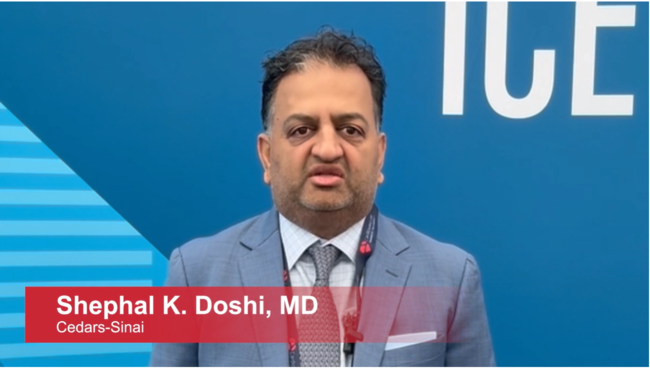
At TCT 2026, the Journal of Invasive Cardiology spoke with Shephal K. Doshi, MD, following his Structural Heart Disease Controversies session, “Left Atrial Appendage Closure for AF Management: CHAMPION or Fading Star?” He discusses how CHAMPION-AF and OPTION are informing the use of left atrial appendage closure as an alternative to long-term oral anticoagulation for stroke prevention in selected patients with atrial fibrillation, highlighting clinical outcomes, patient-centric decision-making, and remaining evidence gaps.
What for you are the most important takeaways from the speakers at your Controversies session?
The field of left atrial appendage closure (LAAC) has been inundated with a lot of recent data, and so a lot of clinicians find it a little bit overwhelming in terms of the multiple different studies that have been published. I want to spend a minute just focusing on our study, the CHAMPION-AF trial, which was the largest study done to date, looking at appendage closure as an alternative, essentially, to Eliquis or direct oral anticoagulants in patients who have no high-risk features of prior bleeding or history of prior bleeding.
In the last year, there have been multiple trials published looking at appendage closure in patients who have atrial fibrillation (AF), either as an alternative to anticoagulation in high-risk patients, patients who have had prior bleeding or who are high-risk for bleeding, or high-risk patients who have a moderate risk of bleeding or low risk of bleeding. as defined by the standard score, what we call HAS-BLED. So, the study that focused a lot on this that we talked about in Controversies was our study, the CHAMPION-AF trial, which is the largest study to date, looking at 3000 patients who are randomized to either receiving Eliquis as an anticoagulant or having appendage closure with the WATCHMAN FLX device (Boston Scientific).
And again, we were looking at patients that didn't really have a prior history of bleeding. The risk of stroke was moderately high, CHA₂DS₂-VASc 3.5, and the risk of bleeding based on the HAS-BLED score was on the lower side, 1.3. And the question was, was the data from the study enough for us to recommend appendage closure for patients who don't have a prior history of bleeding or high risk of bleeding?
The way we looked at it was 2 ways: we looked at how appendage closure compared with bleeding vs Eliquis, simply postprocedural bleeding, and how did it compare to an endpoint looking at stroke, systemic embolism, and cardiovascular death, whether you had a WATCHMAN device or whether you're on blood thinners? We called that the primary efficacy endpoint. What our study showed is, if you take patients who are at an average age in their early 70s, CHA₂DS₂-VASc score of 3.5, HAS-BLED score of 143, essentially the AFib patient whom we believe to be tolerating their Eliquis, we found that that composite rate of stroke, systemic embolism, and cardiovascular death was noninferior to that of talking Eliquis at 3 years.
Now, if we take a look at just the endpoint of ischemic stroke—we weren't powered to look at that, and we will in 5 years, just that endpoint alone—the numerical difference was very small. It took 100 patients to be on anticoagulant for 3 years to have a difference of just 1 stroke, comparing the blood thinner to appendage closure. And what was really important was a stroke substudy that was presented as a late breaker at this TCT meeting, which basically showed us that if you look at the types of strokes, the patients that had appendage closure had a lower rate of disabling stroke. So yes, numerically, there was that 1 stroke difference at 3 years, but when you look at strokes, they were less disabling if you had an appendage closure with the WATCHMAN device compared with anticoagulants.
In the Controversies section, the real question is, do we have data to recommend this as a first-line therapy in patients who are tolerating their anticoagulants? And I say, what came out of that for me is I think we have enough data, and I feel very confident to at least have the discussion with the patient. We should discuss this: obviously with bleeding, we were superior to taking anticoagulants, and from stroke we saw the difference is very small and less disabling. So this is where it warrants a discussion with a patient: what are your goals? What do you think about when you think about taking long-term anticoagulants? Are you someone that can take their anticoagulants 90% of the time? Because that's what the compliance was in the study to get those numbers. If a patient says to you, “Look, doc, for the rest of my life, being on blood thinners is a challenge for me for a multitude of reasons and I'm not sure I'm going to be able to maintain this forever, nor am I taking them compliantly,” then I think we absolutely have the data to recommend appendage closure, as long as you can do it as safely as we did it in our study, that is, with this device using current techniques.
If a patient says to me, “Look, I have no issues taking blood thinners, and my biggest risk, my biggest worry, is that 1 little stroke difference that could be relevant for me,” then for right now, we would say maybe you should stay on your anticoagulant. Now, in 2 years, we'll have the data to look directly at ischemic stroke, looking at absolute numbers. And it really will then depend on a patient-based discussion. But right now, I think most of us felt from the Controversies talk that we have robust data to recommend this as a first-line option, given this is something that a patient is considering.
Do we see what we are learning from trials such as CHAMPION and OPTION being implemented in practice today, or are there any barriers to implementation?
Certainly, if the discussion is had with the patients, we do see CHAMPION and OPTION already happening in patients. Many patients come to us already wanting to have appendage closure and wanting to get off anticoagulants. Now with these trials, we actually have absolute numbers. We can tell them, “Look, what is your stroke risk reduction or what is the risk of stroke on Eliquis? What is your risk of stroke with WATCHMAN?” We actually have the data now that we can have an educated discussion so patients have an understanding.
OPTION is a much easier implementation because a lot of patients come to have an ablation procedure thinking “If I do this ablation, I get off of anticoagulant therapy.” Now, we actually have data to say if you get an ablation and you get your appendage closed, what happens to your stroke risk? What we see consistently from the subset of patients in CHAMPION who had a prior history of AF ablation, also from OPTION and other studies, that the group that consistently has the lowest rate of stroke is a group that has had ablation and has had appendage closure, even lower than the group that stays on anticoagulation after ablation.
So, there clearly is a lot of data that allow us to at least have an educated discussion with patients, and we find that many patients come to us for ablation seeking a means to get off of anticoagulation. That's where the combination of doing appendage closure and isolation of the pulmonary veins or ablation has become almost a first-line therapy.
Is there any additional follow-up or evidence that you need to recommend wider adoption of LAAC?
In 2026, I feel very confident that for the right patient, the data is here. Now, for all patients, we really need to understand what happens at 5 years. So we have 2 more years: in 2028, we will present the data specifically looking at ischemic stroke, but that will still have to be taken in the context of the alternative, which is anticoagulation. So, in 2 years, if we see that the bleeding rates continue to separate and there's much more bleeding, then we will still have to have that patient discussion.
We've looked at smaller studies that have looked at what matters to patients the most and what you find surprising—or not so surprising—is patients say having intracranial hemorrhage or having a major stroke, a disabling stroke, is worse than death. And we recognize that that's what patients fear the most. But surprisingly, what comes in second consistently is having major catastrophic bleeding comes in before a minor stroke. So, I think these things are all relevant. We will have absolute numbers, but we're always going to have the patient discussion. The days of paternalistic medicine, where we know what's best for you Patient Y and Patient X, are over. We really need to have patients involved in these discussions, and patients are taking a more aggressive stance putting their health first and their goals first, so I think all of this will allow us to make a better decision that's patient centric.
Is LAAC a CHAMPION or fading star?
Certainly, we believe that LAAC in general is growing and CHAMPION-AF gives us an option and certainly is a champion. The fading star really is going to be oral anticoagulant therapy because patients don't want it, clinicians also seek an alternative because of the longitudinal follow-up they have to give when someone is on anticoagulant therapy. So, the fading star in my mind is anticoagulation and certainly CHAMPION is blazing forward.
Shephal K. Doshi, MD, is electrophysiologist at Cedars-Sinai.
The transcript has been edited lightly for clarity.
© 2026 HMP Global. All Rights Reserved.
Any views and opinions expressed are those of the author(s) and/or participants and do not necessarily reflect the views, policy, or position of the Journal of Invasive Cardiology or HMP Global, their employees, and affiliates.