Collateral Channel Crossing Failure During Retrograde Chronic Total Occlusion Percutaneous Coronary Intervention: Predictors and Associated Procedural Outcomes From a Multicenter Registry
© 2026 HMP Global. All Rights Reserved.
Any views and opinions expressed are those of the author(s) and/or participants and do not necessarily reflect the views, policy, or position of the Journal of Invasive Cardiology or HMP Global, their employees, and affiliates.
J INVASIVE CARDIOL 2026. doi:10.25270/jic/26.00179. Epub October 29, 2026.
Key Clinical Summary
- Collateral channel crossing failure is a common early barrier during retrograde chronic total occlusion percutaneous coronary intervention (CTO PCI), identifying procedures with lower technical success and more complications.
- Corkscrew collateral morphology and CC0 connection grade were associated with higher odds of crossing failure, whereas better-developed CC2/CC3 connections were associated with lower odds.
- Repeated collateral attempts may mark escalating intraprocedural difficulty and support early strategy reassessment, including an alternative collateral, conversion to an antegrade approach, or procedural termination.
Abstract
Objectives. Retrograde chronic total occlusion percutaneous coronary intervention (CTO PCI) may fail at several stages. The authors evaluated factors associated with collateral channel crossing failure during retrograde CTO PCI and its associations with technical success and procedural complications.
Methods. The authors analyzed procedures from a multicenter CTO PCI registry with attempted retrograde or retrograde-assisted strategies and recorded the retrograde result. The primary endpoint was collateral channel crossing failure. Secondary endpoints included retrograde success, overall technical success, collateral/coronary perforation, donor-vessel injury, vascular complications, and an extended complication composite.
Results. Among 577 retrograde CTO PCI procedures with recorded retrograde result, retrograde success was achieved in 375 (65.0%), and collateral channel crossing failure occurred in 135 (23.4%). Overall technical success was lower with collateral crossing failure than without it (51.9% vs 88.7%), with higher rates of collateral and coronary perforation, vascular complications, and the extended complication composite. In the primary adjusted model restricted to procedures with known collateral connection (CC) grade, corkscrew collateral morphology (adjusted odds ratio [OR], 6.85; 95% CI, 3.63-12.91) and CC0 grade (adjusted OR, 4.70; 95% CI, 1.97-11.26) were associated with higher odds of crossing failure, whereas CC2/CC3 grade was associated with lower odds (adjusted OR, 0.45; 95% CI, 0.22-0.92).
Conclusions. Collateral channel crossing failure was common in retrograde CTO PCI and was associated with lower technical success and greater complication burden. Unfavorable collateral morphology was associated with a higher risk of crossing failure; repeated collateral attempts may indicate escalating procedural difficulty and may warrant strategy reassessment.
Introduction
The retrograde approach has become an essential component of contemporary chronic total occlusion percutaneous coronary intervention (CTO PCI), particularly for anatomically complex lesions where antegrade crossing is unlikely to be straightforward. Structured CTO PCI algorithms emphasize careful assessment of proximal cap ambiguity, occlusion length, distal vessel quality, collateral suitability, and prior procedural failure when selecting an antegrade, retrograde, or hybrid strategy.1-4
Despite these advances, retrograde CTO PCI remains technically demanding. The procedure requires several sequential steps, including selection of an appropriate collateral channel, safe collateral crossing, retrograde CTO segment crossing, externalization or controlled antegrade-retrograde tracking, and final lesion treatment. Failure at any of these stages may prevent successful retrograde recanalization. Therefore, retrograde failure should not be considered a single homogeneous endpoint.5-8
Collateral channel crossing is the first critical technical barrier in retrograde CTO PCI. If the collateral channel cannot be crossed, the retrograde route cannot be established, and the operator must either select an alternative collateral channel, convert to an antegrade strategy, or terminate the procedure. Collateral channel characteristics, including collateral size, collateral connection grade, tortuosity, reverse bends, continuous bends, corkscrew morphology, and septal-channel crossing features, have been associated with retrograde feasibility and collateral tracking success.7-12
However, most registry analyses have evaluated retrograde failure as a composite endpoint, and prior collateral-focused studies have largely emphasized the feasibility of collateral tracking or scoring systems. Less is known about collateral channel crossing failure as a distinct early failure stage in retrograde CTO PCI, and whether this stage-specific failure identifies procedures with lower technical success or a greater complication burden.
We therefore analyzed retrograde CTO PCI procedures from a multicenter registry to identify clinical, angiographic, and collateral-pathway factors associated with collateral channel crossing failure and to evaluate their association with retrograde success, overall technical success, and procedural complications.
Methods
Study design and population
This retrospective, procedure-level analysis was performed using a prospectively maintained multicenter CTO PCI registry including consecutive CTO PCI procedures performed at 3 centers between January 2019 and February 2026. CTO was defined as complete coronary occlusion with Thrombolysis in Myocardial Infarction (TIMI)-0 flow and an estimated duration of at least 3 months, consistent with Chronic Total Occlusion Academic Research Consortium (CTO-ARC) consensus definitions.13 For the present analysis, we included procedures in which a retrograde or retrograde-assisted strategy was attempted at any point during the procedure, and the retrograde procedural result was recorded. Retrograde-assisted strategy was defined as any procedure in which a retrograde route was used, including bailout or combined antegrade-retrograde involvement, as recorded in the registry. Procedures without recorded retrograde involvement and procedures with retrograde involvement but missing or unknown retrograde result were excluded from the retrograde-specific analytic cohort. Each registry entry represented a CTO PCI procedure rather than a unique patient or lesion.
The registry analysis was approved by the Ethics Committee of Necmettin Erbakan University (approval number 2026/6397; date: 13 March 2026), was conducted in accordance with the Declaration of Helsinki, and the requirement for informed consent was waived because of the retrospective nature of the study. Procedures were performed at high-volume CTO PCI centers with established CTO PCI programs during the registry period. Operator-level lifetime CTO PCI and retrograde CTO PCI volumes at the onset of the registry were not systematically captured; therefore, individual operators could not be reliably classified according to prior experience, and formal operator-specific learning curves could not be constructed.
Definitions and endpoints
The primary endpoint was collateral channel crossing failure, defined as failure to establish a usable retrograde collateral route at the procedure level, based on the final recorded retrograde procedural result rather than each individual collateral attempt. Retrograde procedural result was categorized as retrograde successful, collateral not crossed, lesion not crossed by wire, or lesion not crossed by device.
Secondary endpoints included retrograde success, overall technical success, collateral perforation, coronary perforation, donor-vessel dissection or thrombus, vascular complications, and an extended procedural-complication composite. Overall technical success was defined as successful CTO recanalization with final TIMI-3 antegrade flow and residual stenosis of less than 30% in the target vessel. The extended procedural-complication composite included procedure-related death, myocardial infarction (MI), stroke, emergency repeat PCI, emergency CABG, donor-vessel dissection or thrombus, collateral perforation, coronary perforation, and major vascular complications. Procedural complications were site-reported according to registry definitions and counted when the corresponding registry field was explicitly coded positive. MI and stroke were used as site-coded in-hospital registry fields, without central adjudication or post hoc reclassification to standardized definitions. Composite endpoints were counted once per procedure, whereas individual components were non-mutually exclusive. Detailed operational rules are provided in the Supplemental Methods.
Collateral-pathway variables included collateral connection (CC) grade, reverse bend of greater than 90 degrees, continuous bends, corkscrew morphology, and number of recorded collateral attempts. CC grade was recorded according to the CC size grading used in CTO PCI literature. In this grading system, CC0 indicates no continuous connection, CC1 indicates a threadlike continuous connection, CC2 indicates a side branch-like continuous connection, and CC3 indicates a direct connection of greater than 1 mm in diameter. The original Werner description included CC0 through CC2, whereas CC3 has been used in later CTO literature but was not part of the original description. Accordingly, CC2 and CC3 were combined for analysis as better-developed collateral connections.14,15 The term corkscrew morphology was used to describe the angiographic pattern defined in the J-Channel score as 3 or more continuous bends with a vessel amplitude-to-vessel diameter ratio of less than or equal to 2.11 Collateral morphology variables were recorded by the treating operators and were not independently adjudicated or retrospectively reclassified by a core laboratory. Because the number of collateral attempts is partly determined during the procedure, it was interpreted as an intraprocedural difficulty marker rather than a purely preprocedural predictor. Procedures with zero recorded collateral attempts or missing collateral-attempt counts were retained in the retrograde-result cohort but were not included in the main collateral-attempt gradient figure; zero recorded attempts may reflect absent or incomplete recording of attempted channels rather than absence of collateral manipulation.
Statistical analysis
Continuous variables were summarized as median and interquartile range, and categorical variables as counts and percentages. Baseline, angiographic, collateral-pathway, procedural, and outcome variables were compared according to the presence or absence of collateral channel crossing failure. Mann-Whitney U tests were used for continuous variables, and chi-square or Fisher's exact tests were used for categorical variables, as appropriate.
Multivariable logistic regression was used to identify variables associated with collateral channel crossing failure. The primary adjusted model was restricted to procedures with known CC grade to avoid treating unknown or missing CC grade as an anatomic predictor. Candidate variables were selected based on clinical relevance and availability before outcome analysis and included prior coronary artery bypass graft, stump morphology, severe calcification, distal opacification, target vessel, CC grade, corkscrew collateral morphology, and reverse bend.
A full-cohort sensitivity model retained unknown/missing CC grade as a separate category. An exploratory model additionally included 3 or more collateral attempts to evaluate the association of intraprocedural collateral-search complexity with collateral crossing failure. Additional adjusted models evaluated the association of collateral crossing failure with overall technical success and the extended procedural-complication composite.
Model discrimination was assessed using the area under the receiver-operating characteristic curve (AUC). Sensitivity analyses evaluated the robustness of the primary model using the full cohort with unknown/missing CC grade retained as a separate category; after additional adjustment for age, sex, estimated glomerular filtration rate (eGFR), and center; after restricting the collateral-attempt analysis to procedures with at least 1 recorded collateral attempt; and after additional adjustment for calendar year as an indirect assessment of possible temporal learning or changes in case selection. Because complication events were relatively infrequent, the extended-complication model was repeated using penalized logistic regression. All statistical tests were 2-sided, and a P-value of less than 0.05 was considered statistically significant.
Results
Study population and retrograde procedural results
Among 2375 CTO PCI procedures in the registry, 588 involved a retrograde or retrograde-assisted strategy. Eleven of these procedures had missing or unknown retrograde result coding, leaving 577 procedures with a recorded retrograde procedural result for the retrograde-analysis cohort (Figure 1). Retrograde success was achieved in 375 procedures (65.0%). Collateral channel crossing failure occurred in 135 procedures (23.4%), whereas the lesion was not crossed by wire in 48 procedures (8.3%) and was not crossed by device in 19 procedures (3.3%). Overall technical success was achieved in 462 procedures (80.1%). Additional descriptive distributions, including detailed collateral-attempt categories, retrograde success-vs-failure comparisons, and pathway distributions, are provided in Supplemental Tables 1 through 4.
Clinical, angiographic, and collateral-pathway characteristics
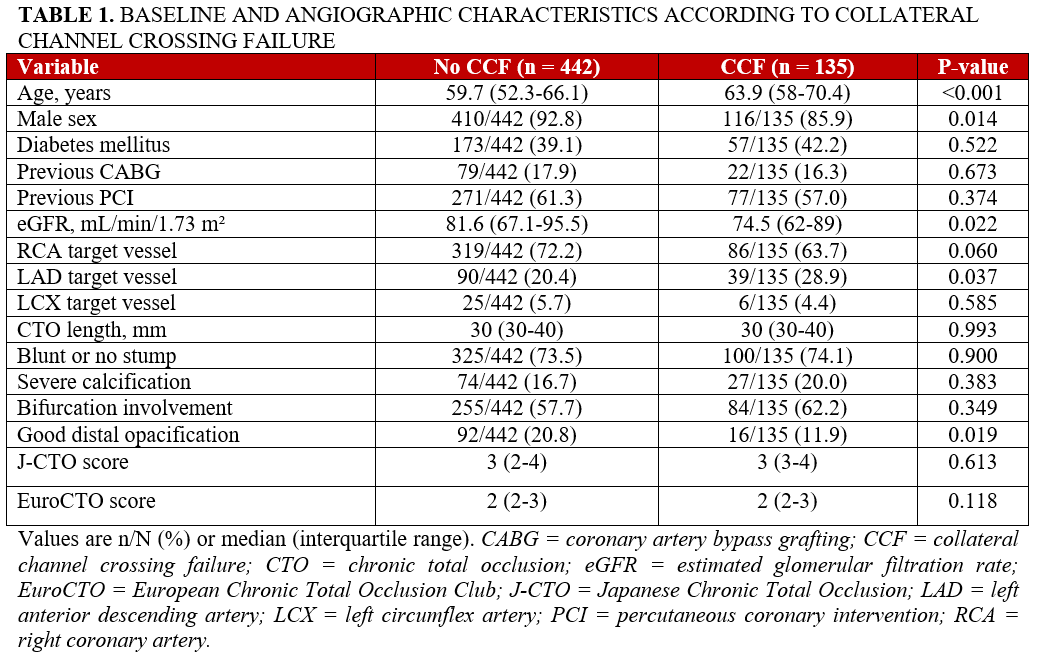
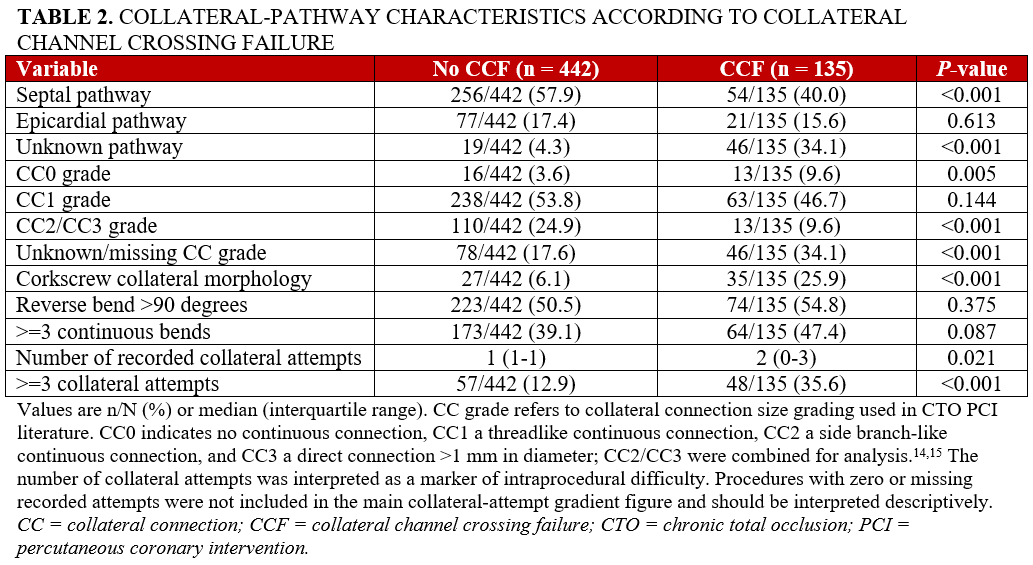
Clinical and angiographic characteristics according to collateral crossing failure are shown in Table 1. Collateral-pathway characteristics differed substantially between procedures with and without collateral crossing failure (Table 2). Corkscrew collateral morphology was more frequent in procedures with collateral crossing failure than in those without collateral crossing failure. CC0 grade and unknown/missing CC grade were also more common in procedures with collateral crossing failure, whereas CC2/CC3 grade was less common. The unknown/missing collateral categories should be interpreted as markers of incomplete angiographic characterization rather than as anatomical or biological predictors.
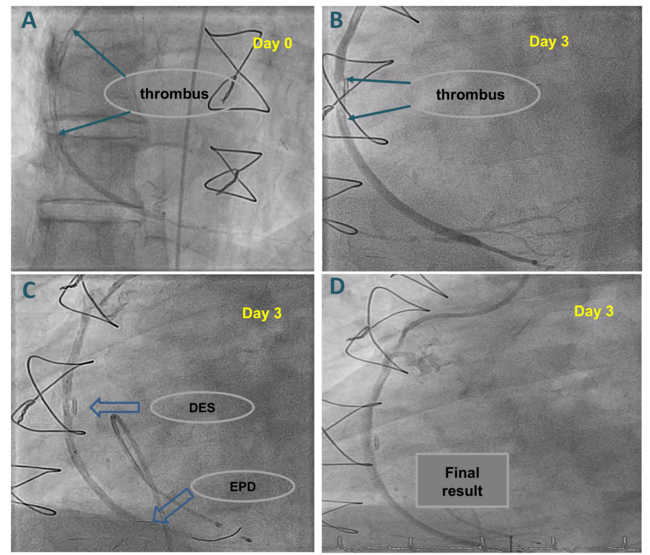
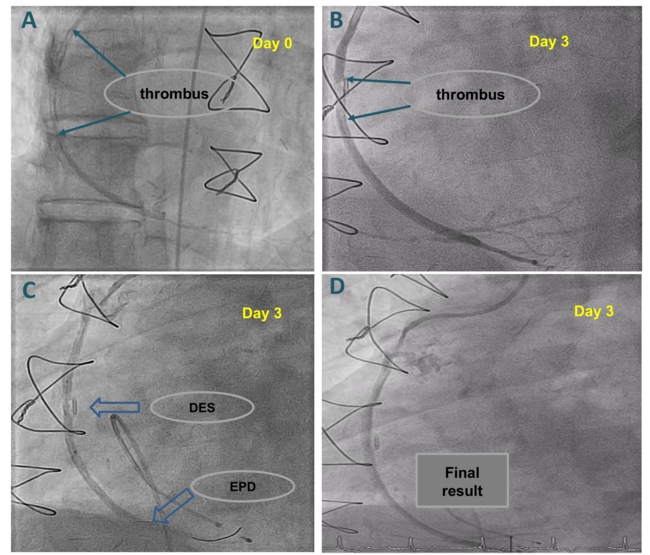
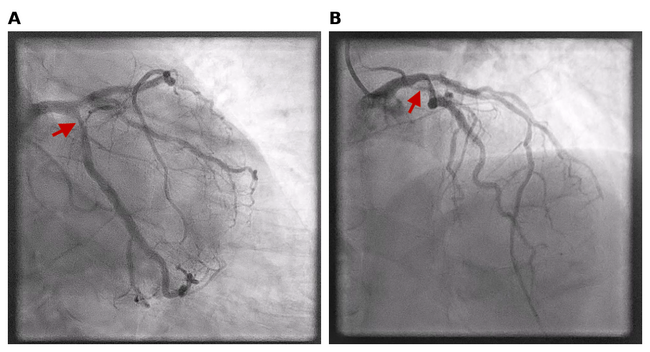
Representative angiographic examples of corkscrew collateral morphology, a CC0 septal collateral selected for retrograde crossing, successful crossing of the same septal collateral using the surfing technique, and the final angiographic result are provided in Supplemental Figure 1 and Videos 1 through 3.
Procedural outcomes associated with collateral crossing failure
Procedural outcomes according to collateral crossing failure are shown in Table 3. Procedures with collateral crossing failure had substantially lower overall technical success than those without (51.9% vs 88.7%). Collateral crossing failure was also associated with higher rates of collateral perforation, coronary perforation, vascular complications, and the extended procedural-complication composite. Donor-vessel dissection or thrombus was uncommon and did not occur more frequently in procedures with collateral crossing failure.
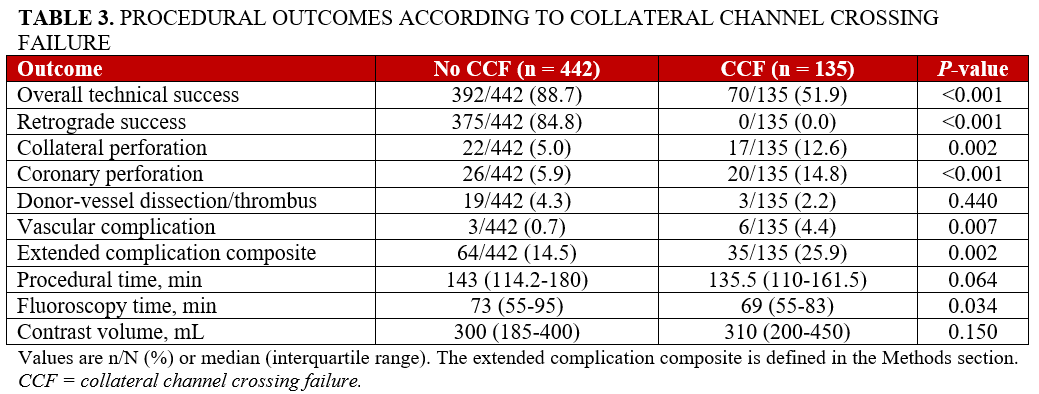
Procedural duration was not longer in procedures with collateral crossing failure. Median procedural time and fluoroscopy time were numerically similar or lower in procedures with collateral crossing failure, whereas contrast volume was numerically higher. This pattern suggests that collateral crossing failure was more closely associated with lower success and higher complication burden than with prolonged procedural duration.
Number of collateral attempts
Among procedures with at least 1 recorded collateral attempt, retrograde success decreased progressively with increasing numbers of attempted collateral channels. Retrograde success was 85.4% when 1 collateral channel was attempted, 69.1% when 2 collateral channels were attempted, and 41.0% when 3 or more collateral channels were attempted. In parallel, collateral crossing failure increased from 5.7% with 1 attempted channel to 21.8% with 2 attempted channels and 45.7% with 3 or more attempted channels (Figure 2). Because the number of attempted collateral channels is partly determined during the procedure, this variable was interpreted as an intraprocedural marker of collateral-search difficulty rather than a purely preprocedural predictor.
Adjusted analyses
In the primary adjusted model, restricted to procedures with known CC grade, corkscrew collateral morphology and CC0 grade were associated with higher odds of collateral crossing failure, whereas CC2/CC3 grade was associated with lower odds. Reverse bend was also associated with higher odds in this restricted model. The model showed acceptable discrimination, with an AUC of 0.76 (Table 4).
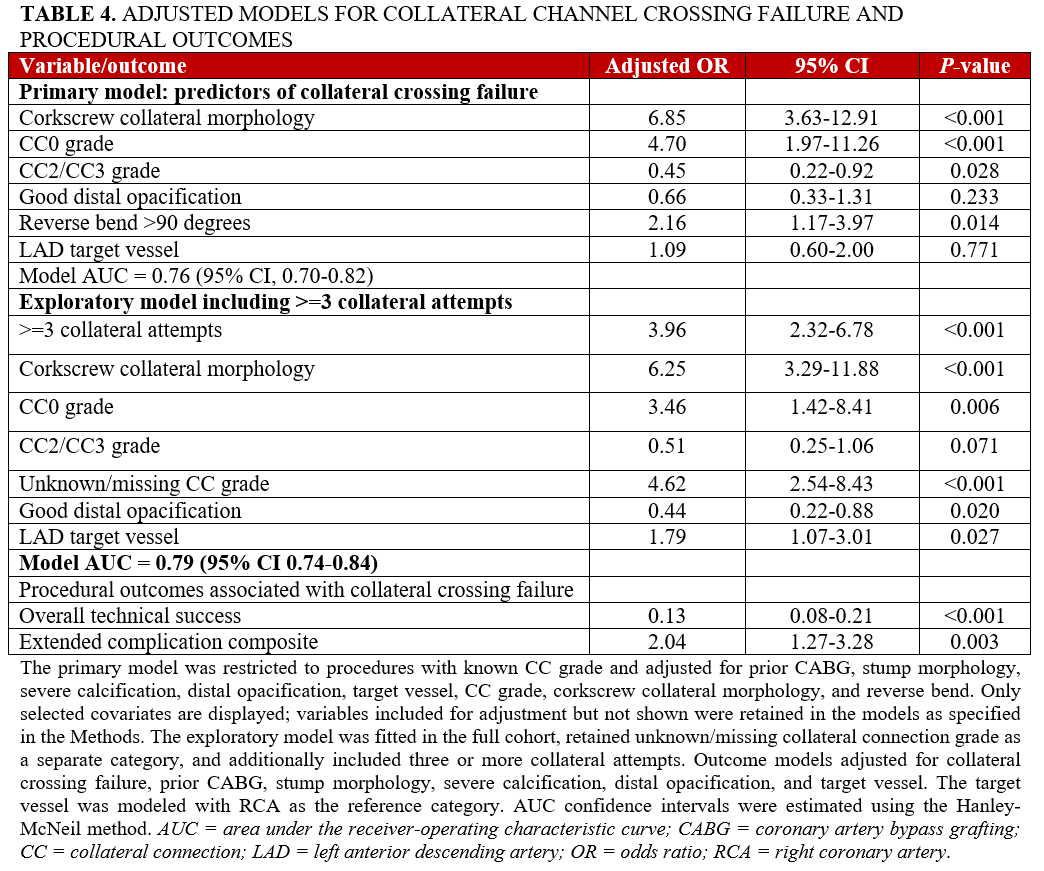
In the exploratory model that additionally included 3 or more collateral attempts, multiple collateral attempts were independently associated with collateral crossing failure. Corkscrew collateral morphology remained strongly associated with collateral crossing failure in this model, which showed slightly improved discrimination. In adjusted outcome models, collateral crossing failure was associated with substantially lower odds of overall technical success and higher odds of the extended procedural-complication composite (Table 4). Sensitivity analyses showed that the main collateral-specific associations were directionally consistent in the full cohort with unknown/missing CC grade retained as a separate category after additional adjustment for age, sex, eGFR, and center; after restricting the collateral-attempt model to procedures with at least 1 recorded collateral attempt; and after additional adjustment for calendar year. Penalized logistic regression yielded a similar estimate for the extended-complication composite (Supplemental Tables 5-10). In the baseline- and center-adjusted sensitivity model, older age was also associated with collateral crossing failure, but the collateral-specific associations were not materially changed (Supplemental Table 6).
Discussion
In this multicenter registry analysis of retrograde CTO PCI, collateral channel crossing failure occurred in approximately 1 in 4 retrograde procedures with a recorded retrograde result. It identified a distinct procedural phenotype characterized by markedly lower overall technical success and higher complication burden. Corkscrew collateral morphology and CC0 grade were strongly associated with this failure, whereas CC2/CC3 grade was associated with a lower likelihood of crossing failure. Three or more collateral attempts further identified an intraprocedural marker of escalating collateral-search difficulty.
Prior retrograde CTO PCI registries have established the feasibility, technical complexity, and procedural risk of the retrograde approach.6,16 However, most have reported retrograde success or failure as a composite procedural endpoint. Prior collateral-focused studies have evaluated collateral tracking feasibility, collateral scoring systems, and predictors of guidewire or microcatheter passage.7,8,10-12 The present study adds to this literature by isolating collateral channel crossing failure as an early stage-specific failure point and linking it to downstream procedural outcomes. This distinction is important because failure occurring before a usable retrograde route is established has different implications than failure after successful collateral crossing.
Retrograde failure is mechanistically heterogeneous and may occur during collateral channel crossing, CTO-segment crossing, device delivery, externalization, or controlled antegrade-retrograde tracking. Because collateral crossing failure occurs before a usable retrograde route is established, overall technical success is more clinically informative than retrograde success alone: recanalization may still be achieved after selection of another collateral or conversion to an antegrade strategy.
Collateral morphology was associated with crossing failure. The tightly coiled course of corkscrew collaterals may hinder wire and microcatheter tracking and increase vulnerability to collateral injury. CC0 grade was associated with higher crossing-failure risk, whereas CC2/CC3 grades were associated with lower risk. These findings extend prior work on collateral grading and tracking success by linking unfavorable collateral anatomy to lower overall technical success and greater complication burden.
The number of collateral attempts should be interpreted differently from baseline angiographic variables. It is partly determined during the procedure and reflects the operator’s response to initial failure. The steep decline in retrograde success as collateral attempts increased suggests that repeated collateral search is not a neutral escalation step. Instead, multiple failed collateral attempts may serve as a practical intraprocedural warning signal that the case has entered a lower-yield, higher-risk phase.
Collateral crossing failure was also associated with higher complication burden. However, this should not be interpreted as proof that crossing failure itself causes all complications. Rather, collateral crossing failure likely marks unfavorable collateral anatomy, repeated manipulation, technical difficulty, and strategy escalation. Component-level analyses showed that the higher composite rate was mainly driven by perforation-related and vascular events rather than by death, stroke, or donor-vessel injury (Supplemental Table 9).
An important nuance is that collateral crossing failure was not associated with longer procedural time. This may reflect earlier abandonment of unsuitable collateral channels, conversion to alternative strategies, or termination before prolonged CTO-segment crossing attempts. Therefore, the adverse implications of collateral crossing failure are better captured by lower success and higher complication burden than by procedural duration alone.
In daily CTO practice, collateral assessment should be treated as a central component of retrograde strategy selection rather than as a preliminary step before CTO crossing. Corkscrew morphology, CC0 grade, poor distal opacification, and repeated failed collateral attempts may support early reassessment of whether to continue retrograde escalation or to select an alternative collateral, convert to antegrade, or terminate the procedure when the expected benefit no longer justifies the risk.
Limitations
This study has several limitations. First, the analysis was retrospective and observational and, therefore, the findings should be interpreted as associations rather than causal effects. Second, the study was performed at the procedure level; repeat procedures in the same patient or lesion may have occurred, and reliable patient- or lesion-level longitudinal identifiers were not available for robust clustering or repeated-lesion analysis. Third, the retrograde-specific analysis was limited to procedures with a recorded retrograde result, and missing or unknown retrograde details may have introduced selection or information bias.
Fourth, several collateral variables, including pathway type and CC grade, contained unknown or missing categories. These categories were retained in the analysis to avoid excluding procedures with incomplete angiographic characterization, but they should not be interpreted as anatomical or biological predictors. Fifth, the number of collateral attempts is an intraprocedural variable and should not be interpreted as a purely preprocedural predictor; similarly, zero recorded attempts may reflect the absence or incomplete recording of attempted channels rather than the absence of collateral manipulation. Sixth, although corkscrew morphology corresponds to established angiographic criteria, collateral morphology was recorded by treating operators without independent core-laboratory adjudication or retrospective reclassification. Interobserver agreement was not assessed; therefore, subjective classification and misclassification of collateral characteristics cannot be excluded.
Seventh, although the study was performed at high-volume CTO PCI centers, operator-level prior experience and individual learning-curve trajectories before registry entry were not systematically available. Therefore, the possible influence of temporal learning, operator experience, case selection, or changes in retrograde strategy over the registry period cannot be excluded. Eighth, the dataset did not capture all details of collateral-channel selection, microcatheter behavior, wire escalation, operator decision-making, or the exact reason for abandoning a retrograde attempt. Finally, the study focused on acute procedural outcomes and did not evaluate longer-term clinical outcomes.
Conclusions
In retrograde CTO PCI, collateral channel crossing failure was common and associated with substantially lower overall technical success and a higher procedural complication burden. Corkscrew collateral morphology and CC0 grade were strongly associated with collateral crossing failure, whereas CC2/CC3 grade was associated with a lower risk. Multiple collateral attempts identified an intraprocedural marker of escalating difficulty. These findings suggest that unfavorable collateral morphology or repeated failed collateral attempts may help identify cases in which strategy reassessment is warranted.
Affiliations and Disclosures
Semi Ozturk, MD1; Ahmet Seyfeddin Gurbuz, MD2; Sule Goktekin, MD3; Sevket Gorgulu, MD4
From the 1Department of Cardiology, Bakırköy Dr. Sadi Konuk Training and Research Hospital, Istanbul, Turkey; 2Department of Cardiology, Necmettin Erbakan University, Konya, Turkey; 3Royal Shrewsbury Hospital, Shrewsbury, United Kingdom; 4Department of Cardiology, Biruni University School of Medicine, Istanbul, Turkey.
Acknowledgments: The authors used ChatGPT (OpenAI) for language editing and formatting suggestions during manuscript preparation. No artificial intelligence (AI) tool was used for data analysis, interpretation, or the generation of scientific conclusions. All scientific content, analyses, interpretations, and references were reviewed and verified by the authors, who take full responsibility for the manuscript. No AI-generated figures or visual content are included in the submission.
Disclosures: The authors report no financial relationships or conflicts of interest regarding the content herein.
Data availability: The data underlying this study are not publicly available due to institutional and patient privacy restrictions but may be made available from the corresponding author upon reasonable request, subject to ethics and institutional approval.
Address for correspondence: Semi Ozturk, MD, Department of Cardiology, Bakırköy Dr. Sadi Konuk Training and Research Hospital, Zuhuratbaba, Dr. Tevfik Sağlam Cd No:11, Bakırköy/Istanbul 34147, Turkey. Email: semi_ozturk@yahoo.com
References
1. Wu EB, Brilakis ES, Mashayekhi K, et al. Global chronic total occlusion crossing algorithm: JACC state-of-the-art review. J Am Coll Cardiol. 2021;78(8):840-853. doi:10.1016/j.jacc.2021.05.055
2. Tajti P, Burke MN, Karmpaliotis D, et al. Update in the percutaneous management of coronary chronic total occlusions. JACC Cardiovasc Interv. 2018;11(7):615-625. doi:10.1016/j.jcin.2017.10.052
3. Christopoulos G, Karmpaliotis D, Alaswad K, et al. Application and outcomes of a hybrid approach to chronic total occlusion percutaneous coronary intervention in a contemporary multicenter US registry. Int J Cardiol. 2015;198:222-228. doi:10.1016/j.ijcard.2015.06.093
4. Karmpaliotis D, Karatasakis A, Alaswad K, et al. Outcomes with the use of the retrograde approach for coronary chronic total occlusion interventions in a contemporary multicenter US registry. Circ Cardiovasc Interv. 2016;9(6):10.1161/CIRCINTERVENTIONS.115.003434 e003434. doi:10.1161/CIRCINTERVENTIONS.115.003434
5. Brilakis ES, Mashayekhi K, Tsuchikane E, et al. Guiding principles for chronic total occlusion percutaneous coronary intervention. Circulation. 2019;140(5):420-433. doi:10.1161/CIRCULATIONAHA.119.039797
6. Galassi AR, Sianos G, Werner GS, et al; Euro CTO Club. Retrograde recanalization of chronic total occlusions in Europe: procedural, in-hospital, and long-term outcomes from the multicenter ERCTO registry. J Am Coll Cardiol. 2015;65(22):2388-2400. doi:10.1016/j.jacc.2015.03.566
7. Zhong X, Ge L, Ma J, et al. Microcatheter collateral channel tracking failure in retrograde percutaneous coronary intervention for chronic total occlusion: incidence, predictors, and management. EuroIntervention. 2019;15(3):e253-e260. doi:10.4244/EIJ-D-18-01003
8. Ioppolo AM, Hovasse T, Benamer H, et al. Angiographic predictors of septal collateral tracking during retrograde percutaneous coronary intervention for chronic total occlusion: anatomical analysis or rolling the dice? J Invasive Cardiol. 2022;34(4):E286-E293. doi:10.25270/jic/21.00211
9. Karacsonyi J, Vemmou E, Nikolakopoulos ID, Ungi I, Rangan BV, Brilakis ES. Complications of chronic total occlusion percutaneous coronary intervention. Neth Heart J. 2021;29(1):60-67. doi:10.1007/s12471-020-01502-1
10. Huang CC, Lee CK, Meng SW, et al. Collateral channel size and tortuosity predict retrograde percutaneous coronary intervention success for chronic total occlusion. Circ Cardiovasc Interv. 2018;11(1):e005124. doi:10.1161/CIRCINTERVENTIONS.117.005124
11. Nagamatsu W, Tsuchikane E, Oikawa Y, et al. Successful guidewire crossing via collateral channel at retrograde percutaneous coronary intervention for chronic total occlusion: the J-Channel score. EuroIntervention. 2020;15(18):e1624-e1632. doi:10.4244/EIJ-D-18-00993
12. Dautov R, Urena M, Nguyen CM, Gibrat C, Rinfret S. Safety and effectiveness of the surfing technique to cross septal collateral channels during retrograde chronic total occlusion percutaneous coronary intervention. EuroIntervention. 2017;12(15):e1859-e1867. doi:10.4244/EIJ-D-16-00650
13. Ybarra LF, Rinfret S, Brilakis ES, et al. Chronic total occlusion academic research consortium. definitions and clinical trial design principles for coronary artery chronic total occlusion therapies: CTO-ARC consensus recommendations. Circulation. 2021;143(5):479-500. doi:10.1161/CIRCULATIONAHA.120.046754
14. Werner GS, Ferrari M, Heinke S, et al. Angiographic assessment of collateral connections in comparison with invasively determined collateral function in chronic coronary occlusions. Circulation. 2003;107(15):1972-1977. doi:10.1161/01.CIR.0000061953.72662.3A
15. Allana SS, Kostantinis S, Rempakos A, et a. The retrograde approach to chronic total occlusion percutaneous coronary interventions: technical analysis and procedural outcomes. JACC Cardiovasc Interv. 2023;16(22):2748-2762. doi:10.1016/j.jcin.2023.08.031