Video Supplement: Snare-Assisted Intraneurysmal Rendezvous for Crossing Complex Aortic Coarctation With Multiple Aneurysms
Video Supplement to "Snare-Assisted Intraneurysmal Rendezvous for Crossing Complex Aortic Coarctation With Multiple Aneurysms" (Brief Communication).
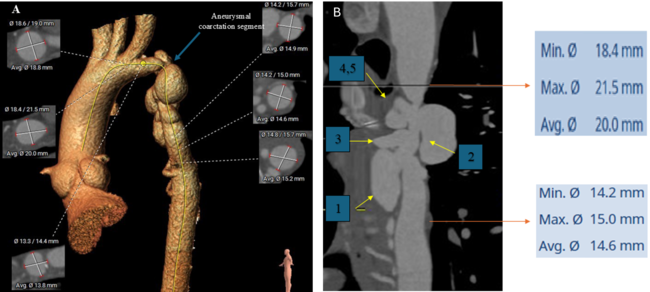
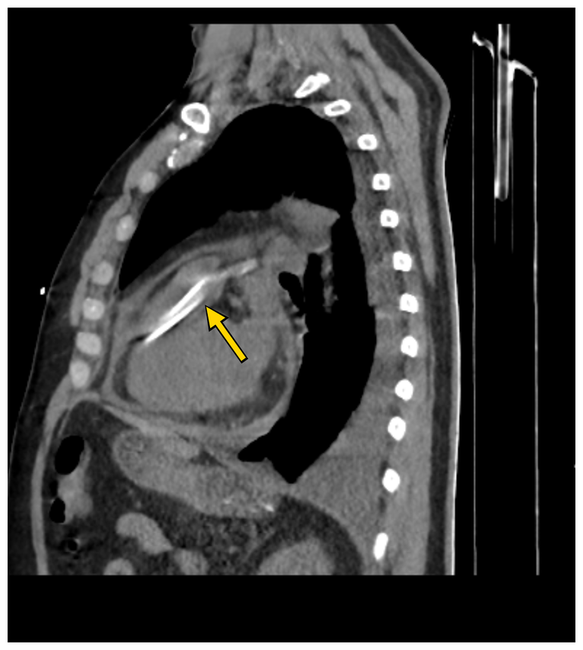
Video 1. Baseline angiography of coarctation with post-stenotic aneurysms. Left anterior oblique pigtail angiogram demonstrating severe coarctation of the descending thoracic aorta with multiple post-stenotic aneurysms.
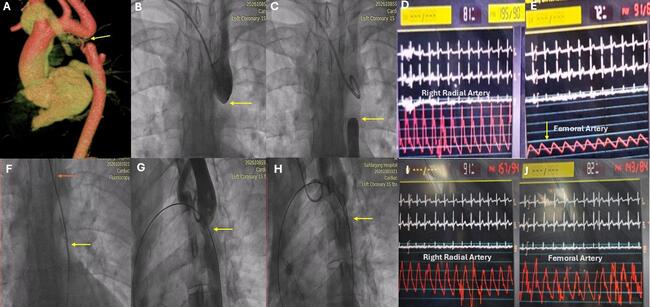
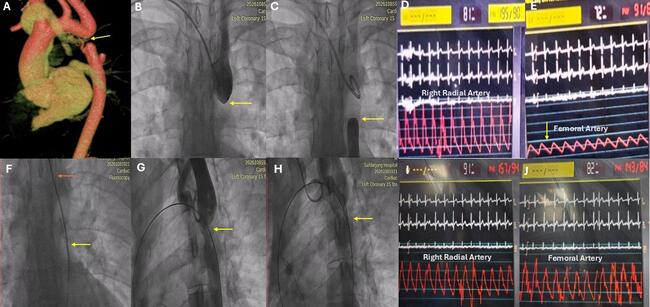
Video 2. Guidewire and catheter positioning for intraneurysmal rendezvous. A hydrophilic guidewire is advanced from the right radial artery into the third post-stenotic aneurysm. A Judkins Right catheter introduced from the right femoral artery is positioned within the same aneurysm in preparation for snare capture.
Video 3. Intraneurysmal guidewire capture and externalization. A femorally introduced snare captures the radially advanced hydrophilic guidewire within the third post-stenotic aneurysm. Externalization through the femoral sheath connects the 2 partial crossings into a continuous arterio-arterial rail.
Video 4. Advancement of the covered-stent delivery system. Following exchange of the hydrophilic guidewire for an Amplatz extra-stiff guidewire, the covered-stent delivery system is advanced across the diseased segment.
Video 5. Balloon predilation before covered-stent implantation. Predilation is performed using a 10 × 60-mm balloon before covered-stent deployment.
Video 6. Angiographic assessment of covered-stent position before deployment. Pigtail angiography demonstrates the position of the undeployed covered stent across the coarctation and associated aneurysmal segment relative to the intended proximal and distal landing zones.
Video 7. Covered-stent deployment. A 57-mm covered stent mounted on a 14 × 60-mm balloon is deployed across the coarctation and associated post-stenotic aneurysmal segment.
© 2026 HMP Global. All Rights Reserved.
Any views and opinions expressed are those of the author(s) and/or participants and do not necessarily reflect the views, policy, or position of the Journal of Invasive Cardiology or HMP Global, their employees, and affiliates.