Clinical Conference Proceedings: IAGS 2026 Summary Document
IAGS-2026 Writing Group: J. Dawn Abbott, Nicholas Amoroso, Herbert Aronow, Steve Bailey, Itsik Ben-Dor, Larry Dean, Eric Dippel, Lawrence Garcia, Adam Greenbaum, Cindy Grines, George Hanzel, Tim Henry, Jimmy Kerrigan, Ayman Magd, Piotr Musialek, Jihad Mustapha, Sigrid Nikol, William O'Neill, Mitul Patel, Rajan Patel, Gus Pichard, Robert Riley, Michael Rinaldi, Jonathan Schwartz, Kristen Skelton, Molly Szerlip, Jacqueline Tamis-Holland, Alexander Truesdell, Bryan (‘Hadley’) Wilson, David Wood
Compiled and edited by: Gary Rowbury, Laurie Onopa, and H. V. ('Skip') Anderson
International Gruentzig Society Conference held January 27 to 30, 2026
Program Director: Robert Bersin, MD
Funding: These proceedings were funded by publication grants from Chiesi
Disclosures: See Appendix
1.1 DCBs for De Novo Coronary Lesions: Which Lesions and Is the Provisional Approach to PCI Back?
Problem Presenter: Mitul Patel
Statement of problem or issue
Percutaneous coronary interventions (PCI) began with balloon catheters. Stents were developed later, primarily to treat the problems of dissections, elastic recoil, and abrupt closure of the vessel. The original stents were made of bare metal with no coating, and while they helped solve the problems of balloon angioplasty, they too were associated with several problems. These included neointimal proliferation, with angiographic and clinical restenosis rates 10%-30%. Drug-eluting coatings were then added to the bare metal stents, thereby creating the drug-eluting stents (DES), and this helped reduce but not completely eliminate neointimal proliferation and restenosis. The success of drug elution has now led us back to the concept of a drug-coated balloon (DCB) that accomplishes dilatation while at the same time depositing the antiproliferative drug agent at the treatment site. This is the minimalist “leave nothing behind” approach.
Gaps in current knowledge
For certain lesions and for specific complications, DES will likely always be necessary. The question is whether noncomplex lesions can be adequately treated as a broad approach with DCBs, using a provisional stenting strategy should complications arise. This was tested in a large-scale randomized clinical trial, the SELUTION De Novo trial (NCT04859985), with over 3,200 patients enrolled, as reported at the TCT conference last year.[1,2] Results of this non-inferiority trial showed that a DCB strategy was not inferior to a standard DES strategy. The primary endpoint of target vessel failure (TVF) at 1 year was 5.3% in the DCB group versus 4.4% in the DES group (P=.02 for non-inferiority). While encouraging, the SELUTION De Novo trial excluded patients with STEMI, CTO, ISR, left main lesions, and surgical grafts, all groups for which dedicated trials will be required.
Possible solutions or future directions
The 5-year results of the SELUTION trial are being collected and will be published. Additionally, there are other clinical trials of DCBs currently underway. An important one is the MAGICAL SV trial, which is testing the MagicTouch sirolimus-coated balloon versus DES in patients with target coronary lesions in small vessels (<2.75 mm). Finally, the provisional approach to stent deployment in PCI clearly is back, in fact, it never really left. This provisional stent question is especially critical in bifurcation PCI with complex anatomies, for example, Medina 1,1,1 with a sidebranch >2.5mm and >50% stenosis. Could DCBs have a role here in treatment of the sidebranch?
References
- Sirolimus-coated balloon meets mark in de novo lesions and ISR: SELUTION. Available online: https://www.tctmd.com/news/sirolimus-coated-balloon-meets-mark-de-novo-lesions-and-isr-selution (accessed on 29 November 2025).
- Gherasie F-A, et al. Paclitaxel- and sirolimus-coated balloons versus drug-eluting stents in coronary artery disease: A comprehensive narrative review. Life. 2026;16(1):63. DOI 10.3390/life16010063.
1.2 Management of Coronary Instent Restenosis (ISR): Are Drug Coated Balloons (DCBs) Now the Answer?
Problem Presenter: Cindy Grines
Statement of problem or issue
There are several smaller clinical trials, with at least one large meta-analysis, comparing DCBs to balloon angioplasty (POBA) for ISR, and these data support DCBs as superior to uncoated balloons alone.[1] A large 600-patient randomized clinical trial, named AGENT, compared paclitaxel-coated DCBs to uncoated balloons for ISR, and found the DCB superior to POBA.[2] On the other hand, a meta-analysis of 5 RCTs (1,100 patients) comparing DCBs with drug-eluting stents (DES) for ISR, found equivalence in the two forms of treatment except there was more recurrent restenosis with DCBs, leading to higher rates of target lesion revascularization in that group.[3] The Swedish registry, SCAAR, examined this question retrospectively using their large dataset, and published a comparison that included over 10,000 coronary lesions in over 9,000 patients.[4] This analysis compared all 3 groups of treated ISR patients: POBA, DCB, and DES. The SCAAR results also showed superiority for both DCB and DES over POBA, and equivalence of DCB and DES with the exception of more target lesion revascularization with DCBs.
Gaps in current knowledge
- How should we select and prepare ISR lesions for the appropriate treatment choice?
- Does the number of layers of previous stents alter the choice of device?
- If the previous stent is under-expanded, will re-expansion alone be sufficient?
- Does vessel size and/or presence of large side branches alter device selection?
Possible solutions or future directions
The specific drug agents used on DCBs will require comparative studies. There are more data available for paclitaxel-coated DCBs, but the recently introduced sirolimus-coated DCB has shown promise for treatment of ISR.[5] The routine use of intravascular imaging (IVI) using intravascular ultrasound (IVUS) or optical coherence tomography (OCT) needs additional dedicated studies for patients with ISR. Imaging with IVUS or OCT can be useful for: (1) assessing the cause of ISR; (2) accurate sizing of the vessel; (3) determination of stent under-expansion. However, IVI remains a Class 2A recommendation in ACC/AHA/SCAI guidelines for revascularization and PCI. Since DCBs require contact time to elute and penetrate tissue at the target lesion treatment site, the optimal balloon inflation time (duration of contact) needs investigation. Preliminary data suggest shorter (median 30 sec) inflations were equivalent to longer (median 60 sec) inflations in terms of major adverse events (MACE) including target lesion revascularization.[6] However, the rates of bailout stent implantation (12.2 vs 8.8%, P=.001) and post-procedural TIMI flow <3 (4.0 vs 2.1%, P=.007) were higher with shorter compared with longer DCB inflation times. Additional studies will help confirm or refute these early findings.
References
- Shaikh S, et al. Meta-Analysis Comparing Drug-Coated Balloon Versus Plain Old Balloon Angioplasty for In-Stent Restenosis of Coronary Arteries. Am J Cardiol. 2024 Oct 15;229:22-27. doi: 10.1016/j.amjcard.2024.07.015. Epub 2024 Jul 18. PMID: 39029724.
- Yeh RW, et al. Paclitaxel-coated balloon vs uncoated balloon for coronary in-stent restenosis: The AGENT IDE Randomized Clinical Trial. JAMA. 2024 Mar 26;331(12):1015-1024. doi: 10.1001/jama.2024.1361. PMID: 38460161; PMCID: PMC10924708.
- Kumar M, et al. Comparison of drug-coated balloons with drug-eluting stents in patients with in-stent restenosis: a systematic review and meta-analysis. Am J Cardiol. 2024 Sep 15;227:57-64. doi: 10.1016/j.amjcard.2024.06.028. Epub 2024 Jul 8. PMID: 38986859.
- von Koch S, et al. Drug-coated balloons versus drug-eluting stents or plain old balloon angioplasty: a long-term in-stent restenosis study. J Am Heart Assoc. 2024 Dec 3;13(23):e036839. doi: 10.1161/JAHA.124.036839. Epub 2024 Nov 22. PMID: 39575722; PMCID: PMC11681599.
- Cutlip DE. Randomized Trial of a Sirolimus Eluting Balloon versus Repeat Drug-Eluting Stenting or Balloon Angioplasty for Coronary In-stent Restenosis. Presented at TCT-2025. Available at: cordis.com/uploads/files/SELUTION-Clinical-Info-Files/100678148_SELUTION4ISR-TCT-HCP-Clinical-Trial-Results-Presentation_Final_2025.pdf. Accessed February 23, 2026.
- Gurgoglione FL, et al. Angiographic and clinical impact of balloon inflation time in percutaneous coronary interventions with sirolimus-coated balloon: A subanalysis of the EASTBOURNE study. Cardiovasc Revasc Med. 2025 Apr;73:70-75. doi: 10.1016/j.carrev.2024.07.021. Epub 2024 Jul 28. PMID: 39122570.
1.3 The Alphabet Soup of Plaque Modification (CB, RA, OA, IVL): Real or Imagined?
(Will SONAR Provide Insight? Are Novel Approaches Needed?)
Problem Presenter: Alex Truesdell
Statement of problem or issue
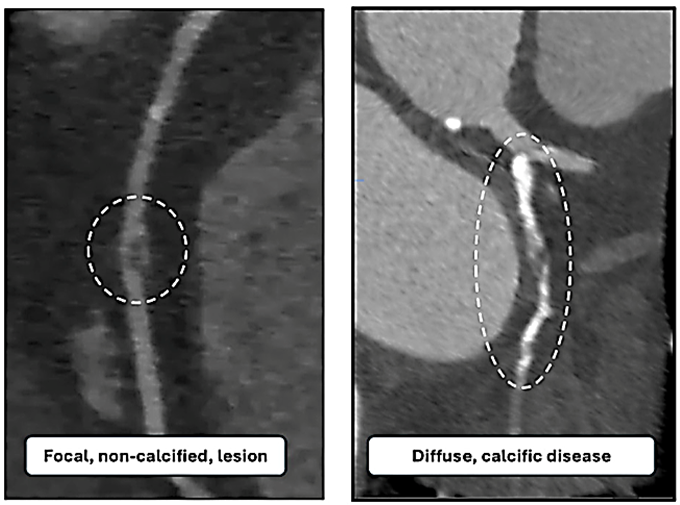
In order to use drug coated balloons (DCBs, the topic of the previous two presentations), and indeed, often to implant drug-eluting stents (or bioresorbable scaffolds) or perform any percutaneous coronary intervention (PCI) at all, the target lesion has to be ‘prepared,’ a process usually referred to as plaque modification. The two primary morphological factors driving plaque modification are diffuseness of disease and extent of coronary calcification (Figure 1).
Gaps in current knowledge
With a range of plaque modification tools available (“alphabet soup”) the questions center on: (1) evaluating the lesion, and (2) planning the optimal type and/or sequence or algorithm for modification and follow-on intervention. In other words, what is the best way to evaluate the target lesion (CCTA, IVUS, OCT, physiology) and what are the ‘best’ devices to use for plaque modification and in what sequence? These questions become even larger when one considers the entire lifecycle management of coronary artery disease over the course of decades, including both clinical events as well as costs. How does any single PCI procedure fit into this larger lifecycle? Is it possible to plan, in advance, not just a single episodic PCI but the optimal set of interventions PCI for lifetime management?
Possible solutions or future directions
Data are emerging on various direct comparisons of devices. For example, at the TCT-2025 conference last October, results of two randomized non-inferiority trials were presented. The Short-CUT trial compared pretreatment with a cutting balloon (CB) to intravascular lithotripsy (IVL) prior to DES implantation.[3] The VICTORY trial compared pretreatment with a super-high-pressure noncompliant balloon to IVL prior to DES implantation.[4] The primary outcome in both trials was determined by final stent expansion, and in both trials the results were equivalent for the comparisons (i.e. non-inferior). Also presented at TCT-2025 were the results of a randomized superiority trial, the SONAR trial, which compared treatment using rotational atherectomy (RA) with IVL.[5] Here, the primary outcome was peri-procedural myocardial injury (PPMI), based on the concept of less embolic debris with IVL. However, results showed that PPMI was equally frequent in both groups (10.8% vs 7.2%, P=.58). The search for the best device strategy will continue, although the larger search for the optimal lifecycle strategy may prove more important in the long run.
References
- Sandoval Y, et al. Coronary Computed Tomography Angiography to Guide Percutaneous Coronary Intervention: Expert Opinion from a SCAI/SCCT Roundtable. J Soc Cardiovasc Angiogr Interv. 2025;4(6):103664. doi: 10.1016/j.jscai.2025.103664. PMID: 40630246; PMCID: PMC12230455.
- Truesdell AG, et al. Intravascular imaging during percutaneous coronary intervention: JACC State-of-the-Art Review. J Am Coll Cardiol. 2023 Feb 14;81(6):590-605. doi: 10.1016/j.jacc.2022.11.045. Erratum in: J Am Coll Cardiol. 2023 Apr 18;81(15):1550. doi: 10.1016/j.jacc.2023.03.003. PMID: 36754518.
- Available at: www.pcronline.com/News/Congress-coverages/TCT/2025/Short-CUT-intravascular-lithotripsy-vs.-cutting-balloon-angioplasty-in-calcified-CAD. Accessed February 24, 2026.
- Available at: www.pcronline.com/News/Congress-coverages/TCT/2025/VICTORY-Intravascular-lithotripsy-vs.-super-high-pressure-PTCA-in-calcified-and-refractory-coronary-lesions. Accessed February 24, 2026.
- Available at: www.tctmd.com/slide/shockwave-balloon-vs-atherectomy-rotablation-calcified-coronary-artery-lesions-primary. Accessed February 24, 2026.
2.1 EARLY TAVR: Sure. Moderate AS: Not So Sure?
Problem Presenter: Molly Szerlip
Statement of problem or issue
In the United States, transcutaneous aortic valve replacement (TAVR) is approved for patients with symptomatic severe aortic stenosis (AS). For patients with asymptomatic severe aortic stenosis, current guidelines recommend optimal medical therapies and clinical surveillance (CS) every 6 to 12 months. Whether these asymptomatic patients with severe AS might benefit from TAVR before symptoms develop has been tested recently in two large randomized clinical trials, which unfortunately reached different conclusions (see below).[1,2] Additionally, patients with symptomatic but only moderate AS are known to be at higher risk for adverse events.[3] Whether these moderate AS patients might benefit from TAVR is of great clinical interest yet there are few data available at present for guidance.
Gaps in current knowledge
- Asymptomatic severe AS
The EARLY TAVR trial enrolled 901 patients (455 randomly assigned TAVR and 446 assigned CS). The primary endpoint at a minimum of 2 years follow-up was a composite of death from any cause, stroke, or unplanned hospitalization for cardiovascular causes. Median follow-up was 3.8 years and Kaplan-Meier curves were extended to 5 years. A primary endpoint event occurred less frequently in the TAVR group compared with the CS group (26.8% versus 45.3%, HR=0.50, P<.001). The investigators concluded that early TAVR was a superior strategy compared with CS.[1]
The EVOLVED trial enrolled 224 patients (113 randomly assigned TAVR and 111 assigned to conservative management). Additionally, all enrolled patients had to have evidence of myocardial fibrosis on gadolinium-enhanced cardiac MRI scans. The planned enrollment of 356 patients was not achieved due to COVID restrictions. The primary endpoint was a composite of all-cause death or unplanned AS–related hospitalization. Median follow-up was 3.5 years (42 months) and Kaplan-Meier curves were extended to 5 years. Occurrence of a primary endpoint event was not significantly different in the TAVR group compared with the conservative management group (18% versus 23%, HR=0.79, P=.44). The investigators concluded that in asymptomatic patients with severe AS and myocardial fibrosis, early TAVR had no demonstrable effect on all-cause death or unplanned AS–related hospitalization. [2]
The differing conclusions reached by these 2 randomized trials leaves a large gap in our knowledge base that will need to be filled in.
- Moderate AS
A recent meta-analysis of five observational studies of early aortic valve replacement (AVR, including both TAVR and SAVR) compared with CS, in patients with moderate AS and reduced LVEF, concluded that early AVR might be associated with improved survival.[4] Given the limited nature of the data, however, larger, appropriately designed randomized trials with long term follow-up are needed.
Possible solutions or future directions
There are two large trials currently underway that are examining early TAVR in patients with moderate AS and reduced LVEF. These are the PROGRESS trial (NCT 04889872) and the EXPAND TAVR II trial (NCT 05149755). More fundamentally, though, there are several areas of investigation for future research studies:
- One is the intriguing question of the definitions of ‘moderate’ and ‘severe’ AS, and the precise role of symptoms: Is it possible that we are dealing only with subsets of the same clinical phenomenon?
- Just how important are structural changes in the myocardium, for example, myocardial fibrosis, across the entire spectrum of AS?
- With earlier implantation of these valves, how important is valve durability? Are we trading one set of problems for another set? For example: paravalvular leak, endocarditis, reintervention, need for permanent pacemaker, etc?
References
- Généreux P, et al. Transcatheter aortic-valve replacement for asymptomatic severe aortic stenosis. N Engl J Med. 2025;392(3):217-227. doi: 10.1056/NEJMoa2405880. Epub 2024 Oct 28. PMID: 39466903.
- Loganath K, et al. Early intervention in patients with asymptomatic severe aortic stenosis and myocardial fibrosis: the EVOLVED Randomized Clinical Trial. JAMA. 2025 Jan 21;333(3):213-221. doi: 10.1001/jama.2024.22730. PMID: 39466640; PMCID: PMC11519785.
- Jacquemyn X, et al. Moderate aortic valve stenosis is associated with increased mortality rate and lifetime loss: systematic review and meta-analysis of reconstructed time-to-event data of 409 680 patients.J Am Heart Assoc. 2024;13(9):e033872. doi: 10.1161/JAHA.123.033872. Epub 2024 May 3. PMID: 38700000; PMCID: PMC11179918.
- Abdelfattah OM, et al. Early aortic valve replacement in moderate aortic stenosis. JACC Adv. 2024;3(9):101190. doi: 10.1016/j.jacadv.2024.101190. PMID: 39253710; PMCID: PMC11381792.
2.2 TAVR for Aortic Insufficiency: ALIGNed for the Future But Are We Ready for ARTIST?
Problem Presenter: George Hanzel
Statement of problem or issue
Clinically significant aortic valve regurgitation (AR) is a relatively common condition, particularly after age 65, and carries a substantial mortality risk.[1] The standard of care for patients with AR has been surgical aortic valve replacement (SAVR).[2] Off-label use of TAVR valves designed for treatment of aortic stenosis has been found less than ideal when used to treat AR; however, specially-designed TAVR valves dedicated for treating AR have had better results.[3]
- SAVR – standard of care [2]
- Analysis of STS database; 12,564 operations
- Overall mortality 1.1%; (mortality 2.7% in patients with LVEF <30%)
- Unknown how many patients were turned down or never referred
- Off-label TAVR – less than ideal [3]
- Meta-analysis: 34 studies; 2162 patients (1193 dedicated devices; 969 off-label)
- Mortality 9% in off-label group versus 3% in dedicated group.
- Embolization/malpostition in 8% off-label group versus 3% dedicated group
- Moderate or greater paravalvular leak (PVL) in 10% off-label group versus 4% dedicated group
- ALIGN-AR trial (NCT04415047) [4]
- 700 high-risk patients enrolled (1352 screened) – single-arm study
- Dedicated device: Trilogy valve (JenaValve Technology)
- 30-day outcomes:
- Mortality = 1.6%
- Stroke = 1.7%
- PPM (perm. pacemaker) = 21.6%
- Moderate or greater AR = 0.5%
- One year mortality = 7.7% (performance goal 25%)
- Excellent hemodynamics and meaningful improvements in functional status and LV remodeling
Gaps in current knowledge
How large is the untreated AR population? Is a PPM implantation rate of 22% acceptable with TAVR for AR? (For comparison, the PPM rate with SAVR is only about 3%.) Are there other anatomic considerations – bicuspid valves, etc.? Are current valve sizes adequate?
Possible solutions or future directions
Several clinical research efforts are underway that will help guide future directions:
- ARTIST trial (NCT06608823)
- 1000+ low and intermediate risk patients with 3-4+ AR and ≥NYHA II
- 1:1 randomization to Trilogy valve vs SAVR (noninferiority)
- Primary endpoint at 1 year: composite of death, stroke, unplanned cardiac rehospitalization
- Planned for 10-year follow-up
- Jena-VAD ALIGN-AR LVAD registry (NCT06594705)
- 50 patients with LVAD and ≥2+ AR
- Primary endpoint(s) 30 days
- 1-year follow-up planned
- JOURNEY trial (NCT06455787)
- 194 high-risk patients with 3-4+ AR and NYHA II
- Single-arm study using J-Valve (Edwards)
- Safety endpoints at 30-days and Mortality at 1-year
- 5-year follow-up planned
References
- Généreux P, et al. Mortality burden for patients with untreated aortic regurgitation. JACC Adv. 2024 Sep 6;3(10):101228. doi: 10.1016/j.jacadv.2024.101228. PMID: 39296816; PMCID: PMC11408366.
- Ryan CT, et al. Outcomes of aortic valve replacement for chronic aortic insufficiency: analysis of the Society of Thoracic Surgeons Database. Ann Thorac Surg. 2022;113(3):763-772. doi: 10.1016/j.athoracsur.2021.04.027. Epub 2021 Apr 25. PMID: 33910050; PMCID: PMC8542644.
- Samimi S, et al. Meta-Analysis of Dedicated vs Off-Label Transcatheter Devices for Native Aortic Regurgitation. JACC Cardiovasc Interv. 2025;18(1):44-57. doi: 10.1016/j.jcin.2024.08.042. Epub 2024 Nov 20. PMID: 39570231.
- Makkar RR, et al. Transcatheter aortic valve implantation with the Trilogy valve for symptomatic native aortic regurgitation (ALIGN-AR): a pivotal, multicentre, single-arm, investigational device exemption study. Lancet. 2025;406(10521):2757-2771. doi: 10.1016/S0140-6736(25)02215-9. Epub 2025 Nov 16. PMID: 41260228.
2.3 Issues Facing TAVR: Lifetime Management and How to Handle the Volume With Expanding Indications in an Aging Population
Problem Presenter: Kristen Skelton
Statement of problem or issue
We have reached a structural heart disease inflection point. Approval of TAVR for asymptomatic severe aortic stenosis reflects an ongoing paradigm shift to proactive disease management.
What we know:
- TAVR now exceeds SAVR in annual operations[1]
- Indications for TAVR are expanding as clinical evidence evolves
- Mitral and tricuspid therapies are accelerating
Lifetime management paradigm
- Initial valve choice determines future options
- Valve durability, coronary artery access, multi-valve sequencing, all matter
- Programs inherit a growing base of valves and repairs requiring surveillance and potential repeat implantation
Capacity mismatch
- Available cath lab time, imaging bandwidth, and structural heart teams are already strained
- Re-interventions require more complex planning and longer procedural times.
- Surveillance burden: serial CT/echo, valve clinics, remote monitoring
- Workforce pipeline for imagers and multi-valve operators is insufficient
Gaps in current knowledge
- Lifetime management
- Early intervention ≠ Early age
- Median age for TAVR has only fallen from 83 years to 79 years; only 5.1% <65 years
- With recent durability data, how to make care pathways more clear?
- Likelihood of more re-interventions
- Capacity constraints
- How to “streamline” care?
- Capacity shock or just system inefficiencies?
- Will ambulatory surgery centers be an alternative to full-service hospitals?
- Is the workforce, and the care system, scalable for lifetime load?
- Should structural programs be required to maintain lifetime registries and capacity forecasts?
- How to amplify and take advantage of existing resources?
Possible solutions or future directions
Complete reassessment of the evaluation, management, and treatment decision pathways for structural heart disease will be necessary as growth in demand develops. Adequate clinical infrastructure is not yet in place: Existing infrastructure will need to be expanded where possible as new infrastructure is carefully planned and developed.[2]
References
- Available at: www.sg2.com/blog/2025/service-line-focus-cardiovascular-care. Accessed March 2, 2026.
- Cook CM, et al. Proactive Management and Treatment of Aortic Stenosis: An International Expert Perspective. J Am Coll Cardiol. 2026;87(4):414-438. doi: 10.1016/j.jacc.2025.10.074. Epub 2025 Nov 14. PMID: 416364
3.1 Advances in Infrainguinal Interventions for Claudicants: Data Supporting Best Applications for DCBs, DES and Endografts
Problem Presenter: Eric Dippel
Statement of problem or issue
- Claudication is more than a symptom
- Age dependent, lifestyle-limiting, associated with higher mortality (3-5x)
- Impacts social, personal, and occupational activities
- SF-36 Quality-of-Life questionnaire
- Patients with claudication perceive themselves worse than patients with severe migraines and on par with NYHA class 3 CHF patients
- Leads to continued functional decline
- Exists on the continuum and scale of a progressive disease
- Public awareness is abysmal
- Current guidelines are based on dogma, not data
- Data demonstrate that interventions on claudicants improves functional outcomes, quality of life, lowers amputation rates, and lowers mortality rates
- The field of vascular medicine is multi-disciplinary and extremely heterogenous
- No consensus among different specialties on treatment strategies, particularly open surgical vs endovascular approaches
- There are “Turf Wars” among specialities
- Attitudes often resemble religion (religious dogma) and religious disagreements
- Variable Training/Operator Experience in different specialties
- Device selection
- CTO crossing abilities
- Alternative access skills
- The heterogeneities and disagreements dramatically affect patient access to care and also physician reimbursement
- Interventionalists are often ostracized for treating claudicants and excluded from the narrative
- Insurance companies deny payment for treating claudicants
- Early vs later stage treatment
- Do we deny women therapy for stage 1 breast cancer because they are not “sick enough” and therefore should wait for the disease to progress?
Gaps in current knowledge
- Surgical data and Endovascular data are not comparable
- Definition of surgical graft patency (open vs closed, 100% vs <100%)
- Definition of endovascular patency (<50% vs >50%)
- Historical dogma, with very little randomized data, drives vascular disease guidelines
- PTA fails against all modalities, but remains the preferred treatment strategy
- Tibial intervention remains forbidden
- Yet, large atherectomy trials and randomized DES studies demonstrate positive data for intervention[1,2]
- The Trans-Atlantic Inter-Society Consensus (TASC) did not even have a tibial classification system until 2015
- Ignoring Good Data is worse than using Bad Data which is worse than No Data
- We do not have “best-endovascular” versus “best-surgery” data
- There is no CREST-2 for peripheral intervention versus medical management [3]
Possible solutions or future directions
- Endovascular societies need to take a stronger stance
- Inter-Disciplinary Cooperation
- More rigorous physician training and education
- Cross-training surgical and endovascular Fellows
- We need more physicians!
- CREST-2[3]
- Do we need a mega-randomized trial of state-of-the-art surgical therapy vs endovascular therapy vs medical therapy?
- Is there any possibility for AI to solve this problem?
References
- Giannopoulos S, et al. Three-year outcomes from the LIBERTY 360 study of endovascular interventions for peripheral artery disease stratified by rutherford category. J Endovasc Ther. 2021;28(2):262-274. doi: 10.1177/1526602820962972. Epub 2020 Oct 5. PMID: 33016805.
- Cui HJ, Wu YF. The efficacy of drug-coated balloons and drug-eluting stents in infrapopliteal revascularization: A Meta-analysis. J Endovasc Ther. 2025;32(6):1799-1820. doi: 10.1177/15266028231222385. Epub 2024 Jan 6. PMID: 38183240.
- Brott TG, et al; CREST-2 Investigators. Medical Management and Revascularization for Asymptomatic Carotid Stenosis. N Engl J Med. 2026;394(3):219-231. doi: 10.1056/NEJMoa2508800. Epub 2025 Nov 21. PMID: 41269206.
3.2 Most Effective Below-The-Knee (BTK) Interventions: A Critical Appraisal
Problem Presenter: Lawrence Garcia
Statement of problem or issue
- Outcomes in peripheral BTK interventions have been biased by earlier data from exclusively above-the-knee (ATK) procedures
- ATK outcomes have focused on (1) vessel patency and (2) measures of walking difficulty
- BTK procedure outcomes are mired in
- Heterogeneity of patients included in studies
- Multiple endpoints and definitions
- Non-uniform nature of assessing and treating wounds (ischemic ulcers)
- Current BTK approaches include:
- POBA (plain old balloon angioplasty)
- DES (drug-eluting stent)
- Ath (atherectomy – including directional and rotational)
- BRS (bioresorbable scaffold)
- DCB-PTX (drug-coated balloon with paclitaxel)
- DCB-Limus (drug-coated balloon with sirolimus or others)
Which one technology wins? And how does it win? When does it “win?” These are the ultimate questions.
The limitations of POBA (also called PTA) are well known. Elastic recoil of the vessel wall at the dilated site along with late lumen loss leads to lower long-term success rates with POBA when compared, for example, with DCBs and some DES.[1]
Gaps in current knowledge
Current clinical trial and study data are heterogenous.
DCB and paclitaxel-DES trials
|
Trial |
Comparison |
Endpoint |
Conclusion |
|
IN.PACT-Deep [2] |
DCB vs POBA |
TLR |
No difference |
|
LEVANT [3] |
DCB vs POBA |
Mortality |
No difference |
|
SAVAL [4] |
DES vs POBA |
Doppler U/S flow |
POBA better |
Atherectomy trials
|
Trial |
Comparison |
Endpoint |
Conclusion |
|
DEFINITIVE-LE [5] |
Directional ath. (observational) |
Patency |
Safe and effective |
|
LIBERTY-360 [6] |
POBA vs Ath. vs DES |
Major amputation+death |
POBA/Ath. Better than DES |
|
JETSTREAM [7] |
Rotational Ath+DCB vs DCB alone |
TLR |
Rotational ath+DCB better |
Sirolimus-eluting stent trials (Figure 1)
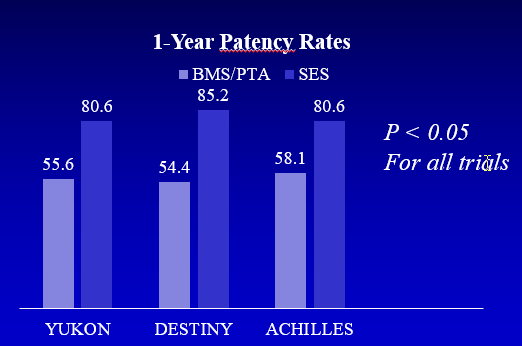
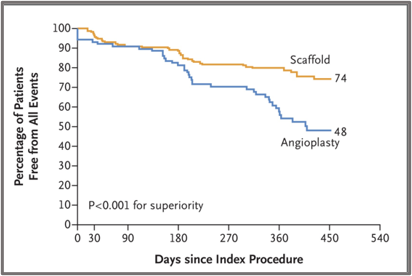
Another variation is the drug-eluting bioresorbable scaffold. This technology can deliver the antiproliferative drug and then the scaffold disappears and goes away. It was tested against PTA (POBA) in the LIFE-BTK trial, using the Esprit everolimus-eluting bioresorbable scaffold from Abbott. [11] The primary endpoint was limb salvage, and the bioresorbable scaffold was superior (Figure 2).
Possible solutions or future directions
BTK trials are “in,” that is, they are popular. New devices, especially new DCB are being studied, examples are listed in the table below:
|
Device |
Company |
Trial |
Comparison |
Clinical group |
|
Magic Touch |
Concept Medical |
LIMES |
POBA |
CLI, |
|
Luminor |
iVascular |
MERLION |
None - observational |
CLI, |
|
Litos |
Acotec |
ACOART II |
POBA |
CLI, |
|
Virtue |
Orchestra BioMed |
(coronary ISR underway) |
-- |
-- |
The larger issues are more strategic and definitional: What is the anatomic target? Are focal, non-calcified, non-occluded lesions included? What is the clinical target? What is the treatment? What is the comparator (control) treatment? What are the endpoints? Is vessel patency beyond 3-6 months mandatory? A recent comprehensive meta-analysis concluded that DCB compared with POBA reduced early revascularizations but showed no significant long-term benefits in amputations or mortality.[12] However, the authors noted especially that small sample sizes, differing definitions and endpoints, and heterogenous populations, made comparisons extremely difficult and conclusions uncertain. Until all these issues are settled, we may still have to deal with uncertainty in the future.
References
- Liistro F, et al. Randomized Controlled Trial of Acotec drug-eluting balloon versus plain balloon for below-the-knee angioplasty. JACC Cardiovasc Interv. 2020;13(19):2277-2286. doi: 10.1016/j.jcin.2020.06.045. Epub 2020 Sep 16. PMID: 32950416.
- Zeller T, et al; IN.PACT DEEP Trial Investigators. The IN.PACT DEEP Clinical Drug-Coated Balloon Trial: 5-Year Outcomes. JACC Cardiovasc Interv. 2020;13(4):431-443. doi: 10.1016/j.jcin.2019.10.059. PMID: 32081236.
- Ouriel K, et al. Safety of paclitaxel-coated balloon angioplasty for femoropopliteal peripheral artery disease. JACC Cardiovasc Interv. 2019 Dec 23;12(24):2515-2524. doi: 10.1016/j.jcin.2019.08.025. Epub 2019 Sep 28. PMID: 31575518.
- van Overhagen H, et al. Primary results of the SAVAL randomized trial of a paclitaxel-eluting nitinol stent versus percutaneous transluminal angioplasty in infrapopliteal arteries. Vasc Med. 2023 Dec;28(6):571-580. doi: 10.1177/1358863X231199489. Epub 2023 Oct 16. PMID: 37844137; PMCID: PMC10693734.
- McKinsey JF, et al; DEFINITIVE LE Investigators. Lower extremity revascularization using directional atherectomy: 12-month prospective results of the DEFINITIVE LE study. JACC Cardiovasc Interv. 2014 Aug;7(8):923-33. doi: 10.1016/j.jcin.2014.05.006. PMID: 25147039.
- Giannopoulos S, et al. Three-year outcomes from the liberty 360 study of endovascular interventions for peripheral artery disease stratified by rutherford category. J Endovasc Ther. 2021 Apr;28(2):262-274. doi: 10.1177/1526602820962972. Epub 2020 Oct 5. PMID: 33016805.
- Shammas NW, et al; JET-RANGER Investigators. Jetstream Atherectomy with paclitaxel-coated balloons: 3-year outcomes of the prospective randomized JET-RANGER Study. Int J Angiol. 2024;34(1):56-59. doi: 10.1055/s-0044-1791546. PMID: 39944148; PMCID: PMC11813604.
- Rastan A, et al. Sirolimus-eluting stents vs. bare-metal stents for treatment of focal lesions in infrapopliteal arteries: a double-blind, multi-centre, randomized clinical trial. Eur Heart J. 2011 Sep;32(18):2274-81. doi: 10.1093/eurheartj/ehr144. Epub 2011 May 26. PMID: 21622669.
- Bosiers M, et al. J Vasc Surg. 2012;55(2):390-8. doi: 10.1016/j.jvs.2011.07.099. Epub 2011 Dec 14. PMID: 22169682.
- Scheinert D, et al; ACHILLES Investigators. A prospective randomized multicenter comparison of balloon angioplasty and infrapopliteal stenting with the sirolimus-eluting stent in patients with ischemic peripheral arterial disease: 1-year results from the ACHILLES trial. J Am Coll Cardiol. 2012;60(22):2290-5. doi: 10.1016/j.jacc.2012.08.989. PMID: 23194941.
- Varcoe RL, et al; LIFE-BTK Investigators. Drug-eluting resorbable scaffold versus angioplasty for infrapopliteal artery disease. N Engl J Med. 2024;390(1):9-19. doi: 10.1056/NEJMoa2305637. Epub 2023 Oct 25. PMID: 37888915.
- Modi K, et al. Drug-coated balloon angioplasty versus percutaneous transluminal angioplasty for below-the-knee interventions in chronic limb-threatening ischemia patients: systematic review and meta-analysis. Ann Vasc Surg. 2026;123:104-118. doi: 10.1016/j.avsg.2025.09.022. Epub 2025 Sep 18. PMID: 40975218.
3.3 Carotid Stenting Following CREST-2: How to Democratize ─ and Do MicroNET Stents and TCAR Have a Role?
Problem Presenter: Piotr Musialek
Statement of problem or issue
Strokes due to atherosclerotic carotid artery disease are often large and disabling. Even if relatively small in terms of embolic cerebral tissue loss, they may be functionally significant (speech or hand area infarct, ocular or cortical blindness, etc.). Carotid-related strokes should be prevented rather than experienced by stroke victims (many of whom would prefer death to their life after stroke) and their families. Treatment of carotid disease after a stroke has occurred is a failure of the system; those at stroke risk should be identified and treated before it occurs.
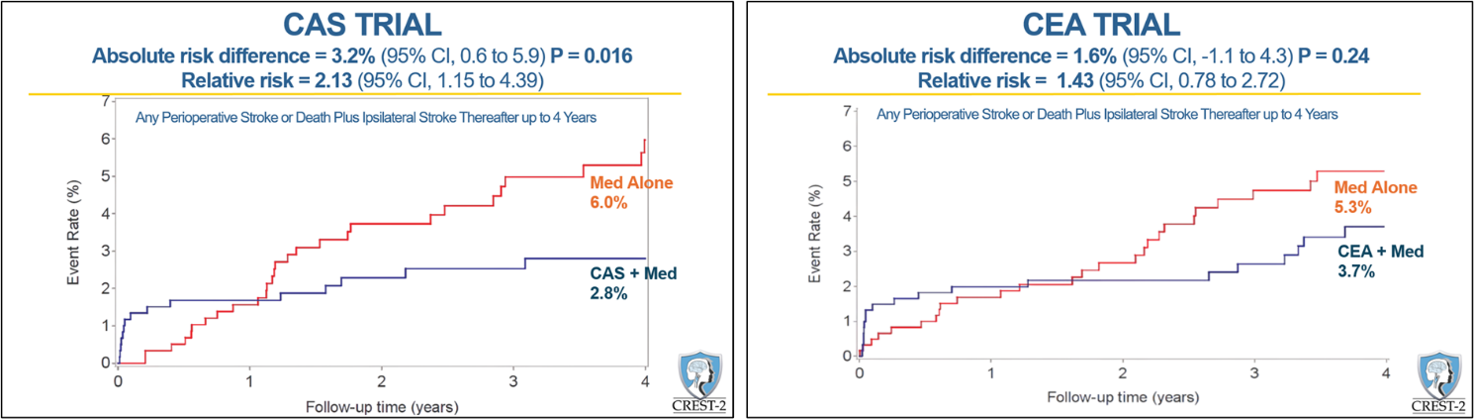
Transfemoral carotid artery stenting (CAS) has been used to treat carotid disease since 1994.[1] However, the final proof of the superiority of CAS compared to carotid endarterectomy (CEA) or medicines alone for patients with asymptomatic carotid disease had to wait for improvements in brain protection devices and new stent designs. Ultimately, the CREST-2 trial demonstrated a clear superiority of CAS added to maximized medical therapy vs. maximized medical therapy alone, whereas CEA failed the test of contemporary evidence (Figure 1).[2]
Gaps in current knowledge
After CREST-2 the question is whether CAS can do still better. Specifically, is it possible to reduce the post-stent adverse event rates even further from the 2.8% (at 4-years) found in the trial? With single-layer stents (such as those used in CREST-2) most of the 30-day post-procedural stroke events occur due to interactions between the stent and the non-insulated background atherothrombotic lesion. Plaque prolapse with or without associated thrombus formation is the leading mechanism of post-procedural cerebral embolic events [3]). Also, in some patients the plaque may continue to develop and extend through the stent struts, up to the point of becoming symptomatic.[4]
Possible solutions and future directions
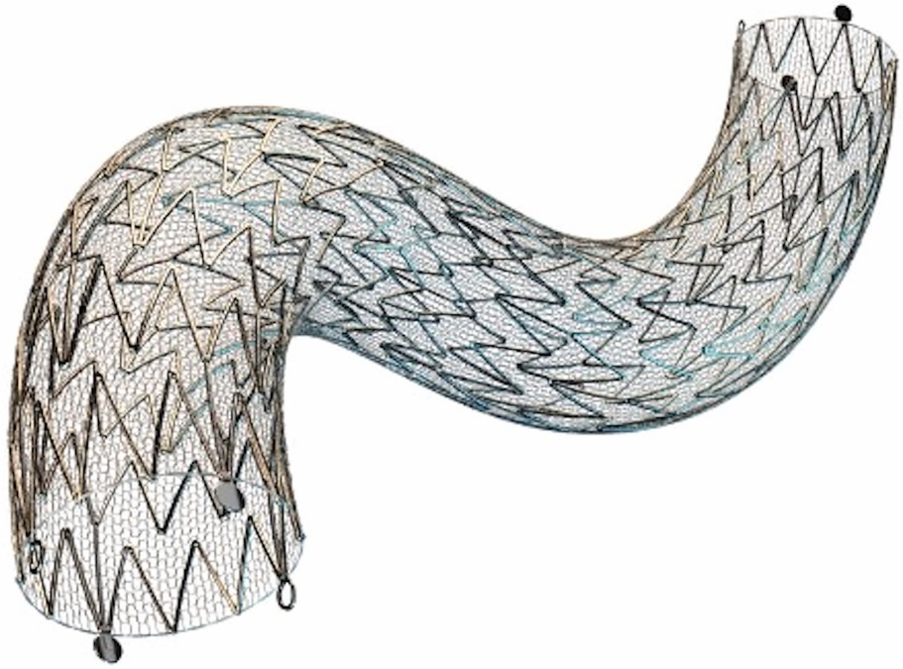
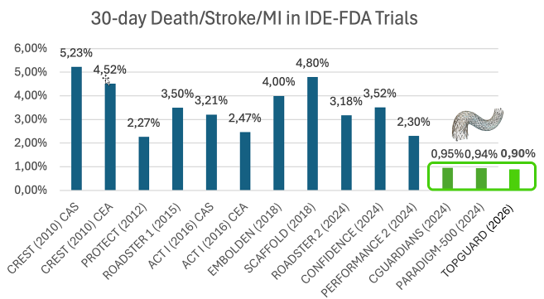
- A nitinol stent with non-metallic micromesh covering, named CGuard (Figure 2), has been developed to sequester the underlying atherosclerotic plaque and help prevent both plaque-related embolic events and intraluminal plaque progression. In a randomized controlled study of cerebral embolism by magnetic resonance imaging, CGuard profoundly reduced cerebral embolism when compared to a conventional single-layer carotid stent.[5] In clinical studies this new carotid stent has been found to result in fewer major adverse event rates – both at 30-days (Fig. 3 below) and later – than any other FDA-IDE study of carotid stents so far.[6] A recent meta-analysis has confirmed superior performance of the MicroNET-covered stent in absence of a “mesh stent” class effect.[7]
- There is a novel surgical technique called TCAR (transcarotid artery revascularization), developed to mimic transfemoral CAS with flow reversal. TCAR requires surgical access via the common carotid artery. It employs a large-bore catheter placed in the antegrade direction and transient common carotid artery clamping with a dynamic flow reversal. With flow reversal the risk of debris from the carotid lesion embolizing to the brain during CAS is nearly totally eliminated. The concomitant placement of the Micronet-covered stent (Fig 2) prevents further plaque-related events [8]. TCAR may play an important role as a vehicle for CAS in patients with absence of functional transfemoral or transradial arterial access (Leriche syndrome, severe type 3 aortic arch, etc.).
The future will revolve around 5 critical steps that must be implemented and questions that must be answered:
- Screening. In order to be truly helpful for patients, that is, to achieve the greatest preventive benefit, we should screen asymptomatic patients to identify the ones that require optimization of medical treatment and, in some, revascularization before strokes occur.[9,10] How and for whom to target the screening to maximize patient benefit? Should there be large scale screening programs? How should the patients be screened? Who will do the screening? Who will pay the costs of screening?
- Referral. How can patients be appropriately channeled to the minimally invasive therapy (CAS) with level-1 evidence of efficacy (Figure 1)? How to increase awareness of neurology and other specialties?
- Type of procedure. Today, the patient must be placed in the very center of the decision-making process. Patients should receive full information about the treatment options, their risks and their relative efficacy (Figure 1).[9]
- Competence. CAS operator competence must be promoted. Only those able to offer competent CAS should perform CAS.
- Monitoring. Procedural outcomes should be monitored and quality assurance processes should be in place. Who will organize and who will pay for monitoring?
References
- Roubin GS, et al. Carotid stent-supported angioplasty: a neurovascular intervention to prevent stroke. Am J Cardiol. 1996;78(3A):8-12. doi: 10.1016/s0002-9149(96)00487-0. PMID: 8751840.
- Brott TG, et al; CREST-2 Investigators. Medical Management and Revascularization for Asymptomatic Carotid Stenosis. N Engl J Med. 2026;394(3):219-231. doi: 10.1056/NEJMoa2508800. Epub 2025 Nov 21. PMID: 41269206.
- Kotsugi M, et al. Carotid Artery Stenting: Investigation of Plaque Protrusion Incidence and Prognosis. JACC Cardiovasc Interv. 2017;10(8):824-831. doi: 10.1016/j.jcin.2017.01.029. PMID: 28427600.
- Tekieli L, et al. Symptomatic atherosclerotic plaque progression in a first-generation carotid stent: management and 5-year clinical and imaging outcome. Eur Heart J Case Rep. 2021;6(1):ytab489. doi: 10.1093/ehjcr/ytab489. PMID: 35174303.
- Karpenko A, et al. Randomized controlled trial of conventional versus micronet-covered stent in carotid artery revascularization. JACC Cardiovasc Interv. 2021;14(21):2377-2387. doi: 10.1016/j.jcin.2021.08.005. PMID: 34736737.
- Metzger DC, et al; C-GUARDIANS Investigators. Safety and Efficacy of a Novel Micro Net Carotid Stent System: Results of the C-GUARDIANS Trial. JACC Cardiovasc Interv. 2025 Dec 22;18(24):3087-3097. doi: 10.1016/j.jcin.2025.09.027. Epub 2025 Dec 1. PMID: 41329120.
- Mazurek A, et al. CARMEN (CArotid Revascularization Systematic Reviews and MEta-aNalyses) Investigators. clinical outcomes of second- versus first-generation carotid stents: a systematic review and meta-analysis. J Clin Med. 2022;11(16):4819. doi: 10.3390/jcm11164819. PMID: 36013058.
- Van Herzeele I, et al. Transcarotid revascularisation using dynamic flow reversal and micronet covered embolic prevention stents (TOPGUARD Study): Key clinical, imaging, peri-procedural and 12-month outcome data. Eur J Vasc Endovasc Surg. 2026:S1078-5884(26)00055-9. doi: 10.1016/j.ejvs.2026.01.021. Epub ahead of print. PMID: 41554373.
- Musialek P, et al. Stroke risk management in carotid atherosclerotic disease: a clinical consensus statement of the ESC Council on Stroke and the ESC Working Group on Aorta and Peripheral Vascular Diseases. Cardiovasc Res. 2025;121(1):13-43. doi: 10.1093/cvr/cvad135. PMID: 37632337.
- Paraskevas KI, et al. Selective Screening for Asymptomatic Carotid Artery Stenosis: An Appraisal of the 2024 European Society of Cardiology (ESC) Guidelines Position. Am J Med. 2025;138(2):209-211. doi: 10.1016/j.amjmed.2024.10.033. Epub 2024 Nov 14. PMID: 39547462.
4.1 COMPLETE, MULTISTARS, BIOVASC and OPTION: Enough Evidence to Standardize STEMI PCI Worldwide?
Problem Presenter: David Wood
Statement of problem or issue
The question is whether or not we should revascularize non-culprit lesions in patients with STEMI. One very strong answer came from the COMPLETE trial (Figure 1).[1] The answer was Yes.
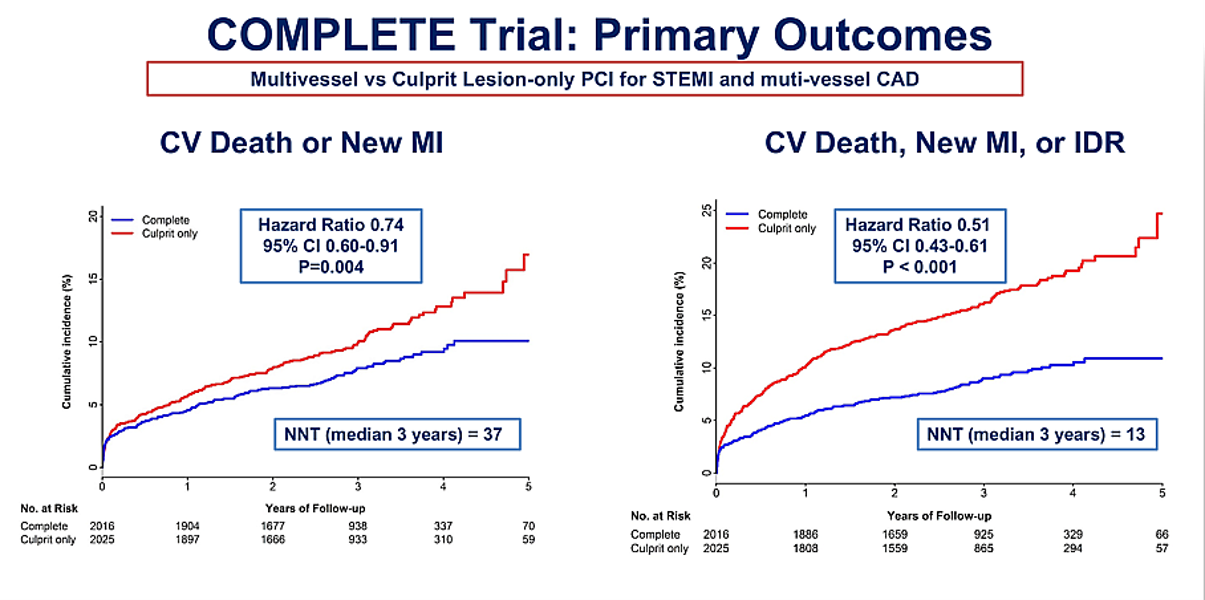
The COMPLETE trial helped change guidelines. In 2012, non-culprit lesion revascularization was a Class C recommendation, that is, don’t do it. In the most recent US (2025) and European (2023) guidelines, it is Class 1A, that is, highly recommended.
Very importantly, COMPLETE had an optical coherence tomography (OCT) substudy, where non-culprit lesion imaging was performed. Nearly one-half of the patients in the substudy had thin-cap fibroatheromas (TCFA) seen on OCT, emphasizing the vulnerability of these lesions to further deterioration, plaque rupture, and subsequent adverse events.[2] This may help explain the mechanism of benefit found with complete revascularization including non-culprit lesions in patients with STEMI. Treating these vulnerable non-culprit lesions helps stabilize them and prevent the later adverse events.
Gaps in current knowledge
Although we recognize that complete revascularization in patients with STEMI is beneficial, there is still disagreement on the timing of non-culprit lesion intervention. Two other randomized trials investigated this question: MULTISTARS and OPTION-STEMI. [3,4] However, both of these were non-inferiority trials. The MULTISTARS investigators found that immediate complete revascularization was not inferior to staged complete revascularization. On the other hand, the OPTION-STEMI investigators found that immediate complete revascularization was “not non-inferior” to a staged approach. Interestingly, in OPTION-STEMI, approximately 30% of the enrolled patients had compromised LV function, with higher Killip class and more evidence of heart failure. These compromised patients had higher adverse event rates with immediate complete versus staged complete revascularization (23% vs 13%, HR=1.79, P=.04). [4]
Finally, the BIOVASC trial randomly assigned patients with acute coronary syndromes to immediate complete or staged complete revascularization.[5] The immediate complete approach was non-inferior to the staged complete approach. However, in the BIOVASC trial only 40% of the enrolled patients had STEMI, whereas 60% had NSTEMI or unstable angina. Therefore, BIOVASC was a non-inferiority trial with a mixed population, and this makes it difficult to interpret for a true STEMI cohort.
Possible solutions or future directions
Important new information will come from the COMPLETE-2 trial (NCT05701358). This trial will randomly assign 5100 patients with STEMI or NSTEMI to either an angiography-guided or physiology-guided treatment strategy for non-culprit lesions. In addition, there will be an OCT substudy in COMPLETE-2 just as there was in the original COMPLETE trial. We do not yet have all the data needed to standardize STEMI PCI worldwide, in regards to treating non-culprit lesions. But we are making excellent progress.
References
- Mehta SR, et al; COMPLETE Trial Steering Committee and Investigators. Complete Revascularization with Multivessel PCI for Myocardial Infarction. N Engl J Med. 2019;381(15):1411-1421. doi: 10.1056/NEJMoa1907775. Epub 2019 Sep 1. PMID: 31475795.
- Pinilla-Echeverri N, et al. Nonculprit Lesion Plaque Morphology in Patients With ST-Segment-Elevation Myocardial Infarction: Results From the COMPLETE Trial Optical Coherence Tomography Substudys. Circ Cardiovasc Interv. 2020;13(7):e008768. doi: 10.1161/CIRCINTERVENTIONS.119.008768. Epub 2020 Jul 10. PMID: 32646305.
- Stähli BE, et al; MULTISTARS AMI Investigators. Timing of Complete Revascularization with Multivessel PCI for Myocardial Infarction. N Engl J Med. 2023;389(15):1368-1379. doi: 10.1056/NEJMoa2307823. Epub 2023 Aug 27. PMID: 37634190.
- Kim MC, et al; OPTION–STEMI Investigators. Immediate versus staged complete revascularisation during index admission in patients with ST-segment elevation myocardial infarction and multivessel disease (OPTION-STEMI): a multicentre, non-inferiority, open-label, randomised trial. Lancet. 2025;406(10507):1032-1043. doi: 10.1016/S0140-6736(25)01529-6. Epub 2025 Aug 31. PMID: 40902612.
- Diletti R, et al; BIOVASC Investigators. Immediate versus staged complete revascularisation in patients presenting with acute coronary syndrome and multivessel coronary disease (BIOVASC): a prospective, open-label, non-inferiority, randomised trial. Lancet. 2023;401(10383):1172-1182. doi: 10.1016/S0140-6736(23)00351-3. Epub 2023 Mar 5. PMID: 36889333.
4.2 STEMI-CS: Any "DanGer" to Unloading Routinely? Complete or CULPRIT Revascularization? Are Shock Teams Needed? How to Handle the Antiplatelet/Anticoagulation Therapy?
Problem Presenter: Alex Truesdell for Rajan Patel
Statement of problem or issue
The DanGer-Shock randomized controlled trial showed a mortality benefit (lower mortality) at 6 months from routine use of mechanical circulatory support (MCS) with a microaxial flow pump among STEMI patients in advanced stages of cardiogenic shock (CS).[1,2] Yet, many questions still remain to be answered. Despite the superior survival in the MCS group, the “danger” encountered in the trial included higher rates of adverse events in the group randomly assigned to MCS compared with those assigned to Standard Care alone (Table 1).[1] These risks were approximately double in MCS patients compared with standard care patients. However, it also be noted that no patients were on renal replacement therapy at 6 months. Also importantly, the increase in bleeding events in the MCS group did not result in increased mortality.
|
Outcome |
MCS + Standard Care (%) |
Standard Care alone (%) |
HR |
|
1° endpoint: death at 180 days |
45.8 |
58.5 |
0.74 |
|
Adverse events: |
|
|
|
|
Moderate or severe bleeding |
21.8 |
11.9 |
2.06 |
|
Limb ischemia |
5.6 |
1.1 |
5.15 |
|
Renal replacement therapy |
41.9 |
26.7 |
1.98 |
|
Sepsis with (+) blood culture |
11.7 |
4.5 |
2.79 |
Table 1. Primary outcomes and adverse event rates in the DanGer Shock trial. Adapted from Møller JE, et al; DanGer Shock Investigators. Microaxial Flow Pump or Standard Care in Infarct-Related Cardiogenic Shock. N Engl J Med. 2024;390(15):1382-1393. Used with permission.
In the DanGer Shock trial, approximately one-half of the patients in both groups underwent non-culprit lesion revascularization in addition their primary PCI. This decision was left to operator discretion. Subgroup analysis did not reveal any important insights. However, the COMPLETE trial showed a benefit with complete revascularization in patients with STEMI. [3] Although CS was an exclusion criterion in COMPLETE, subgroup analysis showed benefits with complete revascularization in patients with reduced ejection fractions and those with Killip Class ≥2. On the other hand, the CULPRIT-SHOCK trial showed that in patients with STEMI and CS, culprit-lesion only PCI was superior to complete revascularization.[4] However, staged or urgent repeat revascularizations were not part of the trial design in CULPRIT-SHOCK, were left to clinical judgment, and the culprit-lesion only group had more of these (Table 2). So, the full answers on culprit-only or complete revascularization in patients with STEMI-CS remain unknown.
|
Outcome |
Culprit lesion only PCI (%) |
Multivessel PCI (%) |
Relative risk
|
P-value |
|
Staged or |
21.5 |
3.8 |
7.43 |
<.001 |
Table 2. Staged or urgent repeat revascularizations in the CULPRIT-SHOCK trial. Adapted from Thiele H, et al; CULPRIT-SHOCK Investigators. PCI Strategies in Patients with Acute Myocardial Infarction and Cardiogenic Shock. N Engl J Med. 2017;377(25):2419-2432. Used with permission.
There is evidence that shock protocols providing structured patient management, along with the implementation of specialized Shock Teams, improves patient care and reduces adverse events compared with non-protocolized care. [6,7]
Gaps in current knowledge
- Shock teams
- How can they be created, developed, and maintained?
- How to maintain quality of care?
- Are they sustainable? Scalable? Transferable?
- Culprit-only, Immediate complete, Staged complete revascularization?
- Are bleeding events related to antithrombotic therapies? How to manage?
- Antiplatelet
- Anticoagulant
Possible solutions or future directions
The use of protocolized care with adoption of best practices (including large bore access and closure) is being examined in the OASIS-AMICS trial (NCT06964685).
Some new information on culprit/complete revascularization, and timing, will come from the COMPLETE-2 trial (NCT05701358). Nevertheless, additional studies are needed.
The area of antithrombotic therapies in STEMI-CS is wide open.[8,9] While bowel absorption of oral agents is known to be decreased in patients with CS, the timing and markers of bowel recovery are unknown. Some research studies have examined the use of intravenous (IV) antiplatelet agents as an alternative to oral agents. However, the recently completed DAPT-SHOCK-AMI trial found more potent platelet inhibition, better coronary flow, fewer PCI complications, and lower rates of major bleeding with the IV antiplatelet agent cangrelor compared with oral ticagrelor; nevertheless, there was no difference in the primary outcome of death+MI+ischemic stroke at 30 days. [10] This should be an active area for future investigations.
References
- Møller JE, et al; DanGer Shock Investigators. Microaxial Flow Pump or Standard Care in Infarct-Related Cardiogenic Shock. N Engl J Med. 2024;390(15):1382-1393. doi: 10.1056/NEJMoa2312572. Epub 2024 Apr 7. PMID: 38587239.
- Kapur NK, et al. Criteria for Defining Stages of Cardiogenic Shock Severity. J Am Coll Cardiol. 2022 Jul 19;80(3):185-198. doi: 10.1016/j.jacc.2022.04.049. PMID: 35835491.
- Mehta SR, et al; COMPLETE Trial Steering Committee and Investigators. Complete Revascularization with Multivessel PCI for Myocardial Infarction. N Engl J Med. 2019 Oct 10;381(15):1411-1421. doi: 10.1056/NEJMoa1907775. Epub 2019 Sep 1. PMID: 31475795.
- Thiele H, et al; CULPRIT-SHOCK Investigators. PCI Strategies in Patients with Acute Myocardial Infarction and Cardiogenic Shock. N Engl J Med. 2017;377(25):2419-2432. doi: 10.1056/NEJMoa1710261. Epub 2017 Oct 30. PMID: 29083953.
- Basir MB, et al; National Cardiogenic Shock Initiative Investigators. Improved Outcomes Associated with the use of Shock Protocols: Updates from the National Cardiogenic Shock Initiative. Catheter Cardiovasc Interv. 2019 Jun 1;93(7):1173-1183. doi: 10.1002/ccd.28307. Epub 2019 Apr 25. PMID: 31025538.
- Warren AF, et al. Cardiogenic Shock: Protocols, Teams, Centers, and Networks. US Cardiol. 2021 Oct 20;15:e18. doi: 10.15420/usc.2021.10. PMID: 39720489.
- Sinha SS, et al. 2025 Concise Clinical Guidance: An ACC Expert Consensus Statement on the Evaluation and Management of Cardiogenic Shock: A Report of the American College of Cardiology Solution Set Oversight Committee. J Am Coll Cardiol. 2025 Apr 29;85(16):1618-1641. doi: 10.1016/j.jacc.2025.02.018. Epub 2025 Mar 17. PMID: 40100174.
- Droppa M, Geisler T. Optimal Antithrombotic Strategies in Cardiogenic Shock. J Clin Med. 2024 Jan 3;13(1):277. doi: 10.3390/jcm13010277. PMID: 38202284.
- D'Andria Ursoleo J, et al. Anti-Platelet Therapy with Cangrelor in Cardiogenic Shock Patients: A Systematic Review and Single-Arm Meta-Analysis. Medicina (Kaunas). 2024 Dec 21;60(12):2092. doi: 10.3390/medicina60122092. PMID: 39768971.
- www.pcronline.com/News/Congress-coverages/ESC/2025/DAPT-SHOCK-AMI-trial-Cangrelor-in-cardiogenic-shock. Accessed march 14, 2026.
4.3 Minimizing Infarct Size in STEMI: Latest Techniques, Pharmacology and How to Manage Microvascular Obstruction
Problem Presenter: William O’Neill
Statement of problem or issue
Infarct size is important because it is correlated with mortality (i.e. survival) both in the short and long terms. [1] The major clinical predictors of infarct size are listed in Table 1. [2]
|
Table 1. Clinical Predictors of Large Infarct Size in STEMI. |
|
|
|
|
|
|
Several strategies to reduce infarct size and enhance myocardial salvage have been investigated over the past 50 years. Many of these have been disproven, but a few have shown promise. One of the important issues is timing of the proposed therapeutic intervention. An outline for this is shown in Figure 1.
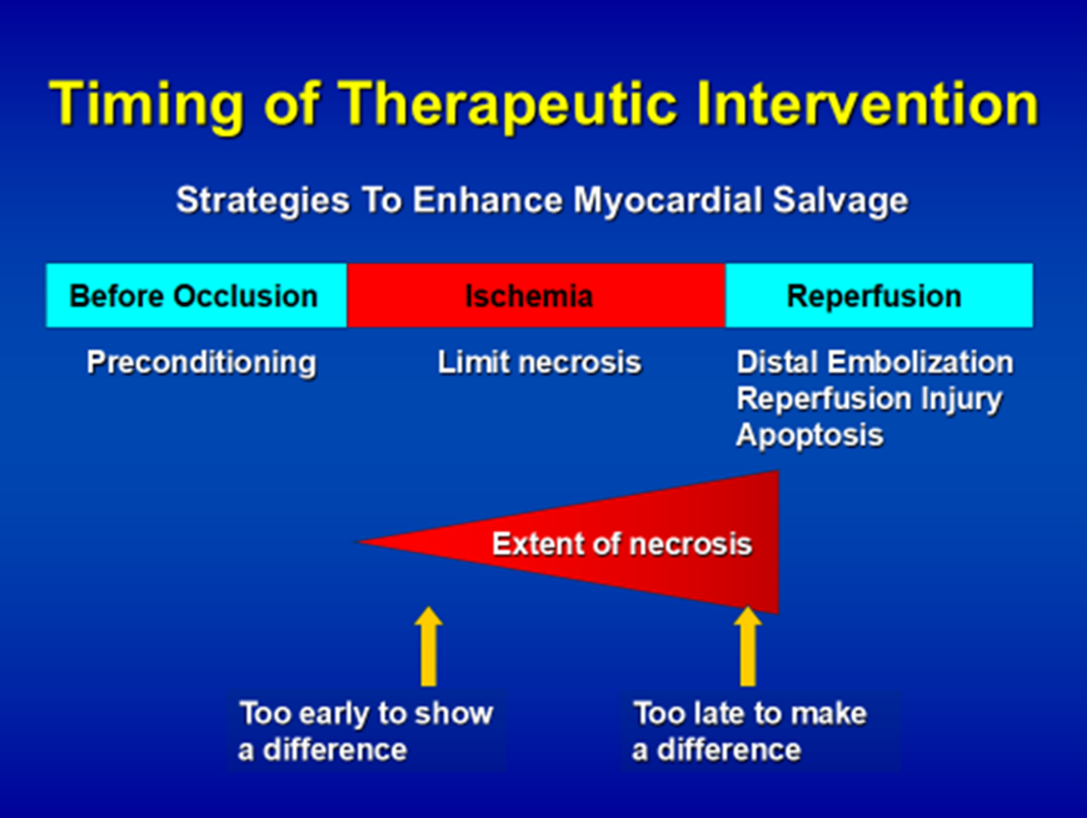
Figure by the author.
Gaps in current knowledge
Beyond achieving rapid and complete reperfusion, and supporting patients hemodynamically and clinically, everything else done therapeutically in this field has enormous gaps in the applicable knowledge base. As shown in Figure 1, understanding the timing of therapeutic intervention is critical: It may be implemented too early to show any difference, or, it may be implemented too late to make any difference.
Possible solutions or future directions
There are two extremely important avenues of investigation for reducing infarct size in the immediate future: (1) LV support (that is, mechanical circulatory support = MCS), for all STEMI patients but especially for those in cardiogenic shock (CS); (2) supersaturated oxygen (SSO2), usually infused via hyperoxygenated blood through a catheter into the target coronary artery immediately after successful PCI.
- Animal and clinical studies support the use of LV unloading (i.e. MCS) instituted immediately prior to reperfusion and continued during recovery. However, implementing MCS delays reperfusion, and this could be harmful. The DTU-STEMI pilot trial found that a brief delay up to 30 minutes to initiate LV support prior to reperfusion did not increase either infarct size or adverse event rates. [3] The full STEMI-DTU randomized trial (NCT03947619) with over 500 patients has been completed and results will be presented later this year.
- Experimental studies also support administration of SSO2 as a method to reduce infarct size, prevent LV remodeling, and improve survival in STEMI. [4-7]
Research suggests that the mechanism of benefit from SSO2 comes from a reduction or elimination of microvascular obstruction in the myocardial capillary beds of reperfused areas (Figure 2). [7,8]
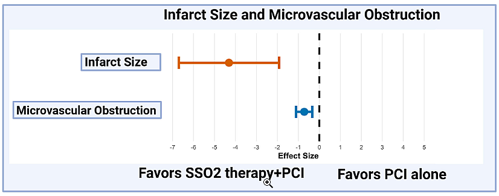
These areas are extremely hopeful for STEMI therapy. In terms of LV preservation and survival we have been stagnant for 30 years. We are now seeing an explosion in new research activity and many new things will come from it.
References
- van Kranenburg M, et al. Prognostic value of microvascular obstruction and infarct size, as measured by CMR in STEMI patients. JACC Cardiovasc Imaging. 2014;7(9):930-9. doi: 10.1016/j.jcmg.2014.05.010. PMID: 25212799.
- Stone GW, et al. Predictors of infarct size after primary coronary angioplasty in acute myocardial infarction from pooled analysis from four contemporary trials. Am J Cardiol. 2007;100(9):1370-5. doi: 10.1016/j.amjcard.2007.06.027. Epub 2007 Aug 17. PMID: 17950792.
- Kapur NK, et al. Unloading the left ventricle before reperfusion in patients with anterior st-segment-elevation myocardial infarction. Circulation. 2019;139(3):337-346. doi: 10.1161/CIRCULATIONAHA.118.038269. PMID: 30586728.
- O'Neill WW, et al; AMIHOT Investigators. Acute Myocardial Infarction with Hyperoxemic Therapy (AMIHOT): a prospective, randomized trial of intracoronary hyperoxemic reperfusion after percutaneous coronary intervention. J Am Coll Cardiol. 2007;50(5):397-405. doi: 10.1016/j.jacc.2007.01.099. Epub 2007 Jul 16. PMID: 17662390.
- Stone GW, et al; AMIHOT-II Trial Investigators. Effect of supersaturated oxygen delivery on infarct size after percutaneous coronary intervention in acute myocardial infarction. Circ Cardiovasc Interv. 2009;2(5):366-75. doi: 10.1161/CIRCINTERVENTIONS.108.840066. Epub 2009 Sep 15. PMID: 20031745.
- Chen S, et al. One-year outcomes of supersaturated oxygen therapy in acute anterior myocardial infarction: The IC-HOT study. Catheter Cardiovasc Interv. 2021;97(6):1120-1126. doi: 10.1002/ccd.29090. Epub 2020 Jul 10. PMID: 32649037.
- Kloner RA, et al. Update on Cardioprotective Strategies for STEMI: Focus on Supersaturated Oxygen Delivery. JACC Basic Transl Sci. 2021;6(12):1021-1033. doi: 10.1016/j.jacbts.2021.07.011. PMID: 35024508.
- Lingamsetty SSP, et al. Effects of supersaturated oxygen therapy on infarct size and microvascular obstruction following myocardial infarction: A systematic review and meta-analysis. Am Heart J. 2026;293:107311. doi: 10.1016/j.ahj.2025.107311. Epub 2025 Nov 24. PMID: 41297689.
5.1 TMVR vs. TMVr: Is TMVR There Yet? When to do TMVr Instead and With What?
Problem Presenter: George Hanzel
Statement of problem or issue
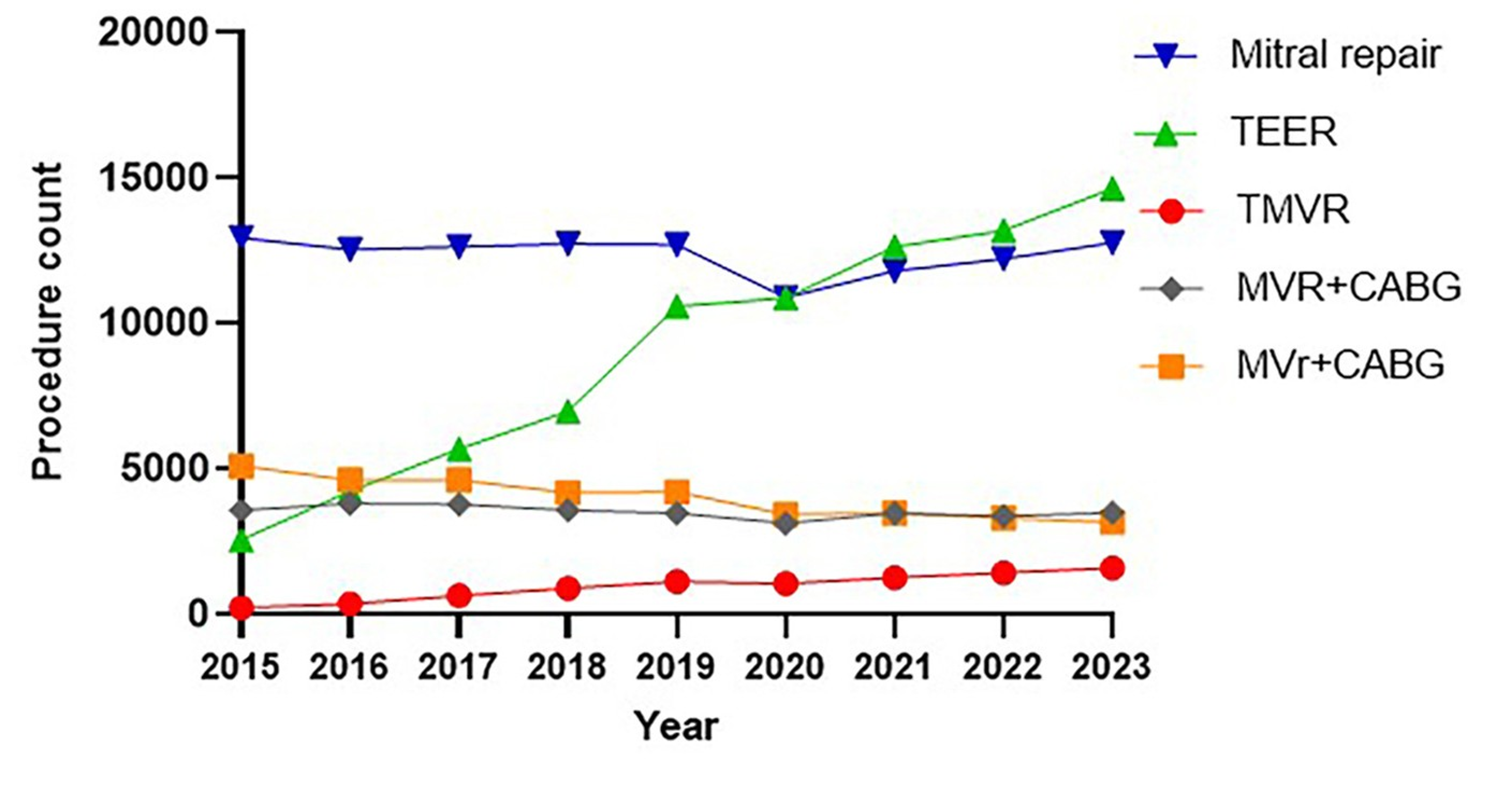
Transcatheter edge-to-edge repair of the mitral valve (M-TEER) has grown steadily over the past decade since its introduction into clinical practice. Transcatheter mitral valve replacement (TMVR) has been introduced more recently but the number of these procedures also is increasing (Figure 1).
One potential problem with M-TEER procedures is the difference between clinical trial results and what we see in clinical practice. For example, the reported rates of MR reduction ≤2 for the MitraClip device is 89-97%, and for the PASCAL device is 90-98%. [2,3] But, is that really what we see in our daily clinical practices? Can we do better with M-TEER?
What are the data for TMVR? Some recent study results are shown below in Table 1. Procedural success seems good, but short-and intermediate-terms outcomes look less favorable.
|
|
|
|
30-days |
1-year |
||
|
Study (Ref) |
Device |
Procedure success |
Mortality |
Stroke |
Mortality |
HF hosp.* |
|
ENCIRCLE (4) |
M3 |
96 |
0.7 |
2.7 |
13.9 |
16.7 |
|
TENDER (5) |
Tendyne |
94.9 |
6.7 |
1.6 |
16.9 |
25.4 |
|
SUMMIT (6) |
Tendyne |
94.2 |
6.8 |
1.9 |
16.8 |
30.1 |
|
INTREPID (7) |
Intrepid |
93.9 |
0 |
0 |
6.7 |
6.7 |
Table 1. Selected clinical results from recent studies of TMVR. All numbers are percents.
Abbreviations: *hosp.=hospitalization; †EFS= early feasibility study.
Further comparisons between M-TEER and TMVR are found in the results of the analysis of the pooled CHOICE-MI and Euro-SMR registries.(8) This was a propensity score-matched analysis of patients undergoing M-TEER (n=411) with MitraClip devices or TMVR (n=235) using one of ten possible valve implants. The primary endpoint comparison of all-cause mortality at 1 year is discussed in detail. Although close, the difference did not reach statistical significance (M-TEER = 18.9% vs TMVR = 25.8%, P=.056).(8) Other differences for the comparison of M-TEER with TMVR included more residual MR≥2 at 1 year (M-TEER = 36.6% vs TMVR=3%, P <.001) and higher NYHA Class I/II (77.8% vs 64.3%, P =.015).
Gaps in current knowledge
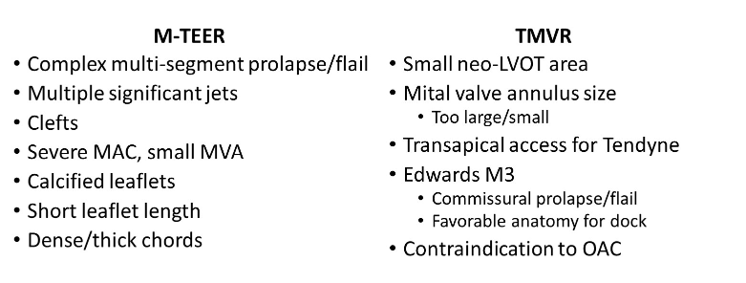
Some of the largest gaps in knowledge involve specific anatomic and clinical factors that could help decide between M-TEER or TMVR. Several of these are shown in Table 2 below.
Possible solutions or future directions
There are quite a few directions for future clinical research. Studies will likely be structured around answering the following questions:
- Which patients are best treated with M-TEER?
- Is MR reduction really as good as reported in trials?
- Which patients are best treated with TMVR?
- Is TMVR ready for prime time?
- When is superiority in MR reduction worth the increased procedural risk?
- Will SESAME/ASA/LAMPOON increase TMVR options for small neo-LVOT?
- Is it possible that valve iterations could reduce risk of LVOTO?
- Transseptal vs transapical?
- How about other transcatheter technologies?
- Leaflet extenders?
- Annuloplasty?
- Others?
- How to deal with M-TEER failures?
References
- Iribarne A, et al. The Society of Thoracic Surgeons Adult Cardiac Surgery Database: 2024 Update on National Trends and Outcomes. Ann Thorac Surg. 2025 Jun;119(6):1139-1150. doi: 10.1016/j.athoracsur.2025.03.011. Epub 2025 Mar 22. PMID: 40127833.
- von Bardeleben RS, et al. 1-Year outcomes with fourth-generation mitral valve transcatheter edge-to-edge repair from the EXPAND G4 Study. JACC Cardiovasc Interv. 2023 Nov 13;16(21):2600-2610. doi: 10.1016/j.jcin.2023.09.029. Epub 2023 Oct 24. PMID: 37877913.
- Waggoner T, et al. Early U.S. Commercial Experience With a Novel Transcatheter Edge-to-Edge Repair System: Insights From Real-World Data. JACC Cardiovasc Interv. 2025;18(16):2036-2046. doi: 10.1016/j.jcin.2025.07.019. PMID: 40866033.
- Guerrero ME, et al; ENCIRCLE Trial Executive Committee and Study Investigators. Percutaneous transcatheter valve replacement in individuals with mitral regurgitation unsuitable for surgery or transcatheter edge-to-edge repair: a prospective, multicountry, single-arm trial. Lancet. 2025 Nov 29;406(10519):2541-2550. doi: 10.1016/S0140-6736(25)02073-2. Epub 2025 Oct 27. Erratum in: Lancet. 2025;406(10519):2540. doi: 10.1016/S0140-6736(25)02380-3. PMID: 41167201.
- Hell MM, et al; TENDER Investigators. Transapical Mitral Valve Replacement: 1-Year Results of the Real-World Tendyne European Experience Registry. JACC Cardiovasc Interv. 2024;17(5):648-661. doi: 10.1016/j.jcin.2023.12.027. Epub 2024 Feb 21. PMID: 38385922.
- Sorajja P, et al. Transcatheter Mitral Valve Replacement for Severe Mitral Annular Calcification: Primary Outcomes From the SUMMIT-MAC Study. J Am Coll Cardiol. 2025:S0735-1097(25)09942-5. doi: 10.1016/j.jacc.2025.10.025. Epub ahead of print. PMID: 41194751.
- Zahr F, et al. 1-Year outcomes following transfemoral transseptal transcatheter mitral valve replacement: Intrepid TMVR Early Feasibility Study Results. JACC Cardiovasc Interv. 2023 Dec 11;16(23):2868-2879. doi: 10.1016/j.jcin.2023.10.001. Epub 2023 Oct 23. PMID: 37902145.
- Ludwig S, et al; the CHOICE-MI and the EuroSMR Investigators (see online Appendix S1). Transcatheter mitral valve replacement or repair for secondary mitral regurgitation: a propensity score-matched analysis. Eur J Heart Fail. 2023 Mar;25(3):399-410. doi: 10.1002/ejhf.2797. Epub 2023 Mar 8. PMID: 36883620.
5.2 Interventional Solutions for TR: Any Room for More "T's" (Triapta, Tricvalve, Trillium) or "C's" (Cormaze, Cardioband) and How to Factor Pacemakers, RV Dysfunction
Problem Presenter: Jonathan Schwartz
Statement of problem or issue
Tricuspid valve insufficiency or regurgitation (TR) has become a popular field of clinical research. Currently, proposed interventional transcatheter solutions are quite numerous. Some of these involve valve repair (such as TriClip, TriCinch, PASCAL, Millipede IRIS, Mistral, LaVingi TR, DragonFly, and others) and some involve replacement (EVOQUE, LUX-Valve, TriFlo, Sapien XT, Trillium, Melody, VDyne, and others). This is a crowded field, and we can expect it get more crowded. We will have to make room for more “T’s” and more “C’s” and probably more of every other letter too. At least temporarily.
Gaps in current knowledge
The largest gaps in our current clinical knowledge base are:
1) management of cardiac implantable electronic devices (CIED);
2) assessment and management of right ventricular (RV) function.
3) design of clinical trials for TR intervention.
Almost all CIED devices affect the native tricuspid valve, usually by propping open the leaflets. This can worsen TR and also potentially make it more difficult to correct with repair or replacement. In the TRISCEND I + II clinical trials of transcatheter tricuspid valve replacement (TTVR) using the EVOQUE valve, 10/152 patients developed CIED-related events; most required new leads or repositioning of existing leads. Yet the authors concluded that TTVR was safe and effective in patients with pre-existing and new CIED.[1,2] Similarly, the TRILUMINATE randomized trial of T-TEER using the TriClip found that T-TEER was safe and effective in patients with CIED, with similar rates of TR reduction and low complication rates in patients with CIED.[3] The populations studied in these trials were quite different and it is difficult to compare them.
Regarding RV function, there is no consensus on which parameter is most useful for prognosis and which could help guide timing of intervention. The tricuspid annular plane systolic excursion (TAPSE) index is likely the most commonly used parameter, but isn’t great used in isolation. Other parameters are RV-PA coupling, which might perhaps be the most suitable and has shown promise. Then there are also TAPSE/PASP ratio, RV global longitudinal strain, RVEF, and PAPi. Finally, the TRI-SCORE is a point-scoring system designed to predict mortality in patients undergoing tricuspid valve surgery. However, it has been found to be useful in studies of transcatheter intervention.[4]
The final gap mentioned is trial design. What outcomes are relevant for tricuspid intervention? What should the control group be? Should there be sham controls? Should there be both a surgical control group as well as an optimal medications control group? When is the RV too far gone for any intervention?
Possible solutions or future directions
We can expect a large number of clinical trials to be done on both existing and nearly-developed devices. Many devices likely will not make it to approval and commercialization. Hopefully, there will be subgroup analyses of currently available trial data as well as any newly generated data; this may help guide development. Competition is a good thing and will drive innovation. Our task now and in the future is to focus on knowledge gaps.
References
- Kodali S, et al; the TRISCEND study investigators. Transfemoral tricuspid valve replacement and one-year outcomes: the TRISCEND study. Eur Heart J. 2023;44(46):4862-4873. doi: 10.1093/eurheartj/ehad667. PMID: 37930776.
- Hahn RT, et al; TRISCEND II Trial Investigators. Transcatheter Valve Replacement in Severe Tricuspid Regurgitation. N Engl J Med. 2025;392(2):115-126. doi: 10.1056/NEJMoa2401918. Epub 2024 Oct 30. PMID: 39475399.
- Tang G, et al. Tricuspid Transcatheter Edge-to-Edge Repair for Severe Tricuspid Regurgitation: 1-Year Outcomes From the TRILUMINATE Randomized Cohort. JACC. 2025 Jan, 85 (3) 235–246. doi.org/10.1016/j.jacc.2024.10.086
- Dreyfus J, et al; TRIGISTRY investigators. TRI-SCORE and benefit of intervention in patients with severe tricuspid regurgitation. Eur Heart J. 2024;45(8):586-597. doi: 10.1093/eurheartj/ehad585. PMID: 37624856.
5.3 Best Practices for Closure of Large Bore Arterial and Venous Access Sites for Structural Interventions
Problem Presenter: Itsik Ben-Dor
Statement of problem or issue
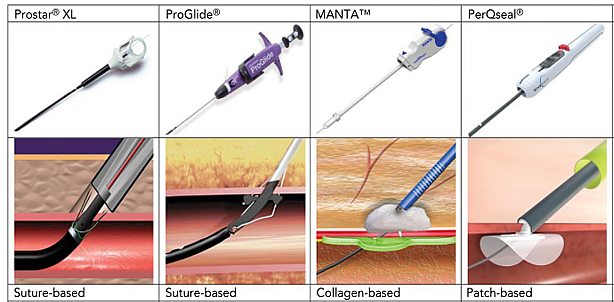
With the development and growth of structural heart interventions, like TAVR requiring large bore arterial access, and TMVR and TTVR both requiring similarly large bore venous access, there are complex issues related to vascular access site closure after completion of the procedure. Several devices are available, and they can be classified as suture-based or plug/patch-based (Figure 1).
Arterial access site
Studies comparing devices for arterial access site closure are not extensive. Furthermore, techniques used by operators as well as the size and disease state of the arteries vary widely, making results difficult to interpret. Two small randomized trials tested a strategy of using two suture devices (ProGlide/ProStyle) versus one suture device plus one plug device (AngioSeal). The conclusions of both were that the suture plus plug strategy was superior.[1,2]
For the newer MANTA collagen plug device, two small randomized trials compared it to a suture-based device, and concluded that the suture-based device and technique was superior.[3,4] A meta-analysis of these two randomized trials confirmed this.[5]
Ongoing research has shown that simplistic interpretations of current trial results are not warranted. Many other vascular factors must be considered. These include, as a partial list only:
-
- Arterial size (diameter, mm)
- Arterial depth (superficial or deep)
- Calcification (anterior, posterior, circumferential)
Algorithms for device selection and step-by-step management of arterial access site closure have been developed and are undergoing continuous refinement.[6] These algorithms can help improve success and avoid complications.
Venous access site
With large bore venous access, the range of sizes is wider than with arterial access. A representative spectrum of sizes is shown in Figure 2.
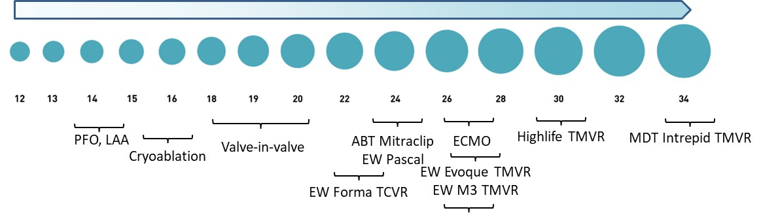
As discussed in the previous session (Session 5.2 – Schwartz), development of new devices for the tricuspid and mitral valves is an extremely active area; so this is a crowded field. More novel devices for large-bore venous access site closure are needed.
Gaps in current knowledge
The gaps in our current knowledge base are enormous and not likely to be filled quickly. A few of these gaps are listed below.
- Can the same device type be used for both artery and vein closures?
- Should surgical cut-downs and closures be used for vessels above a certain French-size?
- Are bail-out options (eg, wire access) always necessary?
- Is consideration of re-entry (ie, absorbable versus permanent) important?
- What is an “acceptable” rate of vascular complications?
Possible solutions or future directions
Many new closure devices and associated techniques are under investigation. We can expect a large number of presentations and publications of the results with these devices in the near future. Five of these closure devices are listed below:
- PerQseal (Vivasure Medical Ltd.) [7]
- Celt ACD (Vasorum Ltd.) [8]
- CLOSER (Rex Medical) [9]
- xCinch (xDot Medical Inc.) [10]
- NOVELRAD VCD (Novelrad – www.novelrad.com)
References
- Yeh CF, et al. Dual ProGlide vs ProGlide and Angio-Seal for Femoral Access Hemostasis After Transcatheter Aortic Valve Replacement: A Randomised Comparative Trial. Can J Cardiol. 2025 Jan;41(1):12-20. doi: 10.1016/j.cjca.2024.09.001. Epub 2024 Sep 6. Erratum in: Can J Cardiol. 2026 Mar 24:S0828-282X(26)00170-4. doi: 10.1016/j.cjca.2026.03.001. PMID: 39245341.
- Rheude T, et al. Comparison of strategies for vascular ACCESS closure after Transcatheter Aortic Valve Implantation: the ACCESS-TAVI randomized trial. Eur Heart J. 2025 Feb 14;46(7):635-645. doi: 10.1093/eurheartj/ehae784. PMID: 39474906.
- van Wiechen MP, et al. Suture- or Plug-Based Large-Bore Arteriotomy Closure: A Pilot Randomized Controlled Trial. JACC Cardiovasc Interv. 2021 Jan 25;14(2):149-157. doi: 10.1016/j.jcin.2020.09.052. Epub 2020 Dec 23. PMID: 33358648.
- Abdel-Wahab M, et al; CHOICE-CLOSURE Investigators. Comparison of a Pure Plug-Based Versus a Primary Suture-Based Vascular Closure Device Strategy for Transfemoral Transcatheter Aortic Valve Replacement: The CHOICE-CLOSURE Randomized Clinical Trial. Circulation. 2022 Jan 18;145(3):170-183. doi: 10.1161/CIRCULATIONAHA.121.057856. Epub 2021 Nov 5. PMID: 34738828.
- Dumpies O, et al. Suture-based versus plug-based closure for large-bore arterial access: an individual patient-level meta-analysis of randomised trials. EuroIntervention. 2025 Oct 20;21(20):e1222-e1233. doi: 10.4244/EIJ-D-25-00001. PMID: 41117657.
- Rosseel L, Montarello NJ, Nuyens P, Tirado-Conte G, Quagliana A, Cornelis K, Floré V, Rosseel M, Bieliauskas G, Sondergaard L, De Backer O. A systematic algorithm for large-bore arterial access closure after TAVI: the TAVI-MultiCLOSE study. EuroIntervention. 2024 Mar 18;20(6):e354-e362. doi: 10.4244/EIJ-D-23-00725. PMID: 37982158.
- Frerker C, et al; Frontier V Investigators. The Frontier V Study: Evaluating the Safety and Clinical Performance of a Large-Bore Vascular Closure Device After Femoral Arterial Access. Catheter Cardiovasc Interv. 2025 Jul;106(1):521-526. doi: 10.1002/ccd.31574. Epub 2025 May 7. PMID: 40343429.
- Wong SC, et al. A multicenter randomized trial comparing the effectiveness and safety of a novel vascular closure device to manual compression in anticoagulated patients undergoing percutaneous transfemoral procedures: The CELT ACD trial. Catheter Cardiovasc Interv. 2017 Nov 1;90(5):756-765. doi: 10.1002/ccd.26991. Epub 2017 Mar 15. PMID: 28296003.
- Wong SC, et al. The CLOSER trial: a multi-center study on the clinical safety and effectiveness of CloserTM VSS, a novel resorbable transfemoral vascular access sealing system. Catheter Cardiovasc Interv. 2017 Nov 1;90(5):798-805. doi: 10.1002/ccd.27241. Epub 2017 Aug 23. PMID: 28833996.
- Sorajja P, et al. Novel, Instantaneous Vascular Closure Solution for Catheter-Based Therapies. J Am Coll Cardiol Basic Trans Science. 2023 Nov, 8 (11) 1416–1418. doi.org/10.1016/j.jacbts.2023.10.002.
6.1 LAA Occlusion: The Best OPTION and how to CHAMPION the Procedural Volume
Problem Presenter: Nick Amoroso
Statement of problem or issue
The burden of atrial fibrillation (Afib) around the world is enormous, estimated at 50-60 million people. Untreated, these individuals are at risk for thromboembolic events, especially stroke. Oral anticoagulation (OAC) has been a mainstay of treatment in patients with Afib, with or without ablation. Yet there are many individuals who are at high risk for bleeding (HBR). Estimates place the proportion of patients with Afib and HAS-BLED scores ≥3 at approximately 30%, resulting in 15-18 million patients who might need alternatives to OAC. Left atrial appendage occlusion (LAAO) is one alternative to anticoagulation. In the ACC/AHA/ACCP/HRS guidelines, LAAO has a Class 2a recommendation. [1] There have been two recent trials of LAAO versus anticoagulation:
OPTION [2]
- Randomized to LAAO (Watchman) or to OAC, after ablation.
- Similar rates of death/embolism/stroke.
- 44% RRR in bleeding, including procedural.
- Conclusion: LAAO non-inferior to OAC in Afib patients after ablation.
CHAMPION [3]
- Randomized to LAAO (Watchman) or to OAC, any eligible Afib patient.
- Similar rates of death/embolism/stroke.
- 45% RRR in bleeding.
- Net clinical benefit (all events): 15.1% (LAAO) vs 21.8% (OAC), HR = 0.66, P<.001.
- Conclusion: LAAO noninferior to OAC in Afib patients eligible for OAC.
The greater difficulty is that only approximately 9% of eligible patients with Afib receive treatments every year. The worldwide capacity of 150,000-180,000 LAAO yearly implants is woefully inadequate. Although this capacity is growing by 25,000-35,000 slots per year, it is still inadequate. Availability of anesthesiologists and EP procedure room slots are bottlenecks.
Gaps in current knowledge
- Should all LAAO devices be considered equal in treatment paradigm?
- How to manage patients with suboptimal LAAO?
- What are long-term effects of LAAO as early first line therapy versus later second-line therapy?
- How to increase LAAO (and all EP) capacity?
- How to increase referrals to close the unmet needs gap?
- Imaging: when are pre-procedure and/or post-procedure imaging not needed?
Possible solutions or future directions
Longer-term directions:
- Comparative studies of strategies - what is needed to provide both the best Afib control and the best thromboembolic protection for patients.
Shorter-term directions:
- How can we improve access to care with LAAO?
- Support for care referrals-
- Automated referrals from patient records.
- AI-supported patient identification, referral, and capacity analysis.
- AI-agent for automated patient and provider education.
- Legislation/policy changes for widespread economic support (insurance, reimbursement, national health coverage).
- LAAO implant efficiencies-
- Predictive analytics for implant device choice, procedure planning.
- AI-augmented procedure imaging.
- Reduce multiple providers needed (i.e. anesthesia, procedural imager, etc).
- Make follow-up less burdensome-
- Improved techniques to obviate routine f/u imaging.
- Reduce registry burden-
- Re-evaluate frequency of follow-up and necessary end-points.
- Automated data collection.
References
- Joglar J, et al. 2023 ACC/AHA/ACCP/HRS Guideline for the Diagnosis and Management of Atrial Fibrillation. J Am Coll Cardiol. 2024; 83: 109–279. doi.org/10.1016/j.jacc.2023.08.017.
- Wazni OM, et al; OPTION Trial Investigators. Left Atrial Appendage Closure after Ablation for Atrial Fibrillation. N Engl J Med. 2025 Apr 3;392(13):1277-1287. doi: 10.1056/NEJMoa2408308. Epub 2024 Nov 16. PMID: 39555822.
- Doshi SK, et al; CHAMPION-AF Investigators. Left Atrial Appendage Closure or Anticoagulation for Atrial Fibrillation. N Engl J Med. 2026 Mar 28. doi: 10.1056/NEJMoa2517213. Epub ahead of print. PMID: 41910347.
6.2 Interventional Strategies for HFrEF: Shunt the Atrium or Squeeze the Muscle(s)?
Problem Presenter: Steve Bailey
Statement of problem or issue
Heart failure with reduced ejection fraction (HFrEF) continues to be a serious clinical problem. While optimal medical therapy for HFrEF has been shown to improve outcomes, the 5-year mortality rate remains very high at 50%-75%.[1,2] This is partly due to overall low use of optimal medical therapy after hospitalization for heart failure.[3] There are several non-pharmacologic therapies (ie, devices) which may help improve outcomes in HFrEF patients, and this subject area is under active investigation presently.
Gaps in current knowledge
Hemodynamic information has been shown to be useful in identifying and classifying HFrEF patients and guiding their management.[4,5] A recent meta-analysis of pooled, patient-level data from three randomized trials of implantable hemodynamic monitors (pulmonary artery or left atrial pressure) demonstrated lower mortality and fewer heart failure hospitalizations in patients with implantable monitors compared to control patients.[6] However, this remains a large knowledge gap area, since the precise hemodynamic parameters of greatest utility are not known.
-
- Knowledge Gap: What do we need to treat, and how?
- Afterload
- Preload
- Contractility
- Myocardial Stress/Strain
- Cardiopulmonary Coupling
- Resting state alone, or Rest/Exercise
- Knowledge Gap: What do we need to treat, and how?
Possible solutions or future directions
An overview of device therapy for HFrEF is shown below:
- Cardiac resynchronization (CRT)
- Adaptive CRT (aCRT)
- Endocardial CRT systems (WiSE-CRT)
- Neuromodulation
- Baroreflex
- Vagus nerve
- Remote monitoring / Implantable sensors
- CardioMems
- Heartlogic
- Corvu
- Regenerative and bioelectronic devices
- Stem-cell scaffolds
- Bioelectronic patches
- Microelectronic muscle stimulators
- Synchronized diaphragmatic stimulation
- Bioelectronic mesh
- Heart on a Chip
- Cardiac contractility modulation (CCM)
- Impulse Dynamics
- Left ventricular unloading & circulatory support devices
- Implantable left atrial shunt
- Interatrial flow regulator
- Partial mechanical LV unloading (Synergy pump)
- Interatrial and pericardial decompression devices
- Parachute device
- AccuCinch
Two recent studies of atrial (inter-atrial) shunting have yielded important insights. First, in the RELIEVE-HF trial, atrial shunting did not improve clinical outcomes overall.[7] However, in an exploratory analysis, shunting did improve outcomes in patients with HFrEF, but was associated with worse outcomes in patients with HFpEF.[7]
Second, in the REDUCE-LAP II trial, atrial shunting in patients with LVEF≥40% was associated with reverse LV remodeling over 2 years.[8] A cluster of variables were identified consistent with existence of responder and non-responder phenotypes. Changes in cardiac structure and function were more favorable in responders compared to non-responders. Future directions will include both improving adoption of optimal medical therapies, and investigating and then applying various devices.
References
- Rao VN, et al. Optimal Medical Therapy and Outcomes Among Patients With Chronic Heart Failure With Reduced Ejection Fraction. JACC Heart Fail. 2024;12(11):1862-1875. doi: 10.1016/j.jchf.2024.05.026. Epub 2024 Aug 7. PMID: 39115518.
- Bozkurt B, et al; WRITING COMMITTEE MEMBERS. HF STATS 2024: Heart Failure Epidemiology and Outcomes Statistics An Updated 2024 Report from the Heart Failure Society of America. J Card Fail. 2025;31(1):66-116. doi: 10.1016/j.cardfail.2024.07.001. Epub 2024 Sep 24. PMID: 39322534.
- Shoji S, et al. Guideline-Directed Medical Therapy After Hospitalization for Acute Heart Failure: Insights From the CONNECT-HF. J Am Heart Assoc. 2024;13(24):e036998. doi: 10.1161/JAHA.124.036998. Epub 2024 Dec 10. PMID: 39655748.
- Kramer DG, et al. Quantitative evaluation of drug or device effects on ventricular remodeling as predictors of therapeutic effects on mortality in patients with heart failure and reduced ejection fraction: a meta-analytic approach. J Am Coll Cardiol. 2010;56(5):392-406. doi: 10.1016/j.jacc.2010.05.011. PMID: 20650361.
- Rajagopalan N, et al. Practical Guidance for Hemodynamic Assessment by Right Heart Catheterization in Management of Heart Failure. JACC Heart Fail. 2024;12(7):1141-1156. doi: 10.1016/j.jchf.2024.03.020. PMID: 38960519.
- Lindenfeld J, et al; GUIDE-HF, CHAMPION, and LAPTOP-HF Investigators. Implantable Hemodynamic Monitors Improve Survival in Patients With Heart Failure and Reduced Ejection Fraction. J Am Coll Cardiol. 2024;83(6):682-694. doi: 10.1016/j.jacc.2023.11.030. PMID: 38325994.
- Stone GW, et al; RELIEVE-HF Investigators. Interatrial Shunt Treatment for Heart Failure: The Randomized RELIEVE-HF Trial. Circulation. 2024;150(24):1931-1943. doi: 10.1161/CIRCULATIONAHA.124.070870. Epub 2024 Sep 23. PMID: 39308371.
- Patel RB, et al. Atrial Shunt Device Effects on Cardiac Structure and Function in Heart Failure With Preserved Ejection Fraction: The REDUCE LAP-HF II Randomized Clinical Trial. JAMA Cardiol. 2024 Jun 1;9(6):507-522. doi: 10.1001/jamacardio.2024.0520. PMID: 38630494.
6.3 Strategies for HFpEF: Mavacamten, SESAME, PIMSRA, or More Shunts?
Problem Presenter: Adam Greenbaum
Statement of problem or issue
Heart failure (HF) with preserved ejection fraction (HFpEF) accounts for approximately one-half of all heart failure cases, and its prevalence is increasing.[1] No drug has yet been proven to reduce mortality in HFpEF patients; therefore, medical therapies are focused on relief of symptoms and reduction in comorbidities. While some comorbidities are modifiable, like hypertension, obesity, sleep apnea, and metabolic syndrome, others are not, like age and female sex. An overview of current approaches in HFpEF is shown below:
- SGLT2 inhibitors (empagliflozin, dapagliflozin)
- Reduce hospitalization and cardiovascular death
- MRA (mineralocorticoid) inhibitors (finerenone, spironolactone)
- Reduce hospitalization and cardiovascular death
- ARN inhibitors (sacubitril/valsartan)
- Beta blockers/Calcium channel blockers for atrial fibrillation
- Diet/weight loss (GLP-1 antagonists)
- Improve 6-minute walk test; KCCQ (semaglutide)
- Reduce HF hospitalizations (tirzepatide)
- Exercise
Gaps in current knowledge
How to combine and adjust medical therapies to reduce HF hospitalizations, improve quality-of-life, and ultimately reduce mortality, is a knowledge gap area that requires additional research studies. In addition, various devices have been proposed as therapies in HFpEF. However, one aggressive approach, inter-atrial shunting, was found to benefit only patients with HFrEF, but was harmful in patients with HFpEF.[2] The reasons for this are unknown and constitute a knowledge gap.
Another large knowledge-gap area are physiologic parameters and endpoints. We do not yet know which parameters are most useful for assessing clinical status and response to therapy. Some candidates are listed below:
- Hemodynamics (which?)
- Measures of diastolic function (which?)
- Hospital admissions for heart failure
- Quality-of-Life scores
- Mortality
Possible solutions or future directions
There are two avenues for future approaches: novel drugs and novel devices.
Novel drugs
- Cardiac myosin inhibitors (mavacamten, aficamten, RLC-1)
- Reduce NT-proBNP, troponin
- Improve diastolic dysfunction and NYHA class in some phase 2 studies
- Soluble guanylate cyclase (sGC) stimulators (riociguat, vericiguat, cinaciguat)
- Increase cGMP, enhance nitric oxide (NO)
- Vasodilatation, increase cardiac output
- Improve hemodynamics in HFpEF
- Anti-inflammatory drugs (IL-1 antagonists)
- Decrease CMP, increase peak VO2 (Anikinra)
- Anti-fibrotic drugs (VS-041)
- MMP and endotroponin inhibition – improves diastolic dysfunction
Novel devices and transcatheter therapies
- Alternative inter-atrial shunt concepts
- Concentrate on specific patient subsets
- Examine shunt size and/or shunt characteristics
- Cardiac contractility modulation (CCM)
- Approved for HFrEF
- Device delivers signals during diastole (5 hours/day, 1-hour intervals, recharge 40-60min/week)
- Improves calcium cycling, enhances contractility
- Renal denervation
- Reduces sympathetic drive, lowers blood pressure, may decrease inflammation
- Preclinical and pilot studies show –
- Increased VO2, E/e’ ratio, NT-pro-BNP, NYHA class - Improves cardiac function, increases exercise capacity, fewer hospitalizations
- The UNLOAD-HFpEF sham-controlled trial (NCT05030987) is currently underway
- Splanchnic nerve ablation
- Targets the right greater splanchnic nerve (access via the azygous vein)
- Reduces filling pressures in response to exercise
- Pericardial resection
- The PeriCut company makes a small device to perform percutaneous pericardiotomy via the subxiphoid approach
The CCM approach in patients with HFpEF was studied in a small pilot trial.[3] The results showed improvements in NYHA class and exercise tolerance, concomitant reductions in hospitalizations, and an 18-point increase in KCCQ scores.[3] A larger, sham-controlled clinical trial, the AIM-HIGHer trial (NCT05064709), is currently enrolling, and planned for 1500 patients.
Splanchnic nerve ablation was examined in a sham-controlled randomized trial, the REBALANCE-HF trial. [4] Results showed that the procedure was safe and technically feasible, but did not reduce exercise PCWP at 1 month (the primary endpoint) or improve clinical outcomes at 12 months in a broad population of patients with HFpEF. It is now being targeted at patients with higher filling pressures and less severe diastolic dysfunction.
Pericardial resection was studied in a small pilot trial (REIMAGINE-HFpEF, NCT06702501).[5, 6] Preliminary results found no change in baseline PCWP but less increase in exercise PCWP, lower PA pressures, and increased peak VO2 and KCCQ scores.
The larger question for the future is whether any device therapy will make sense, or be found useful, either alone or in combination with drug therapy.
References
- WRITING COMMITTEE MEMBERS. HF STATS 2025: Heart Failure Epidemiology and Outcomes Statistics An Updated 2025 Report from the Heart Failure Society of America. J Card Fail. 2026 Feb;32(2):439-498. doi: 10.1016/j.cardfail.2025.07.007. Epub 2025 Sep 22. PMID: 40987671.
- Stone GW, et al; RELIEVE-HF Investigators. Interatrial Shunt Treatment for Heart Failure: The Randomized RELIEVE-HF Trial. Circulation. 2024 Dec 10;150(24):1931-1943. doi: 10.1161/CIRCULATIONAHA.124.070870. Epub 2024 Sep 23. PMID: 39308371
- Linde C, et al. Cardiac contractility modulation therapy improves health status in patients with heart failure with preserved ejection fraction: a pilot study (CCM-HFpEF). Eur J Heart Fail. 2022 Dec;24(12):2275-2284. doi: 10.1002/ejhf.2619. Epub 2022 Aug 11. PMID: 35855646.
- Fudim M, et al. Endovascular Ablation of the Greater Splanchnic Nerve in Heart Failure With Preserved Ejection Fraction: The REBALANCE-HF Randomized Clinical Trial. JAMA Cardiol. 2024;9(12):1143–1153. doi:10.1001/jamacardio.2024.2612
- Borlaug, B, Strong, M. Heart Failure Solutions: The PeriCut Device as a Treatment for HFpEF. J Am Coll Cardiol Basic Trans Science. 2024 Apr, 9 (4) 448–450. doi:10.1016/j.jacbts.2024.02.010.
- Killiu A. Percutaneous Pericardiotomy: Preliminary findings from the PeriCut Catheter System Early Feasibility Stud (REIMAGINE-HFpEF). Presented at THT-2026, Boston, MA. Available at: www.thtmeeting.com. Accessed April 20, 2026.
7.1 ECPR for Cardiac Arrest: Trending, but in Whom and When is it Futile? Do ECMO Devices Need to be Improved?
Problem Presenter: Jacqueline Tamis-Holland
Statement of problem or issue
There are approximately 370, 000 sudden cardiac deaths (cardiac arrests) every year in the United States.[1] Patients who have VTVF as the cause for their cardiac arrest have better outcomes than patients with arrest from other causes, but even so, survival after VTVF cardiac arrest is very low at approximately 30%. With refractory VTVF (defined as >3 shocks or >10 minutes of CPR), survival is only 5% to 15%.
Over the past 10 to 15 years, multiple observational studies from excellent centers throughout the world have shown that extracorporeal cardiopulmonary resuscitation (ECPR) can be effective in patients with refractory cardiac arrest.[2] However, ECPR must be instituted within the first hour of the arrest. Beyond the first hour, survival declines dramatically.[3]
Gaps in current knowledge
One of the largest gaps in our current knowledge base arises from the discordance between observational data and the results of 3 randomized trials of ECPR that have been performed to date.[4-6] Additionally, the trials are all different and have yielded very different conclusions (Table 1).
|
Feature: |
ARREST [4] |
PRAGUE [5] |
INCEPTION [6] |
|
Centers |
Single |
Single |
Multiple |
|
No. patients |
30 |
254 |
133 |
|
Baseline rhythm |
Shockable |
Any |
Shockable |
|
Site of randomization |
ED |
Field |
Field |
|
Cross-overs |
None |
Permitted |
Permitted |
|
Conclusions |
Improved survival at hospital discharge (43% vs 7%). |
Trend toward improved 180-day survival with favorable neuro status: |
No difference in 30-day survival with favorable neuro status: |
Table 1. Comparison of selected features of three randomized controlled trials of ECPR versus conventional resuscitation for out-of-hospital sudden cardiac death.
What has been learned from the various studies is that there are certain key features to success with ECPR. These key features are summarized below:
- Proper patient selection (Figure 1).
- Early consideration of ECPR (immediately on first shock).
- Rapid coordination and transport.
- Rapid mobility of ECMO team on site.
- ECPR teams should be immediately available.
- ECPR initiated within 10 to 15 minutes of arrival.
- Expertise in care.
Common criteria we use at our institution (which parallel criteria used around the world) for selecting patients appropriately for ECPR are shown in the figure below.
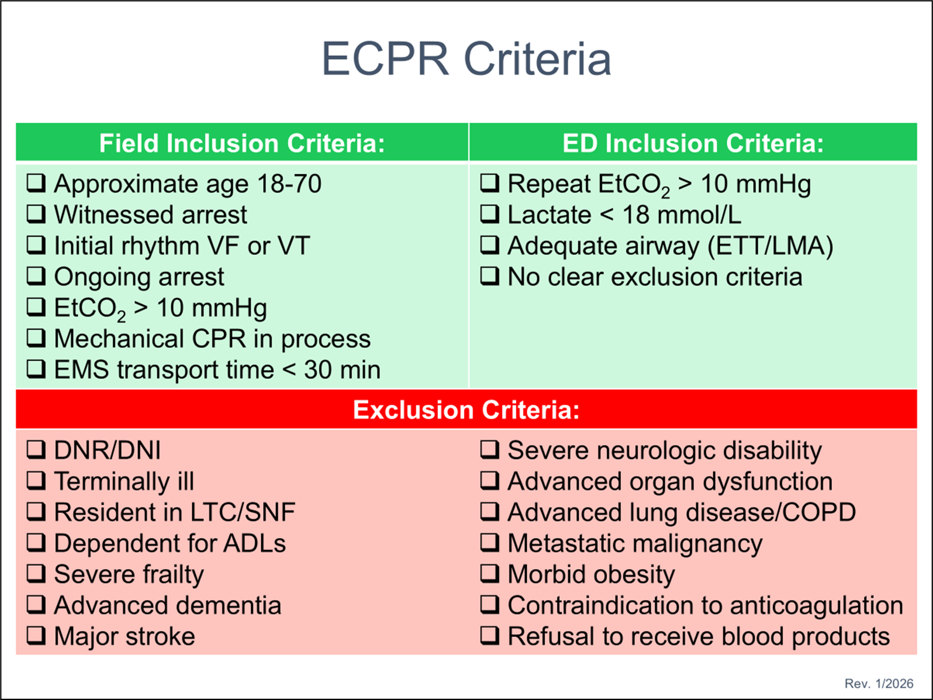
Other gap areas in our knowledge base are listed below:
- Does ECPR improve outcomes? Under all scenarios or only some? At what cost?
- Will outcomes be better if we adopt a “Load-and-Go” strategy for all patients with refractory arrest?
- Will institutional reporting of outcomes and associated costs create barriers to implementing this strategy?
- Can we develop Systems-of-Care for cardiac arrest patients?
- Improve proportion of eligible patients
- Expand EMS and community awareness
- Create mobile ECMO units and call teams to perform ECMO cannulation for ECPR at remote sites.
- How can we improve the safety of ECPR?
- Improve ECPR simulation mannequins for greater practice experience.
- Develop smaller devices (especially, cannulas) to allow safer cannulations.
- Consider alternative options for safe cannulation like mobile fluoroscopic C-arms of echo guidance.
Possible solutions or future directions
In addition to finding answers to the knowledge gap areas outlined above, it will need to be determined in whose domain the subject of ECPR resides. Is it the emergency medicine specialist, the critical care intensivist, the interventional cardiologist, or possibly the surgeon? A combination of these specialists working together on ECMO teams might be one solution. It is important that each institution considering ECPR determine who can be an ECMO cannulator, and whether fluoroscopic guidance or echo guidance are preferred or required.
Some further insights will likely come from registries of sudden cardiac death, like the CARES registry.[7] In addition, a large, multicenter, international randomized trial of ECPR versus conventional resuscitation, the OSIRIS trial (NCT06805344), is currently enrolling patients. This trial is anticipated to be completed in 2029.
References
- Jaiswal V, et al. Demographics and Trends of Sudden Cardiac Death-Related Mortality in the United States, 1999 to 2022. J Am Heart Assoc. 2025;14(18):e040340. doi: 10.1161/JAHA.124.040340. Epub 2025 Sep 11. PMID: 40932104.
- Morrison LJ, et al. International Consensus on Evidence Gaps and Research Opportunities in Extracorporeal Cardiopulmonary Resuscitation for Refractory Out-of-Hospital Cardiac Arrest: A Report From the National Heart, Lung, and Blood Institute Workshop. J Am Heart Assoc. 2025;14(6):e036108. doi: 10.1161/JAHA.124.036108. Epub 2025 Mar 5. PMID: 40040619.
- Kosmopoulos M, et al. The Association of Time to Reperfusion With VA-ECMO With Survival of Patients Who Experience Refractory Out-of-Hospital Cardiac Arrest. Circulation. 2025;152(12):902-904. doi: 10.1161/CIRCULATIONAHA.125.074507. Epub 2025 Sep 22. PMID: 40982582.
- Yannopoulos D, et al. Advanced reperfusion strategies for patients with out-of-hospital cardiac arrest and refractory ventricular fibrillation (ARREST): a phase 2, single centre, open-label, randomised controlled trial. Lancet. 2020;396(10265):1807-1816. doi: 10.1016/S0140-6736(20)32338-2. Epub 2020 Nov 13. PMID: 33197396.
- Belohlavek J, et al; Prague OHCA Study Group. Effect of Intra-arrest Transport, Extracorporeal Cardiopulmonary Resuscitation, and Immediate Invasive Assessment and Treatment on Functional Neurologic Outcome in Refractory Out-of-Hospital Cardiac Arrest: A Randomized Clinical Trial. JAMA. 2022;327(8):737-747. doi: 10.1001/jama.2022.1025. PMID: 35191923.
- Suverein MM, et al. Early Extracorporeal CPR for Refractory Out-of-Hospital Cardiac Arrest. N Engl J Med. 2023;388(4):299-309. doi: 10.1056/NEJMoa2204511. PMID: 36720132.
- Available at: www.mycares.net/sitepages/aboutcares.jsp. Accessed April 22, 2026.
7.2 Circulatory Support for Cardiogenic Shock: Matching the Device Strategy to the Patient for Best Outcomes
Problem Presenter: Mike Rinaldi
Statement of problem or issue
Cardiogenic shock (CS) is a life-threatening condition characterized by severe circulatory failure with insufficient cardiac output and end-organ hypoperfusion. Short-term mortality ranges from 30% to 40% and 1-year mortality approaches or exceeds 50%.[1] General principles governing the management of patients with CS due to heart failure (HF) or myocardial infarction (AMI) are listed below:
- The cornerstone of CS care is right-heart catheterization (RHC).
- RHC has been associated with mortality benefit.
- Congestion kills
- More strongly associated with mortality than the cardiac index
- Support devices must allow for both perfusion and decongestion
- Management of CS centers on assessment of:
- Severity of shock (SCAI-CSWG class)
- Hemodynamic phenotype (LV, RV, Bi-V, HF-CS)
- Acuity (acute versus chronic)
- Hemodynamic and hemo-metabolic response to therapies
One useful algorithm for assessing CS patients and choosing mechanical circulatory support (MCS) devices can be found in the Scientific Statement from the American Heart Association (Geller BJ, et al. Circulation. 2022;146(6):e50-e68). [2]
It is important to realize that MCS devices are not magic. They are not resurrection tools. Critical decisions about when and how to put them on, how to manage them, how to take them off quickly, and then what to do after that, are just as important as having any of them available. A de-escalation plan is just as important as an initiation plan. One example of a set of weaning strategies can be found in the AHA statement. [2]
Average MCS support times are typically 3-to-5 days, although a microflow pump (Impella) placed via axillary access can remain much longer, even for weeks or more. Patients who fail may need an implantable ventricular assist device (RVAD/LVAD), an orthotopic heart transplant, or palliative/hospice care.
Gaps in current knowledge
There is one randomized trial of an MCS device in patients with AMI-CS, and it showed a mortality benefit.[3] A randomized trial of MCS in patients with HF-CS showed no benefit.[4] However, it is important to recognize: (1) HF-CS is more heterogeneous that AMI-CS, (2) early initiation and appropriate patient selection are critical, (3) stabilization on MCS is only temporary and allows for decongestion and other interventions to change the course of the underlying problem, and thereby bridge the patient to further definitive therapy. How to efficiently and effectively organize these principles for HF-CS patients is a knowledge gap area. Furthermore, identifying which HF-CS patients might benefit the most from MCS, and which ones do not benefit at all, is also a gap area.
Reducing complications is an important area where some data are available, but much more needs to be done. Some current strategies to reduce complications, and which need refinement, are listed below:
- Bivalirudin is superior to heparin for anticoagulation in ECMO; reduces HIT.
- Arterial access with ultrasound guidance and micropuncture needles.
- No arterial cannulas >17F.
- Pre-close access sites.
- Universal antegrade perfusion sheath reduces limb ischemia.
- Early support before hepatic injury causes coagulopathy.
- Brief support times: initiate early, manage aggressively, reassess frequently, terminate ASAP.
Possible solutions or future directions
We will need to determine how MCS devices and care management protocols can be fitted together into a comprehensive “system of care.” It is likely that clinical benefits reside in the care team and not in any device. To examine this question, we need to design clinical trials able to test the “system of care” hypothesis, and this may not be easy.
Encouraging early RHC and interpretation of clinical and hemodynamic data according to SCAI shock classification categories, along with frequent patient reevaluation, must be undertaken. Industry sponsored education programs and artificial intelligence (AI) based data analyses likely will help.
Another avenue for future direction will be to determine if a “hub-and-spoke” system can be designed. Smaller, regional hospitals might then be able to initiate MCS support and transfer patients to larger, central hospitals.
References
- Sinha SS, et al. 2025 Concise Clinical Guidance: An ACC Expert Consensus Statement on the Evaluation and Management of Cardiogenic Shock: A Report of the American College of Cardiology Solution Set Oversight Committee. J Am Coll Cardiol. 2025;85(16):1618-1641. doi: 10.1016/j.jacc.2025.02.018. Epub 2025 Mar 17. PMID: 40100174.
- Geller BJ, et al. Escalating and De-escalating Temporary Mechanical Circulatory Support in Cardiogenic Shock: A Scientific Statement From the American Heart Association. Circulation. 2022;146(6):e50-e68. doi: 10.1161/CIR.0000000000001076. Epub 2022 Jul 7. PMID: 35862152.
- Møller JE, et al; DanGer Shock Investigators. Microaxial Flow Pump or Standard Care in Infarct-Related Cardiogenic Shock. N Engl J Med. 2024;390(15):1382-1393. doi: 10.1056/NEJMoa2312572. Epub 2024 Apr 7. PMID: 38587239.
- Ostadal P, et al; ECMO-CS Investigators. Extracorporeal Membrane Oxygenation in the Therapy of Cardiogenic Shock: Results of the ECMO-CS Randomized Clinical Trial. Circulation. 2023;147(6):454-464. doi: 10.1161/CIRCULATIONAHA.122.062949. Epub 2022 Nov 6. PMID: 36335478.
7.3 Chronic Pulmonary Hypertension: Is POBA Enough for CTEPH? Embolectomy? And What About Denervation?
Problem Presenter: Dawn Abbott
Statement of problem or issue
Pulmonary embolism (PE) is the third leading cause of cardiovascular death. It often occurs in conjunction with other serious conditions, where it is a major contributor both to mortality and morbidity in the United States.[1] Approximately 1%-to-9% of patients with PE will develop a condition called chronic thromboembolic pulmonary hypertension (CTEPH). However, CTEPH also can develop in some patients with no clinical history of PE.[2]
Gradually over time, many of these patients develop a secondary microvasculopathy involving arterioles, venules, and capillaries. This includes muscularization of arterioles, venular fibrosis, and in some cases features of veno-occlusive disease. These distal changes help explain why pulmonary hypertension may persist even after a proximal obstruction has been relieved.
Pulmonary thromboendarterectomy (PTE) is the standard first-line therapy for proximal, operable CTEPH. However, about 36% of patients are considered inoperable, most often due to distal disease or comorbidities. In addition, roughly 25% have persistent or recurrent pulmonary hypertension after surgery. These limitations highlight the need for effective medical and interventional alternatives. Riociguat, a stimulator of guanylyl cyclase, is the only FDA-approved medical therapy for inoperable or persistent/recurrent CTEPH.
More recently, balloon pulmonary angioplasty (BPA) has been shown to be effective in patients with inoperable CTEPH (Figure 1).[3,4]
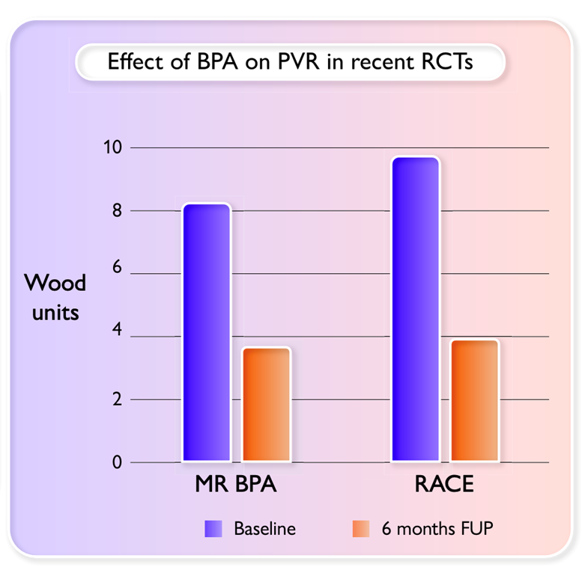
In addition to BPA, another form of therapy, radiofrequency pulmonary artery denervation (PADN) is being explored for its potential role.[5]
Gaps in current knowledge
Some knowledge gap areas are listed below:
- What combinations of therapies (medications, surgery, BPA) and in what order, will be most effective.
- Presence and reversibility of microvascular disease pre-BPA.
- Timing between BPA treatments.
- How to improve success in CTO and pouch lesions without increasing complications.
- Will dedicated devices improve procedural outcomes.
- Where does pulmonary artery denervation (PADN) fit in.
- Should we be treating symptomatic patients with CTEPD.
Possible solutions or future directions
A great deal more work is required to understand CTEPH and how to treat it safely and effectively. Several avenues for future clinical research and development are listed below;
- Create a large registry, prospectively collected, comprehensive in scope.
- Develop consensus definitions and treatment thresholds.
- 3-D modeling of pulmonary vasculature/Dual energy CT
- Expand clinical endpoints beyond 6MWD to RV recovery and QoL measures.
- Development of specialized equipment for CTO approaches:
- High anatomic variability.
- Often no visible collaterals.
- No CT mapping guidance.
- No uniform procedural approach.
- Are extraluminal crossing techniques possible.
- How to perform with unknown distal pathology
- RCTs for combination therapies.
- AI-based imaging analysis for predicting response to therapies.
- Sham studies of pulmonary artery denervation.
References
- Palaniappan LP, et al. 2026 Heart Disease and Stroke Statistics: A Report of US and Global Data From the American Heart Association. Circulation. 2026 Mar 3;153(9):e275-e906. doi: 10.1161/CIR.0000000000001412. Epub 2026 Jan 21. PMID: 41562125.
- Yang J, et al. Evaluation and Management of Chronic Thromboembolic Pulmonary Hypertension. Chest. 2023 Aug;164(2):490-502. doi: 10.1016/j.chest.2023.03.029. Epub 2023 Mar 28. PMID: 36990148.
- Kawakami T, et al. Balloon pulmonary angioplasty versus riociguat in inoperable chronic thromboembolic pulmonary hypertension (MR BPA): an open-label, randomised controlled trial. Lancet Respir Med. 2022 Oct;10(10):949-960. doi: 10.1016/S2213-2600(22)00171-0. Epub 2022 Aug 1. PMID: 35926544.
- Jaïs X, et al. Balloon pulmonary angioplasty versus riociguat for the treatment of inoperable chronic thromboembolic pulmonary hypertension (RACE): a multicentre, phase 3, open-label, randomised controlled trial and ancillary follow-up study. Lancet Respir Med. 2022 Oct;10(10):961-971. doi: 10.1016/S2213-2600(22)00214-4. Epub 2022 Aug 1. PMID: 35926542.
- Romanov A, et al. Pulmonary Artery Denervation for Patients With Residual Pulmonary Hypertension After Pulmonary Endarterectomy. J Am Coll Cardiol. 2020 Aug 25;76(8):916-926. doi: 10.1016/j.jacc.2020.06.064. PMID: 32819465.
8.1 Managing Complex Aortic and Iliac Occlusive Disease: Endovascular Solutions for Aortic Stenoses, Aortic Bifurcation, Infrarenal and Juxtarenal
Problem Presenter: Sigrid Nikol
Statement of problem or issue
There are different pathological expressions for atherosclerotic disease of the lower aorta in men and women:
Men – more diffuse aortoiliac bifurcation disease
Women – focal infrarenal stenosis/occlusion
renovisceral – involving aorta and renal arteries
Transcutaneous catheter-based treatments are available. Covered balloon-expandable stentgrafts (CBE) have been shown to be superior to bare-metal stents for transcutaneous therapy in aortoiliac disease, with long-term (5-10 years) patency rates of 65-75%.[1-4] However, at present, longer-term outcomes with CBE are still not yet as favorable as open surgical revascularization, which has long-term patency rates of 75-85%.[5] The materials in stentgrafts have been improved over the years but further refinements are needed. In addition, devices are not universally available or not approved for use in all countries.
Gaps in current knowledge
For aortoiliac bifurcation disease, the Covered Endovascular Reconstruction of the Aortic Bifurcation (CERAB) technique was developed to reconstruct the aortic bifurcation in the most optimal anatomical and physiological manner possible. [6]
Short-term patency rates (3-5 years) with CERAB are favorable at 78%-80%.[7,8] However, recently reported 10-year patency is less favorable at 67%. [9] This may be partly due to the occurrence of limb-crush, where one of the iliac limbs is less expanded than the other limb (“crushed”) and must be re-expanded.[7] Radial strength of the stentgrafts may be an important factor in stent under-expansion leading to limb-crush. This is a knowledge-gap area.
For isolated infrarenal aorta stenosis/occlusion not involving the iliac arteries, focal endovascular treatment can be performed using balloon angioplasty alone, self-expandable or balloon-expandable bare metal stents, and endograft (covered stentgraft) placement. Due to various problems with current and older devices (like thrombosis, occlusion, embolization, etc), a novel balloon-expandable stentgraft with high radial force strength (BeGraft-aortic, Bentley InnoMed), originally developed for treatment of congenital aortic stenosis, was evaluated for use here in complex lesions of the infrarenal aorta. Initial results have proven favorable. [10] In 54 patients, with median follow-up of 4.5 years (range 1-8 years), the patency rate was 100%. Only three patients (3/54=5.6%) required repeat angioplasty for recurrence.
Possible solutions or future directions
Development of novel stentgrafts like the BeGraft-aortic will make it possible to attempt endovascular treatments in complex aorto-visceral disease (Figure 1).[11]
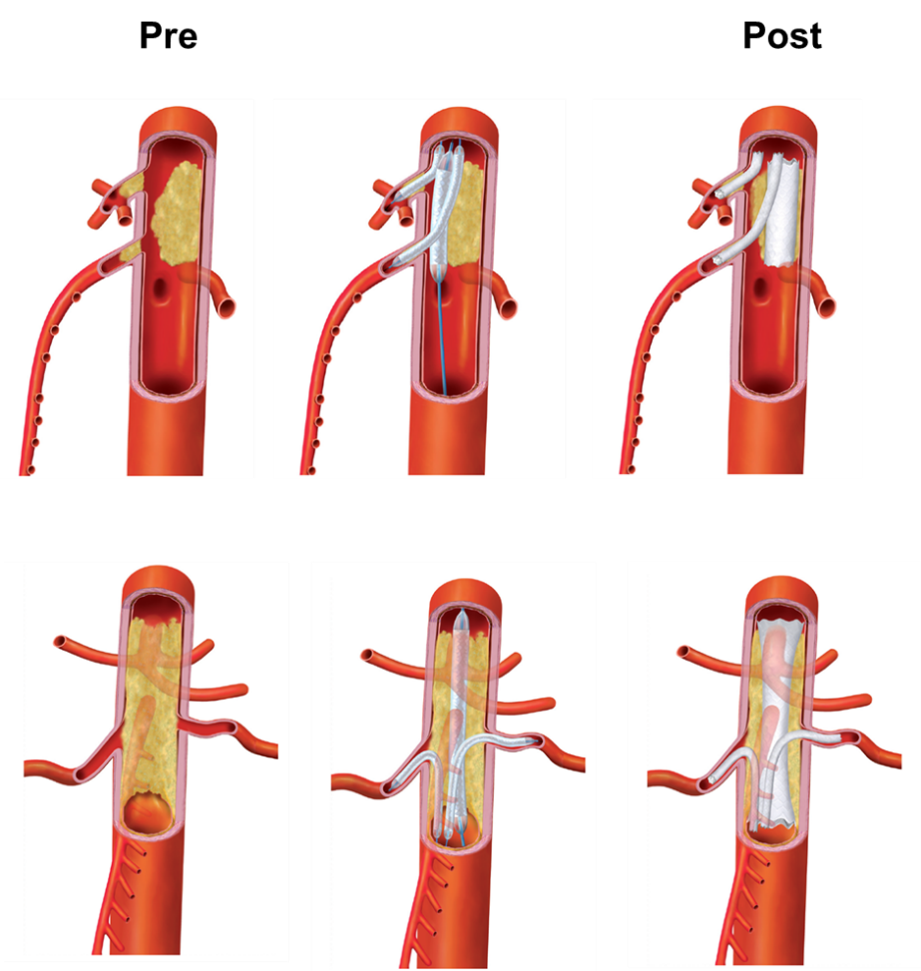
Additional future directions for clinical investigation will include:
- Understanding the gender differences in atherosclerotic disease of the aorta, iliacs, and visceral arteries.
- Improving the radial strength of stentgrafts;
- Combination of lithotripsy and stentgrafts to overcome radial strength limits.
- Improved stentgraft designs that preserve native aortoiliac bifurcation geometry and permit crossover maneuvers into the contralateral artery.
- Manufacturing larger and longer balloon-expandable stentgrafts.
References
- Mwipatayi BP, et al; COBEST co-investigators. Durability of the balloon-expandable covered versus bare-metal stents in the Covered versus Balloon Expandable Stent Trial (COBEST) for the treatment of aortoiliac occlusive disease. J Vasc Surg. 2016;64(1):83-94.e1. doi: 10.1016/j.jvs.2016.02.064. Epub 2016 Apr 28. PMID: 27131926.
- Mwipatayi BP, et al. A systematic review of covered balloon-expandable stents for treating aortoiliac occlusive disease. J Vasc Surg. 2020;72(4):1473-1486.e2. doi: 10.1016/j.jvs.2020.01.084. Epub 2020 Apr 28. PMID: 32360678.
- Bontinis V, et al. Editor's Choice - Covered Stents Versus Bare Metal Stents in the Treatment of Aorto-iliac Disease: A Systematic Review and Individual Participant Data Meta-analysis. Eur J Vasc Endovasc Surg. 2024;68(3):348-358. doi: 10.1016/j.ejvs.2024.06.008. Epub 2024 Jun 12. PMID: 38876369.
- Piazza M, et al. Systematic Literature Review and Meta-analysis of Covered Balloon-Expandable Stents for Aortoiliac Occlusive Disease. J Vasc Interv Radiol. 2026;37(4):107969. doi: 10.1016/j.jvir.2025.107969. Epub 2025 Dec 19. PMID: 41422888.
- Colacchio EC, et al. Open Versus Endovascular Repair With Covered Stents for Complex Aortoiliac Occlusive Disease: Cost Analysis Results. Ann Vasc Surg. 2023;97:382-391. doi: 10.1016/j.avsg.2023.05.029. Epub 2023 Jun 1. PMID: 37268106.
- Goverde PC, et al. Covered endovascular reconstruction of aortic bifurcation (CERAB) technique: a new approach in treating extensive aortoiliac occlusive disease. J Cardiovasc Surg (Torino). 2013;54(3):383-7. PMID: 23640357.
- Taeymans K, et al. Three-year outcome of the covered endovascular reconstruction of the aortic bifurcation technique for aortoiliac occlusive disease. J Vasc Surg. 2018;67(5):1438-1447. doi: 10.1016/j.jvs.2017.09.015. Epub 2017 Nov 21. PMID: 29169878.
- Rouwenhorst KB, et al. Long-term outcomes of the Covered Endovascular Reconstruction of the Aortic Bifurcation (CERAB) technique in patients with aorto-iliac occlusive disease. J Endovasc Ther. 2025 Feb;32(1):110-120. doi: 10.1177/15266028231166539. Epub 2023 Apr 28. PMID: 37114939.
- Available at: www.radcliffevascular.com/video-index/linc-25-10-year-outcomes-first-patients-treated-cerab-extensive-aortoiliac-occlusive. Accessed May 2, 2026.
- See E, et al. Covered balloon-expandable stents in isolated abdominal aortic stenosis or occlusion in 54 patients, predominantly women. Vasa. 2025 Nov 14. doi: 10.1024/0301-1526/a001248. Epub ahead of print. PMID: 41234061.
- Nikol S, et al. How to do it - Endovascular solutions for the renovisceral segment in coral reef aortas. Vasa. 2025 Nov 14. doi: 10.1024/0301-1526/a001249. Epub ahead of print. PMID: 41234060.
8.2 Bioresorbable Scaffolds for Vascular Interventions: Is it Time to Move Up or Stay BTK?
Problem Presenter: Lawrence Garcia
Statement of problem or issue
Standard endovascular treatment for above-the-knee common (CFA) and superficial (SFA) femoral artery disease has been self-expanding metallic nitinol stents.[1] The mechanical properties of nitinol in response to flexion, compression, and torsion within these arteries have made it the preferred stent material. Metal fracture, thrombosis, and restenosis have been the limiting issues with nitinol, but overall the problems have been acceptably few. A polymer-coated, drug-eluting (paclitaxel), self-expanding nitinol stent (Eluvia) was found to be remarkably effective in reducing restenosis in femoral artery lesions and maintaining primary patency over 3 years.[2]
Bioresorbable vascular scaffolds (BVS) have been available for many years to treat iliac and femoral artery lesions. However, results to date with these devices have been decidedly mixed.[3,4]
Gaps in current knowledge
Alternative stent materials to nitinol have many disadvantages, which are thought to be due to the superior ability of nitinol metal to absorb the flexion, compression, and torsion forces that exist in the iliofemoral arterial system. This is a huge knowledge gap area. In addition, long lesions, heavily calcified lesions, and in-stent restenosis are areas where the knowledge base is weak.
Possible solutions or future directions
In the arteries below the knee, an everolimus-eluting BVS was superior to balloon angioplasty alone in patients with chronic limb-threatening ischemia (CLTI) and infrapopliteal artery disease [5]. Separately, a new polymeric, balloon-expandable, sirolimus-eluting BVS has been developed for the above the knee location and is presently undergoing clinical study.[6,7] Earlier this year (2026) the preliminary results in 20 patients with 3-year follow-up were presented at a symposium.[8] Primary patency was 100% with no stent fractures or thrombosis. The study (NCT04584632) is still ongoing and full results are awaited.
References
- Bamdé CC, et al. Evaluation of balloon and self-expandable stents for common femoral artery stenosis. J Vasc Surg. 2025 Feb;81(2):397-407. doi: 10.1016/j.jvs.2024.09.017. Epub 2024 Sep 23. PMID: 39321897.
- Gray WA, et al; IMPERIAL investigators. A polymer-coated, paclitaxel-eluting stent (Eluvia) versus a polymer-free, paclitaxel-coated stent (Zilver PTX) for endovascular femoropopliteal intervention (IMPERIAL): a randomised, non-inferiority trial. Lancet. 2018 Oct 27;392(10157):1541-1551. doi: 10.1016/S0140-6736(18)32262-1. Epub 2018 Sep 24. PMID: 30262332.
- Bontinck J, et al. Treatment of the femoropopliteal artery with the bioresorbable REMEDY stent. J Vasc Surg. 2016 Nov;64(5):1311-1319. doi: 10.1016/j.jvs.2016.05.066. Epub 2016 Jul 25. PMID: 27462002.
- Obara H, et al. Five-Year Outcomes of the Bioresorbable Peripheral Remedy Stent in the Treatment of Iliac Artery Disease. J Vasc Interv Radiol. 2023 Jun;34(6):1024-1035.e2. doi: 10.1016/j.jvir.2023.01.038. Epub 2023 Feb 16. PMID: 36806564.
- Varcoe RL, et al; LIFE-BTK Investigators. Drug-Eluting Resorbable Scaffold versus Angioplasty for Infrapopliteal Artery Disease. N Engl J Med. 2024 Jan 4;390(1):9-19. doi: 10.1056/NEJMoa2305637. Epub 2023 Oct 25. PMID: 37888915.
- Tannu M, et al. Femoropopliteal Endovascular Intervention: A Review of the Current Landscape. Circ Cardiovasc Interv. 2025 May;18(5):e014024. doi: 10.1161/CIRCINTERVENTIONS.124.014024. Epub 2025 Apr 25. PMID: 40276857.
- El Khoury R, et al. The Efemoral Vascular Scaffold System (EVSS): A Novel, Resorbable, Sirolimus-eluting Device for Percutaneous Peripheral Intervention (PPI). J Vasc Surg 2024;80:e68-e69.
- Available at: www.prnewswire.com/news-releases/efemoral-medical-reports-exceptional-long-term-efemoral-i-results-highlighting-durability-and-differentiated-performance-in-femoropopliteal-disease-302747762.html. Accessed May 5, 2026.
8.3 Peripheral Atherectomy: Under or Over Utilized? Where is the Data Showing Benefit?
Problem Presenter: Jihad Mustapha
Statement of problem or issue
Peripheral arterial disease (PAD) in the arteries below-the-knee (BTK, i.e. infrapopliteal) is associated with substantial morbidity and mortality, yet this is under-recognized and under-appreciated by many clinicians. Two large studies examined and compared the 5-year mortality rates for patients with PAD and certain common cancers. The findings were that more patients die from PAD than from all cancers except lung cancer.[1,2]
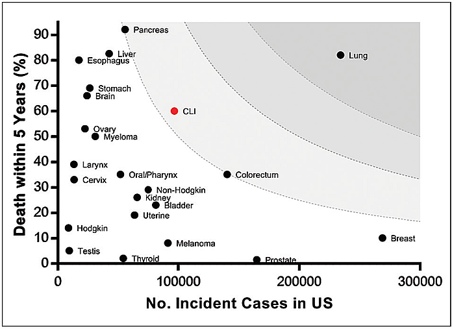
In addition, nontraumatic lower-extremity amputation is a devastating complication of BTK PAD, and also is associated with high mortality as well as substantial medical costs. A recent policy statement from the American Heart Association focused attention on nontraumatic amputations, and called for efforts to reduce these amputations by 20% by 2030.[3] Unfortunately, while endovascular therapies have been used for many years in BTK PAD, it remains a challenging and difficult vascular territory.[4]
Gaps in current knowledge
Atherectomy as a vessel- and lesion-preparation procedure has been performed for over 25 years, yet is often criticized as lacking in supportive evidence.[5] Nevertheless, substantial evidence supporting atherectomy in BTK PAD exists, and the general lack of awareness is one of the major knowledge gap areas in this disease.[5,6] In a recent comprehensive review of 322 published studies of multiple types of atherectomy (directional, orbital, rotational, etc.), with over 100,000 patients included, 1-year mortality was 2.8% and major amputations were very low at 1.7%.[6]
Possible solutions or future directions
Recent policy statements are helpful at increasing public and clinician awareness of the seriousness of BTK PAD. Education, focused seminars, teaching and demonstration courses, and more clinical outcomes and quality-of-life studies may help reverse the lack of attention that has plagued this field.
References
- Mustapha JA, et al. Endovascular Today, 2019 (May) 18(5):80-82.
- Armstrong DG, et al. Five-year mortality and direct costs of care for people with diabetic foot complications are comparable to cancer. J Foot Ankle Res. 2020;13(1):16. doi: 10.1186/s13047-020-00383-2. PMID: 32209136.
- Creager MA, et al. Reducing Nontraumatic Lower-Extremity Amputations by 20% by 2030: Time to Get to Our Feet: A Policy Statement From the American Heart Association. Circulation. 2021 Apr 27;143(17):e875-e891. doi: 10.1161/CIR.0000000000000967. Epub 2021 Mar 25. PMID: 33761757.
- Zilinyi RS, et al. Surgical and Endovascular Therapies for Below-the-Knee Peripheral Arterial Disease: A Contemporary Review. J Soc Cardiovasc Angiogr Interv. 2024 Jan 29;3(3Part A):101268. doi: 10.1016/j.jscai.2023.101268. PMID: 39131787.
- Mustapha JA, et al. Propensity Score-Adjusted Comparison of Long-Term Outcomes Among Revascularization Strategies for Critical Limb Ischemia. Circ Cardiovasc Interv. 2019 Sep;12(9):e008097. doi: 10.1161/CIRCINTERVENTIONS.119.008097. Epub 2019 Sep 9. PMID: 31495219.
- Carr JG, et al. Published Evidence on Peripheral Atherectomy: A meta-analysis and systematic literature review of more than 300 original investigations. J Soc Cardiovasc Angiogr Interv. 2025 Oct 21;4(11):104009. doi: 10.1016/j.jscai.2025.104009. PMID: 41324060.
9.1 Renal Denervation: Comparison of Therapeutic Approaches, Efficacy, Adoption and Reimbursement
Problem Presenter: Herb Aronow
Statement of problem or issue
Effective control of hypertension (HTN) is a critical public health goal. Renal artery denervation (RDN) is a safe and effective adjunctive therapy, typically reserved for patients whose blood pressures are not well controlled on medications or who have serious medication side effects. Presently, both radiofrequency and ultrasound devices are available for intravascular RDN, and are FDA-approved devices (Figure 1).
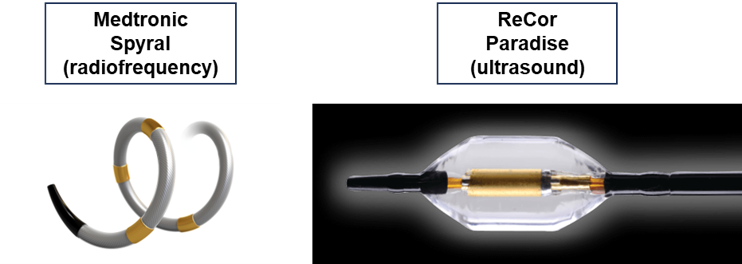
A substantial body of evidence supports the safety and efficacy of RDN therapy.[1-4]
Gaps in current knowledge
There are several areas where gaps in knowledge or gaps in therapeutic application exist. Several of these are shown below:
- HTN care is fragmented, disorganized, and mostly inadequate
- Unclear responsibilities (primary care, cardiology, nephrology, vascular medicine, geriatrics, etc)
- Incomplete evaluations for secondary causes of HTN
- Lack of attention - “treatment inertia”
- Provider perceptions of RDN ineffectiveness
- Holdover from original negative trials (e.g. SYMPLICITY HTN-3)
- Difficult and challenging reimbursement environment for RDN
- Only Category III (temporary) codes available at present; Category I expected in 2027/2028
- Category III codes have no assigned wRVUs (i.e. no physician reimbursement)
So, the fragmentation in HTN care, the general misunderstanding of the effectiveness of RDN therapy, and the currently inadequate reimbursements from payors, have combined to limit widespread uptake of RDN.
Possible solutions or future directions
Current RDN devices will continue to evolve, and so will the procedure protocols by which they are applied. In addition, new technologies will be developed and will need to be tested both in sham-controlled as well as in head-to-head comparative studies. Two examples of novel devices that at present are undergoing clinical investigation are shown in Figure 2.

Other courses for the future will need to focus on:
- Renewing the focus on HTN evaluation and treatment.
- Overcoming fragmentation in HTN care.
- Demonstrating real-world cost effectiveness of HTN therapies, including RDN.
- Adjusting reimbursement systems for RDN therapy.
- Providing guidance on building hospital-based and/or clinic-based HTN programs.
References
- Singh S, et al. Renal denervation in hypertension: An updated meta-analysis of the randomized controlled trials. Catheter Cardiovasc Interv. 2023 Oct;102(4):663-671. doi: 10.1002/ccd.30796. Epub 2023 Aug 6. PMID: 37545184.
- Fengler K, et al. A Three-Arm Randomized Trial of Different Renal Denervation Devices and Techniques in Patients With Resistant Hypertension (RADIOSOUND-HTN). Circulation. 2019 Jan 29;139(5):590-600. doi: 10.1161/CIRCULATIONAHA.118.037654. PMID: 30586691.
- Fengler K, et al. 6- and 12-Month Follow-Up From a Randomized Clinical Trial of Ultrasound vs Radiofrequency Renal Denervation (RADIOSOUND-HTN). JACC Cardiovasc Interv. 2023 Feb 13;16(3):367-369. doi: 10.1016/j.jcin.2022.10.058. PMID: 36792266.
- Mufarrih SH, et al. Randomized Trials of Renal Denervation for Uncontrolled Hypertension: An Updated Meta-Analysis. J Am Heart Assoc. 2024 Aug 20;13(16):e034910. doi: 10.1161/JAHA.124.034910. Epub 2024 Aug 14. PMID: 39140334.
- Mahfoud F, et al. Alcohol-Mediated Renal Denervation Using the Peregrine System Infusion Catheter for Treatment of Hypertension. JACC Cardiovasc Interv. 2020 Feb 24;13(4):471-484. doi: 10.1016/j.jcin.2019.10.048. Erratum in: JACC Cardiovasc Interv. 2020 Nov 23;13(22):2717. doi: 10.1016/j.jcin.2020.10.012. PMID: 32081241.
9.2 Combined Imaging/Physiology Catheters: Devices Everyone Should Have and Use and How AI will Make Them Even Better
Problem Presenter: Jimmy Kerrigan
Statement of problem or issue
Intravascular imaging (IVI) used in percutaneous coronary intervention (PCI) saves lives. A large network meta-analysis of 22 trials with over 15,000 patients and weighted mean duration of follow-up of 25 months (range 6-60 months) demonstrated this (Figure 1).[1]

Similarly, the 10-year results of the FAME trial demonstrated that physiology-guided PCI using fractional flow reserve (FFR) measured with intracoronary pressure wires reduced subsequent events over this very long interval.[2]
Despite these findings, use of either IVI or coronary physiology in the United States remains low (Figure 2).[3,4] Although there has been a slight trend of increased use over the past decade, overall use of IVI is approximately 15% of PCI cases. [3] However, recent reports from the National Cardiovascular Data Registry (NCDR) and other surveys suggest the use of coronary physiology is approaching 30% to 35% of cases.[4]
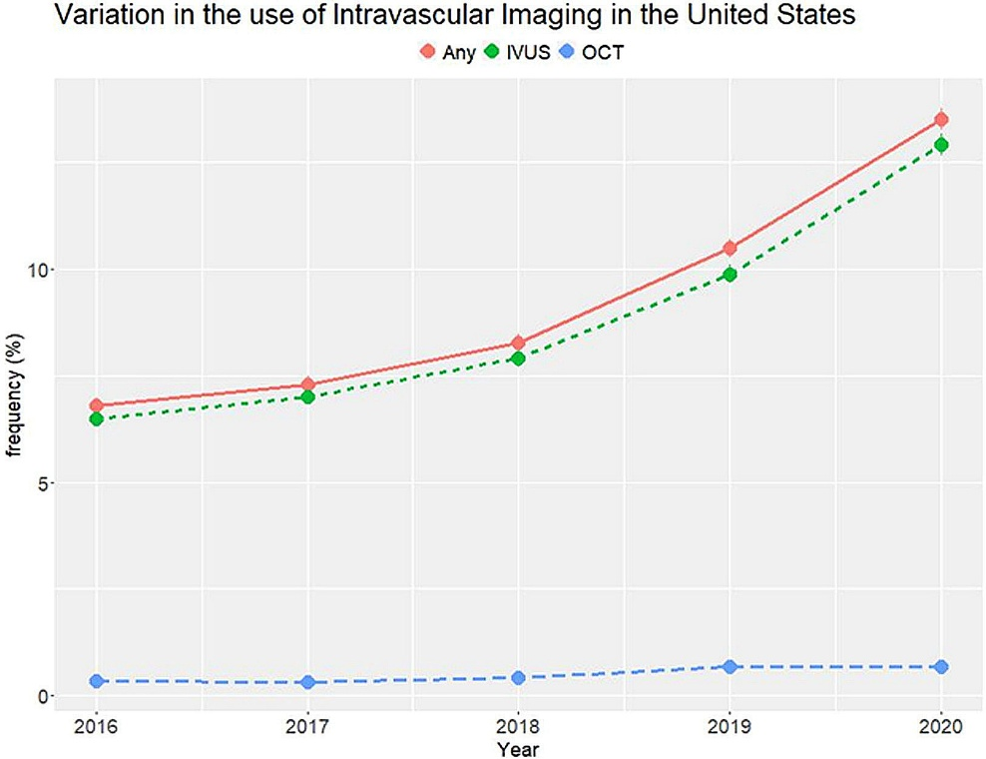
Gaps in current knowledge
The largest knowledge gaps are:
- How to increase the use of IVI and coronary physiology by operators.
- How to get adequate payments/reimbursements for these procedures.
- How to get hospitals to invest in the appropriate equipment.
- Will alternative methods like angio-derived physiology measures be useful?
- Will combinations of IVI and physiology be superior to either alone?
Possible solutions or future directions
Quantitative angiographic analysis systems incorporating computational fluid dynamics equations can estimate several parameters from angiograms that previously could be determined only by measuring intracoronary pressures directly with a pressure-sensing wire. Indices like FFR, iFR, and others can now be estimated by angiography. The advantages of these angiography-based systems are that angiographic imaging is the standard imaging modality by which coronary arteries are evaluated and interventional procedures are conducted. The disadvantages are that processing time for angiography-based analyses can be long, and images must be clear and uncomplicated, without convolutions, tortuosity, and overlap. Catheter technology also is evolving, and it is possible that catheters incorporating both imaging and physiology will become available. Whether these newer methodologies will replace previous ones is still undetermined. Issues to be addressed include workflow integration, operator and staff familiarity and comfort, and demonstrating that use of the derived information influences and improves patient care and is not done just for the sake of using catheters. Costs, facility reimbursement (or, penalties for non-use), and value will also be important considerations influencing utilzation.[5,6]
References
- Stone GW, et al. Intravascular imaging-guided coronary drug-eluting stent implantation: an updated network meta-analysis. Lancet. 2024 Mar 2;403(10429):824-837. doi: 10.1016/S0140-6736(23)02454-6. Epub 2024 Feb 21. PMID: 38401549.
- Collet C, et al. Fractional flow reserve-guided percutaneous coronary intervention versus medical therapy for stable coronary artery disease: long-term results of the FAME 2 trial. Nat Med. 2026 Jan;32(1):318-324. doi: 10.1038/s41591-025-04132-5. Epub 2026 Jan 15. PMID: 41540107.
- Chaturvedi A, et al. Regional Disparities and Predictors of Intracoronary Imaging Use During Percutaneous Coronary Intervention in the United States. Am J Cardiol. 2025 Jul 3;255:1-9. doi: 10.1016/j.amjcard.2025.06.017. Epub ahead of print. PMID: 40617275.
- Carvalho PEP, et al. Contemporary coronary physiology practice: An international survey of interventional cardiologists. Cardiovasc Revasc Med. 2026 Mar 29:S1553-8389(26)00056-4. doi: 10.1016/j.carrev.2026.02.011. Epub ahead of print. PMID: 41912370.
- Volleberg RHJA, et al. Combining Optical Coherence Tomography and Fractional Flow Reserve for Decision Making in Percutaneous Coronary Intervention: Insights From the FUSION Study. J Soc Cardiovasc Angiogr Interv. 2025 Oct 7;4(11):104001. doi: 10.1016/j.jscai.2025.104001. PMID: 41324056.
- Fearon WF, et al; ALL-RISE Investigators. Angiography-Derived Fractional Flow Reserve to Guide PCI. N Engl J Med. 2026 Mar 29. doi: 10.1056/NEJMoa2600949. Epub ahead of print. PMID: 41910384.
9.3 Uncaging Coronary Artery Aneurysms: Have we Made Progress and Which Ones to Treat?
Problem Presenter: Steve Bailey
Statement of problem or issue
Coronary artery aneurysms (CAA) are common; they are found in approximately 6% of coronary angiograms and 8% of coronary CT studies. It is important to distinguish CAA from coronary artery ectasia (CAE). With CAA all three layers of the vessel wall form a localized enlargement which extends <1/3 of vessel length; CAE is diffuse, generalized enlargement that extends ≥1/3 of vessel length. Some characteristic features of CAA, along with common clinical presentations and types of treatments, are described in Kawsara A, et al.[1]
There is a classification system for CAA:
Type 1: Aneurysms grow rapidly during the acute phase (first 4 weeks) often accompanied by pericarditis.
Type 2: Aneurysms develop slowly during subacute and chronic phases; may remain asymptomatic or cause angina.
Type 3: Infective aneurysms; with high risk of fatality.
Giant CAA (>20mm) are particularly significant due to their elevated risk of complications, including in situ thrombosis, distal embolization, and rupture.
Gaps in current knowledge
Long term prognosis of CAA is not favorable. The largest collection of data is the Coronary Artery Aneurysm Registry (CAAR - NCT02563626), with 1,729 consecutive patients from 33 hospitals across 9 countries. [2,3] In the most recent report, after median follow-up of 45 months, 379 patients died (21.9%), and 641 (37.1%) developed a major adverse cardiovascular event (MACE: all-cause death, heart failure, unstable angina, and reinfarction). Age, diabetes, renal insufficiency, peripheral vessel disease, reduced LVEF, acute indication for the index coronary angiography, and the number of coronary vessels presenting severe stenosis, were independent predictors of MACEs. How these factors interact to produce adverse events, beyond their known associations with atherosclerotic coronary disease risks and outcomes, is a large knowledge gap area.
As outlined in Kawsara, there are many clinical management challenges for patients with CAA. All existing data is observational only; no specific guidelines exist. Treatment is often driven by management of underlying coronary artery disease, other comorbid conditions, and their sequelae. Stents (bare metal [BMS] and drug-eluting [DES]), covered stents (CS) or stentgrafts, and coil embolization, are all available for percutaneous transcatheter treatment of CAA. Little comparative data exists to help guide treatment choices. Encouragingly, the initial report from CAAR found clear mortality and event-free survival advantages with DES compared to BMS.
Although CS represent a potentially life-saving intervention for CAA that perforate or rupture (CAP), their application has expanded to other CAA contexts. Yet long-term outcomes of CS in these non-perforation scenarios remains limited. A recent meta-analysis of three studies of the PK Papyrus CS covered stent system found that MACE (cardiac death, stent thrombosis [ST], and target lesion revascularization [TLR]} were significantly higher in patients treated with CS for CAA compared with those treated for CAP (Jurado-Román).[4]
Possible solutions or future directions
- Studies of the underlying etiology and pathophysiology of CAA and CAE?
- Are these two completely separate entities, or different phenotypes of the same disease?
- Should incidentally discovered CAAs be intervened upon?
- Better assessments of risk of adverse events.
- Is there a role for a US registry to evaluate outcomes?
- Should anti-inflammatory agents be added to medication regimens for CAA?
- Interventional studies:
- New and improved covered stent designs.
- Self-expanding stents with and without coverings.
- New coil designs for coil embolization.
- Gel injections for aneurysm closure.
- Energy sources for aneurysm closure.
References
- Kawsara A, et al. Management of Coronary Artery Aneurysms. JACC Cardiovasc Interv. 2018;11(13):1211-1223. doi: 10.1016/j.jcin.2018.02.041. PMID: 29976357.
- Núñez-Gil IJ, et al; CAAR investigators. Coronary artery aneurysms, insights from the international coronary artery aneurysm registry (CAAR). Int J Cardiol. 2020;299:49-55. doi: 10.1016/j.ijcard.2019.05.067. Epub 2019 Jul 19. PMID: 31378382.
- Sánchez-Sánchez I, et al; CAAR Investigators. Long-Term Prognosis of Coronary Aneurysms: Insights of CAAR, an International Registry. JACC Cardiovasc Interv. 2024;17(22):2681-2691. doi: 10.1016/j.jcin.2024.08.034. PMID: 39603781.
- Jurado-Román A, et al. Meta-long Papyrus: Meta-analysis of mid to long-term outcomes of PK Papyrus covered stent. Catheter Cardiovasc Interv. 2024;104(3):492-498. doi: 10.1002/ccd.31157. Epub 2024 Jul 20. PMID: 39033331.
10.1 Diagnosing ANOCA/INOCA and Treating MINOCA in the Interventional Laboratory
Problem Presenter: Tim Henry
Statement of problem or issue
Angina can be caused by: (1) epicardial coronary artery disease; (2) microvascular disease; (3) vasoconstrictive disease (vasoreactivity); and (4) several miscellaneous conditions such as myocardial bridges, etc.[1-4] Although often considered as separate entities, many patients have combinations of these abnormalities present in varying proportions. To design effective treatment strategies it is critical to understand properly the underlying mechanism of angina. It is becoming increasingly clear that the microvasculature plays a critical role in many pf the unmet clinical needs in cardiovascular disease.
Gaps in current knowledge
Clinical areas where microvascular disease and vasoreactivity play key roles include:
- ANOCA (angina with non-obstructed coronary arteries).
- INOCA (ischemia with non-obstructed coronary arteries.
- MINOCA (myocardial infarction with non-obstructed coronary arteries.
- HFpEF (approximately 75% have microvascular dysfunction).
- STEMI/NSTEMI with MVO (microvascular obstruction – 60% of anterior MI patients have MVO resulting in worse long-term prognosis).
- Post-PCI and post-CTO angina: 20-40% of patients have ongoing angina, At times due to incomplete revascularization or diffuse disease, but frequently it involves microvascular disease or vasoconstriction.
- Refractory angina: Frequently involves bot epicardial and microvascular disease.
- Long COVID – microvascular dysfunction plays a key role.
- Hypertrophic cardiomyopathy (HCM) – microvascular dysfunction frequently is the cause of angina.
In order to understand and characterize the etiology of ongoing angina despite medical therapy, invasive coronary functional physiology testing (ICFT) is often required.[1-4] The ICFT is performed using adenosine infusion to assess endothelium independent function, acetylcholine (Ach) to assess endothelium-dependent function (low dose ACh), and epicardial coronary vasospasm (high dose Ach). Challenges remain regarding the best method to assess microvascular function (doppler ultrasound versus bolus thermodilution versus continuous thermodilution, with several novel methods under investigation), and technical issues (radial versus femoral access, pre- or post-nitroglycerin, and ad hoc versus elective off medications).
Possible solutions or future directions
We know from the CorMicA randomized clinical trial that ICFT-guided therapy is superior to empiric treatment only (Ford TJ, et al).[5] This was confirmed by the ILIAS ANOCA trial and the AID-ANGIO study for ANOCA/INOCA, and by the PROMISE trial for MINOCA.[6-9]
MINOCA is another large knowledge gap area. MINOCA is not a specific diagnosis, but rather an umbrella descriptive term that covers multiple underlying mechanisms that can lead to myocardial infarction (MI) without significant epicardial atherosclerotic obstruction. Some of these mechanisms are listed below:
- Coronary microvascular disease.
- Coronary artery vasospasm.
- Plaque erosion.
- Coronary thromboembolism.
- Spontaneous coronary artery dissection.
- Myocarditis.
- Takotsubo syndrome (autonomic neurovascular dysfunction).
- Nonischemic cardiomyopathies.
Future approaches will be based on studies designed to understand the appropriate medications for specific phenotypes.[2,3,8] Current medications include nitrates, beta-blockers, calcium channel antagonists, statins, angiotensin receptor blockers and converting enzyme inhibitors, and ranolazine. Non-medication lifestyle therapies include exercise, weight loss, psychotherapy, and meditation. Novel device-based therapies to be investigated include transcutaneous nerve stimulation and stellate ganglion blockade, external counterpulsation, and coronary sinus reducer implantation.
References
- Taqueti VR, Di Carli MF. Coronary Microvascular Disease Pathogenic Mechanisms and Therapeutic Options: JACC State-of-the-Art Review. J Am Coll Cardiol. 2018 Nov 27;72(21):2625-2641. doi: 10.1016/j.jacc.2018.09.042. PMID: 30466521.
- Samuels BA, et al; Microvascular Network (MVN). Comprehensive Management of ANOCA, Part 1-Definition, Patient Population, and Diagnosis: JACC State-of-the-Art Review. J Am Coll Cardiol. 2023 Sep 19;82(12):1245-1263. doi: 10.1016/j.jacc.2023.06.043. PMID: 37704315.
- Smilowitz NR, et al; Microvascular Network (MVN). Comprehensive Management of ANOCA, Part 2-Program Development, Treatment, and Research Initiatives: JACC State-of-the-Art Review. J Am Coll Cardiol. 2023 Sep 19;82(12):1264-1279. doi: 10.1016/j.jacc.2023.06.044. PMID: 37704316.
- de Silva R, et al. Refractory angina: mechanisms and stratified treatment in obstructive and non-obstructive chronic myocardial ischaemic syndromes. Eur Heart J. 2025 Oct 7;46(38):3738-3757. doi: 10.1093/eurheartj/ehaf284. PMID: 40590516.
- Ford TJ, et al. Stratified Medical Therapy Using Invasive Coronary Function Testing in Angina: The CorMicA Trial. J Am Coll Cardiol. 2018 Dec 11;72(23 Pt A):2841-2855. doi: 10.1016/j.jacc.2018.09.006. Epub 2018 Sep 25. PMID: 30266608.
- Boerhout CKM, et al. Coronary function testing vs angiography alone to guide treatment of angina with non-obstructive coronary arteries: the ILIAS ANOCA trial. Eur Heart J. 2025 Nov 7;46(42):4396-4406. doi: 10.1093/eurheartj/ehaf580. PMID: 40796241.
- Jerónimo A, et al. Comprehensive diagnosis in chronic coronary syndromes combining angiography and intracoronary testing: the AID-ANGIO study. EuroIntervention. 2025 Jan 6;21(1):35-45. doi: 10.4244/EIJ-D-24-00499. PMID: 39773829.
- Douglas PS, et al. Survival After Initial Stress Testing vs Anatomic Testing in Suspected Coronary Artery Disease: Long-Term Follow-Up of the PROMISE Randomized Clinical Trial. JAMA Cardiol. 2025 Oct 1;10(10):1050-1054. doi: 10.1001/jamacardio.2025.2882. PMID: 40864459.
- Vrints C, et al; ESC Scientific Document Group. 2024 ESC Guidelines for the management of chronic coronary syndromes. Eur Heart J. 2024 Sep 29;45(36):3415-3537. doi: 10.1093/eurheartj/ehae177. Erratum in: Eur Heart J. 2025 Apr 22;46(16):1565. doi: 10.1093/eurheartj/ehaf079. PMID: 39210710.
10.2 Left Main PCI: New Life Following a NOBLE Effort?
Problem Presenter: Hadley Wilson for Ayman Magd
Statement of problem or issue
Current guidelines from both European and United States cardiovascular societies recommend revascularization with CABG over PCI for patients with left main disease (Figure 1).[1,2]
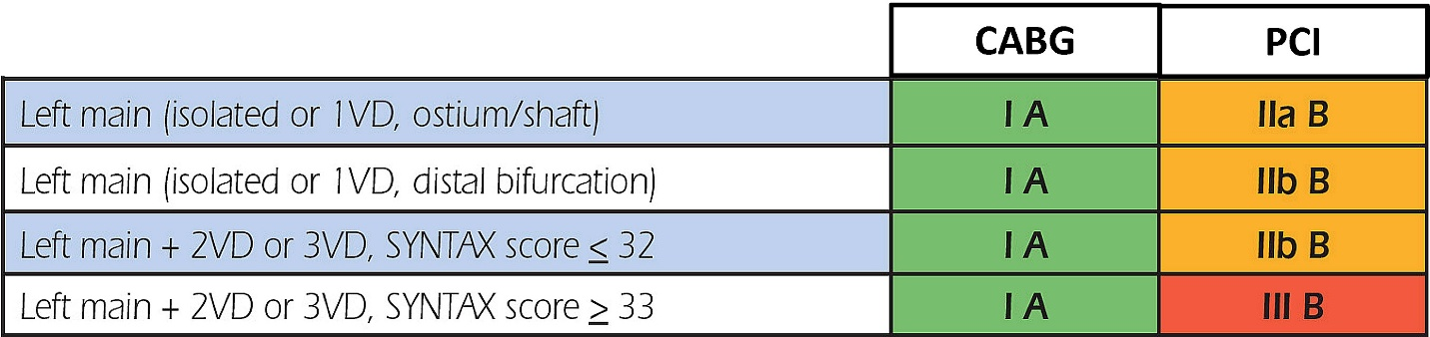
These recommendations were based on two large clinical trials of revascularization in patients with left main disease, EXCEL and NOBLE, which compared CABG with PCI.[3,4] At 5-years after their index procedures, patients in both trials showed no difference in mortality, but significant differences in other endpoints like myocardial infarction and ischemia-driven repeat revascularization, all in favor of CABG.
Gaps in current knowledge
Recent investigation has revealed a large knowledge gap in our understanding of PCI in left main disease, especially as derived from these two large trials, EXCEL and NOBLE. The 10-year results from the NOBLE trial revealed that all-cause mortality was lower in patients with acute coronary syndromes treated with PCI compared to CABG, whereas mortality was equivalent in patients with chronic, stable coronary syndromes (Figure 2).[5]
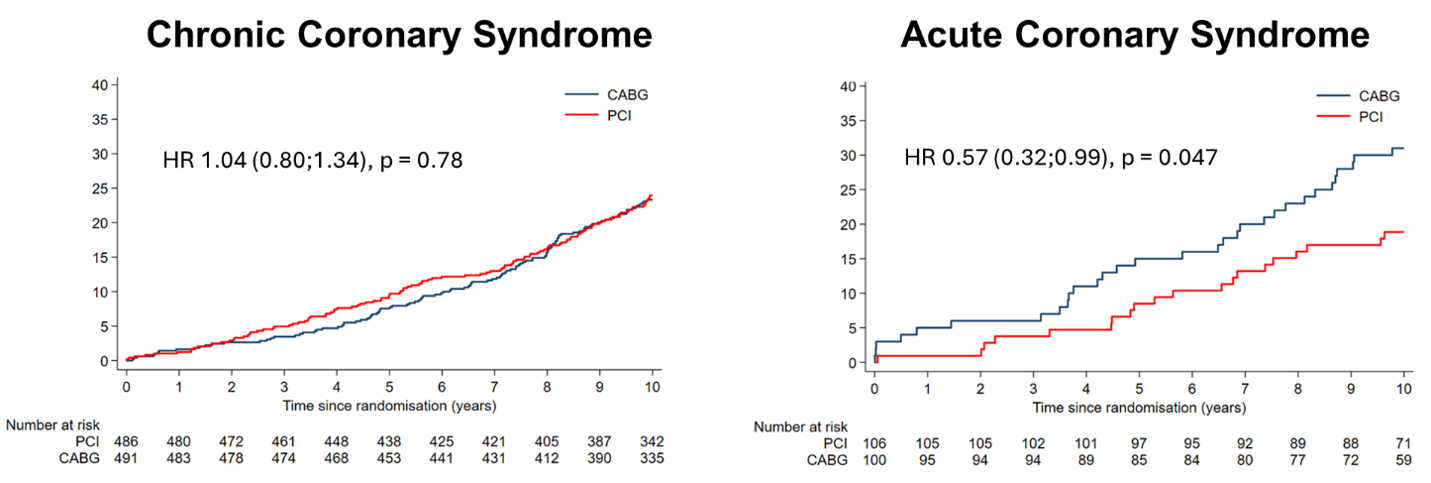
Additionally, further analysis of these two trials revealed the important role that intravascular ultrasound (IVUS) imaging may have played. In the NOBLE trial, the 10-year outcomes data revealed that the lowest mortality was observed in patients with IVUS-guided PCI (Figure 3).[5] In the EXCEL trial, it was noted that larger minimal stent area (MSA) in the left main, as determined by IVUS at the conclusion of the PCI procedure, was associated with significantly better long term clinical outcomes.[6]
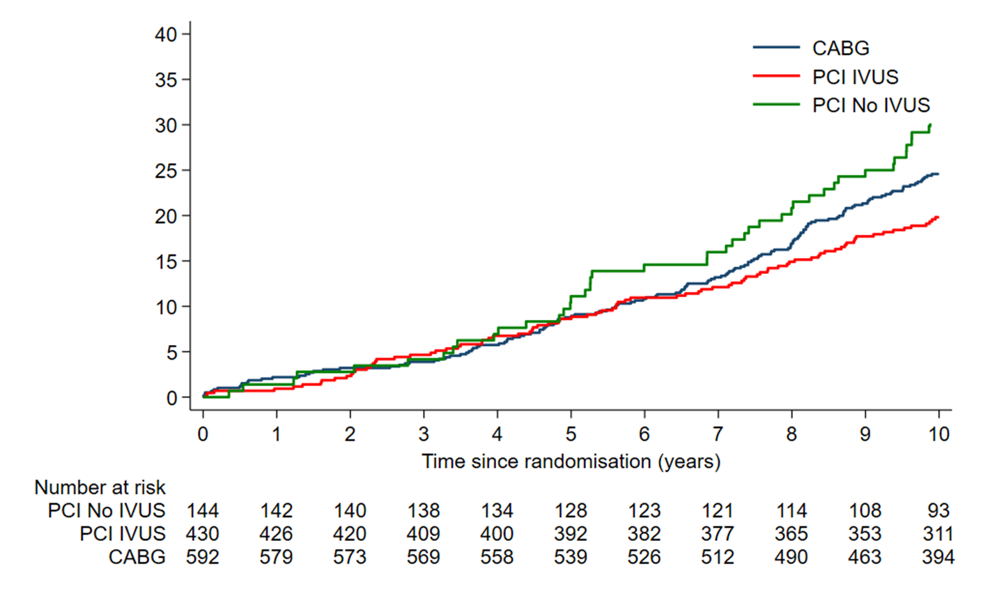
Possible solutions or future directions
At the times that these two large trials, EXCEL and NOBLE, were undertaken, there was greater emphasis placed on stent deployment techniques and less on lesion preparation, procedure optimization, and use of imaging guidance. The task for the future will be to explore all of this new information. The role of IVUS-guided lesion preparation prior to stent implantation, adjunctive therapies like intravascular lithotripsy (IVL), atherectomy, and others, require thorough investigation.
References
- Neumann FJ, et al; ESC Scientific Document Group. 2018 ESC/EACTS Guidelines on myocardial revascularization. Eur Heart J. 2019;40(2):87-165. doi: 10.1093/eurheartj/ehy394. Erratum in: Eur Heart J. 2019 Oct 1;40(37):3096. doi: 10.1093/eurheartj/ehz507. PMID: 30165437.
- Lawton JS, et al. 2021 ACC/AHA/SCAI Guideline for Coronary Artery Revascularization: A Report of the American College of Cardiology/American Heart Association Joint Committee on Clinical Practice Guidelines. Circulation. 2022;145(3):e18-e114. doi: 10.1161/CIR.0000000000001038. Epub 2021 Dec 9. Erratum in: Circulation. 2022 Mar 15;145(11):e772. doi: 10.1161/CIR.0000000000001060. PMID: 34882435.
- Stone GW, et al; EXCEL Trial Investigators. Five-Year Outcomes after PCI or CABG for Left Main Coronary Disease. N Engl J Med. 2019;381(19):1820-1830. doi: 10.1056/NEJMoa1909406. Epub 2019 Sep 28. Erratum in: N Engl J Med. 2020;382(11):1078. doi: 10.1056/NEJMx200004. PMID: 31562798.
- Holm NR, et al; NOBLE investigators. Percutaneous coronary angioplasty versus coronary artery bypass grafting in the treatment of unprotected left main stenosis: updated 5-year outcomes from the randomised, non-inferiority NOBLE trial. Lancet. 2020;395(10219):191-199. doi: 10.1016/S0140-6736(19)32972-1. Epub 2019 Dec 23. PMID: 31879028.
- Holck EN, et al. Percutaneous coronary intervention versus coronary artery bypass grafting for unprotected left main stenosis: 10-year final results from the randomised, open-label, non-inferiority NOBLE trial. Lancet. 2026;407(10536):1374-1382. doi: 10.1016/S0140-6736(26)00205-9. PMID: 41936368.
- Maehara A, et al. Impact of final minimum stent area by IVUS on the 3-year outcome after PCI of left main coronary disease: the EXCEL trial. J Am Coll Cardiol. 2017;69:963.
10.3 Session/Topic Radiation Safety in the Interventional Laboratory
Problem Presenter: Robert Riley
Statement of problem or issue
Studies of health hazards and occupational risks have consistently shown that personnel who work in cardiac catheterization laboratories, including cardiologists, technicians, and nurses, have higher levels of radiation exposure than in many other fields.[1-3] In fact, interventional cardiologists as a group are exposed to more radiation than nuclear power plant workers. These radiation risks are manifested through higher rates of cancers (brain, thyroid, hematopoietic, and skin), lens cataracts, and cardiovascular disease. In addition to radiation, the use of lead aprons by invasive cardiologists leads over time to orthopedic injuries of the neck, back, and legs. Professional societies have taken notice and have begun to publish studies and consensus statements advocating for greater protections for catheterization laboratory personnel.[4,5]
Gaps in current knowledge
There are enormous gaps in our knowledge base regarding radiation exposure. We only know some of the most basic details about radiation physics as it applies to the catheterization laboratory. Image intensifier distance, table height, left-right orientation, and a few other geometric details are only some of the factors that affect the amount of scatter radiation to which catheterization laboratory personnel are exposed. But there are many other considerations such as tube angulations, pulsed fluoroscopy dosing, contour shielding, etcetera, that remain only minimally explored. The true risks of longitudinal radiation exposure over many years have yet to be determined. Annual and lifetime thresholds and cumulative exposure limits must be defined.
Possible solutions or future directions
Greater professional society involvement will be enormously helpful and should be increasing. Cardiologist engagement through the professional societies is important for this. Improved x-ray technology to reduce radiation exposure levels is under development and must continue to evolve. Enhanced radiation protection devices (ERPD) like integrated leaded panels, ceiling-mounted lead-glass or lead-acrylic screens, radiation-blocking pads and drapes, and other items, are already in use and should continue to increase. Seamlessly integrating radiation protection activities into workflow is necessary and requires constant monitoring and oversight. The benefits are worth it.
References
- Zakeri F, et al. Biological effects of low-dose ionizing radiation exposure on interventional cardiologists. Occup Med (Lond). 2010 Sep;60(6):464-9. doi: 10.1093/occmed/kqq062. Epub 2010 Jun 2. PMID: 20519631.
- Andreassi MG, et al. Occupational Health Risks in Cardiac Catheterization Laboratory Workers. Circ Cardiovasc Interv. 2016 Apr;9(4):e003273. doi: 10.1161/CIRCINTERVENTIONS.115.003273. PMID: 27072525.
- Abudayyeh I, et al. Occupational Health Hazards in the Cardiac Catheterization Laboratory: Results of the 2023 SCAI Survey. J Soc Cardiovasc Angiogr Interv. 2025 Mar 4;4(4):102493. doi: 10.1016/j.jscai.2024.102493. PMID: 40308248.
- Tamirisa KP, et al; ACC Women in Cardiology Advocacy Work Group. Radiation Exposure, Training, and Safety in Cardiology. JACC Adv. 2024 Feb 29;3(4):100863. doi: 10.1016/j.jacadv.2024.100863. PMID: 38939686.
- Salavitabar A, et al. ALARA+: Summit on Radiation and Orthopedic Risks in Fluoroscopic Laboratories. J Soc Cardiovasc Angiogr Interv. 2026 Mar 24;5(4):104166. doi: 10.1016/j.jscai.2025.104166. PMID: 42111090.
11.1 Artificial Intelligence in Interventional Medicine: Beyond Imaging to Procedures. Where are we Headed?
Problem Presenter: Larry Dean
Statement of problem or issue
Coronary computed tomography angiography (CCTA) has evolved dramatically as an imaging technology, and quantitative methods of assessment, including several based on artificial intelligence (AI) programs, are being applied to these systems.[1] One specific area of interest is use of CCTA for planning PCI procedures, especially PCI of chronic total occlusions (CTO).[2,3] These analytic programs can inform operators about many features of the planned procedure, including luminal dimensions, lesion (or occlusion) length, anticipated stent length, plaque composition including calcium burden, case complexity, guide catheter selection, optimal fluoroscopic angles, and others.
Gaps in current knowledge
Everything in this field is a knowledge gap area. One important aspect to be explored is the existence of proprietary technologies in CCTA and AI. Ready access to images and the systems by which they can be manipulated and combined must be available.
Possible solutions or future directions
First, interventional cardiologists will need to become familiar with CCTA and interpretation of the images. Credentialing likely will be required, and in some institutions already is, and interventional cardiologists must be part of this process. Additionally, cardiologists will need to become more familiar will AI and what it can and cannot do.
Multimodality imaging has been used in structural heart interventions for years. [4] And, as another example, certain electrophysiology ablation procedures already utilize multimodality imaging. [5] With AI-enhanced CCTA it may become possible to have real-time integrated multimodality imaging as a routine component of PCI procedures. When this was combined with a hands-free, wearable, computer screen with reconstructed 3-dimensional CCTA images of CTO lesions, it has been demonstrated and found feasible for guiding PCI.[6] These and many other systems will have to be examined to determine their ultimate utility. Interventional cardiologists must be involved in leading AI use and its appropriate application in our field.
One concern with AI applied to imaging and “AI coaching” during procedures is the possibility for AI-generated hallucinations.[7] The ultimate question is: Will these systems really make us better?
References
- Jo JI, et al. Artificial Intelligence-Driven Assessment of Coronary Computed Tomography Angiography for Intermediate Stenosis: Comparison With Quantitative Coronary Angiography and Fractional Flow Reserve. Am J Cardiol. 2025 Mar 15;239:82-89. doi: 10.1016/j.amjcard.2024.12.011. Epub 2024 Dec 11. PMID: 39672486.
- Sandoval Y, et al. Coronary Computed Tomography Angiography to Guide Percutaneous Coronary Intervention: Expert Opinion from a SCAI/SCCT Roundtable. J Soc Cardiovasc Angiogr Interv. 2025 May 1;4(6):103664. doi: 10.1016/j.jscai.2025.103664. PMID: 40630246.
- Kumar S, et al. The Role of Coronary Computed Tomography Angiography in Chronic Total Occlusion Percutaneous Coronary Intervention. JACC Cardiovasc Interv. 2026 Jan 12;19(1):1-14. doi: 10.1016/j.jcin.2025.10.055. PMID: 41534971.
- Agricola E, et al. Multimodality imaging for patient selection, procedural guidance, and follow-up of transcatheter interventions for structural heart disease: a consensus document of the EACVI Task Force on Interventional Cardiovascular Imaging: part 1: access routes, transcatheter aortic valve implantation, and transcatheter mitral valve interventions. Eur Heart J Cardiovasc Imaging. 2023 Aug 23;24(9):e209-e268. doi: 10.1093/ehjci/jead096. PMID: 37283275.
- Ninni S, et al. Stereotactic Radioablation for Ventricular Tachycardia in the Setting of Electrical Storm. Circ Arrhythm Electrophysiol. 2022;15(9):e010955. doi: 10.1161/CIRCEP.122.010955. Epub 2022 Sep 8. PMID: 36074658.
- Opolski MP, et al. Feasibility and safety of augmented-reality glass for computed tomography-assisted percutaneous revascularization of coronary chronic total occlusion: A single center prospective pilot study. J Cardiovasc Comput Tomogr. 2017;11(6):489-496. doi: 10.1016/j.jcct.2017.09.013. Epub 2017 Sep 21. PMID: 28964751.
- Xia M, et al. On Hallucinations in Artificial Intelligence-Generated Content for Nuclear Medicine Imaging (the DREAM Report). J Nucl Med. 2026;67(2):166-174. doi: 10.2967/jnumed.125.270653. PMID: 41198241.
11.2 Joint Position Statement of the ACC, IAGS and SCAI: Addressing the Cardiovascular Risk Factors of Obesity and Inflammation
Problem Presenter: Gus Pichard
Statement of problem or issue
Biological processes collectively named “inflammation” have been recognized as important contributors to development of cardiovascular disease. Chronic, silent, low-grade inflammation, together with mediators like cytokines and other humoral and cellular immunomodulators, plays a pivotal role in atherosclerosis, myocardial infarction, and heart failure. [1,2]
An example of this in our own field of interventional cardiology comes from a large PCI registry of over 15,000 patients. [3] Patients in the registry were classified into one of four risk categories based on LDL-cholesterol (cholesterol risk) and high sensitivity C-reactive protein (hs-CRP) values at the time of their index PCI procedures. Over the next year, major adverse cardiovascular events occurred at the highest rates in the patients at highest inflammatory risk. [3]
One very important theory that has gained increasing credence in the past 20-30 years is the obesity-adipokine hypothesis.[2] This proposal states that visceral adipose tissue is a pro-inflammatory endocrine organ and obesity leads to chronic systemic inflammation. Therefore, obesity must be a major target of any effective therapeutic program designed to address chronic inflammation and its cardiovascular consequences.
Gaps in current knowledge
Cardiovascular professional societies have begun to focus on the obesity-inflammation-cardiovascular disease paradigm and provide guidance on helping manage it.[4,5] There are numerous multidisciplinary approaches possible, but efforts to implement them are only just beginning, and their optimal structure for achieving sustained improvements in outcomes is not yet understood (Figure 1).
In addition to obesity management, characterization of inflammation (inflammatory state, inflammatory risk) is still an enormous subject of active investigation.[1,2] While hs-CRP is widely available and easily tested, there are many other cytokine markers that are under investigation. We are a long way from knowing which are the “best” markers.
Furthermore, the role of psychosocial stress in the etiology of obesity, inflammation, and as an independent risk factor on its own for cardiovascular disease, is receiving increased attention.[6] An example of this comes from a study of 624 patients with stable coronary artery disease.[7] In these patients, hemodynamic reactivity, changes in endothelial function, and vasoconstriction were examined during mental stress (public speaking). A stress risk score was then calculated for each patient, and they were grouped by tertiles of this score. Over the subsequent 6 years, patients in the highest tertile of stress risk had the highest rates of major adverse cardiovascular events.[7]
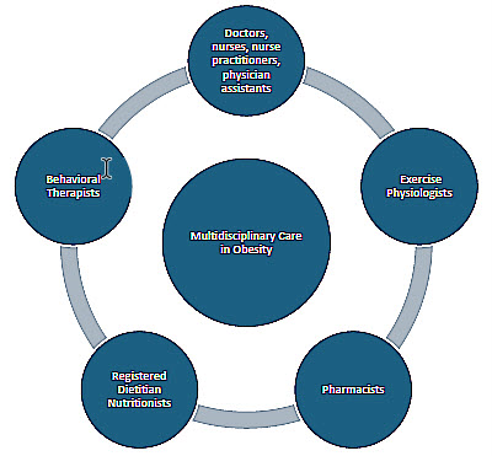
Possible solutions or future directions
More studies of inflammatory markers and their relationships to cardiovascular disease and adverse events are planned. The linkages between mental health, psychosocial stress, obesity and chronic inflammation, and cardiovascular disease need to be explored in depth. Some data are already emerging. It appears the women may be more at risk for psychosocial stress compared with men.[8] One study using cardiac MRI (cMRI) scans found that myocardial tissue changes (longer T1) occurred in women under stress conditions compared to non-stress conditions, while in men there was no difference in T1 between stress and non-stress conditions.[9] Much more research in this area is needed.
Finally, therapeutic interventions designed to address psychosocial stress, obesity, chronic inflammation, and other factors involved in cardiovascular diseases, will have to be proven effective in reducing these factors and improving clinical outcomes.
References
- Mensah GA, et al. Inflammation and Cardiovascular Disease: 2025 ACC Scientific Statement: A Report of the American College of Cardiology. J Am Coll Cardiol. 2025 Sep 29:S0735-1097(25)07555-2. doi: 10.1016/j.jacc.2025.08.047. Epub ahead of print. PMID: 41020749.
- Packer M. Evolutionary History of the Comorbidity-Driven Coronary Microvascular Endothelial Inflammation Hypothesis and Its Metamorphosis to the Adipokine Hypothesis of Heart Failure With a Preserved Ejection Fraction. JACC Heart Fail. 2026 Feb;14(2):102822. doi: 10.1016/j.jchf.2025.102822. Epub 2025 Nov 8. PMID: 41269201.
- Bay B, et al. Residual cholesterol and inflammatory risk in statin-treated patients undergoing percutaneous coronary intervention. Eur Heart J. 2025 Aug 21;46(32):3167-3177. doi: 10.1093/eurheartj/ehaf196. PMID: 40208236.
- Gilbert O, et al. 2025 Concise Clinical Guidance: An ACC Expert Consensus Statement on Medical Weight Management for Optimization of Cardiovascular Health: A Report of the American College of Cardiology Solution Set Oversight Committee. J Am Coll Cardiol. 2025 Aug 19;86(7):536-555. doi: 10.1016/j.jacc.2025.05.024. Epub 2025 Jun 20. PMID: 40539956.
- Kittleson MM, et al. 2025 ACC Scientific Statement on the Management of Obesity in Adults With Heart Failure: A Report of the American College of Cardiology. J Am Coll Cardiol. 2025 Nov 18;86(20):1953-1975. doi: 10.1016/j.jacc.2025.05.008. Epub 2025 Jun 13. PMID: 40512113.
- Bueno H, et al; ESC Scientific Document Group. 2025 ESC Clinical Consensus Statement on mental health and cardiovascular disease: developed under the auspices of the ESC Clinical Practice Guidelines Committee. Eur Heart J. 2025;46(41):4156-4225. doi: 10.1093/eurheartj/ehaf191. PMID: 40878270.
- Moazzami K, et al. Cardiovascular reactivity to mental stress and adverse cardiovascular outcomes in patients with coronary artery disease. J Am Heart Assoc. 2025;14(3):e034683. doi: 10.1161/JAHA.124.034683. Epub 2025 Jan 23. PMID: 39846285.
- Ebong IA, et al; American College of Cardiology Cardiovascular Disease in Women Committee. The Role of Psychosocial Stress on Cardiovascular Disease in Women: JACC State-of-the-Art Review. J Am Coll Cardiol. 2024;84(3):298-314. doi: 10.1016/j.jacc.2024.05.016. PMID: 38986672.
- Moukarzel M, et al. Sex differences in the relationship between psychosocial stress and myocardial tissue characteristics: a CMR imaging study. Circ Cardiovasc Imaging. 2025;18(11):e017667. doi: 10.1161/CIRCIMAGING.124.017667. Epub 2025 Oct 9. PMID: 41064868.
11.3 Joint Position Statement of the ACC, IAGS and SCAI: The American Board of Cardiovascular Medicine
Problem Presenter: Hadley Wilson
Statement of problem or issue
Several professional societies within cardiology joined together to submit a proposal for a new American Board of Cardiovascular Medicine. These professional organizations included: American College of Cardiology (ACC), Heart Rhythm Society (HRS), American Heart Association (AHA), Society for Cardiac Angiography and Interventions (SCAI), and Heart Failure Society of America (HFSA). Three fundamental principles underlying the new cardiovascular board are the following:
- The new Board will chart a path focused on ensuring that cardiologists are able to demonstrate continued clinical competency over the span of their careers, meeting the unique needs of today’s cardiovascular patients.
- The new CV Board will provide a professional home and governance structure that is more representative of cardiovascular physicians and their practice.
- Built by cardiovascular professionals, the new Board will prioritize lifelong learning and continuous self-improvement.
The proposal was submitted to the American Board of Medical Specialties (ABMS) in January 2024. In February 2025 the proposal was denied. Presently, cardiovascular medicine is under the auspices of the American Board of Internal Medicine (ABIM), which exists within the ABMS. Cardiovascular medicine was created within ABIM in 1941.
Gaps in current knowledge
Members of the cardiology professional societies and their leaders are considering several options. Data and opinions are being gathered together, and strategies are being debated. [1]
Possible solutions or future directions
There are four focus areas under consideration:
- End the pursuit of a new cardiovascular medicine board.
- Remain within ABMS/ABIM structures –
- Consider resubmitting the new board proposal in January 2027.
- Seek an alternative partner:
- National Board of Physicians and Surgeons (NBPS).
- American Board of Physician Specialties (ABPS).
- American Osteopathic Association (AOA).
- Complete independence.
Another possibility would be to work directly with states and their licensing boards, healthcare organizations, and payors like CMS and various insurance companies. This possibility seems less likely due to the expense and scope of the work involved.
References
- Available at: www. cvboard.org/pressreleases/official-update-from-the-american-board-of-cardiovascular-medicine. Accessed May 22, 2026.