Phenotype-Specific Mitral Regurgitation Trajectories Following Transcatheter Aortic Valve Replacement in Low-Flow Aortic Stenosis
© 2026 HMP Global. All Rights Reserved.
Any views and opinions expressed are those of the author(s) and/or participants and do not necessarily reflect the views, policy, or position of the Journal of Invasive Cardiology or HMP Global, their employees, and affiliates.
J INVASIVE CARDIOL 2026. doi:10.25270/jic/26.00155. Epub August 26, 2026.
Key Clinical Summary
- Mitral regurgitation trajectory after transcatheter aortic valve replacement differed across low-flow aortic stenosis phenotypes.
- Classical low-flow, low-gradient aortic stenosis had the highest risk of mitral regurgitation worsening and the lowest event-free survival.
- Phenotype-informed surveillance may help identify patients needing closer echocardiographic follow-up and optimization of heart failure therapy.
Abstract
Objectives. Mitral regurgitation (MR) evolution after transcatheter aortic valve replacement (TAVR) in low-flow aortic stenosis (LFAS) is poorly characterized. The authors evaluated MR trajectories across LFAS phenotypes, predictors of MR worsening, and associations with clinical outcomes.
Methods. The authors retrospectively studied 614 patients with LFAS undergoing TAVR: 153 with low-flow high-gradient (LFHG) (24.9%), 155 with classical low-flow low-gradient (cLFLG) (25.2%), and 306 with paradoxical low-flow low-gradient (pLFLG) (49.8%). MR severity was abstracted from clinical echocardiography reports using a 6-level ordinal scale. MR worsening was defined as a grade increase of at least 1 from baseline MR at approximately 30 days or 1 year. Multivariable logistic models identified predictors of MR worsening. Kaplan-Meier and Cox models evaluated associations of MR trajectory and LFAS subtype with all-cause death, heart failure hospitalization, and their composite.
Results. Among 614 LFAS patients, 443 had 30-day and 290 had 1-year echocardiographic follow-up. At 30 days, MR trajectory differed significantly across LFAS phenotypes, with the highest rate of worsening in cLFLG and the lowest in LFHG. At 1 year, unadjusted MR trajectory distributions did not differ significantly across phenotypes. In adjusted logistic models, cLFLG remained independently associated with MR worsening at both timepoints. MR worsening was associated with worse unadjusted outcomes at 30 days but was not independently associated with the composite endpoint after multivariable adjustment. LFAS phenotype, particularly cLFLG, remained the dominant predictor of adverse clinical outcomes.
Conclusions. MR evolution after TAVR is phenotype-specific; patients with cLFLG have the highest risk of MR worsening and lowest event-free survival, supporting phenotype-informed post-TAVR surveillance.
Introduction
Transcatheter aortic valve replacement (TAVR) has revolutionized the management of severe aortic stenosis (AS), particularly in patients deemed high or prohibitive surgical risk.1 However, the heterogeneity of AS phenotypes presents unique challenges in predicting postprocedural outcomes and optimizing patient selection. Low-flow aortic stenosis (LFAS), characterized by a stroke volume index of less than 35 mL/m², encompasses distinct subtypes with varying pathophysiological mechanisms and prognoses.2
The 3 primary LFAS phenotypes—low-flow high gradient (LFHG), classical low-flow, low-gradient (cLFLG), and paradoxical low-flow, low-gradient (pLFLG)—differ fundamentally in their underlying hemodynamics.2-3 LFHG typically represents true severe AS with preserved contractility; cLFLG is characterized by reduced left ventricular ejection fraction (LVEF) (<50%), suggestive of myocardial dysfunction; while pLFLG paradoxically combines preserved LVEF with low-flow, often due to pronounced concentric remodeling and small cavity size.4 These phenotypic distinctions have proven prognostically important, with cLFLG patients experiencing particularly poor outcomes even after successful TAVR.5
Concomitant mitral regurgitation (MR) is prevalent in LFAS patients, affecting 30% to 50% of those undergoing TAVR.6,7 The complex interplay between AS and MR creates a challenging clinical scenario, as relief of AS may theoretically improve MR through reduced LV pressures and improved hemodynamics. However, the trajectory of MR following TAVR in this population is neither fully understood nor clearly predictable, with competing mechanisms of potential improvement as well as progression.
Previous studies have demonstrated conflicting results regarding MR evolution post-TAVR, with approximately half of patients with significant baseline MR improving, whereas a substantial proportion have persistent or worsening MR.7,8 These disparate findings likely reflect the heterogeneous nature of the studied populations and the failure to account for distinct AS phenotypes. The prognostic implications of MR changes after TAVR remain particularly controversial, with some studies suggesting increased mortality with persistent or worsening MR, while others find no significant association.7-9
The phenotype-specific behavior of MR after TAVR in LFAS patients has not been systematically evaluated. Understanding these patterns is crucial for several reasons: (1) it may inform preprocedural risk stratification and patient counseling, (2) it has implications for post-TAVR surveillance protocols, and (3) it may identify subgroups warranting closer surveillance and future study of staged mitral intervention strategies.
This study aimed to characterize the evolution of MR across LFAS phenotypes following TAVR and evaluate its potential association with clinical outcomes (all-cause mortality and heart failure [HF] hospitalization). We hypothesized that MR trajectory would vary significantly between LFHG, cLFLG, and pLFLG subtypes because of their distinct pathophysiological substrates, and that these differences would have phenotype-specific prognostic implications.
Methods
Study population
Adults (≥18 years old) who underwent TAVR at a high-volume quaternary care hospital in New York City between January 2019 and December 2022 were included if they fulfilled hemodynamic LFAS criteria (stroke volume index <35 mL/m² and aortic valve area ≤1.0 cm²). Reasons for exclusion included prior valve surgery (n = 98), concomitant procedures (n = 45), in-hospital mortality (n = 31), and inadequate echocardiographic assessment (n = 58).
Low-flow subtypes were classified as the following:
- LFHG (low-flow high-gradient): a mean gradient of greater than or equal to 40 mm Hg
- cLFLG (classical low-flow, low-gradient): an LVEF of less than 50% and a mean gradient of less than 40 mm Hg
- pLFLG (paradoxical low-flow, low-gradient): an LVEF of greater than or equal to 50% and a mean gradient of less than 40 mm Hg
A multidisciplinary Heart Team determined patient eligibility for TAVR based on comprehensive evaluation including cardiovascular conditions, functional status assessment using New York Heart Association classification and Kansas City Cardiomyopathy Questionnaire scores, frailty assessment, and procedural risk stratification using the Society of Thoracic Surgeons Predicted Risk of Mortality (STS-PROM) score. The transcatheter valve systems utilized included the SAPIEN 3 (Edwards Lifesciences); the CoreValve, Evolut R, and Evolut PRO (Medtronic); and the ACURATE neo and neo2 (Boston Scientific).
Baseline demographic, clinical, and echocardiographic data were extracted retrospectively from the electronic medical record. The study protocol was approved by the Institutional Review Board at the Icahn School of Medicine at Mount Sinai, with waiver of informed consent because of the retrospective design.
Transcatheter aortic valve platform was abstracted from procedural records and categorized as SAPIEN, CoreValve/Evolut, or ACURATE; CoreValve and Evolut generations were grouped as a single self-expanding valve family.
Echocardiography
Transthoracic echocardiographic studies were performed. The mechanism of MR was not recorded. MR severity was abstracted from routine clinical echocardiography reports and mapped to a 6-level ordinal scale: 0 none/trace, 1 mild, 2 mild-to-moderate, 3 moderate, 4 moderate-to-severe, and 5 severe. Moderate-or-greater MR was defined as a grade of greater than or equal to 3. Quantitative MR parameters were not consistently available.
Post-TAVR echocardiograms were obtained within defined windows: early (15-90 days, targeting 30 days) and late (185-545 days, targeting 365 days). Eligibility for early and late MR-trajectory analyses was assessed independently. When multiple echocardiograms existed within a window, the study closest to the target day was selected.
MR change from baseline was categorized as follows:
- Worsened: increase by at least 1 grade
- Stable: no change in grade
- Improved: decline by at least 1 grade
Outcomes
The primary clinical outcome was a composite of all-cause mortality or HF hospitalization. Secondary clinical outcomes included all-cause mortality and HF hospitalization as individual endpoints. The primary echocardiographic outcome was change in MR grade.
For clinical outcome analyses involving MR trajectory, MR worsening was treated as a landmark exposure at the corresponding echocardiographic timepoint. Patients with events before the landmark or echocardiograms obtained after a composite outcome event were excluded from the corresponding landmark analysis; follow-up for outcomes began at the landmark timepoint.
Statistical analysis
Continuous variables are presented as medians and interquartile ranges, with statistical testing performed using analysis of variance (ANOVA) or Kruskal-Wallis tests for non-normally distributed variables. Categorical variables are presented as number (percentage of total group) and compared using chi-squared test with post-hoc pairwise comparisons when significant differences were detected.
Multivariable logistic regression, using the models described below, was performed to identify predictors of MR worsening (vs stable/improved) at both 30-day and 1-year timepoints. Age and STS-PROM score were analyzed as continuous variables (per 1 year and per 1% increase, respectively). Baseline MR grade was modeled as a continuous ordinal variable in the primary multivariable models; moderate-or-greater MR, defined as a grade of at least 3, was used for descriptive baseline characterization. Complete case analysis was performed, with sample sizes varying by model because of missing data. Exploratory interaction terms between LFAS subtype and MR worsening were tested for clinical outcomes but were not included in final primary models because of limited subgroup event counts and model instability. Statistical significance was defined as a P-value of less than 0.05.
Cox proportional hazards regression was performed to evaluate associations between MR worsening, LFAS phenotype, and clinical outcomes using landmark analyses at the corresponding echocardiographic timepoint. MR worsening was treated as a landmark exposure. Patients with composite events before the landmark, echocardiograms occurring on or after a composite-event date, or who were missing required model covariates were excluded from the corresponding model. Age and STS-PROM scores were analyzed as continuous variables. Baseline MR grade was modeled as a continuous ordinal variable on the 0-to-5 clinical scale.
Three hierarchical models were used where event counts allowed: a basic model adjusted for LFAS phenotype, age, sex, and baseline MR grade; an extended model additionally adjusted for STS-PROM score and prosthesis-patient mismatch; and a full model additionally adjusted for chronic kidney disease (CKD), atrial fibrillation (AF), and coronary artery disease (CAD). Extended and full models were restricted to patients with complete STS-PROM score and prosthesis-patient mismatch data. For 1-year secondary outcomes, extended and full models were suppressed when events-per-variable was critically low, or estimates were unstable.
The basic model included fundamental adjustments selected a priori for clinical relevance and parsimony: LFAS phenotype, age, sex, and baseline MR grade. Age was modeled continuously per 1-year increase, and baseline MR grade was modeled as a continuous ordinal variable on the 0-to-5 clinical scale. The extended model included procedure-related factors and risk assessment variables: the basic model plus STS-PROM score, modeled continuously per 1% increase, and prosthesis-patient mismatch. STS-PROM score has demonstrated predictive value for mortality in TAVR patients, and prosthesis-patient mismatch has been associated with incomplete MR resolution after aortic valve replacement.10,11 The full model takes the extended model one step further by incorporating additional comorbidities that have clinically been demonstrated to impact MR significantly: CKD,12 AF,13 and clinically-significant CAD.14 Clinically significant CAD was defined as having a history of one or more of the following: myocardial infarction, percutaneous coronary intervention, and/or coronary artery bypass grafting. Interaction terms between LFAS subtype and MR worsening were tested but excluded from final models when limited subgroup events were detected.
Analyses were performed separately for composite outcome (death or HF hospitalization), all-cause mortality, and HF hospitalization. Kaplan-Meier curves were generated for the overall cohort stratified by MR trajectory and LFAS subtypes. Log-rank tests compared survival curves with post-hoc pairwise comparisons when indicated.
In an exploratory analysis, 3-category MR trajectory distributions were compared between SAPIEN and CoreValve/Evolut platforms using Pearson chi-square tests at 30 days and 1 year. Separate logistic regression models evaluated MR worsening vs stable/improved MR, with valve platform added to the basic adjustment set of LFAS phenotype, age, sex, and baseline MR grade. Because only 5 patients received ACURATE valves, this platform was summarized descriptively but excluded from inferential analyses.
Statistical analyses were performed using R (version 4.3.0; R Foundation for Statistical Computing) in RStudio (Posit, PBC). Two-sided P-values of less than 0.05 defined statistical significance. Pairwise comparisons of MR trajectory distributions were adjusted using the Holm method.
Results
Study population
A total of 614 patients met inclusion criteria. LFAS phenotype distribution was 153 patients with LFHG (24.9%), 155 patients with cLFLG (25.2%), and 306 patients with pLFLG (49.8%).
Baseline characteristics by subtype
Baseline characteristics differed across LFAS subtypes (Table 1). Median age was slightly lower in patients with LFHG (81 years [74-86]) compared with those with pLFLG (83 years [77-88]) and cLFLG (83 years [76-89]) (P = .023). Male sex was less prevalent in pLFLG (54%) compared with cLFLG (80%) and LFHG (61%) (P < .001).
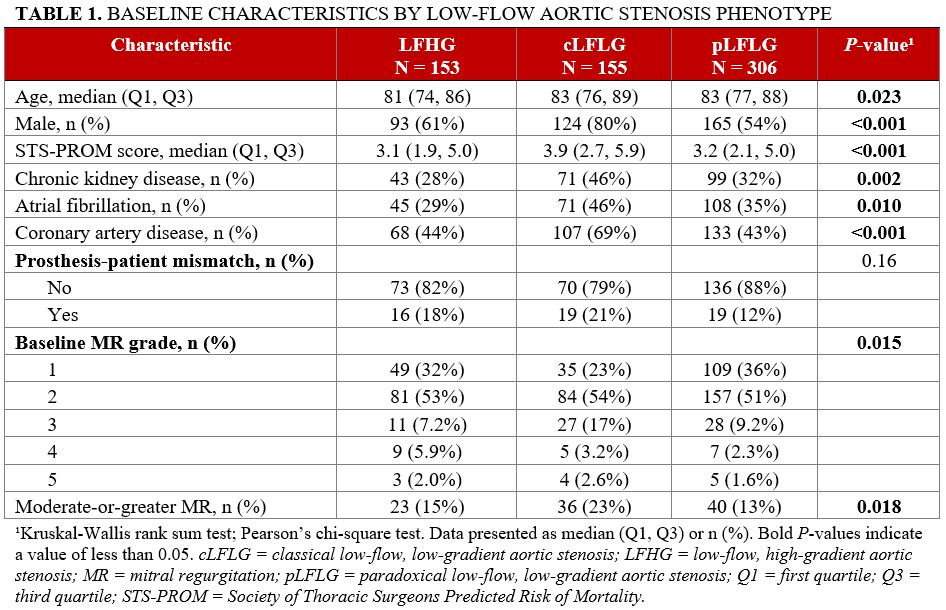
Patients with cLFLG had a higher prevalence of CKD, AF, and CAD compared with pLFLG and LFHG (46% vs 32% and 28%; 46% vs 35% and 29%; and 69% vs 43% and 44%, respectively; all P ≤ .01). Baseline moderate-or-greater MR (grade ≥3) was also more frequent in cLFLG (23%) than in pLFLG (13%) or LFHG (15%) (P = .018). Rates of prosthesis-patient mismatch did not differ significantly between subtypes (P = .16).
MR trajectories after TAVR
Early trajectory (30-day)
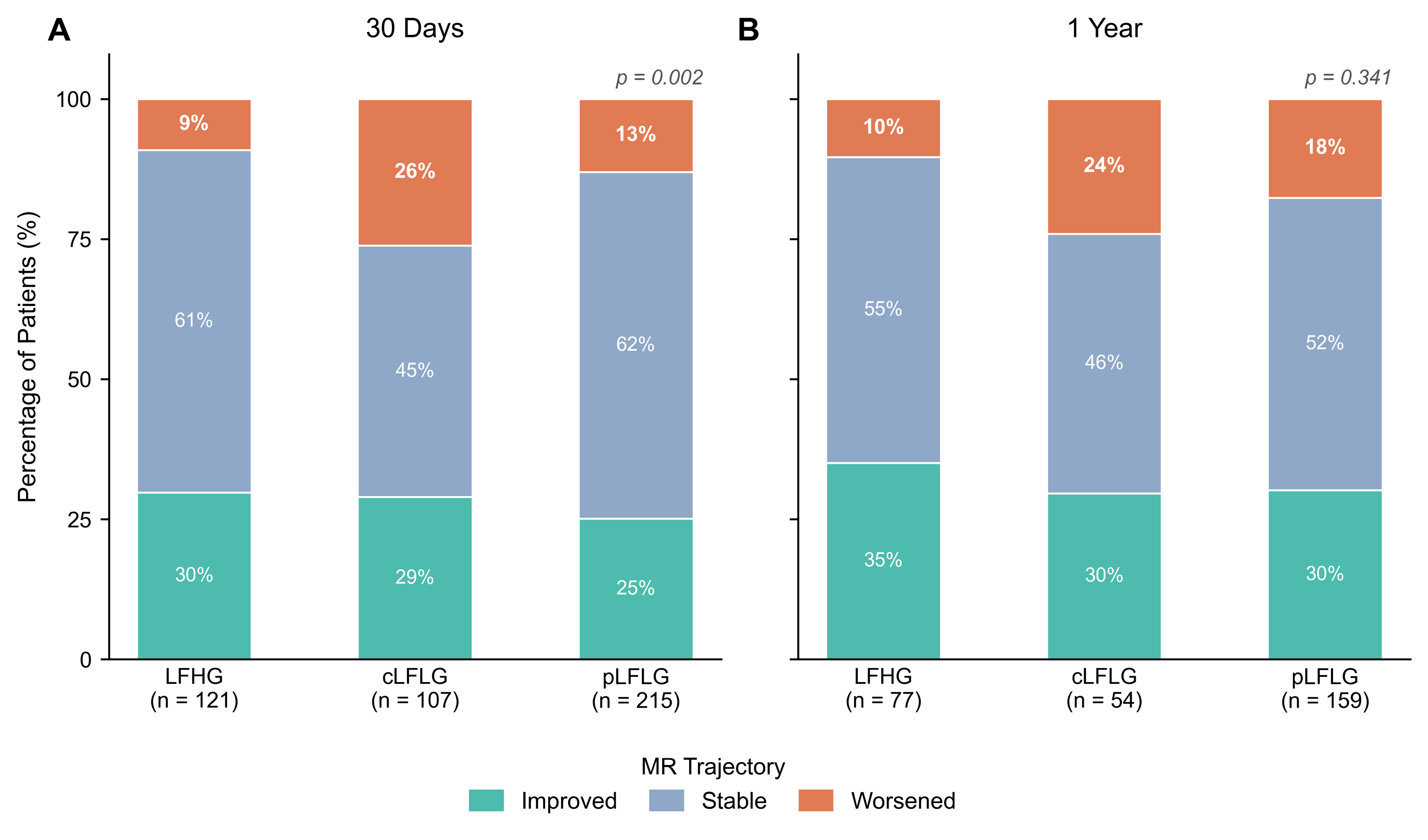
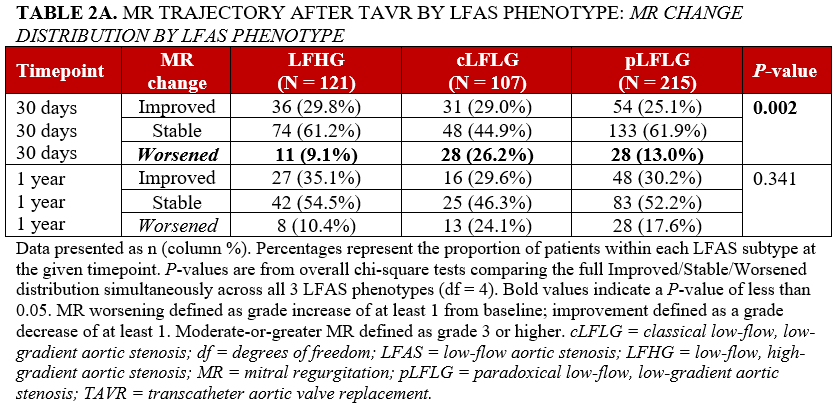
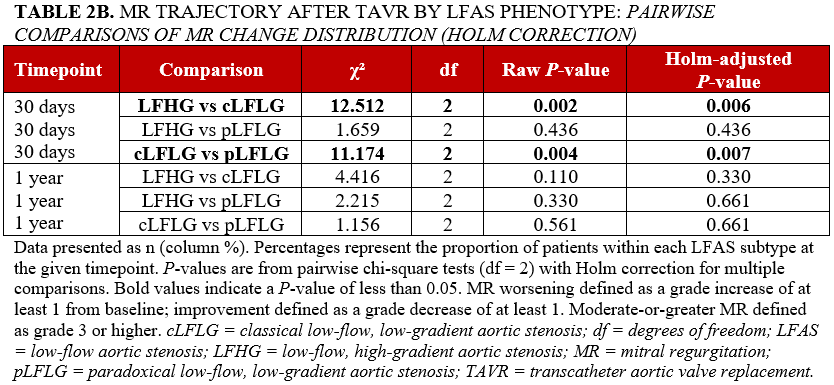
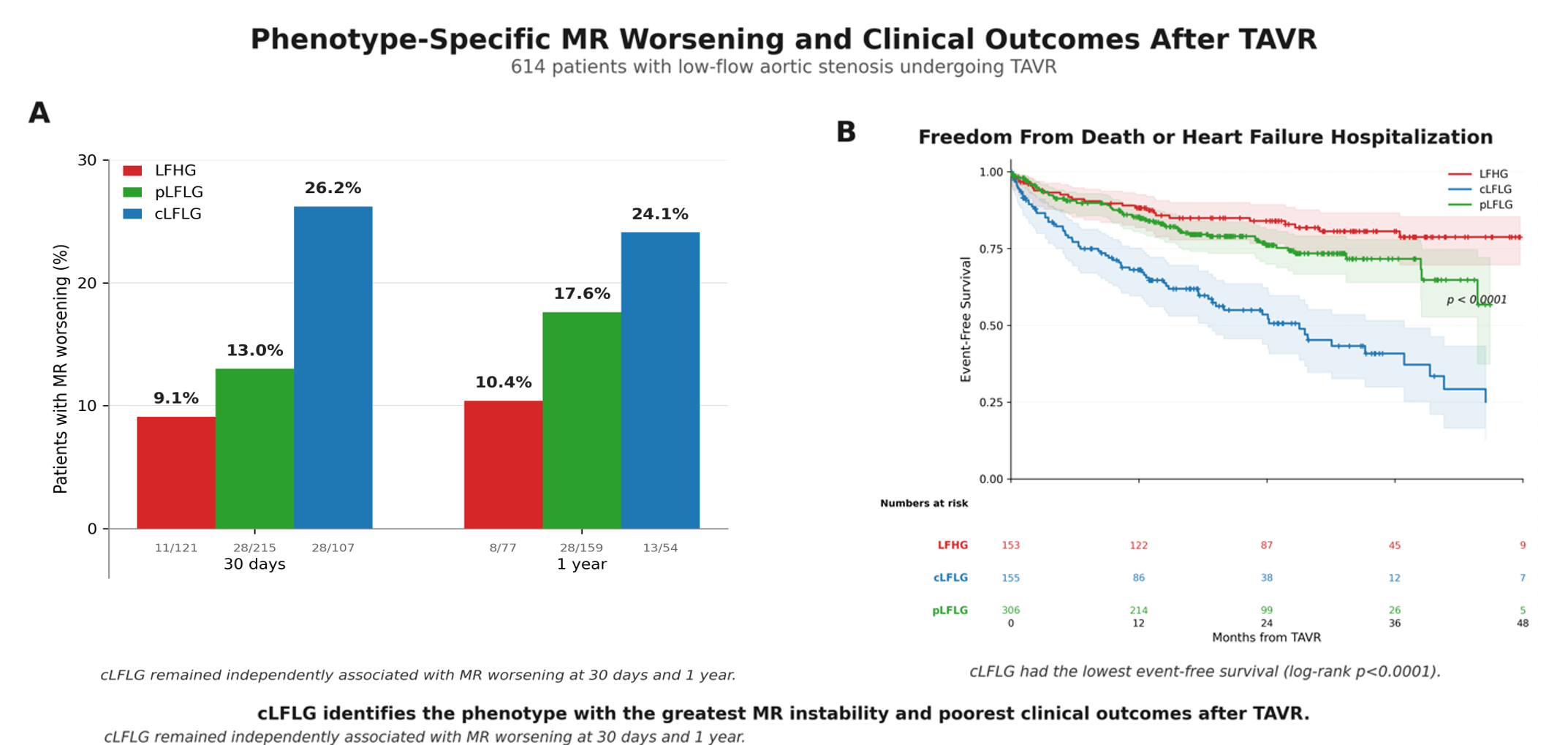
Among 443 patients with baseline and 30-day echocardiographic follow up, 67 (15.1%) experienced MR worsening from baseline (Figure 1, Table 2). The overall distribution of MR change (improved/stable/worsened) differed significantly across LFAS phenotypes (χ² = 16.88, df = 4, P = .002), with higher rates of early MR worsening in cLFLG (26.2%) than in pLFLG (13.0%) or LFHG (9.1%) (Table 2A). Post-hoc pairwise comparisons (Table 2B) revealed that MR-change distribution in cLFLG differed from both pLFLG (Holm-adjusted P = .007) and LFHG (Holm-adjusted P = .006), whereas pLFLG and LFHG did not differ (Holm-adjusted P = .44).
Late trajectory (1-year)
Among 290 patients with 1-year echocardiograms, 49 (16.9%) had worsening of MR compared with baseline (Figure 1, Table 2). In contrast to the early timepoint, the distribution of MR change at 1 year did not differ significantly across LFAS phenotypes (χ² = 4.51, df = 4, P = .34), and no pairwise comparison between subtypes remained significant after multiplicity adjustment (all Holm-adjusted P ≥ .33).
Valve platform and MR trajectory
Valve-platform data were available for all 614 patients: 343 (55.9%) received SAPIEN, 266 (43.3%) received CoreValve/Evolut, and 5 (0.8%) received ACURATE valves. Among SAPIEN and CoreValve/Evolut recipients, the 3-category MR trajectory distribution did not differ significantly at 30 days (χ² = 4.83, df = 2, P = .090; N = 441) or 1 year (χ² = 1.68, df = 2, P = .431; N = 286). After adjustment for LFAS phenotype, age, sex, and baseline MR grade, CoreValve/Evolut use was not associated with MR worsening at 30 days (adjusted odds ratio [OR], 0.70; 95% CI, 0.37-1.31; P = .261) or 1 year (adjusted OR, 0.94; 95% CI, 0.44-2.00; P = .880). ACURATE was summarized descriptively because of the small sample size (Supplemental Table 1).
Predictors of MR worsening
Early MR worsening (30-day)
In multivariable logistic regression at 30 days with LFHG as the reference group (Table 3A), the cLFLG phenotype was independently associated with higher odds of MR worsening across all models (full-model OR, 4.93; 95% CI, 1.79-15.4; all P ≤ .003). In contrast, pLFLG did not differ significantly from LFHG in any model (full-model OR, 1.81; 95% CI, 0.70-5.30; P = .24).
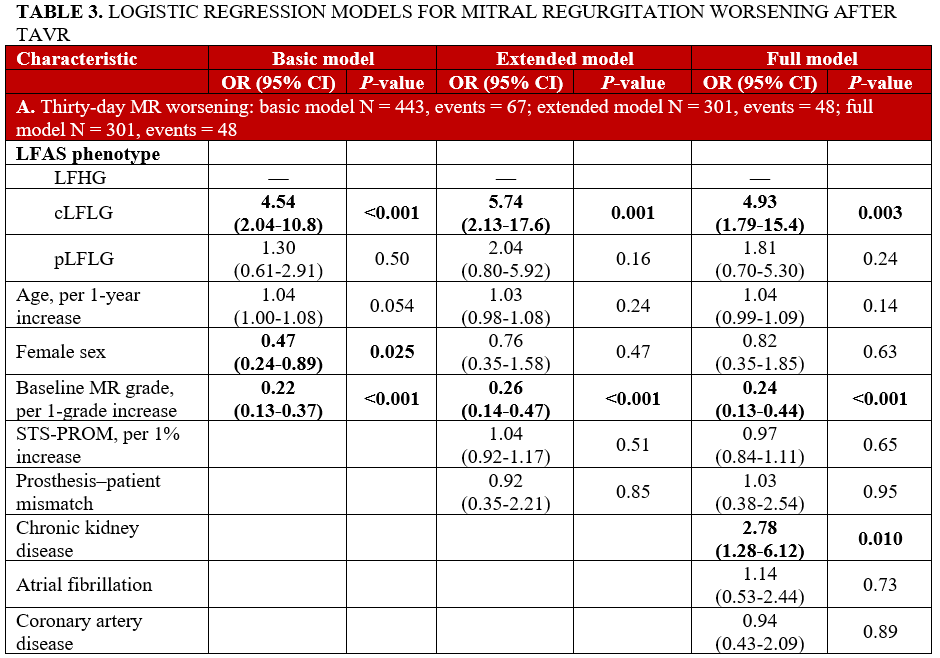
Higher baseline MR grade was associated with lower odds of early MR worsening (full-model OR, 0.24 per grade increase; 95% CI, 0.13-0.44; P < .001). Female sex was associated with lower odds of early MR worsening in the basic model (OR, 0.47; 95% CI, 0.24-0.89; P = .025); however, this association was attenuated and no longer significant after additional adjustment. In the fully adjusted model, CKD emerged as an independent risk factor for 30-day MR worsening (OR, 2.78; 95% CI, 1.28-6.12; P = .010). Age, STS-PROM score, prosthesis-patient mismatch, AF, and CAD were not significant predictors in the full model.
Late MR worsening (1-year)
In multivariable logistic regression at 1 year (Table 3B) with LFHG as the reference group, the cLFLG phenotype remained independently associated with higher odds of MR worsening across all models (full-model OR, 4.98; 95% CI, 1.20-22.8; P = .031). In contrast, pLFLG did not differ significantly from LFHG in any model (full-model OR, 1.27; 95% CI, 0.43-4.14; P = .68).
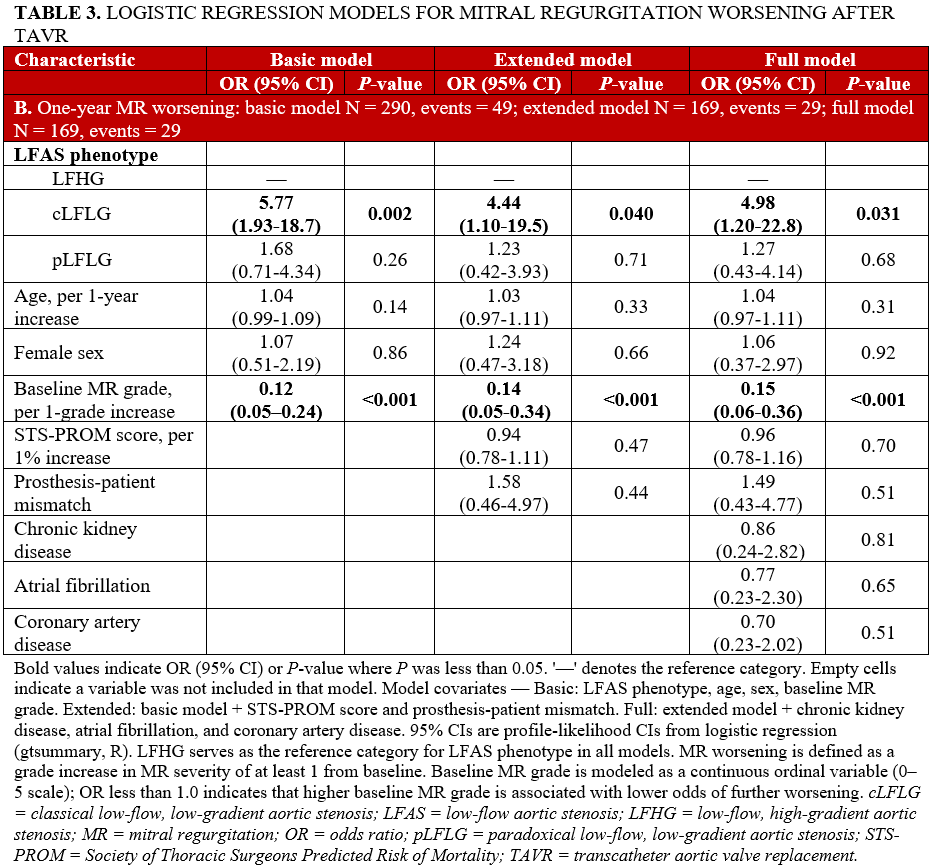
Although the unadjusted 1-year MR-change distribution did not differ significantly across LFAS phenotypes, cLFLG remained independently associated with MR worsening in adjusted binary logistic models. Baseline MR grade remained inversely associated with late MR worsening (full-model OR, 0.15 per grade increase; 95% CI, 0.06-0.36; P < .001).
Compared with patients who were not included, those in the 1-year MR-trajectory analytic cohort had lower STS-PROM scores and lower prevalence of cLFLG, CKD, AF, and moderate-or-greater baseline MR (Supplemental Table 2).
Clinical outcomes
Outcomes by LFAS subtype
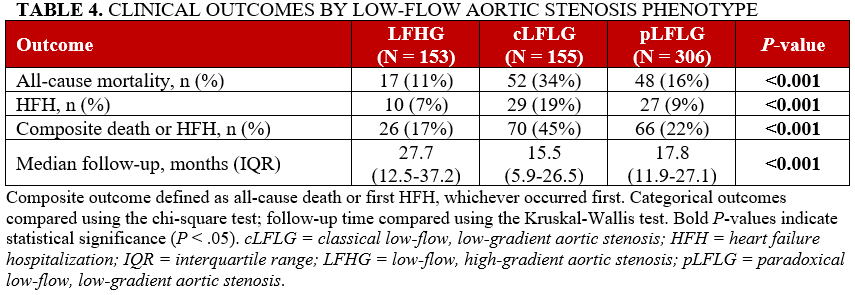
Clinical outcomes varied by phenotype (Table 4). Patients with cLFLG had higher rates of all-cause mortality compared with LFHG and pLFLG (34% vs 11% and 16%, respectively), HF hospitalization (19% vs 7% and 9%, respectively), and the composite endpoint of death or HF hospitalization (45% vs 17% and 22%, respectively) during follow-up (all P < .001). Median follow-up also differed across phenotypes, with shorter follow-up for patients with cLFLG and pLFLG compared with LFHG.
Landmark Cox models for composite outcomes
Among 443 patients in the 30-day landmark cohort, 98 (22.1%) experienced the composite outcome of death or HF hospitalization after the landmark timepoint (Table 5). In the basic Cox model, 30-day MR worsening was associated with higher risk of the composite outcome (hazard ratio [HR], 1.81; 95% CI, 1.11-2.96; P = .017); however, this association was attenuated and no longer significant after further adjustment for STS-PROM score and comorbidities (full-model HR, 1.33; 95% CI, 0.73-2.44; P = .358).
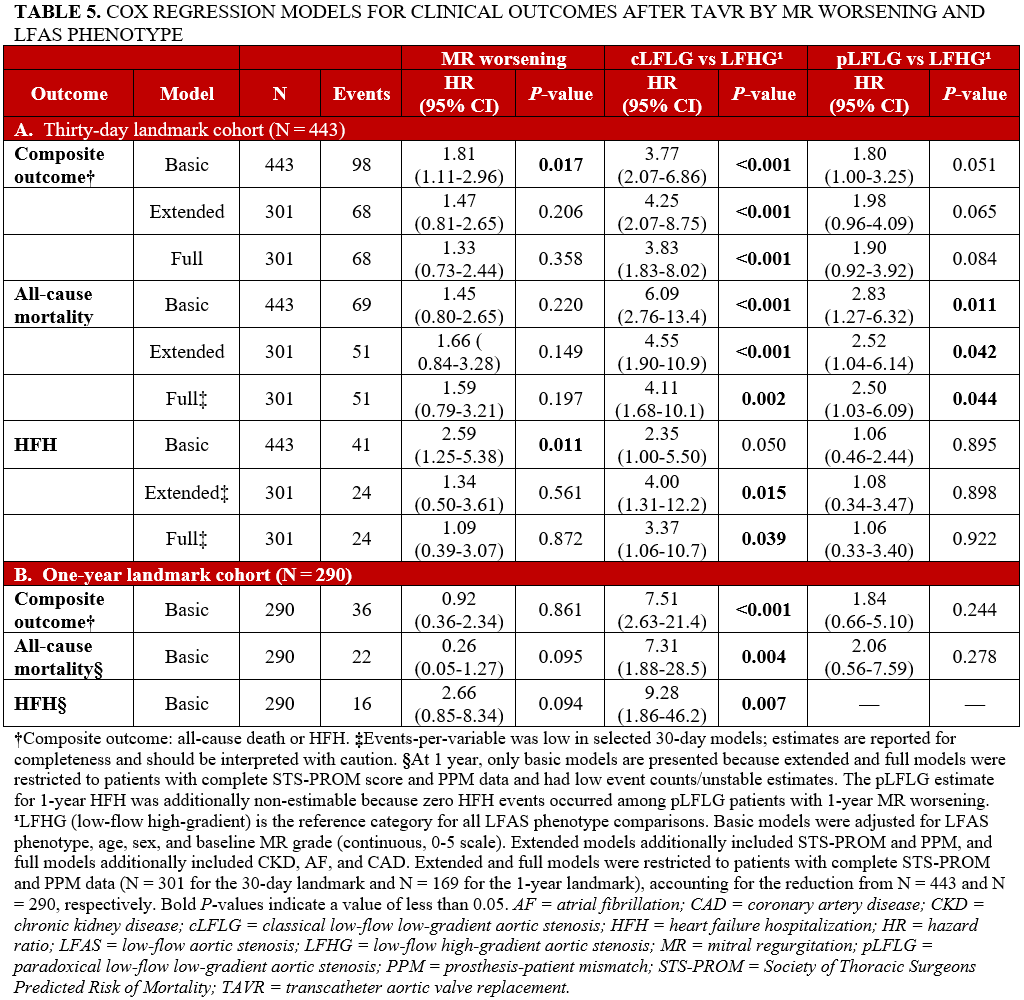
Across all models, LFAS phenotype remained a strong predictor of adverse outcomes. Compared with LFHG, patients with cLFLG had an approximately 4-fold higher risk of the composite outcome (full-model HR, 3.83; 95% CI, 1.83-8.02; P < .001), whereas pLFLG showed a nonsignificant trend toward higher risk (HR, 1.90; 95% CI, 0.92-3.92; P = .084). In the fully adjusted model, CKD was also independently associated with increased risk (HR, 2.11; 95% CI, 1.22-3.64; P = .008), while age showed a modest inverse association with the composite outcome (HR, 0.96 per year; 95% CI, 0.93-0.99; P = .014). Baseline MR grade, STS-PROM score, prosthesis-patient mismatch, AF, and CAD were not significant predictors.
Interaction terms between LFAS subtype and 30-day MR worsening were tested in exploratory models and were not statistically significant (all interaction P > .60).
Among 290 patients in the 1-year landmark cohort, 36 (12.4%) experienced the composite outcome of death or HF hospitalization after the landmark timepoint. In basic Cox models using LFHG as the reference phenotype, 1-year MR worsening was not associated with the composite outcome (HR, 0.92; 95% CI, 0.36-2.34; P = .861). In contrast, cLFLG remained strongly associated with higher risk of the composite outcome (HR, 7.51; 95% CI, 2.63-21.4; P < .001), whereas pLFLG was not significantly associated with risk (HR, 1.84; 95% CI, 0.66-5.10; P = .244). Extended and full 1-year models were limited by missing STS-PROM score/prosthesis–patient mismatch data and low event counts; therefore, they were not emphasized.
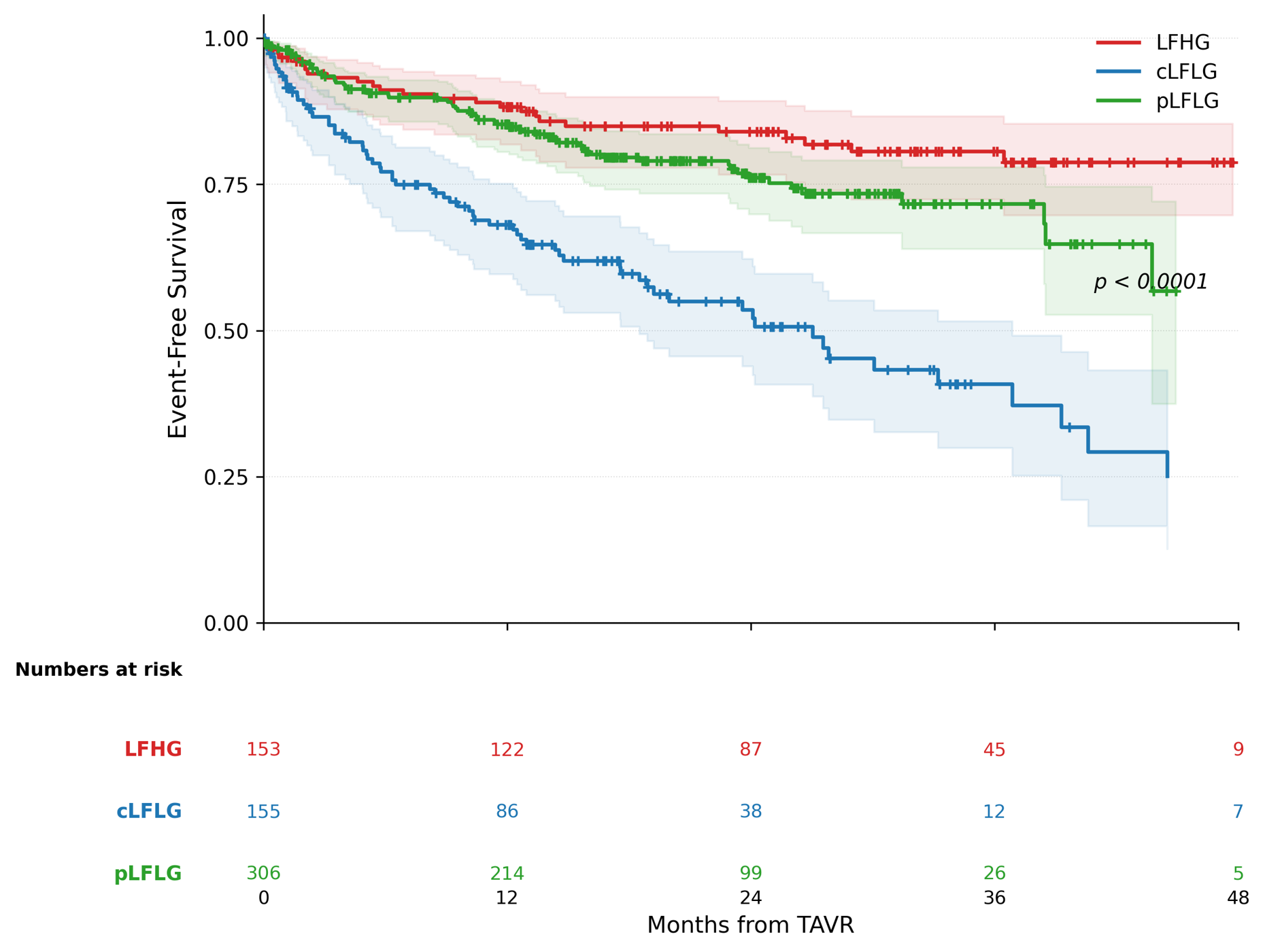
Exploratory models including interaction terms between LFAS subtype and 1-year MR worsening did not demonstrate significant interactions (all interaction P > .10; data not shown). Kaplan-Meier curves stratified by LFAS subtype alone showed the lowest event-free survival in cLFLG patients (log-rank P < .0001).
Secondary outcomes
For all-cause mortality in the 30-day landmark cohort, 69 deaths occurred among 443 patients in the basic model. Thirty-day MR worsening was not significantly associated with mortality in the basic model (HR, 1.45; 95% CI, 0.80-2.65; P = .22) or full model (HR, 1.59; 95% CI, 0.79-3.21; P = .20). In contrast, cLFLG was strongly associated with mortality in both the basic (HR, 6.09; 95% CI, 2.76-13.44; P < .001) and full model (HR, 4.11; 95% CI, 1.68-10.05; P = .002).
For HF hospitalization in the 30-day landmark cohort, 41 events occurred among 443 patients in the basic model. Thirty-day MR worsening was associated with HF hospitalization in the basic model (HR, 2.59; 95% CI, 1.25-5.38; P = .011), but this association was attenuated after full adjustment (HR, 1.09; 95% CI, 0.39-3.07; P = .87). cLFLG remained associated with HF hospitalization in the full model (HR, 3.37; 95% CI, 1.06-10.7; P = .039).
At the 1-year landmark, 22 deaths and 16 HF hospitalizations occurred among 290 patients in the basic models. One-year MR worsening was not significantly associated with mortality or HF hospitalization, whereas cLFLG remained associated with higher risk of both mortality and HF hospitalization in the basic models.
Kaplan-Meier survival analyses
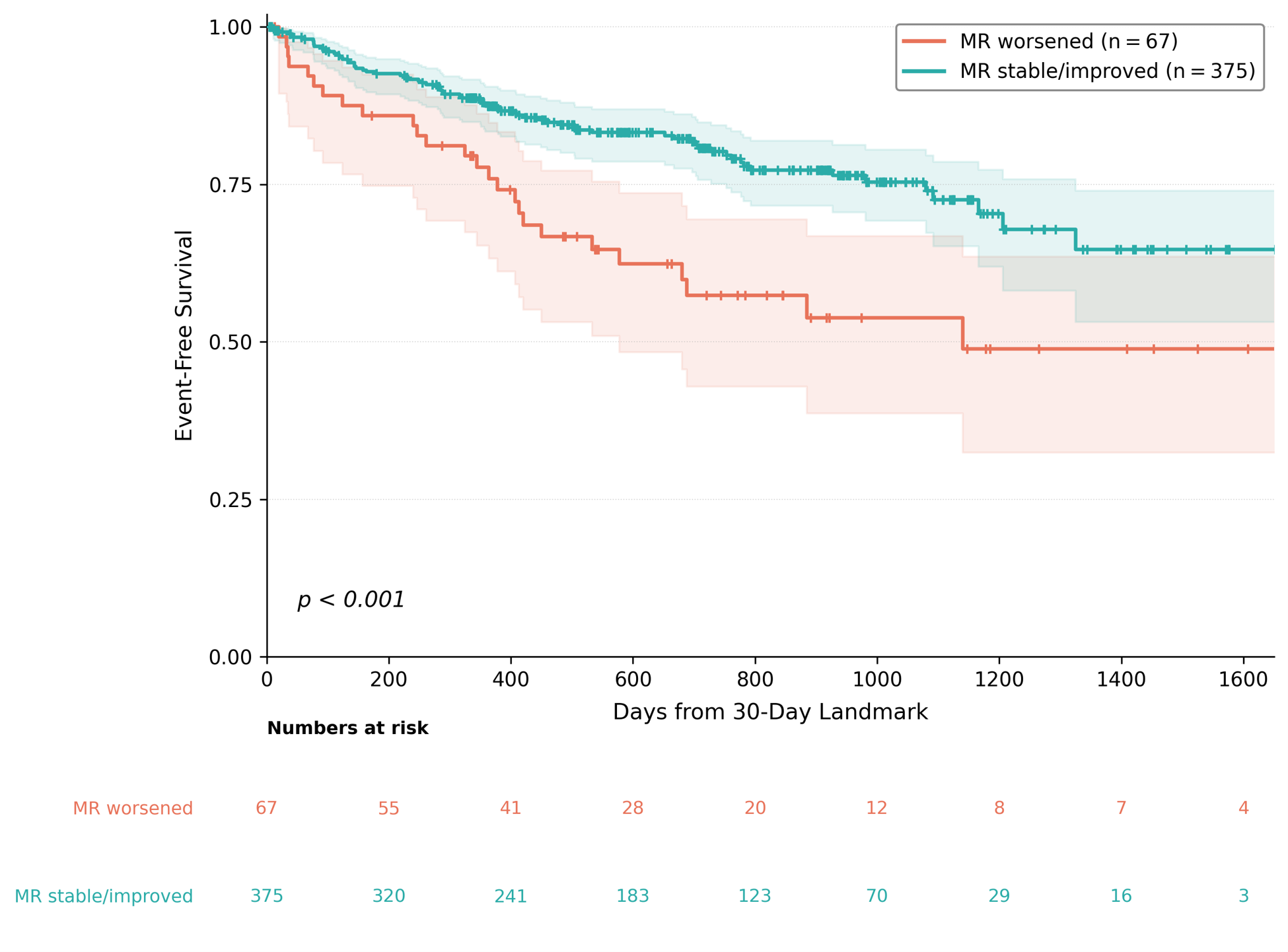
Kaplan-Meier analyses demonstrated worse unadjusted event-free survival among patients with 30-day MR worsening compared with those with stable or improved MR after the 30-day landmark (log-rank P < .001; Figure 2); however, this association was attenuated and no longer significant after multivariable adjustment. One-year MR worsening was not associated with a difference in unadjusted event-free survival (log-rank P = .98). When stratified by LFAS phenotype, event-free survival differed significantly across subtypes in the full LFAS cohort (log-rank P < .0001; Figure 3), with the lowest event-free survival observed among cLFLG patients.
Discussion
Principal findings
The principal findings of this study are 5-fold. First, early MR trajectory after TAVR differed significantly across LFAS phenotypes, with the highest rate of 30-day MR worsening observed in cLFLG. At 30 days, cLFLG patients had a nearly 3-fold higher crude rate of MR worsening compared with LFHG patients and a nearly 5-fold higher adjusted odds of MR worsening in the fully adjusted model. Second, although the unadjusted distribution of MR change at 1 year did not differ significantly across phenotypes, cLFLG remained independently associated with MR worsening in adjusted logistic models at both 30 days and 1 year. Third, MR worsening was associated with worse unadjusted outcomes at 30 days but was not independently associated with the composite endpoint after multivariable adjustment. Fourth, LFAS phenotype, particularly cLFLG, remained the dominant predictor of adverse clinical outcomes. Fifth, a substantial residual MR burden persisted after TAVR, with MR worsening observed in 15.1% of patients at 30 days and 16.9% at 1 year, highlighting an ongoing clinical challenge in this population. Exploratory analyses also found no association between SAPIEN vs CoreValve/Evolut platform and MR trajectory or adjusted odds of MR worsening at either timepoint, suggesting that the observed phenotype-associated patterns were not clearly attributable to valve-platform selection (Figure 4).
Interpretation of phenotype-specific MR evolution
The observed phenotype-specific patterns likely reflect distinct pathophysiological mechanisms underlying each LFAS subtype. In cLFLG, the combination of reduced LVEF and low transvalvular gradient suggests advanced myocardial dysfunction with possible hibernating myocardium.15 The high rate of MR worsening in this group may reflect more advanced myocardial phenotype with worse ventricular dysfunction, impaired contractile reserve, and greater comorbidity burden. Unlike paradoxical LFLG-AS, in which the low gradient may result from small cavity size, the adverse ventricular remodeling, annular dilation, persistent elevation in filling pressures, or impaired contractile reserve in cLFLG may limit the potential for MR improvement even after afterload reduction.16 Because MR mechanism was not available in this study, these mechanistic explanations remain hypothesis-generating.
The persistence of an independent association between cLFLG and MR worsening in adjusted models, despite a nonsignificant unadjusted 1-year trajectory comparison, may reflect the importance of baseline MR severity and competing patient selection effects. Higher baseline MR grade was inversely associated with subsequent worsening, likely because patients with more advanced MR at baseline had less room to worsen on an ordinal grading scale. Adjustment for baseline MR severity may therefore reveal an association between cLFLG phenotype and MR worsening that is less apparent in unadjusted distributional comparisons. In addition, 1-year echocardiographic follow-up was limited to a healthier survivor cohort, which may have attenuated unadjusted differences across phenotypes.
Prior evidence suggests that functional mechanisms are common in LFLG AS. In the TOPAS-TAVI registry, MR was functional in 77.2% and mixed in 22.7% of patients with at least mild MR.7 However, this external distribution cannot be assumed to apply to the present cohort, particularly across all 3 LFAS phenotypes. Because functional and organic MR may respond differently to afterload reduction and reverse remodeling after TAVR, unmeasured differences in MR etiology across phenotypes could partly account for the observed trajectory differences. These associations therefore remain hypothesis-generating.
MR worsening and clinical outcomes
Although 30-day MR worsening was associated with the composite outcome and HF hospitalization in the basic model, more extensive multivariable adjustment in the extended and full models led to the loss of an independent association. This raises a number of possibilities regarding the role of MR worsening. First, MR worsening may function primarily as a marker of adverse myocardial remodeling rather than an independent mediator of clinical outcomes. Underlying LV dysfunction and adverse ventricular remodeling may themselves drive adverse clinical outcomes while also promoting MR worsening, thereby providing a shared pathophysiologic substrate for the observed association between MR trajectory and prognosis. Prior studies in patients with LFLG AS have similarly linked ventricular characteristics and recovery of LV systolic function with MR evolution after TAVR.7 Consistent with this possibility, cLFLG, characterized by reduced LV systolic function, was associated with worse clinical outcomes in our cohort, but also with worsening MR, suggesting its role as a confounder.
However, LFAS phenotype was already included in the basic models, in which 30-day MR worsening remained independently associated with the composite outcome and HF hospitalization, suggesting that phenotype alone does not account for these associations. The subsequent attenuation in the fully adjusted models may therefore reflect additional confounding by procedural risk and comorbid disease burden. Interpretation should nevertheless account for the smaller complete-case sample available for full multivariable adjustment, which reduced the number of patients and events and consequently the precision of these estimates.
Exploratory interaction analyses did not identify a phenotype-specific association between MR worsening and outcomes. However, event counts were significantly limited following stratification by LFAS subtype, MR trajectory, landmark timepoint, and outcome, particularly at 1 year. Thus, these analyses should be considered hypothesis-generating and larger cohorts are needed to address this question.
pLFLG showed intermediate rates of MR worsening—which may be due to the heterogeneous nature and pathophysiology of the group2,5—whereas LFHG had the most stable trajectory. The LFHG group’s stability may reflect less advanced myocardial disease and more predictable hemodynamic responses to afterload reduction.
Clinical implications
Our findings have several important clinical implications. First, preprocedural counseling and patient selection should incorporate phenotype-specific expectations regarding MR evolution. Patients with cLFLG should be advised that MR may be less likely to improve after TAVR, and clinicians should recognize that relief of aortic valve obstruction may not fully reverse the mitral valve pathology in this subgroup. This may influence decisions regarding concomitant or staged mitral intervention in selected cases.
Second, post-TAVR surveillance protocols should be tailored by phenotype. cLFLG patients, as well as those with MR worsening, warrant closer echocardiographic monitoring, particularly beyond the immediate postprocedural period, as this may identify patients with a more advanced LFAS substrate who require closer follow-up and optimization of HF therapy.
Although treated similarly in the current analysis, it is important to note that the clinical importance of a 1-grade increase in MR depends on both the baseline and resulting MR severity. For example, progression from mild to mild-to-moderate MR may represent an early sign of unfavorable remodeling but may not, by itself, alter management. In contrast, progression from moderate to moderate-to-severe MR results in a more consequential residual MR burden and may prompt closer echocardiographic and clinical reassessment, particularly if it persists. Thus, worsening should be interpreted in the context of the resulting MR severity and overall clinical course rather than by the grade change alone.
For patients with persistent or worsening MR after TAVR, particularly those with symptoms despite optimization of HF therapy and with moderate-to-severe or severe MR, a staged approach to concomitant MR may be appropriate. Transcatheter edge-to-edge repair (TEER) post-TAVR utilizing MitraClip (Abbott) has been shown to improve MR severity and functional status.17,18 PASCAL (Edwards Lifesciences) provides an alternative TEER platform, with randomized data in degenerative MR but limited evidence specific to post-TAVR patients.19 Transcatheter mitral valve replacement and other emerging repair technologies may broaden options for patients unsuitable for TEER, but their role and optimal timing after TAVR require prospective evaluation.
Comparison with previous studies
Our results both confirm and extend previous observations regarding MR evolution after TAVR. The overall rates of improvement and worsening we observed align with prior reports, though most studies have not been stratified by AS phenotype.8,20,21 In contrast to prior reports linking persistent or worsening MR after TAVR with adverse outcomes, MR worsening was not independently associated with outcomes after multivariable adjustment in our cohort.7,20,21 This difference may reflect variation in study populations, definitions of MR trajectory, landmark selection, and covariate adjustment, and underscores the importance of accounting for heterogeneous AS phenotypes.
Future directions
Future studies should validate predictors of persistent or worsening MR and determine whether MR trajectory adds prognostic information within LFAS phenotypes. Larger multicenter cohorts are also needed to identify which patients with cLFLG may benefit from intensified surveillance, optimized HF therapy, or staged mitral intervention.
Limitations
Several limitations merit consideration. Most importantly, MR mechanism was not available in the analytic dataset and could not be reconstructed. Therefore, we could not distinguish primary, secondary, or mixed MR; determine whether mechanism differed across LFAS phenotypes; or assess whether MR etiology confounded the observed associations. Because functional and organic MR may respond differently to afterload reduction and reverse remodeling after TAVR, this limitation restricts mechanistic interpretation of the phenotype-specific trajectories.
Second, the single-center design may limit generalizability, though our quaternary care center's diverse population enhances external validity.
Third, MR severity was graded using a 6-level clinical scale derived from routine echocardiographic reporting rather than standardized laboratory adjudication. Quantitative measures, including effective regurgitant orifice area, regurgitant volume, vena contracta, and proximal isovelocity surface area,22 were not consistently available. Because the study relied on routine clinical reports without independent rereading, formal interobserver variability could not be assessed. MR grading may also vary with loading conditions, image quality, and the integration of qualitative and semiquantitative findings. Although this approach reflects real-world clinical interpretation, it may limit reproducibility.
Fourth, echocardiographic follow-up was incomplete and subject to survivorship bias, particularly at 1 year. Patients without 1-year echocardiographic follow-up had higher mortality and greater comorbidity burden than those with follow-up (Supplemental Table 2); therefore, late MR trajectory findings should be interpreted as applying to patients who survived and returned for interval echocardiographic reassessment.
Fifth, our sample size limited some subgroup analyses, particularly the phenotype-specific interaction analyses and 1-year outcome models.
Finally, although valve platform was examined, other procedural factors and medical therapy optimization could not be rigorously assessed. Only 5 patients received ACURATE valves, precluding meaningful inferential comparison of that platform.
Conclusions
This study provides novel insights into phenotype-specific MR evolution following TAVR in patients with LFAS. We demonstrate 3 key findings: first, early MR trajectory differed significantly by LFAS phenotype, with patients with cLFLG experiencing the highest rate of 30-day MR worsening. Although unadjusted 1-year MR-change distributions did not differ significantly across phenotypes, cLFLG remained independently associated with MR worsening in adjusted models at both 30 days and 1 year. Second, LFAS phenotype, particularly cLFLG, remained the strongest determinant of adverse clinical outcomes after TAVR, whereas MR worsening was associated with worse unadjusted outcomes but was not independently associated with the composite endpoint after multivariable adjustment. Third, MR worsening occurred in a substantial minority of LFAS patients after TAVR, underscoring the persistent clinical burden of residual or progressive MR in this population, and representing a substantial clinical challenge regardless of statistical associations with mortality. These findings support phenotype-informed post-TAVR surveillance, particularly for patients with cLFLG, and further study of staged mitral intervention in select patients with persistent or worsening MR.
Affiliations and Disclosures
Akarsh Sharma, MD1; Esha Vaish, MD2; Eileen Galvani, MD1; Annapoorna S. Kini, MD3; Samin K. Sharma, MD3; Stamatios Lerakis, MD, PhD3
From the 1Icahn School of Medicine at Mount Sinai, Mount Sinai Hospital, New York, New York; 2Department of Medicine at Mount Sinai Morningside and West, New York, New York; 3Mount Sinai Fuster Heart Hospital, Icahn School of Medicine at Mount Sinai, New York, New York.
Acknowledgments: The authors thank Yash Prakash, MD, for assistance with early data collection and curation, and for helpful preliminary project discussions. They also thank members of the Lerakis Cardiovascular Imaging Laboratory for assistance with data collection and refinement of project ideas.
Artificial intelligence (AI) statement: During preparation of this manuscript, the authors used Claude (Anthropic) and ChatGPT (OpenAI) to assist with statistical code debugging, identification of potentially relevant literature, and review of the manuscript for internal consistency. AI assistance was used to support review of the Results, Discussion, tables, figures, and captions. The authors independently reviewed, edited, and verified all AI-assisted suggestions including statistical outputs, literature references, and manuscript text, and take full responsibility for the final content of the publication.
Disclosures: The authors report no financial relationships or conflicts of interest regarding the content herein.
Address for correspondence: Stamatios Lerakis, MD, PhD, Icahn School of Medicine at Mount Sinai, 1 Gustave L. Levy Place, New York, NY 10029, USA. Email: stamatios.lerakis@mountsinai.org
References
1. Otto CM, Nishimura RA, Bonow RO, et al. 2020 ACC/AHA guideline for the management of patients with valvular heart disease: executive summary: a report of the American College of Cardiology/American Heart Association Joint Committee on Clinical Practice Guidelines. J Am Coll Cardiol. 2021;77(4):450-500. doi:10.1016/j.jacc.2020.11.035
2. Clavel MA, Magne J, Pibarot P. Low-gradient aortic stenosis. Eur Heart J. 2016;37(34):2645-2657. doi:10.1093/eurheartj/ehw096
3. Eleid MF, Sorajja P, Michelena HI, Malouf JF, Scott CG, Pellikka PA. Flow-gradient patterns in severe aortic stenosis with preserved ejection fraction: clinical characteristics and predictors of survival. Circulation. 2013;128(16):1781-1789. doi:10.1161/CIRCULATIONAHA.113.003695
4. Sharma N, Sachedina AK, Kumar S. Low-flow, low-gradient severe aortic stenosis: a review. Heart Int. 2023;17(1):8-12. doi:10.17925/HI.2023.17.1.8
5. Wagener M, Reuthebuch O, Heg D, et al. Clinical outcomes in high-gradient, classical low-flow, low-gradient, and paradoxical low-flow, low-gradient aortic stenosis after transcatheter aortic valve implantation: a report from the SwissTAVI registry. J Am Heart Assoc. 2023;12(12):e029489. doi:10.1161/JAHA.123.029489
6. Nombela-Franco L, Ribeiro HB, Urena M, et al. Significant mitral regurgitation left untreated at the time of aortic valve replacement: a comprehensive review of a frequent entity in the transcatheter aortic valve replacement era. J Am Coll Cardiol. 2014;63(24):2643-2658. doi:10.1016/j.jacc.2014.02.573
7. Freitas-Ferraz AB, Lerakis S, Barbosa Ribeiro H, et al. Mitral regurgitation in low-flow, low-gradient aortic stenosis patients undergoing TAVR: insights from the TOPAS-TAVI registry. JACC Cardiovasc Interv. 2020;13(5):567-579. doi:10.1016/j.jcin.2019.11.042
8. Nombela-Franco L, Eltchaninoff H, Zahn R, et al. Clinical impact and evolution of mitral regurgitation following transcatheter aortic valve replacement: a meta-analysis. Heart. 2015;101(17):1395-1405. doi:10.1136/heartjnl-2014-307120
9. Chakravarty T, Van Belle E, Jilaihawi H, et al. Meta-analysis of the impact of mitral regurgitation on outcomes after transcatheter aortic valve implantation. Am J Cardiol. 2015;115(7):942-949. doi:10.1016/j.amjcard.2015.01.022
10. Wang TKM, Wang MTM, Gamble GD, Webster M, Ruygrok PN. Performance of contemporary surgical risk scores for transcatheter aortic valve implantation: a meta-analysis. Int J Cardiol. 2017;236:350-355. doi:10.1016/j.ijcard.2016.12.188
11. Angeloni E, Melina G, Pibarot P, et al. Impact of prosthesis-patient mismatch on the regression of secondary mitral regurgitation after isolated aortic valve replacement with a bioprosthetic valve in patients with severe aortic stenosis. Circ Cardiovasc Imaging. 2012;5(1):36-42. doi:10.1161/CIRCIMAGING.111.967612
12. Kipourou K, O'Driscoll JM, Sharma R. Valvular heart disease in patients with chronic kidney disease. Eur Cardiol. 2022;17:e02. doi:10.15420/ecr.2021.25
13. Vavalle JP, Arora S. Atrial fibrillation: not an innocent bystander in the treatment of functional mitral regurgitation. JACC Cardiovasc Interv. 2020;13(20):2385-2387. doi:10.1016/j.jcin.2020.07.041
14. Dewey TM, Brown DL, Herbert MA, et al. Effect of concomitant coronary artery disease on procedural and late outcomes of transcatheter aortic valve implantation. Ann Thorac Surg. 2010;89(3):758-767; discussion 767. doi:10.1016/j.athoracsur.2009.12.033
15. Urena M, Webb JG, Eltchaninoff H, et al. Late cardiac death in patients undergoing transcatheter aortic valve replacement: incidence and predictors of advanced heart failure and sudden cardiac death. J Am Coll Cardiol. 2015;65(5):437-448. doi:10.1016/j.jacc.2014.11.027
16. Gould KL, Johnson NP. Ischemia in aortic stenosis: new insights and potential clinical relevance. J Am Coll Cardiol. 2016;68(7):698-701. doi:10.1016/j.jacc.2016.05.070
17. Witberg G, Codner P, Landes U, et al. Transcatheter treatment of residual significant mitral regurgitation following TAVR: a multicenter registry. JACC Cardiovasc Interv. 2020;13(23):2782-2791. doi:10.1016/j.jcin.2020.07.014
18. Nagasaka T, Shechter A, Patel V, et al. Two-year clinical outcomes of staged transcatheter mitral edge-to-edge repair after transcatheter aortic valve replacement. Am J Cardiol. 2024;224:46-54. doi:10.1016/j.amjcard.2024.05.032
19. Lim DS, Smith RL, Gillam LD, et al; CLASP IID Pivotal Trial Investigators. Randomized comparison of transcatheter edge-to-edge repair for degenerative mitral regurgitation in prohibitive surgical risk patients. JACC Cardiovasc Interv. 2022;15(24):2523-2536. doi:10.1016/j.jcin.2022.09.005
20. Ferruzzi GJ, Silverio A, Giordano A, et al. Prognostic impact of mitral regurgitation before and after transcatheter aortic valve replacement in patients with severe low-flow, low-gradient aortic stenosis. J Am Heart Assoc. 2023;12(17):e029553. doi:10.1161/JAHA.123.029553
21. Nappi F, Nenna A, Timofeeva I, Mihos C, Gentile F, Chello M. Mitral regurgitation after transcatheter aortic valve replacement. J Thorac Dis. 2020;12(5):2926-2935. doi:10.21037/jtd.2020.01.69
22. Zoghbi WA, Adams D, Bonow RO, et al. Recommendations for noninvasive evaluation of native valvular regurgitation: a report from the American Society of Echocardiography Developed in Collaboration with the Society for Cardiovascular Magnetic Resonance. J Am Soc Echocardiogr. 2017;30(4):303-371. doi:10.1016/j.echo.2017.01.007