Expanding the PERT Paradigm: Incorporating Oncology Expertise Into Multidisciplinary Management of Cancer-Associated Thrombosis
© 2026 HMP Global. All Rights Reserved.
Any views and opinions expressed are those of the author(s) and/or participants and do not necessarily reflect the views, policy, or position of the Journal of Invasive Cardiology or HMP Global, their employees, and affiliates.
J INVASIVE CARDIOL 2026. doi:10.25270/jic/26.00303. Epub September 16, 2026.
Despite advances in oncologic therapy, cancer-associated thrombosis (CAT) remains a major source of morbidity and mortality.1,2 Therapeutic anticoagulation is the cornerstone of management; however, patients with cancer face increased risks of recurrent venous thromboembolism (VTE), major bleeding, and ongoing tumor-driven thrombosis.2 Contemporary catheter-based therapies (CBT) have expanded treatment options for patients with intermediate- and high-risk pulmonary embolism (PE), providing rapid reduction in thrombus burden while avoiding many bleeding risks of systemic thrombolysis.3,4 Observational studies suggest CBT may improve short-term outcomes in selected patients with malignancy, although available evidence remains largely retrospective and focused on procedural success and early clinical endpoints.3,4
Current treatment algorithms appropriately emphasize assessment of hemodynamic compromise, right ventricular dysfunction, and procedural feasibility when considering catheter-based intervention. Yet, these frameworks may incompletely capture the complexity of CAT. In many patients with cancer, the critical question is whether thrombectomy may meaningfully alter the patient's clinical trajectory. Answering this question requires understanding the underlying biology driving thrombosis, the anticipated response to oncologic therapy, and the likelihood of preventing recurrent VTE events, which are considerations that extend beyond traditional cardiovascular risk assessment.
We propose a designated role for oncology in multidisciplinary thrombectomy decision-making for patients with malignancy. While PE response teams (PERTs) are uniquely positioned to assess the hemodynamic urgency and technical feasibility of intervention, oncologists provide essential insight into tumor biology, expected response to systemic therapy, mechanisms of recurrent thrombosis, and overall disease trajectory. These factors define what we refer to as biologic reversibility and should complement traditional assessments of hemodynamic risk when evaluating candidacy for CBT.
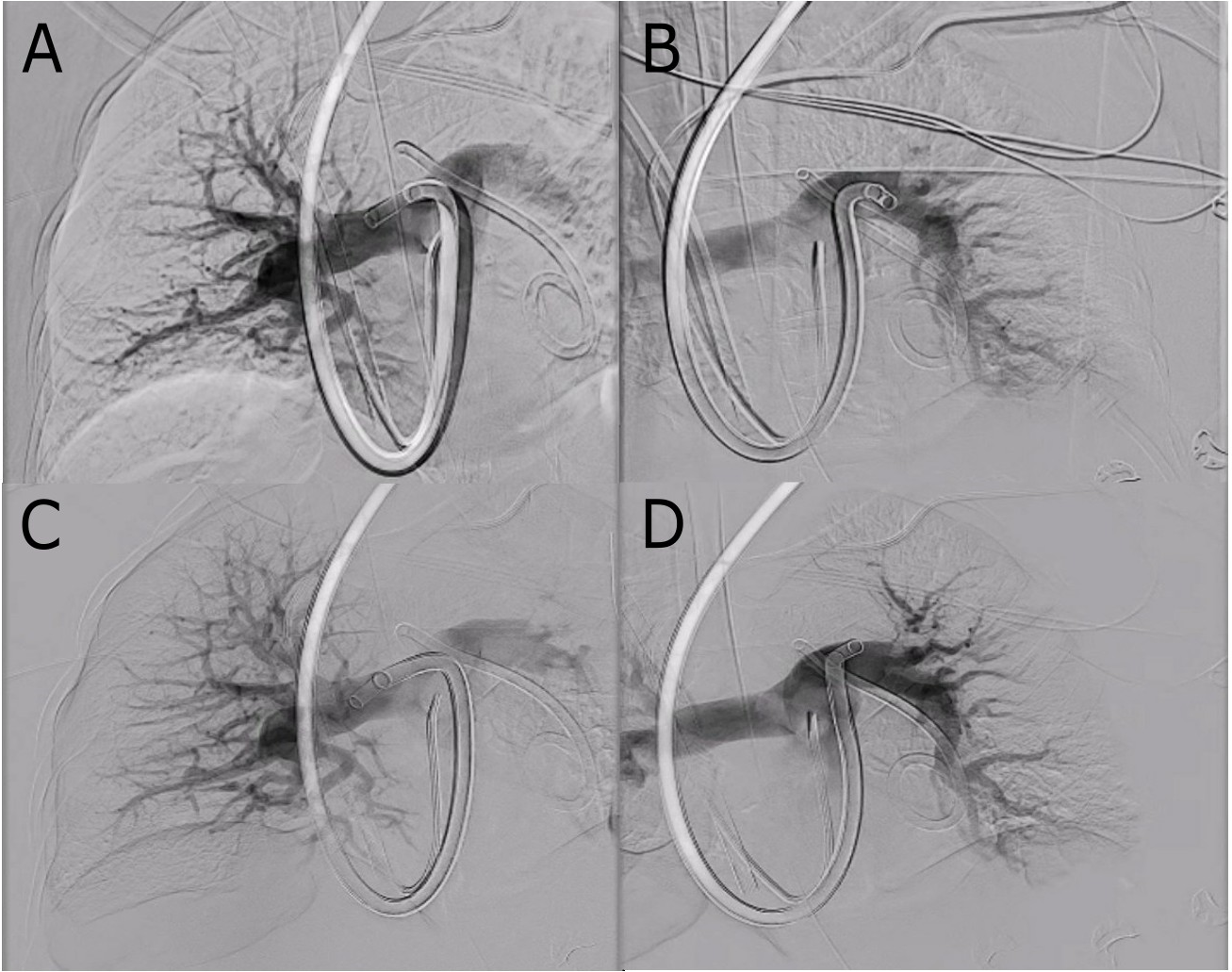
A recent clinical encounter illustrates this challenge. A woman in her early 60s with clear cell renal cell carcinoma and tumor thrombus extending into the inferior vena cava underwent nephrectomy and thrombectomy. Her postoperative course was complicated by massive PE requiring mechanical thrombectomy (MT) (Figure). Because tumor embolization was suspected, MT was favored over catheter-directed thrombolysis to restore pulmonary perfusion and obtain tissue. Histopathology confirmed malignant cells within the retrieved thrombus. Ongoing postoperative bleeding risk initially precluded anticoagulation, and despite subsequent thrombectomy and eventual therapeutic anticoagulation, the patient experienced recurrent PE. As a third thrombectomy was considered, the central question was no longer whether additional thrombus could be removed, but whether repeated intervention was likely to provide meaningful benefit if the recurrent embolization reflected uncontrolled tumor biology rather than conventional thromboembolic disease. Answering this required assessing oncologic response, recurrence mechanisms, and whether additional therapy may modify the underlying disease process.
Current frameworks prioritize restoration of cardiopulmonary physiology through assessment of hemodynamic compromise, right ventricular dysfunction, and escalating oxygen requirements. These parameters identify patients most likely to derive immediate physiologic benefit from thrombus removal. Implicit within this paradigm, however, is the assumption that successful restoration of pulmonary blood flow will meaningfully alter subsequent clinical outcomes. In malignancy, that assumption may not hold. CBT effectively addresses the hemodynamic consequences of thrombosis but does not necessarily modify the biologic processes responsible for recurrent thrombus formation. Tumor thrombus, persistent intravascular tumor progression, or refractory cancer-associated hypercoagulability may continue to drive recurrent embolic events despite technically successful intervention and appropriate anticoagulation. In these circumstances, repeated thrombectomy may restore physiology while offering diminishing clinical benefit.
This distinction can be understood through the concept of biologic reversibility. Whereas hemodynamic reversibility reflects the ability of thrombectomy to restore cardiopulmonary physiology, biologic reversibility reflects the likelihood that the underlying thrombotic mechanism is modifiable through effective oncologic therapy. Importantly, biologic reversibility must not be equated with staging or life expectancy. Patients with metastatic disease receiving highly effective targeted or immunologic therapies may have substantial biologic reversibility, whereas patients with progressive intravascular tumor extension despite systemic treatment may have little opportunity to alter the underlying thrombotic process despite repeated intervention. Accordingly, biologic reversibility exists along a continuum and is determined not by prognosis alone but by the expected response of the underlying malignancy to available therapy.
Assessment of biologic reversibility requires expertise in tumor biology, anticipated treatment response, mechanisms of recurrent thrombosis, and disease trajectory that is not routinely captured by cardiopulmonary risk assessment. We therefore propose that oncologic expertise be incorporated into multidisciplinary thrombectomy decision-making for patients with CAT, alongside established assessments of hemodynamic risk and procedural feasibility. Such an approach recognizes that the clinical benefit of thrombus removal may depend not only on restoration of pulmonary perfusion but also on the modifiability of the underlying thrombotic process. Incorporating oncologic assessment into PERT decision-making may provide a more comprehensive framework for identifying patients with CAT in whom CBT is most likely to confer durable clinical benefit.
Affiliations and Disclosures
Aditya Belamkar, MD1; Aishwarya Pastapur, MD2; Nausheen Akhter, MD2; Daniel Schimmel, MD2
From the 1Department of Internal Medicine, Northwestern University Feinberg School of Medicine, Chicago, Illinois; 2Division of Cardiology, Northwestern University Feinberg School of Medicine and Bluhm Cardiovascular Institute at Northwestern Medicine, Chicago, Illinois.
Disclosures: Dr Schimmel has relationships with Medtronic (educational grant), Boston Scientific (educational grant, consulting, advisory board), Edwards (educational grant), Abbott (educational grant), Penumbra (research, consulting, speaker), Stryker (research, consulting, speaker), Inquis Medical (research, consulting), Johnson & Johnson (research), Gradient (research), HeartFlow (research), and Pulnovo (research). The remaining authors report no financial relationships or conflicts of interest regarding the content herein.
Address for correspondence: Daniel Schimmel, MD, Bluhm Cardiovascular Institute, Northwestern Memorial Hospital, 676 North Saint Clair Street Suite 2330 Chicago, IL 60611, USA. Email: dschimme@nm.org
References
1. Khorana AA, Mackman N, Falanga A, et al. Cancer-associated venous thromboembolism. Nat Rev Dis Primers. 2022;8(1):11. doi:10.1038/s41572-022-00336-y
2. Girardi L, Wang TF, Ageno W, Carrier M. Updates in the incidence, pathogenesis, and management of cancer and venous thromboembolism. Arterioscler Thromb Vasc Biol. 2023;43(6):824-831. doi:10.1161/ATVBAHA.123.318779
3. Leiva O, Yang EH, Rosovsky RP, Alviar C, Bangalore S. In-hospital and readmission outcomes of patients with cancer admitted for pulmonary embolism treated with or without catheter-based therapy. Int J Cardiol. 2024;408:132165. doi:10.1016/j.ijcard.2024.132165
4. Fan J, Jiang P, Cui Y, et al. Clinical characteristics, risk factors, and outcomes of cancer and noncancer patients with hospital-acquired pulmonary embolism: a retrospective cohort study. Ann Vasc Surg. 2026;126:153-165. doi:10.1016/j.avsg.2026.01.027