Understanding the Role of Calcium in Stent Strut Malapposition: An OCT Analysis
By Alistair C. Lindsay, MD, PhD
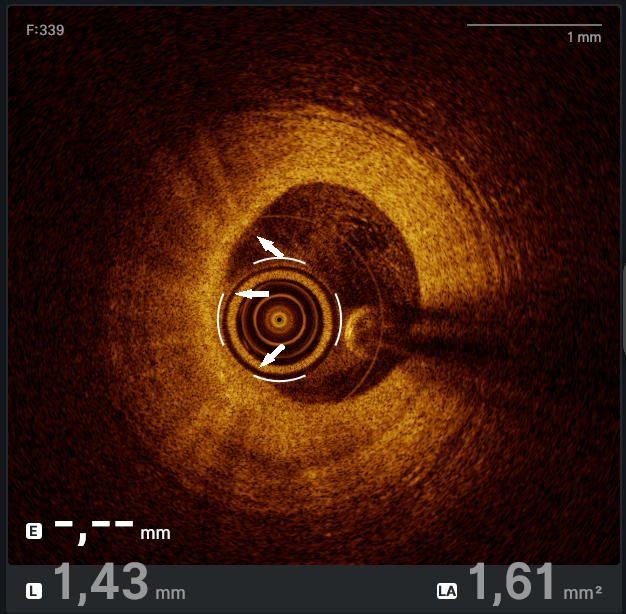
Stent strut malapposition is a risk factor for stent thrombosis and restenosis, ultimately leading to higher rates of recurrent clinical events in patients undergoing percutaneous coronary intervention (PCI). While intravascular ultrasound (IVUS) has traditionally been used to assess stent deployment, more recently optical coherence tomography (OCT) — a novel intracoronary diagnostic technique with an axial resolution approximately ten times greater than IVUS (approximately 10-20 μm) — has been used to provide improved detection of stent malapposition (see figure below). A further unique feature of OCT is the ability to image through calcium and thus measure the thickness of superficial calcification which may affect stent deployment.
Legend: Semi-automated quanitification of strut malapposition using a novel software package (Odierna v.2.2, Department of Cardiovascular Diseases, Division of Imaging and Cardiovascular Dynamics, Catholic University Leuven, Leuven, Belgium). By drawing an automated contour around the lumen (image A), the software is then able to give precise measurements on the malapposition distance between the vessel wall and each individual stent strut (image B).
However, OCT remains a relatively new technique, and to date does not have sufficiently large and prolonged follow-up data to correlate the imaging findings with clinical events that are now relatively rare in the era of second-generation DESs and optimal anticoagulation therapy. Nonetheless, it is logical to propose that poor stent expansion, gross strut malapposition and distortion, and protruding plaques and thrombus — as assessed by OCT — are ominous signs that should be avoided and corrected if feasible and safe to do so. The aim of this study was to investigate the relationship between OCT-determined plaque and vessel characteristics and stent strut malapposition in a consecutive series of patients undergoing PCI.
Plaque characteristics — including the extent and depth of calcification — were measured for 23 patients, and the number of malapposed struts following final postdilatation was quantified. Both patient and lesion characteristics associated with malapposition were assessed using univariate and multivariate analyses. The mean lesion length was 25.2 ± 10.8 mm, with a minimal lumen area (MLA) of 2.2 ± 1.2 mm2; eight percent of all stent struts were malapposed. By univariate analysis, the percentage of malapposed struts was found to correlate with the circumferential extent of calcification (P=.04) but no correlation was seen with the depth of calcification. Using multivariate analysis, the circumferential extent of vessel wall calcification was the only plaque feature seen on OCT that correlated with the percentage of malapposed struts (P=.01).
This study highlights the benefits of using OCT to assess atherosclerotic plaque prior to stent deployment, and shows that the circumferential extent — rather than the depth — of calcium appears to correlate with the risk of stent strut malapposition. In such calcified lesions, OCT can also be used to ensure optimal strut apposition after optimal post dilatation. Ongoing work aims to establish the relationship between OCT findings at stent implantation, and subsequent clinical and angiographic outcomes.
Read full article: Predictors of Stent Strut Malapposition in Calcified Vessels Using Frequency-Domain Optical Coherence Tomography / Alistair C. Lindsay, MD, PhD, Manuel Paulo, MD, Kadriye Kilickesmez, MD, Rodrigo Tejeiro, MD, Eduardo Alegría-Barrero, MD, PhD, Pak Hei Chan, MD, Nicolas Foin, PhD, Dimitris Syrseloudis, MD, Carlo Di Mario, MD, PhD / J INVASIVE CARDIOL 2013;25(9):429-434