3.3 Carotid Stenting Following CREST-2: How to Democratize and do Micromesh Stents and TCAR Have a Role?
Problem Presenter: Piotr Musialek
Problem Presenter: Piotr Musialek
These proceedings summarize the educational activity of the 18th Biennial Meeting of the International Andreas Gruentzig Society held January 27 to 30, 2026, in Puerto Ayora, Santa Cruz, Ecuador.
Faculty Disclosures Sponsors
2026 IAGS Summary Document
Statement of problem or issue
Strokes due to atherosclerotic carotid artery disease are often large and disabling. Even if relatively small in terms of embolic cerebral tissue loss, they may be functionally significant (speech or hand area infarct, ocular or cortical blindness, etc.). Carotid-related strokes should be prevented rather than experienced by stroke victims (many of whom would prefer death to their life after stroke) and their families. Treatment of carotid disease after a stroke has occurred is a failure of the system; those at stroke risk should be identified and treated before it occurs.
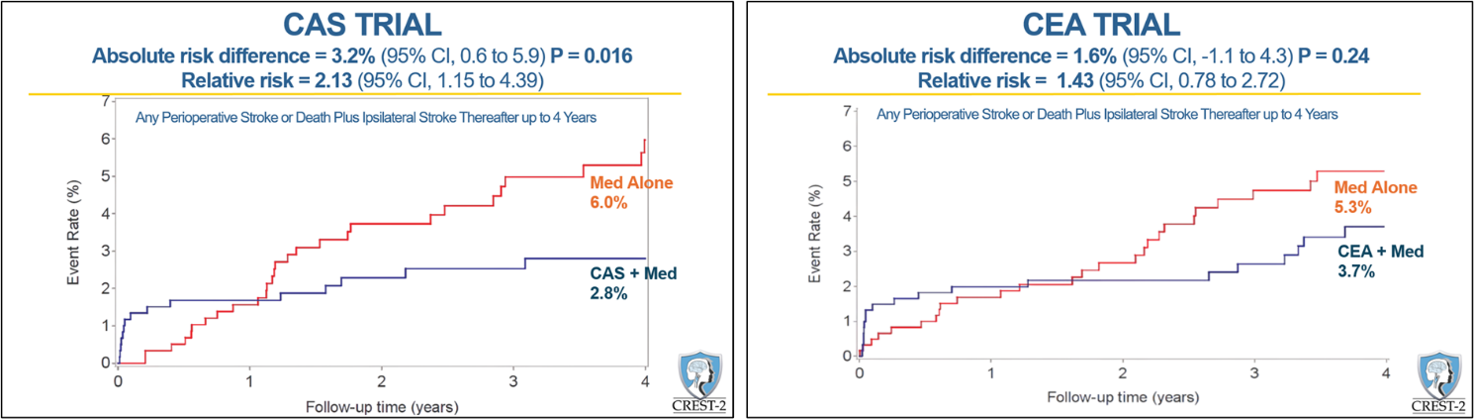
Transfemoral carotid artery stenting (CAS) has been used to treat carotid disease since 1994.[1] However, the final proof of the superiority of CAS compared to carotid endarterectomy (CEA) or medicines alone for patients with asymptomatic carotid disease had to wait for improvements in brain protection devices and new stent designs. Ultimately, the CREST-2 trial demonstrated a clear superiority of CAS added to maximized medical therapy vs. maximized medical therapy alone, whereas CEA failed the test of contemporary evidence (Figure 1).[2]
Gaps in current knowledge
After CREST-2 the question is whether CAS can do still better. Specifically, is it possible to reduce the post-stent adverse event rates even further from the 2.8% (at 4-years) found in the trial? With single-layer stents (such as those used in CREST-2) most of the 30-day post-procedural stroke events occur due to interactions between the stent and the non-insulated background atherothrombotic lesion. Plaque prolapse with or without associated thrombus formation is the leading mechanism of post-procedural cerebral embolic events [3]). Also, in some patients the plaque may continue to develop and extend through the stent struts, up to the point of becoming symptomatic.[4]
Possible solutions and future directions
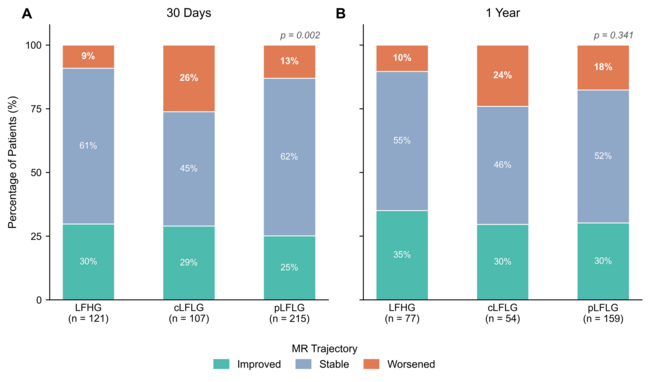
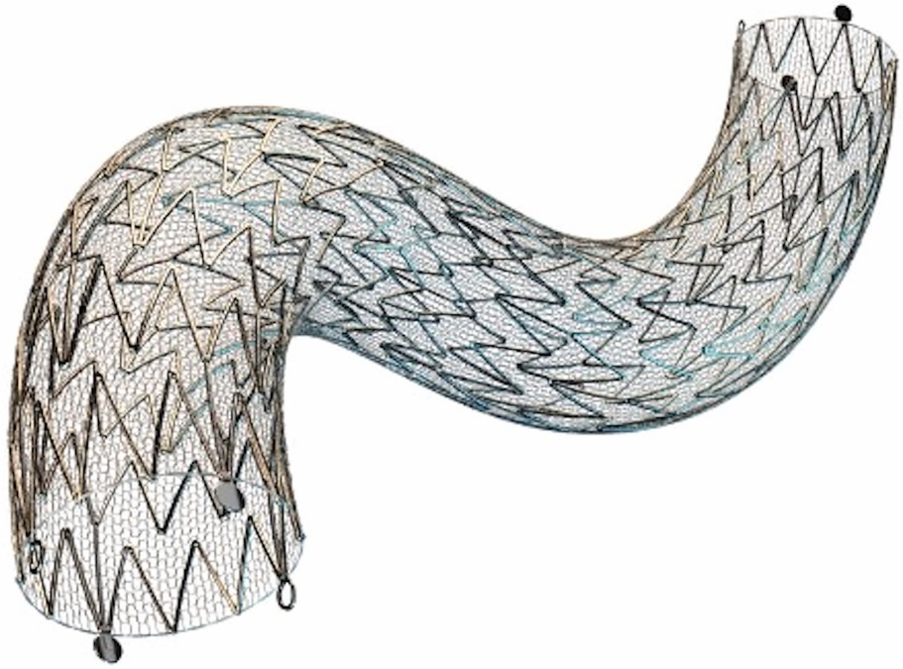
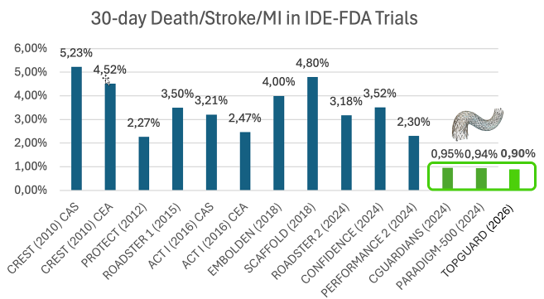
- A nitinol stent with non-metallic micromesh covering, named CGuard (Figure 2), has been developed to sequester the underlying atherosclerotic plaque and help prevent both plaque-related embolic events and intraluminal plaque progression. In a randomized controlled study of cerebral embolism by magnetic resonance imaging, CGuard profoundly reduced cerebral embolism when compared to a conventional single-layer carotid stent.[5] In clinical studies this new carotid stent has been found to result in fewer major adverse event rates – both at 30-days (Fig. 3 below) and later – than any other FDA-IDE study of carotid stents so far.[6] A recent meta-analysis has confirmed superior performance of the MicroNET-covered stent in absence of a “mesh stent” class effect.[7]
- There is a novel surgical technique called TCAR (transcarotid artery revascularization), developed to mimic transfemoral CAS with flow reversal. TCAR requires surgical access via the common carotid artery. It employs a large-bore catheter placed in the antegrade direction and transient common carotid artery clamping with a dynamic flow reversal. With flow reversal the risk of debris from the carotid lesion embolizing to the brain during CAS is nearly totally eliminated. The concomitant placement of the Micronet-covered stent (Fig 2) prevents further plaque-related events [8]. TCAR may play an important role as a vehicle for CAS in patients with absence of functional transfemoral or transradial arterial access (Leriche syndrome, severe type 3 aortic arch, etc.).
The future will revolve around 5 critical steps that must be implemented and questions that must be answered:
- Screening. In order to be truly helpful for patients, that is, to achieve the greatest preventive benefit, we should screen asymptomatic patients to identify the ones that require optimization of medical treatment and, in some, revascularization before strokes occur.[9,10] How and for whom to target the screening to maximize patient benefit? Should there be large scale screening programs? How should the patients be screened? Who will do the screening? Who will pay the costs of screening?
- Referral. How can patients be appropriately channeled to the minimally invasive therapy (CAS) with level-1 evidence of efficacy (Figure 1)? How to increase awareness of neurology and other specialties?
- Type of procedure. Today, the patient must be placed in the very center of the decision-making process. Patients should receive full information about the treatment options, their risks and their relative efficacy (Figure 1).[9]
- Competence. CAS operator competence must be promoted. Only those able to offer competent CAS should perform CAS.
- Monitoring. Procedural outcomes should be monitored and quality assurance processes should be in place. Who will organize and who will pay for monitoring?
References
- Roubin GS, et al. Carotid stent-supported angioplasty: a neurovascular intervention to prevent stroke. Am J Cardiol. 1996;78(3A):8-12. doi: 10.1016/s0002-9149(96)00487-0. PMID: 8751840.
- Brott TG, et al; CREST-2 Investigators. Medical Management and Revascularization for Asymptomatic Carotid Stenosis. N Engl J Med. 2026;394(3):219-231. doi: 10.1056/NEJMoa2508800. Epub 2025 Nov 21. PMID: 41269206.
- Kotsugi M, et al. Carotid Artery Stenting: Investigation of Plaque Protrusion Incidence and Prognosis. JACC Cardiovasc Interv. 2017;10(8):824-831. doi: 10.1016/j.jcin.2017.01.029. PMID: 28427600.
- Tekieli L, et al. Symptomatic atherosclerotic plaque progression in a first-generation carotid stent: management and 5-year clinical and imaging outcome. Eur Heart J Case Rep. 2021;6(1):ytab489. doi: 10.1093/ehjcr/ytab489. PMID: 35174303.
- Karpenko A, et al. Randomized controlled trial of conventional versus micronet-covered stent in carotid artery revascularization. JACC Cardiovasc Interv. 2021;14(21):2377-2387. doi: 10.1016/j.jcin.2021.08.005. PMID: 34736737.
- Metzger DC, et al; C-GUARDIANS Investigators. Safety and Efficacy of a Novel Micro Net Carotid Stent System: Results of the C-GUARDIANS Trial. JACC Cardiovasc Interv. 2025 Dec 22;18(24):3087-3097. doi: 10.1016/j.jcin.2025.09.027. Epub 2025 Dec 1. PMID: 41329120.
- Mazurek A, et al. CARMEN (CArotid Revascularization Systematic Reviews and MEta-aNalyses) Investigators. clinical outcomes of second- versus first-generation carotid stents: a systematic review and meta-analysis. J Clin Med. 2022;11(16):4819. doi: 10.3390/jcm11164819. PMID: 36013058.
- Van Herzeele I, et al. Transcarotid revascularisation using dynamic flow reversal and micronet covered embolic prevention stents (TOPGUARD Study): Key clinical, imaging, peri-procedural and 12-month outcome data. Eur J Vasc Endovasc Surg. 2026:S1078-5884(26)00055-9. doi: 10.1016/j.ejvs.2026.01.021. Epub ahead of print. PMID: 41554373.
- Musialek P, et al. Stroke risk management in carotid atherosclerotic disease: a clinical consensus statement of the ESC Council on Stroke and the ESC Working Group on Aorta and Peripheral Vascular Diseases. Cardiovasc Res. 2025;121(1):13-43. doi: 10.1093/cvr/cvad135. PMID: 37632337.
- Paraskevas KI, et al. Selective Screening for Asymptomatic Carotid Artery Stenosis: An Appraisal of the 2024 European Society of Cardiology (ESC) Guidelines Position. Am J Med. 2025;138(2):209-211. doi: 10.1016/j.amjmed.2024.10.033. Epub 2024 Nov 14. PMID: 39547462.
© 2026 HMP Global. All Rights Reserved.
Any views and opinions expressed are those of the author(s) and/or participants and do not necessarily reflect the views, policy, or position of the Journal of Invasive Cardiology or HMP Global, their employees, and affiliates.