7.3 Chronic Pulmonary Hypertension: Is POBA Enough for CTEPH? Embolectomy? And What About Denervation?
Problem Presenter: Dawn Abbott
Problem Presenter: Dawn Abbott
These proceedings summarize the educational activity of the 18th Biennial Meeting of the International Andreas Gruentzig Society held January 27 to 30, 2026, in Puerto Ayora, Santa Cruz, Ecuador.
Faculty Disclosures Sponsors
2026 IAGS Summary Document
Statement of problem or issue
Pulmonary embolism (PE) is the third leading cause of cardiovascular death. It often occurs in conjunction with other serious conditions, where it is a major contributor both to mortality and morbidity in the United States.[1] Approximately 1%-to-9% of patients with PE will develop a condition called chronic thromboembolic pulmonary hypertension (CTEPH). However, CTEPH also can develop in some patients with no clinical history of PE.[2]
Gradually over time, many of these patients develop a secondary microvasculopathy involving arterioles, venules, and capillaries. This includes muscularization of arterioles, venular fibrosis, and in some cases features of veno-occlusive disease. These distal changes help explain why pulmonary hypertension may persist even after a proximal obstruction has been relieved.
Pulmonary thromboendarterectomy (PTE) is the standard first-line therapy for proximal, operable CTEPH. However, about 36% of patients are considered inoperable, most often due to distal disease or comorbidities. In addition, roughly 25% have persistent or recurrent pulmonary hypertension after surgery. These limitations highlight the need for effective medical and interventional alternatives. Riociguat, a stimulator of guanylyl cyclase, is the only FDA-approved medical therapy for inoperable or persistent/recurrent CTEPH.
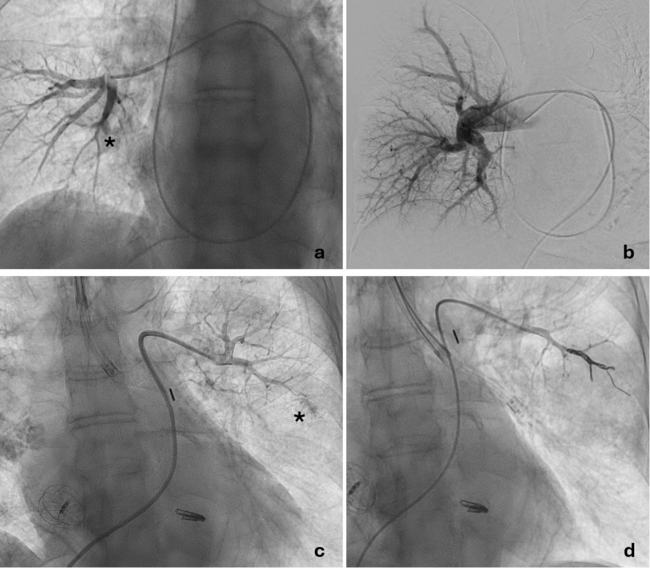
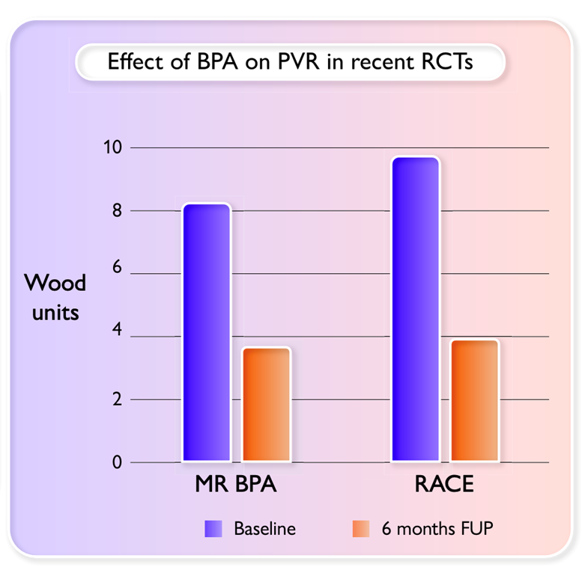
More recently, balloon pulmonary angioplasty (BPA) has been shown to be effective in patients with inoperable CTEPH (Figure 1).[3,4]
In addition to BPA, another form of therapy, radiofrequency pulmonary artery denervation (PADN) is being explored for its potential role.[5]
Gaps in current knowledge
Some knowledge gap areas are listed below:
- What combinations of therapies (medications, surgery, BPA) and in what order, will be most effective.
- Presence and reversibility of microvascular disease pre-BPA.
- Timing between BPA treatments.
- How to improve success in CTO and pouch lesions without increasing complications.
- Will dedicated devices improve procedural outcomes.
- Where does pulmonary artery denervation (PADN) fit in.
- Should we be treating symptomatic patients with CTEPD.
Possible solutions or future directions
A great deal more work is required to understand CTEPH and how to treat it safely and effectively. Several avenues for future clinical research and development are listed below;
- Create a large registry, prospectively collected, comprehensive in scope.
- Develop consensus definitions and treatment thresholds.
- 3-D modeling of pulmonary vasculature/Dual energy CT
- Expand clinical endpoints beyond 6MWD to RV recovery and QoL measures.
- Development of specialized equipment for CTO approaches:
- High anatomic variability.
- Often no visible collaterals.
- No CT mapping guidance.
- No uniform procedural approach.
- Are extraluminal crossing techniques possible.
- How to perform with unknown distal pathology
- RCTs for combination therapies.
- AI-based imaging analysis for predicting response to therapies.
- Sham studies of pulmonary artery denervation.
References
- Palaniappan LP, et al. 2026 Heart Disease and Stroke Statistics: A Report of US and Global Data From the American Heart Association. Circulation. 2026 Mar 3;153(9):e275-e906. doi: 10.1161/CIR.0000000000001412. Epub 2026 Jan 21. PMID: 41562125.
- Yang J, et al. Evaluation and Management of Chronic Thromboembolic Pulmonary Hypertension. Chest. 2023 Aug;164(2):490-502. doi: 10.1016/j.chest.2023.03.029. Epub 2023 Mar 28. PMID: 36990148.
- Kawakami T, et al. Balloon pulmonary angioplasty versus riociguat in inoperable chronic thromboembolic pulmonary hypertension (MR BPA): an open-label, randomised controlled trial. Lancet Respir Med. 2022 Oct;10(10):949-960. doi: 10.1016/S2213-2600(22)00171-0. Epub 2022 Aug 1. PMID: 35926544.
- Jaïs X, et al. Balloon pulmonary angioplasty versus riociguat for the treatment of inoperable chronic thromboembolic pulmonary hypertension (RACE): a multicentre, phase 3, open-label, randomised controlled trial and ancillary follow-up study. Lancet Respir Med. 2022 Oct;10(10):961-971. doi: 10.1016/S2213-2600(22)00214-4. Epub 2022 Aug 1. PMID: 35926542.
- Romanov A, et al. Pulmonary Artery Denervation for Patients With Residual Pulmonary Hypertension After Pulmonary Endarterectomy. J Am Coll Cardiol. 2020 Aug 25;76(8):916-926. doi: 10.1016/j.jacc.2020.06.064. PMID: 32819465.
© 2026 HMP Global. All Rights Reserved.
Any views and opinions expressed are those of the author(s) and/or participants and do not necessarily reflect the views, policy, or position of the Journal of Invasive Cardiology or HMP Global, their employees, and affiliates.