Chapter 1: Beyond Core ADHD Symptoms: Why Associated Features Matter
Drs Craig Chepke, Andrew Cutler, and Greg Mattingly discuss the importance of assessing and monitoring executive function and emotional regulation in attention-deficit/hyperactivity disorder (ADHD).
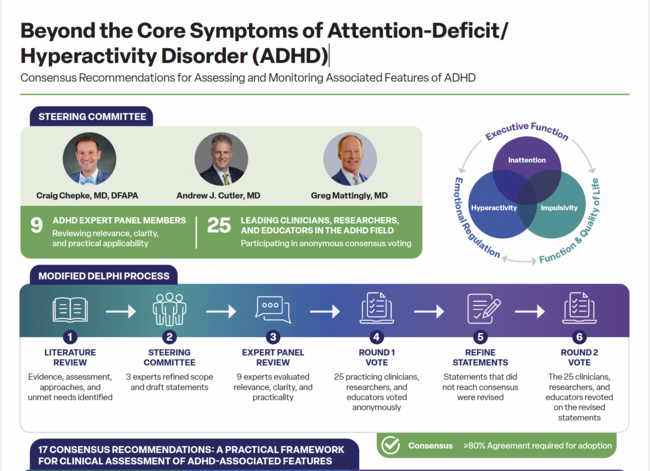
View the poster: Consensus Recommendations for Assessing and Monitoring Associated Features of Attention-Deficit/Hyperactivity Disorder in Clinical Practice.
Transcript
Greg Mattingly, MD: Welcome to the Psych Congress Network. I'm Dr Greg Mattingly here today with 2 of my very best friends, Craig Chepke and Dr Andrew Cutler. We're going to talk about a topic that has never been more important, and that is how do we monitor ADHD in the real world, looking beyond core ADHD symptoms, but looking at those associated features? So, we're going to talk about a topic we kind of pulled together on this. We all said, "Listen, what are the unmet needs in the ADHD field?" Andy, I think you and I talked about that in particular, beyond symptoms, but talking about impairment.
Andrew Cutler, MD: Absolutely.
Mattingly: Where do those symptoms cause a difficulty in our life? Craig, I know you've been a parent raising kids with ADHD.
Craig Chepke, MD, DFAPA: Absolutely.
Mattingly: It's not just the checklist of those 18 symptoms. It can be emotional frustration, it can be impulse control, it can be self-esteem, right?
Chepke: Right. The diagnostic criteria for ADHD are things that we outwardly see and can observe, but we don't really talk about what do people with ADHD experience? What do they feel? What's going on for them? That's a huge unmet need.
Cutler: Yeah. Of course, guys, remember, to make a diagnosis in DSM, it's not just a certain number of symptoms. You have to have impairment or distress. For ADHD, it's at least 2 different areas.
Mattingly: At least 2 different areas. So, impairment, not just at school, not just at home, not just at work...
Chepke: Not just in social settings.
Mattingly: ... it's got to be a little bit of everything, right?
Chepke: You're right.
Mattingly: When you talk about those levels of impairment... Craig, this next part was your idea. Talk about how we kind of said, "Listen, how do we go beyond just the 3 opinions we have and how we practice, but let's get a good evidence base about how we handle these associated features and impairment."
Chepke: You're right, Greg. We talk about these types of conversations all the time amongst ourselves, and we don't want to just make it a consensus of 3 people. That's not the right way to approach things to get a really broad and reliable type of consensus. So, we set it up as multi-level. There's the 3 of us, and then we broke it down also into the next level of 9 other leading clinicians. Then, after that vote, went down to 25 other clinicians. So, we really had a great broad network of consensus that we had to achieve to get each of the statements of our consensus to be approved.
Mattingly: Andy, before we started giving opinions, the first thing we did is we went out and looked at the literature, right?
Cutler: That's right.
Mattingly: Did a deep dive into the literature about what does the literature say about how to manage these associated features with emotional frustration, executive function, organization, planning, time management.
Cutler: Absolutely.
Mattingly: You know, my favorite new term is time blindness.
Cutler: Time blindness.
Mattingly: Time blindness. My patients, their clock doesn't run the way other people do. They have to have prompts, reminders, and things of that nature. So, what does the literature tell us about the science of this? Craig, I kind of jokingly, I told Andy, I was working on a journal article and all I had to do was the references.
Chepke: Okay.
Mattingly: I told my wife, "I'm going to wake up Saturday morning, I'm going to get those references done." So, my wife wakes up on Saturday morning, she goes, "Greg, you're getting all your references done." I said, "Nope, I'm Googling procrastination." But our patients get stuck there.
Cutler: That's right.
Mattingly: For us, it's kind of a joking matter, but our patients that get stuck where, "I put something off and now I'm overwhelmed, and I shut down. I put something off, and now I'm so frustrated I'm blowing up with you because I can't modulate my frustration." So, we wanted to do a deep dive into literature about things like procrastination, impulse control, emotional modulation, executive function to see what do we know and what do we not know. Craig, you then said, "Okay, let's get the 3 of us together." Let's say, "Does this make sense?" So, the 3 of us got together and had a number of emails, a couple of discussions talking about this topic. Then we went out and recruited 9 other what we think of..
Cutler: Nine other experts.
Mattingly: ... as clinical or research experts in the field to say that our 3 ideas made sense to them. So, external validity.
Chepke: Correct.
Mattingly: Right?
Cutler: That's right.
Mattingly: To make sure that the ideas, the things we're tossing around, the literature review was thorough. Then, we started making decisions and statements. It was really kind of interesting; we made decisions and statements. We said, "Now, let's take it to a bigger audience and say, do we agree as clinicians, as experts, as researchers?"
 Craig Chepke, MD, DFAPA
Dr Craig Chepke is a board-certified psychiatrist in clinical practice as the medical director of Excel Psychiatric Associates in Huntersville, North Carolina. He serves as an adjunct associate professor of psychiatry for the Atrium Health Psychiatry Residency Program and is the chief medical officer of Psych Congress. As part of an interdisciplinary treatment team in his practice, he employs a person-centered care model to tailor treatments to each individual's needs, integrating traditional pharmacotherapy with psychotherapeutic and physical health and wellness interventions. His clinical and academic interests include serious mental illness, movement disorders, ADHD, and sleep medicine. Dr Chepke has been recognized as a distinguished fellow of the American Psychiatric Association and is a recipient of the National Alliance on Mental Illness Exemplary Psychiatrist Award.
 Greg Mattingly, MD
Dr Greg Mattingly is a physician and principal investigator in clinical trials for Midwest Research Group. He is also a founding partner of St Charles Psychiatric Associates and an associate clinical professor at Washington University. A St Louis native, he earned his medical degree and received a Fulbright scholarship while attending Washington University. Dr Mattingly is board certified in adult and adolescent psychiatry, and he is a diplomate of the National Board of Medical Examiners. He has been a principal investigator in over 400 clinical trials focusing on ADHD, anxiety disorders, major depression, bipolar disorder, and schizophrenia. Having served on numerous national and international advisory panels, he has received recognition for clinical leadership and neuroscience research. Dr Mattingly is also the president of the American Professional Society of ADHD and Related Disorders and a member of the Scientific Advisory Board for the World Federation of ADHD.
 Andrew Cutler, MD
Dr Andrew J. Cutler is a clinical associate professor of psychiatry at SUNY Upstate Medical University in New York, and he serves as the chief medical officer of the Neuroscience Education Institute. He received his MD from the University of Virginia School of Medicine, where he was also elected to the Alpha Omega Alpha honor medical society and received the Merck Award for outstanding medical scholarship. He completed his medical internship, internal medicine residency, and psychiatry residency at the University of Virginia Medical Center, where he served as chief resident of psychiatric medicine and did research on dopamine receptor pharmacology. Dr Cutler then served as the first assistant professor and director of psychiatric medicine at the University of Chicago. He is board-certified in both internal medicine and psychiatry. Dr Cutler has also been the principal investigator on over 400 psychiatric and medical clinical trials.
This program was independently developed with funding from Otsuka Pharmaceuticals.