11.2 Joint Position Statement of the ACC, IAGS and SCAI: Addressing the Cardiovascular Risk Factors of Obesity and Inflammation
Problem Presenter: Gus Pichard
Problem Presenter: Gus Pichard
These proceedings summarize the educational activity of the 18th Biennial Meeting of the International Andreas Gruentzig Society held January 27 to 30, 2026, in Puerto Ayora, Santa Cruz, Ecuador.
Faculty Disclosures Sponsors
2026 IAGS Summary Document
Statement of problem or issue
Biological processes collectively named “inflammation” have been recognized as important contributors to development of cardiovascular disease. Chronic, silent, low-grade inflammation, together with mediators like cytokines and other humoral and cellular immunomodulators, plays a pivotal role in atherosclerosis, myocardial infarction, and heart failure. [1,2]
An example of this in our own field of interventional cardiology comes from a large PCI registry of over 15,000 patients. [3] Patients in the registry were classified into one of four risk categories based on LDL-cholesterol (cholesterol risk) and high sensitivity C-reactive protein (hs-CRP) values at the time of their index PCI procedures. Over the next year, major adverse cardiovascular events occurred at the highest rates in the patients at highest inflammatory risk. [3]
One very important theory that has gained increasing credence in the past 20-30 years is the obesity-adipokine hypothesis.[2] This proposal states that visceral adipose tissue is a pro-inflammatory endocrine organ and obesity leads to chronic systemic inflammation. Therefore, obesity must be a major target of any effective therapeutic program designed to address chronic inflammation and its cardiovascular consequences.
Gaps in current knowledge
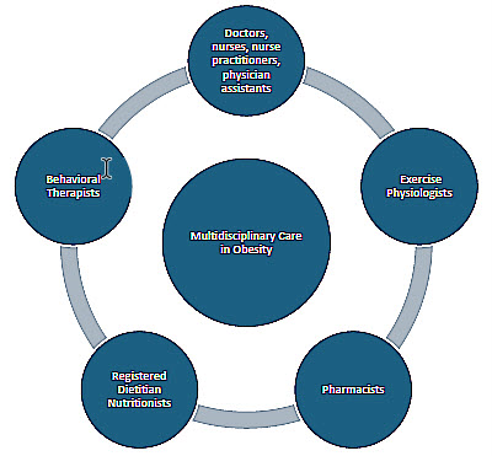
Cardiovascular professional societies have begun to focus on the obesity-inflammation-cardiovascular disease paradigm and provide guidance on helping manage it.[4,5] There are numerous multidisciplinary approaches possible, but efforts to implement them are only just beginning, and their optimal structure for achieving sustained improvements in outcomes is not yet understood (Figure 1).
In addition to obesity management, characterization of inflammation (inflammatory state, inflammatory risk) is still an enormous subject of active investigation.[1,2] While hs-CRP is widely available and easily tested, there are many other cytokine markers that are under investigation. We are a long way from knowing which are the “best” markers.
Furthermore, the role of psychosocial stress in the etiology of obesity, inflammation, and as an independent risk factor on its own for cardiovascular disease, is receiving increased attention.[6] An example of this comes from a study of 624 patients with stable coronary artery disease.[7] In these patients, hemodynamic reactivity, changes in endothelial function, and vasoconstriction were examined during mental stress (public speaking). A stress risk score was then calculated for each patient, and they were grouped by tertiles of this score. Over the subsequent 6 years, patients in the highest tertile of stress risk had the highest rates of major adverse cardiovascular events.[7]
Possible solutions or future directions
More studies of inflammatory markers and their relationships to cardiovascular disease and adverse events are planned. The linkages between mental health, psychosocial stress, obesity and chronic inflammation, and cardiovascular disease need to be explored in depth. Some data are already emerging. It appears the women may be more at risk for psychosocial stress compared with men.[8] One study using cardiac MRI (cMRI) scans found that myocardial tissue changes (longer T1) occurred in women under stress conditions compared to non-stress conditions, while in men there was no difference in T1 between stress and non-stress conditions.[9] Much more research in this area is needed.
Finally, therapeutic interventions designed to address psychosocial stress, obesity, chronic inflammation, and other factors involved in cardiovascular diseases, will have to be proven effective in reducing these factors and improving clinical outcomes.
References
- Mensah GA, et al. Inflammation and Cardiovascular Disease: 2025 ACC Scientific Statement: A Report of the American College of Cardiology. J Am Coll Cardiol. 2025 Sep 29:S0735-1097(25)07555-2. doi: 10.1016/j.jacc.2025.08.047. Epub ahead of print. PMID: 41020749.
- Packer M. Evolutionary History of the Comorbidity-Driven Coronary Microvascular Endothelial Inflammation Hypothesis and Its Metamorphosis to the Adipokine Hypothesis of Heart Failure With a Preserved Ejection Fraction. JACC Heart Fail. 2026 Feb;14(2):102822. doi: 10.1016/j.jchf.2025.102822. Epub 2025 Nov 8. PMID: 41269201.
- Bay B, et al. Residual cholesterol and inflammatory risk in statin-treated patients undergoing percutaneous coronary intervention. Eur Heart J. 2025 Aug 21;46(32):3167-3177. doi: 10.1093/eurheartj/ehaf196. PMID: 40208236.
- Gilbert O, et al. 2025 Concise Clinical Guidance: An ACC Expert Consensus Statement on Medical Weight Management for Optimization of Cardiovascular Health: A Report of the American College of Cardiology Solution Set Oversight Committee. J Am Coll Cardiol. 2025 Aug 19;86(7):536-555. doi: 10.1016/j.jacc.2025.05.024. Epub 2025 Jun 20. PMID: 40539956.
- Kittleson MM, et al. 2025 ACC Scientific Statement on the Management of Obesity in Adults With Heart Failure: A Report of the American College of Cardiology. J Am Coll Cardiol. 2025 Nov 18;86(20):1953-1975. doi: 10.1016/j.jacc.2025.05.008. Epub 2025 Jun 13. PMID: 40512113.
- Bueno H, et al; ESC Scientific Document Group. 2025 ESC Clinical Consensus Statement on mental health and cardiovascular disease: developed under the auspices of the ESC Clinical Practice Guidelines Committee. Eur Heart J. 2025;46(41):4156-4225. doi: 10.1093/eurheartj/ehaf191. PMID: 40878270.
- Moazzami K, et al. Cardiovascular reactivity to mental stress and adverse cardiovascular outcomes in patients with coronary artery disease. J Am Heart Assoc. 2025;14(3):e034683. doi: 10.1161/JAHA.124.034683. Epub 2025 Jan 23. PMID: 39846285.
- Ebong IA, et al; American College of Cardiology Cardiovascular Disease in Women Committee. The Role of Psychosocial Stress on Cardiovascular Disease in Women: JACC State-of-the-Art Review. J Am Coll Cardiol. 2024;84(3):298-314. doi: 10.1016/j.jacc.2024.05.016. PMID: 38986672.
- Moukarzel M, et al. Sex differences in the relationship between psychosocial stress and myocardial tissue characteristics: a CMR imaging study. Circ Cardiovasc Imaging. 2025;18(11):e017667. doi: 10.1161/CIRCIMAGING.124.017667. Epub 2025 Oct 9. PMID: 41064868.
© 2026 HMP Global. All Rights Reserved.
Any views and opinions expressed are those of the author(s) and/or participants and do not necessarily reflect the views, policy, or position of the Journal of Invasive Cardiology or HMP Global, their employees, and affiliates.