3.2 Most Effective Below-The-Knee (BTK) Interventions: A Critical Appraisal
Problem Presenter: Lawrence Garcia
Problem Presenter: Lawrence Garcia
These proceedings summarize the educational activity of the 18th Biennial Meeting of the International Andreas Gruentzig Society held January 27 to 30, 2026, in Puerto Ayora, Santa Cruz, Ecuador.
Faculty Disclosures Sponsors
2026 IAGS Summary Document
Statement of problem or issue
- Outcomes in peripheral BTK interventions have been biased by earlier data from exclusively above-the-knee (ATK) procedures
- ATK outcomes have focused on (1) vessel patency and (2) measures of walking difficulty
- BTK procedure outcomes are mired in
- Heterogeneity of patients included in studies
- Multiple endpoints and definitions
- Non-uniform nature of assessing and treating wounds (ischemic ulcers)
- Current BTK approaches include:
- POBA (plain old balloon angioplasty)
- DES (drug-eluting stent)
- Ath (atherectomy – including directional and rotational)
- BRS (bioresorbable scaffold)
- DCB-PTX (drug-coated balloon with paclitaxel)
- DCB-Limus (drug-coated balloon with sirolimus or others)
Which one technology wins? And how does it win? When does it “win?” These are the ultimate questions.
The limitations of POBA (also called PTA) are well known. Elastic recoil of the vessel wall at the dilated site along with late lumen loss leads to lower long-term success rates with POBA when compared, for example, with DCBs and some DES.[1]
Gaps in current knowledge
Current clinical trial and study data are heterogenous.
DCB and paclitaxel-DES trials
|
Trial |
Comparison |
Endpoint |
Conclusion |
|
IN.PACT-Deep [2] |
DCB vs POBA |
TLR |
No difference |
|
LEVANT [3] |
DCB vs POBA |
Mortality |
No difference |
|
SAVAL [4] |
DES vs POBA |
Doppler U/S flow |
POBA better |
Atherectomy trials
|
Trial |
Comparison |
Endpoint |
Conclusion |
|
DEFINITIVE-LE [5] |
Directional ath. (observational) |
Patency |
Safe and effective |
|
LIBERTY-360 [6] |
POBA vs Ath. vs DES |
Major amputation+death |
POBA/Ath. Better than DES |
|
JETSTREAM [7] |
Rotational Ath+DCB vs DCB alone |
TLR |
Rotational ath+DCB better |
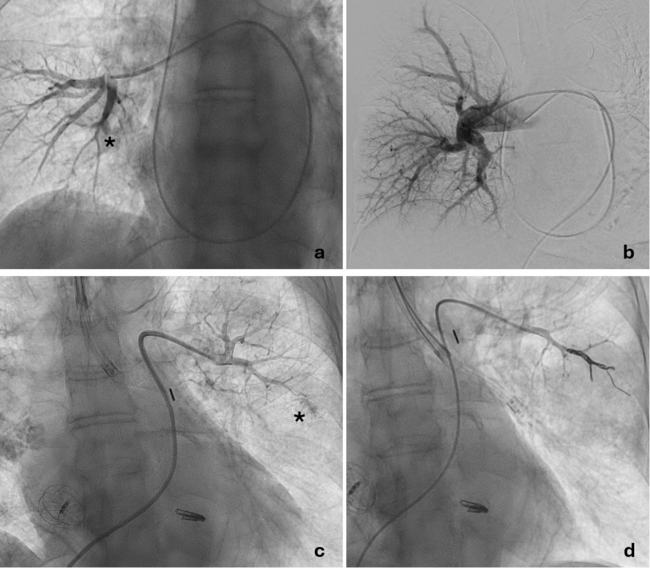
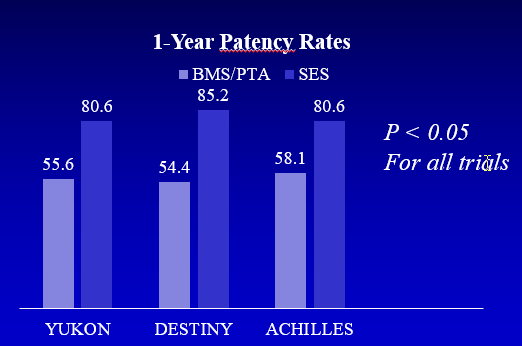
Sirolimus-eluting stent trials (Figure 1)
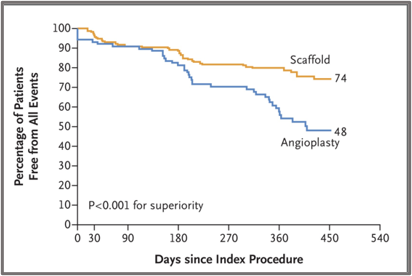
Another variation is the drug-eluting bioresorbable scaffold. This technology can deliver the antiproliferative drug and then the scaffold disappears and goes away. It was tested against PTA (POBA) in the LIFE-BTK trial, using the Esprit everolimus-eluting bioresorbable scaffold from Abbott. [11] The primary endpoint was limb salvage, and the bioresorbable scaffold was superior (Figure 2).
Possible solutions or future directions
BTK trials are “in,” that is, they are popular. New devices, especially new DCB are being studied, examples are listed in the table below:
|
Device |
Company |
Trial |
Comparison |
Clinical group |
|
Magic Touch |
Concept Medical |
LIMES |
POBA |
CLI, |
|
Luminor |
iVascular |
MERLION |
None - observational |
CLI, |
|
Litos |
Acotec |
ACOART II |
POBA |
CLI, |
|
Virtue |
Orchestra BioMed |
(coronary ISR underway) |
-- |
-- |
The larger issues are more strategic and definitional: What is the anatomic target? Are focal, non-calcified, non-occluded lesions included? What is the clinical target? What is the treatment? What is the comparator (control) treatment? What are the endpoints? Is vessel patency beyond 3-6 months mandatory? A recent comprehensive meta-analysis concluded that DCB compared with POBA reduced early revascularizations but showed no significant long-term benefits in amputations or mortality.[12] However, the authors noted especially that small sample sizes, differing definitions and endpoints, and heterogenous populations, made comparisons extremely difficult and conclusions uncertain. Until all these issues are settled, we may still have to deal with uncertainty in the future.
References
- Liistro F, et al. Randomized Controlled Trial of Acotec drug-eluting balloon versus plain balloon for below-the-knee angioplasty. JACC Cardiovasc Interv. 2020;13(19):2277-2286. doi: 10.1016/j.jcin.2020.06.045. Epub 2020 Sep 16. PMID: 32950416.
- Zeller T, et al; IN.PACT DEEP Trial Investigators. The IN.PACT DEEP Clinical Drug-Coated Balloon Trial: 5-Year Outcomes. JACC Cardiovasc Interv. 2020;13(4):431-443. doi: 10.1016/j.jcin.2019.10.059. PMID: 32081236.
- Ouriel K, et al. Safety of paclitaxel-coated balloon angioplasty for femoropopliteal peripheral artery disease. JACC Cardiovasc Interv. 2019 Dec 23;12(24):2515-2524. doi: 10.1016/j.jcin.2019.08.025. Epub 2019 Sep 28. PMID: 31575518.
- van Overhagen H, et al. Primary results of the SAVAL randomized trial of a paclitaxel-eluting nitinol stent versus percutaneous transluminal angioplasty in infrapopliteal arteries. Vasc Med. 2023 Dec;28(6):571-580. doi: 10.1177/1358863X231199489. Epub 2023 Oct 16. PMID: 37844137; PMCID: PMC10693734.
- McKinsey JF, et al; DEFINITIVE LE Investigators. Lower extremity revascularization using directional atherectomy: 12-month prospective results of the DEFINITIVE LE study. JACC Cardiovasc Interv. 2014 Aug;7(8):923-33. doi: 10.1016/j.jcin.2014.05.006. PMID: 25147039.
- Giannopoulos S, et al. Three-year outcomes from the liberty 360 study of endovascular interventions for peripheral artery disease stratified by rutherford category. J Endovasc Ther. 2021 Apr;28(2):262-274. doi: 10.1177/1526602820962972. Epub 2020 Oct 5. PMID: 33016805.
- Shammas NW, et al; JET-RANGER Investigators. Jetstream Atherectomy with paclitaxel-coated balloons: 3-year outcomes of the prospective randomized JET-RANGER Study. Int J Angiol. 2024;34(1):56-59. doi: 10.1055/s-0044-1791546. PMID: 39944148; PMCID: PMC11813604.
- Rastan A, et al. Sirolimus-eluting stents vs. bare-metal stents for treatment of focal lesions in infrapopliteal arteries: a double-blind, multi-centre, randomized clinical trial. Eur Heart J. 2011 Sep;32(18):2274-81. doi: 10.1093/eurheartj/ehr144. Epub 2011 May 26. PMID: 21622669.
- Bosiers M, et al. J Vasc Surg. 2012;55(2):390-8. doi: 10.1016/j.jvs.2011.07.099. Epub 2011 Dec 14. PMID: 22169682.
- Scheinert D, et al; ACHILLES Investigators. A prospective randomized multicenter comparison of balloon angioplasty and infrapopliteal stenting with the sirolimus-eluting stent in patients with ischemic peripheral arterial disease: 1-year results from the ACHILLES trial. J Am Coll Cardiol. 2012;60(22):2290-5. doi: 10.1016/j.jacc.2012.08.989. PMID: 23194941.
- Varcoe RL, et al; LIFE-BTK Investigators. Drug-eluting resorbable scaffold versus angioplasty for infrapopliteal artery disease. N Engl J Med. 2024;390(1):9-19. doi: 10.1056/NEJMoa2305637. Epub 2023 Oct 25. PMID: 37888915.
- Modi K, et al. Drug-coated balloon angioplasty versus percutaneous transluminal angioplasty for below-the-knee interventions in chronic limb-threatening ischemia patients: systematic review and meta-analysis. Ann Vasc Surg. 2026;123:104-118. doi: 10.1016/j.avsg.2025.09.022. Epub 2025 Sep 18. PMID: 40975218.
© 2026 HMP Global. All Rights Reserved.
Any views and opinions expressed are those of the author(s) and/or participants and do not necessarily reflect the views, policy, or position of the Journal of Invasive Cardiology or HMP Global, their employees, and affiliates.