4.1 COMPLETE, MULTISTARS, BIOVASC and OPTION: Enough Evidence to Standardize STEMI PCI Worldwide?
Problem Presenter: David Wood
Problem Presenter: David Wood
These proceedings summarize the educational activity of the 18th Biennial Meeting of the International Andreas Gruentzig Society held January 27 to 30, 2026, in Puerto Ayora, Santa Cruz, Ecuador.
Faculty Disclosures Sponsors
2026 IAGS Summary Document
Statement of problem or issue
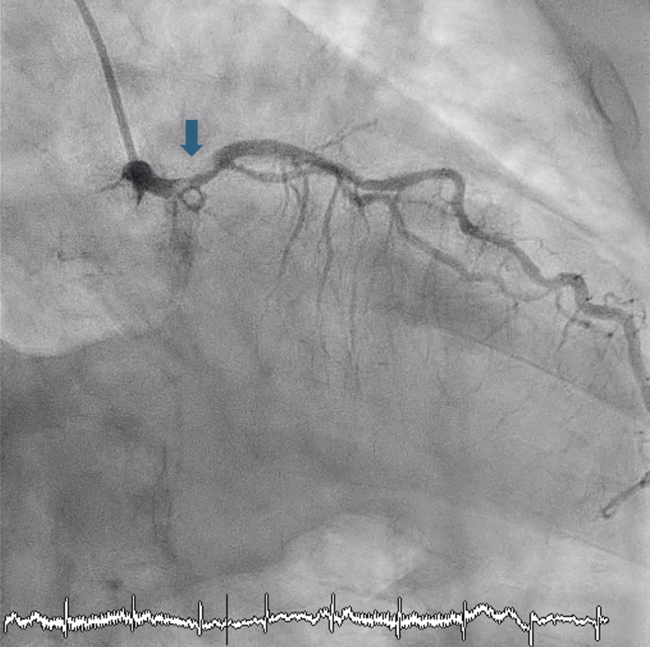
The question is whether or not we should revascularize non-culprit lesions in patients with STEMI. One very strong answer came from the COMPLETE trial (Figure 1).[1] The answer was Yes.
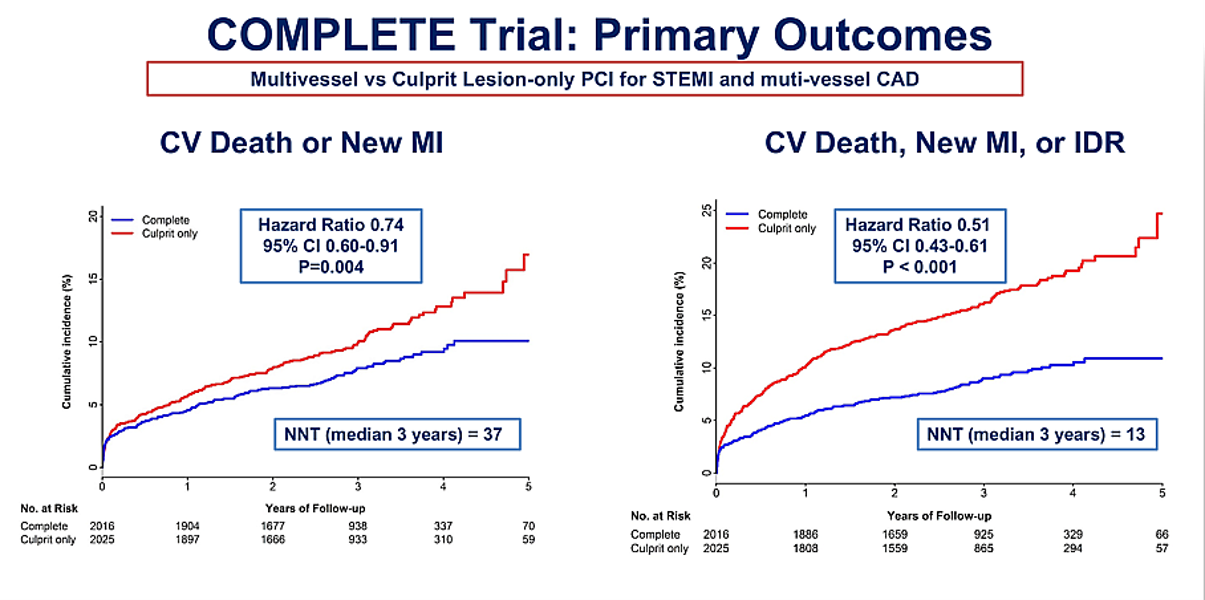
The COMPLETE trial helped change guidelines. In 2012, non-culprit lesion revascularization was a Class C recommendation, that is, don’t do it. In the most recent US (2025) and European (2023) guidelines, it is Class 1A, that is, highly recommended.
Very importantly, COMPLETE had an optical coherence tomography (OCT) substudy, where non-culprit lesion imaging was performed. Nearly one-half of the patients in the substudy had thin-cap fibroatheromas (TCFA) seen on OCT, emphasizing the vulnerability of these lesions to further deterioration, plaque rupture, and subsequent adverse events.[2] This may help explain the mechanism of benefit found with complete revascularization including non-culprit lesions in patients with STEMI. Treating these vulnerable non-culprit lesions helps stabilize them and prevent the later adverse events.
Gaps in current knowledge
Although we recognize that complete revascularization in patients with STEMI is beneficial, there is still disagreement on the timing of non-culprit lesion intervention. Two other randomized trials investigated this question: MULTISTARS and OPTION-STEMI. [3,4] However, both of these were non-inferiority trials. The MULTISTARS investigators found that immediate complete revascularization was not inferior to staged complete revascularization. On the other hand, the OPTION-STEMI investigators found that immediate complete revascularization was “not non-inferior” to a staged approach. Interestingly, in OPTION-STEMI, approximately 30% of the enrolled patients had compromised LV function, with higher Killip class and more evidence of heart failure. These compromised patients had higher adverse event rates with immediate complete versus staged complete revascularization (23% vs 13%, HR=1.79, P=.04). [4]
Finally, the BIOVASC trial randomly assigned patients with acute coronary syndromes to immediate complete or staged complete revascularization.[5] The immediate complete approach was non-inferior to the staged complete approach. However, in the BIOVASC trial only 40% of the enrolled patients had STEMI, whereas 60% had NSTEMI or unstable angina. Therefore, BIOVASC was a non-inferiority trial with a mixed population, and this makes it difficult to interpret for a true STEMI cohort.
Possible solutions or future directions
Important new information will come from the COMPLETE-2 trial (NCT05701358). This trial will randomly assign 5100 patients with STEMI or NSTEMI to either an angiography-guided or physiology-guided treatment strategy for non-culprit lesions. In addition, there will be an OCT substudy in COMPLETE-2 just as there was in the original COMPLETE trial. We do not yet have all the data needed to standardize STEMI PCI worldwide, in regards to treating non-culprit lesions. But we are making excellent progress.
References
- Mehta SR, et al; COMPLETE Trial Steering Committee and Investigators. Complete Revascularization with Multivessel PCI for Myocardial Infarction. N Engl J Med. 2019;381(15):1411-1421. doi: 10.1056/NEJMoa1907775. Epub 2019 Sep 1. PMID: 31475795.
- Pinilla-Echeverri N, et al. Nonculprit Lesion Plaque Morphology in Patients With ST-Segment-Elevation Myocardial Infarction: Results From the COMPLETE Trial Optical Coherence Tomography Substudys. Circ Cardiovasc Interv. 2020;13(7):e008768. doi: 10.1161/CIRCINTERVENTIONS.119.008768. Epub 2020 Jul 10. PMID: 32646305.
- Stähli BE, et al; MULTISTARS AMI Investigators. Timing of Complete Revascularization with Multivessel PCI for Myocardial Infarction. N Engl J Med. 2023;389(15):1368-1379. doi: 10.1056/NEJMoa2307823. Epub 2023 Aug 27. PMID: 37634190.
- Kim MC, et al; OPTION–STEMI Investigators. Immediate versus staged complete revascularisation during index admission in patients with ST-segment elevation myocardial infarction and multivessel disease (OPTION-STEMI): a multicentre, non-inferiority, open-label, randomised trial. Lancet. 2025;406(10507):1032-1043. doi: 10.1016/S0140-6736(25)01529-6. Epub 2025 Aug 31. PMID: 40902612.
- Diletti R, et al; BIOVASC Investigators. Immediate versus staged complete revascularisation in patients presenting with acute coronary syndrome and multivessel coronary disease (BIOVASC): a prospective, open-label, non-inferiority, randomised trial. Lancet. 2023;401(10383):1172-1182. doi: 10.1016/S0140-6736(23)00351-3. Epub 2023 Mar 5. PMID: 36889333.
© 2026 HMP Global. All Rights Reserved.
Any views and opinions expressed are those of the author(s) and/or participants and do not necessarily reflect the views, policy, or position of the Journal of Invasive Cardiology or HMP Global, their employees, and affiliates.