8.1 Managing Complex Aortic and Iliac Occlusive Disease: Endovascular Solutions for Aortic Stenoses, Aortic Bifurcation, Infrarenal and Juxtarenal
Problem Presenter: Sigrid Nikol
Problem Presenter: Sigrid Nikol
These proceedings summarize the educational activity of the 18th Biennial Meeting of the International Andreas Gruentzig Society held January 27 to 30, 2026, in Puerto Ayora, Santa Cruz, Ecuador.
Faculty Disclosures Sponsors
2026 IAGS Summary Document
Statement of problem or issue
There are different pathological expressions for atherosclerotic disease of the lower aorta in men and women:
Men – more diffuse aortoiliac bifurcation disease
Women – focal infrarenal stenosis/occlusion
renovisceral – involving aorta and renal arteries
Transcutaneous catheter-based treatments are available. Covered balloon-expandable stentgrafts (CBE) have been shown to be superior to bare-metal stents for transcutaneous therapy in aortoiliac disease, with long-term (5-10 years) patency rates of 65-75%.[1-4] However, at present, longer-term outcomes with CBE are still not yet as favorable as open surgical revascularization, which has long-term patency rates of 75-85%.[5] The materials in stentgrafts have been improved over the years but further refinements are needed. In addition, devices are not universally available or not approved for use in all countries.
Gaps in current knowledge
For aortoiliac bifurcation disease, the Covered Endovascular Reconstruction of the Aortic Bifurcation (CERAB) technique was developed to reconstruct the aortic bifurcation in the most optimal anatomical and physiological manner possible. [6]
Short-term patency rates (3-5 years) with CERAB are favorable at 78%-80%.[7,8] However, recently reported 10-year patency is less favorable at 67%. [9] This may be partly due to the occurrence of limb-crush, where one of the iliac limbs is less expanded than the other limb (“crushed”) and must be re-expanded.[7] Radial strength of the stentgrafts may be an important factor in stent under-expansion leading to limb-crush. This is a knowledge-gap area.
For isolated infrarenal aorta stenosis/occlusion not involving the iliac arteries, focal endovascular treatment can be performed using balloon angioplasty alone, self-expandable or balloon-expandable bare metal stents, and endograft (covered stentgraft) placement. Due to various problems with current and older devices (like thrombosis, occlusion, embolization, etc), a novel balloon-expandable stentgraft with high radial force strength (BeGraft-aortic, Bentley InnoMed), originally developed for treatment of congenital aortic stenosis, was evaluated for use here in complex lesions of the infrarenal aorta. Initial results have proven favorable. [10] In 54 patients, with median follow-up of 4.5 years (range 1-8 years), the patency rate was 100%. Only three patients (3/54=5.6%) required repeat angioplasty for recurrence.
Possible solutions or future directions
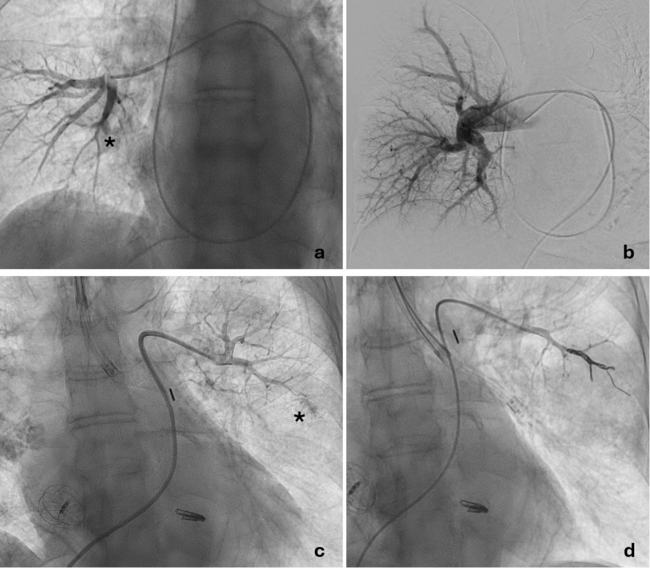
Development of novel stentgrafts like the BeGraft-aortic will make it possible to attempt endovascular treatments in complex aorto-visceral disease (Figure 1).[11]
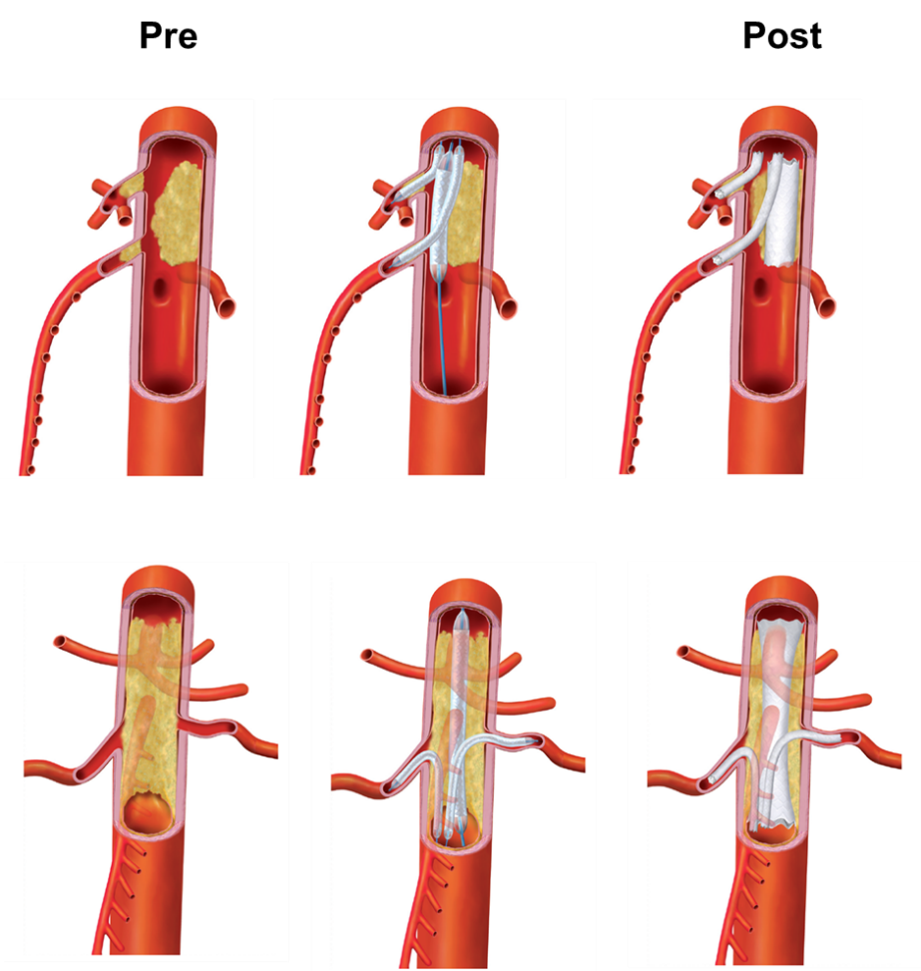
Additional future directions for clinical investigation will include:
- Understanding the gender differences in atherosclerotic disease of the aorta, iliacs, and visceral arteries.
- Improving the radial strength of stentgrafts;
- Combination of lithotripsy and stentgrafts to overcome radial strength limits.
- Improved stentgraft designs that preserve native aortoiliac bifurcation geometry and permit crossover maneuvers into the contralateral artery.
- Manufacturing larger and longer balloon-expandable stentgrafts.
References
- Mwipatayi BP, et al; COBEST co-investigators. Durability of the balloon-expandable covered versus bare-metal stents in the Covered versus Balloon Expandable Stent Trial (COBEST) for the treatment of aortoiliac occlusive disease. J Vasc Surg. 2016;64(1):83-94.e1. doi: 10.1016/j.jvs.2016.02.064. Epub 2016 Apr 28. PMID: 27131926.
- Mwipatayi BP, et al. A systematic review of covered balloon-expandable stents for treating aortoiliac occlusive disease. J Vasc Surg. 2020;72(4):1473-1486.e2. doi: 10.1016/j.jvs.2020.01.084. Epub 2020 Apr 28. PMID: 32360678.
- Bontinis V, et al. Editor's Choice - Covered Stents Versus Bare Metal Stents in the Treatment of Aorto-iliac Disease: A Systematic Review and Individual Participant Data Meta-analysis. Eur J Vasc Endovasc Surg. 2024;68(3):348-358. doi: 10.1016/j.ejvs.2024.06.008. Epub 2024 Jun 12. PMID: 38876369.
- Piazza M, et al. Systematic Literature Review and Meta-analysis of Covered Balloon-Expandable Stents for Aortoiliac Occlusive Disease. J Vasc Interv Radiol. 2026;37(4):107969. doi: 10.1016/j.jvir.2025.107969. Epub 2025 Dec 19. PMID: 41422888.
- Colacchio EC, et al. Open Versus Endovascular Repair With Covered Stents for Complex Aortoiliac Occlusive Disease: Cost Analysis Results. Ann Vasc Surg. 2023;97:382-391. doi: 10.1016/j.avsg.2023.05.029. Epub 2023 Jun 1. PMID: 37268106.
- Goverde PC, et al. Covered endovascular reconstruction of aortic bifurcation (CERAB) technique: a new approach in treating extensive aortoiliac occlusive disease. J Cardiovasc Surg (Torino). 2013;54(3):383-7. PMID: 23640357.
- Taeymans K, et al. Three-year outcome of the covered endovascular reconstruction of the aortic bifurcation technique for aortoiliac occlusive disease. J Vasc Surg. 2018;67(5):1438-1447. doi: 10.1016/j.jvs.2017.09.015. Epub 2017 Nov 21. PMID: 29169878.
- Rouwenhorst KB, et al. Long-term outcomes of the Covered Endovascular Reconstruction of the Aortic Bifurcation (CERAB) technique in patients with aorto-iliac occlusive disease. J Endovasc Ther. 2025 Feb;32(1):110-120. doi: 10.1177/15266028231166539. Epub 2023 Apr 28. PMID: 37114939.
- Available at: www.radcliffevascular.com/video-index/linc-25-10-year-outcomes-first-patients-treated-cerab-extensive-aortoiliac-occlusive. Accessed May 2, 2026.
- See E, et al. Covered balloon-expandable stents in isolated abdominal aortic stenosis or occlusion in 54 patients, predominantly women. Vasa. 2025 Nov 14. doi: 10.1024/0301-1526/a001248. Epub ahead of print. PMID: 41234061.
- Nikol S, et al. How to do it - Endovascular solutions for the renovisceral segment in coral reef aortas. Vasa. 2025 Nov 14. doi: 10.1024/0301-1526/a001249. Epub ahead of print. PMID: 41234060.
© 2026 HMP Global. All Rights Reserved.
Any views and opinions expressed are those of the author(s) and/or participants and do not necessarily reflect the views, policy, or position of the Journal of Invasive Cardiology or HMP Global, their employees, and affiliates.