8.3 Peripheral Atherectomy: Under or Over Utilized? Where is the Data Showing Benefit?
Problem Presenter: Jihad Mustapha
Problem Presenter: Jihad Mustapha
These proceedings summarize the educational activity of the 18th Biennial Meeting of the International Andreas Gruentzig Society held January 27 to 30, 2026, in Puerto Ayora, Santa Cruz, Ecuador.
Faculty Disclosures Sponsors
2026 IAGS Summary Document
Statement of problem or issue
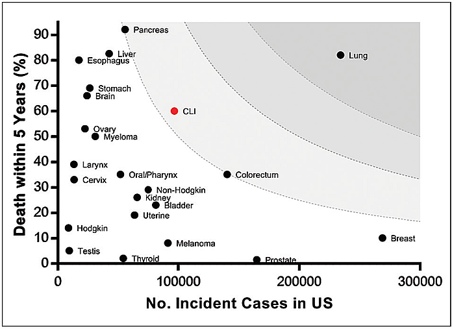
Peripheral arterial disease (PAD) in the arteries below-the-knee (BTK, i.e. infrapopliteal) is associated with substantial morbidity and mortality, yet this is under-recognized and under-appreciated by many clinicians. Two large studies examined and compared the 5-year mortality rates for patients with PAD and certain common cancers. The findings were that more patients die from PAD than from all cancers except lung cancer.[1,2]
In addition, nontraumatic lower-extremity amputation is a devastating complication of BTK PAD, and also is associated with high mortality as well as substantial medical costs. A recent policy statement from the American Heart Association focused attention on nontraumatic amputations, and called for efforts to reduce these amputations by 20% by 2030.[3] Unfortunately, while endovascular therapies have been used for many years in BTK PAD, it remains a challenging and difficult vascular territory.[4]
Gaps in current knowledge
Atherectomy as a vessel- and lesion-preparation procedure has been performed for over 25 years, yet is often criticized as lacking in supportive evidence.[5] Nevertheless, substantial evidence supporting atherectomy in BTK PAD exists, and the general lack of awareness is one of the major knowledge gap areas in this disease.[5,6] In a recent comprehensive review of 322 published studies of multiple types of atherectomy (directional, orbital, rotational, etc.), with over 100,000 patients included, 1-year mortality was 2.8% and major amputations were very low at 1.7%.[6]
Possible solutions or future directions
Recent policy statements are helpful at increasing public and clinician awareness of the seriousness of BTK PAD. Education, focused seminars, teaching and demonstration courses, and more clinical outcomes and quality-of-life studies may help reverse the lack of attention that has plagued this field.
References
- Mustapha JA, et al. Endovascular Today, 2019 (May) 18(5):80-82.
- Armstrong DG, et al. Five-year mortality and direct costs of care for people with diabetic foot complications are comparable to cancer. J Foot Ankle Res. 2020;13(1):16. doi: 10.1186/s13047-020-00383-2. PMID: 32209136.
- Creager MA, et al. Reducing Nontraumatic Lower-Extremity Amputations by 20% by 2030: Time to Get to Our Feet: A Policy Statement From the American Heart Association. Circulation. 2021 Apr 27;143(17):e875-e891. doi: 10.1161/CIR.0000000000000967. Epub 2021 Mar 25. PMID: 33761757.
- Zilinyi RS, et al. Surgical and Endovascular Therapies for Below-the-Knee Peripheral Arterial Disease: A Contemporary Review. J Soc Cardiovasc Angiogr Interv. 2024 Jan 29;3(3Part A):101268. doi: 10.1016/j.jscai.2023.101268. PMID: 39131787.
- Mustapha JA, et al. Propensity Score-Adjusted Comparison of Long-Term Outcomes Among Revascularization Strategies for Critical Limb Ischemia. Circ Cardiovasc Interv. 2019 Sep;12(9):e008097. doi: 10.1161/CIRCINTERVENTIONS.119.008097. Epub 2019 Sep 9. PMID: 31495219.
- Carr JG, et al. Published Evidence on Peripheral Atherectomy: A meta-analysis and systematic literature review of more than 300 original investigations. J Soc Cardiovasc Angiogr Interv. 2025 Oct 21;4(11):104009. doi: 10.1016/j.jscai.2025.104009. PMID: 41324060.
© 2026 HMP Global. All Rights Reserved.
Any views and opinions expressed are those of the author(s) and/or participants and do not necessarily reflect the views, policy, or position of the Journal of Invasive Cardiology or HMP Global, their employees, and affiliates.