9.1 Renal Denervation: Comparison of Therapeutic Approaches, Efficacy, Adoption and Reimbursement
Problem Presenter: Herb Aronow
Problem Presenter: Herb Aronow
These proceedings summarize the educational activity of the 18th Biennial Meeting of the International Andreas Gruentzig Society held January 27 to 30, 2026, in Puerto Ayora, Santa Cruz, Ecuador.
Faculty Disclosures Sponsors
2026 IAGS Summary Document
Statement of problem or issue
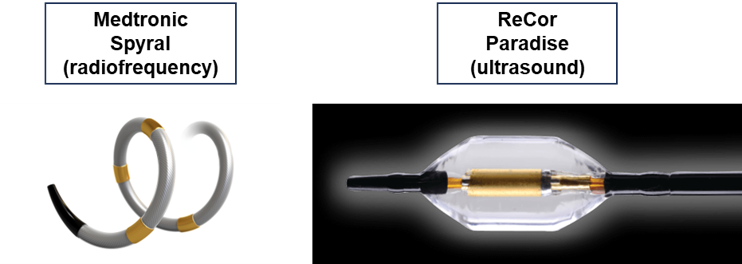
Effective control of hypertension (HTN) is a critical public health goal. Renal artery denervation (RDN) is a safe and effective adjunctive therapy, typically reserved for patients whose blood pressures are not well controlled on medications or who have serious medication side effects. Presently, both radiofrequency and ultrasound devices are available for intravascular RDN, and are FDA-approved devices (Figure 1).
A substantial body of evidence supports the safety and efficacy of RDN therapy.[1-4]
Gaps in current knowledge
There are several areas where gaps in knowledge or gaps in therapeutic application exist. Several of these are shown below:
- HTN care is fragmented, disorganized, and mostly inadequate
- Unclear responsibilities (primary care, cardiology, nephrology, vascular medicine, geriatrics, etc)
- Incomplete evaluations for secondary causes of HTN
- Lack of attention - “treatment inertia”
- Provider perceptions of RDN ineffectiveness
- Holdover from original negative trials (e.g. SYMPLICITY HTN-3)
- Difficult and challenging reimbursement environment for RDN
- Only Category III (temporary) codes available at present; Category I expected in 2027/2028
- Category III codes have no assigned wRVUs (i.e. no physician reimbursement)
So, the fragmentation in HTN care, the general misunderstanding of the effectiveness of RDN therapy, and the currently inadequate reimbursements from payors, have combined to limit widespread uptake of RDN.
Possible solutions or future directions
Current RDN devices will continue to evolve, and so will the procedure protocols by which they are applied. In addition, new technologies will be developed and will need to be tested both in sham-controlled as well as in head-to-head comparative studies. Two examples of novel devices that at present are undergoing clinical investigation are shown in Figure 2.

Other courses for the future will need to focus on:
- Renewing the focus on HTN evaluation and treatment.
- Overcoming fragmentation in HTN care.
- Demonstrating real-world cost effectiveness of HTN therapies, including RDN.
- Adjusting reimbursement systems for RDN therapy.
- Providing guidance on building hospital-based and/or clinic-based HTN programs.
References
- Singh S, et al. Renal denervation in hypertension: An updated meta-analysis of the randomized controlled trials. Catheter Cardiovasc Interv. 2023 Oct;102(4):663-671. doi: 10.1002/ccd.30796. Epub 2023 Aug 6. PMID: 37545184.
- Fengler K, et al. A Three-Arm Randomized Trial of Different Renal Denervation Devices and Techniques in Patients With Resistant Hypertension (RADIOSOUND-HTN). Circulation. 2019 Jan 29;139(5):590-600. doi: 10.1161/CIRCULATIONAHA.118.037654. PMID: 30586691.
- Fengler K, et al. 6- and 12-Month Follow-Up From a Randomized Clinical Trial of Ultrasound vs Radiofrequency Renal Denervation (RADIOSOUND-HTN). JACC Cardiovasc Interv. 2023 Feb 13;16(3):367-369. doi: 10.1016/j.jcin.2022.10.058. PMID: 36792266.
- Mufarrih SH, et al. Randomized Trials of Renal Denervation for Uncontrolled Hypertension: An Updated Meta-Analysis. J Am Heart Assoc. 2024 Aug 20;13(16):e034910. doi: 10.1161/JAHA.124.034910. Epub 2024 Aug 14. PMID: 39140334.
- Mahfoud F, et al. Alcohol-Mediated Renal Denervation Using the Peregrine System Infusion Catheter for Treatment of Hypertension. JACC Cardiovasc Interv. 2020 Feb 24;13(4):471-484. doi: 10.1016/j.jcin.2019.10.048. Erratum in: JACC Cardiovasc Interv. 2020 Nov 23;13(22):2717. doi: 10.1016/j.jcin.2020.10.012. PMID: 32081241.
© 2026 HMP Global. All Rights Reserved.
Any views and opinions expressed are those of the author(s) and/or participants and do not necessarily reflect the views, policy, or position of the Journal of Invasive Cardiology or HMP Global, their employees, and affiliates.