Improving Tardive Dyskinesia Detection Through Routine Clinical Monitoring

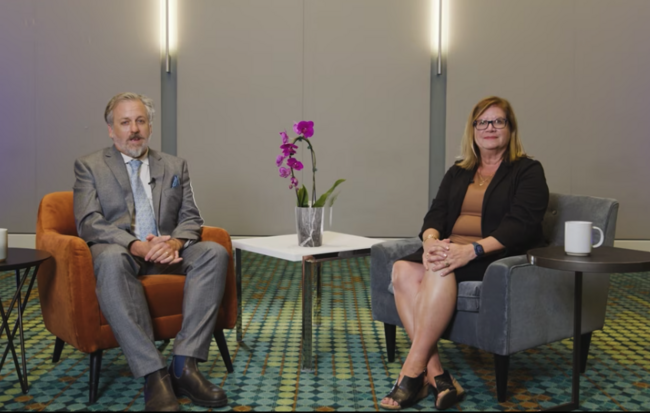
Because initial signs of tardive dyskinesia (TD) may be subtle, it’s easy to miss early symptoms during routine visits with patients. In this conversation with Jonathan Meyer, MD, and Brooke Kempf, PMHNP-BC, the clinicians offer their thoughts on how to incorporate both observational and structured TD assessment into everyday clinical practice.
Meyer and Kempf underscore the utility of treating every visit as an informal TD assessment, review the recommended frequency of conducting a structured Abnormal Involuntary Movement Scale (AIMS) exam, and highlight the role that educating patients, family members, and clinical staff may play in detecting early signs of TD.
Key Takeaways for Clinical Practice:
- Clinicians should visually assess patients at every visit, document observed movements, and perform a more structured examination when changes or new abnormal movements are identified.
- For most patients, a formal AIMS examination should be performed twice yearly, with more frequent assessments when clinically indicated.
- Educating patients, family members, and clinical staff to recognize and report new abnormal movements can help identify signals or symptoms that prompt a structured TD evaluation.
For more expert insights, visit the Tardive Dyskinesia Excellence Forum.
Editors' note: This interview has been lightly edited for clarity.
Psych Congress Network: How can clinicians effectively integrate both observation and structured assessments like AIMS into routine monitoring for TD?
Jonathan Meyer, MD: I think part of it is just noting that every time you lay eyes on somebody, you've done an exam. Maybe you don't do the full exam, but certainly document what you see. Then if something has changed, you'll do a more complete and structured exam.
A good way to get into the subject is to actually talk to your patient. Ask them, have they noticed anything different? I can't see restlessness sometimes, or Parkinsonism if the person is seated—but if the patient has noticed something that’s different, then I'll do a more formal exam.
But know who your patient is, know what’s different, and then at that point do a more formal exam. Typically, the AIMS for most people is a twice-yearly exam, sometimes a little bit more often.
Brooke Kempf, PMHNP-BC: If possible, if you can build it into your electronic health record (EHR), that's a wonderful way to receive a reminder to conduct a TD assessment, though I know in the past in our system becomes a little bit overloaded and doesn't always signal at the right time.
But Jonathan mentioned something important about educating the patient on what to watch for—that way they can report to you if they're noticing things. I think also educating family members so that they can watch for this movement [is helpful]. Educating your other staff, the front office staff, nursing staff, any other staff that could say, “Hey, I noticed when Joe was sitting in the waiting room while waiting for you, his mouth was making these funny movements.”
There's our red flag. When we're hearing these red flags, or in that normal appointment, we see a red flag, that's when we go a step further and do a more structured exam.
But as Jonathan mentioned, during every visit we should be assessing by just a visual of our patient.
Brooke Kempf, MSN, PMHNP-BC, has worked as a psychiatric nurse at Hamilton Center in Terre Haute, Indiana, since she graduated from Indiana State University with an associate degree in 1994. Her passion for mental health was sparked as she worked as a charge nurse on the Inpatient Unit and continued to grow as she served in their outpatient setting while obtaining her bachelor’s degree from ISU in 1996. She was awarded the 2008 Hamilton Award for Outstanding Staff Member. Kempf was then able to obtain her master’s degree from the State University at Stony Brook of New York and is board-certified by the ANCC as a psychiatric mental health nurse practitioner. She currently practices as the Hospitalist for the Inpatient Psychiatric Unit of Hamilton Center Community Mental Health Center in Terre Haute, Indiana and is an adjunct lecturer for IUPUI’s PMHNP program, and was awarded the 2022 Daisy Award for Extraordinary Nursing Faculty.
Jonathan Meyer, MD, is a Voluntary Clinical Professor of Psychiatry at University of California, San Diego, and a Distinguished Life Fellow of the American Psychiatric Association. Dr. Meyer is a graduate of Stanford University and Harvard Medical School, and finished psychiatry residency and fellowships at LA General Medical Center. Dr. Meyer has teaching duties at UC San Diego, is a Senior Academic Advisor to the California Department of State Hospitals, and is a psychopharmacology consultant to the first episode psychosis program at the Balboa Naval Medical Center.
Dr Meyer has lectured and published extensively on psychopharmacology. Along with Dr Stephen Stahl he is co-author of the Clozapine Handbook published in 2019, The Clinical Use of Antipsychotic Plasma Levels released in 2021, and The Lithium Handbook published in 2023, all three by Cambridge University Press.
© 2026 HMP Global. All Rights Reserved.
Any views and opinions expressed above are those of the author(s) and do not necessarily reflect the views, policy, or position of the Psych Congress Network or HMP Global, their employees, and affiliates.