Knowing When to Initiate Treatment for TD
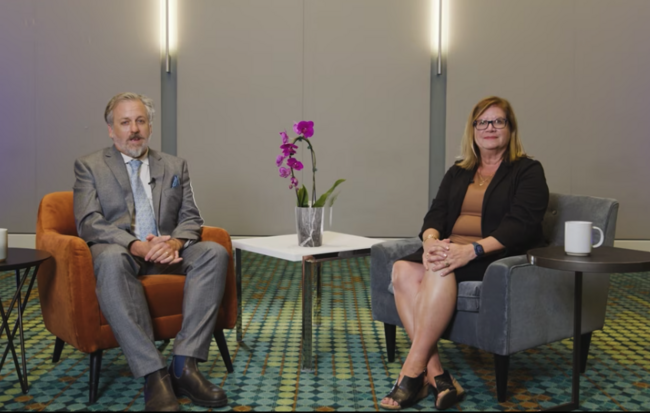
When a patient presents with signs of tardive dyskinesia (TD), how can clinicians gauge whether it’s time to initiate treatment? In this video, Psych Congress Elevate Co-Chair Kristian Dambrino, DNP, PMHNP-BC, discusses practical considerations for pinpointing whether and when to begin targeted treatment for TD.
Dambrino first offers an overview of how the US Food and Drug Administration (FDA) approval of 2 vesicular monoamine transporter 2 (VMAT2) inhibitors has changed the landscape for TD treatment. She then highlights why clinicians should ensure they are looking beyond objective measures and incorporating the patient’s perspective when determining TD severity and developing a treatment plan.
Key Takeaways for Clinical Practice:
- Since 2017, 2 FDA-approved VMAT2 inhibitors have become available for TD, both of which work early, remain effective over time, and do not worsen mood or the underlying psychiatric diagnosis.
- While clinicians should use the Abnormal Involuntary Movement Scale (AIMS) to assess TD symptoms, they should also evaluate the patient's day-to-day functional impact because objective severity and patient distress may not align.
- When considering treatment initiation, clinicians should engage patients and, when appropriate, caregivers in shared decision-making while discussing medication safety and potential functional benefits.
Read the Transcript:
Kristian Dambrino, DNP, PMHNP-BC: Hey, I'm Kristian Dambrino. I'm a psychiatric nurse practitioner based in Nashville, Tennessee, where I own my own clinic. I'm also on faculty at Belmont University College of Nursing.
Psych Congress Network: How has the availability of VMAT2 inhibitors changed the treatment landscape for TD?
Dambrino: When I was in my graduate nursing program at Vanderbilt University, we learned about anticholinergics for the treatment of tardive dyskinesia. I graduated in 2017, at which point the first FDA-approved VMAT2 inhibitor became available.
After I graduated, I really started to learn about these treatment options, not only that they were available, but about the effect size and how they work early.
They don't worsen mood. They don't worsen that underlying psychiatric diagnosis. Not only do they work early, they also can work over time.
We now have 2 FDA-approved medications—the VMAT2 inhibitors—that are available. Right after graduation, I was working with severe and persistent mental illness in my patients, so there was actually quite a bit of tardive dyskinesia that I was seeing in clinical practice. I learned that I really needed to collaborate with the psychiatrist that I was working with to be able to recognize tardive dyskinesia, differentiate that from drug-induced parkinsonism, and that VMAT2 inhibitors—absolutely in my clinical experience as well as the data that we have—were very, very effective in treating tardive dyskinesia in my patients.
PCN: What factors should clinicians consider when deciding whether and when to initiate treatment for TD?
Dambrino: When a clinician is deciding whether and when to initiate treatment for tardive dyskinesia, it is incredibly important to consider not just the AIMS score. We always use the AIMS in assessing TD symptoms, and we'll score that. But that's based on what we're seeing objectively.
We really need to dig deeper and ask, what is the impact of these movements, if they are present in our patients, even if they seem to be mild or if they're quantitatively mild per the AIMS, what's the impact on the patient's day-to-day?
As many of us know, patients don't necessarily notice those movements even if those movements are more severe, and some of our patients who have mild TD can be more bothered by those movements.
So, it's really important to involve the patient, and caregivers, if we have a release of information, in choosing a medication.
Much of the time, our patients will have reservations about adding another medication to the regimen, so it's also important for us to teach that we know those medications are safe, we know that they don't change that underlying mental illness, and really know the data with those medications and that they can actually help improve not only symptoms of tardive dyskinesia, but the functional impact of those symptoms.
Thank you so much for joining me today, and I hope to see you at the next Psych Congress.
Kristian Dambrino, DNP, PMHNP-BC, is a board-certified psychiatric nurse practitioner and the founder of Dambrino Wellness, a mental health clinic in Nashville, Tennessee. She holds a Master of Science in Nursing from Vanderbilt University and a Doctor of Nursing Practice from Belmont University.
A Fulbright Scholar, she is conducting research in Indonesia and India on reducing mental health stigma through nursing capacity building, and serves as adjunct faculty at Belmont University College of Nursing, with prior faculty appointments at Michigan State University and Marian University. As a national speaker and consultant, she serves in leadership as co-chair of Psych Congress Elevate and brings her clinical and research expertise to stages and institutions across the country.
© 2026 HMP Global. All Rights Reserved.
Any views and opinions expressed above are those of the author(s) and do not necessarily reflect the views, policy, or position of the Psych Congress Network or HMP Global, their employees, and affiliates.