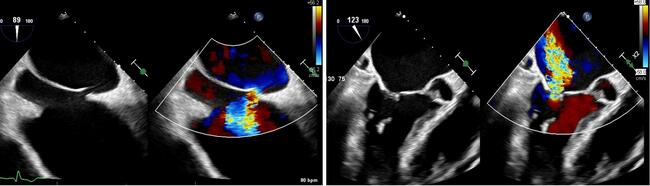
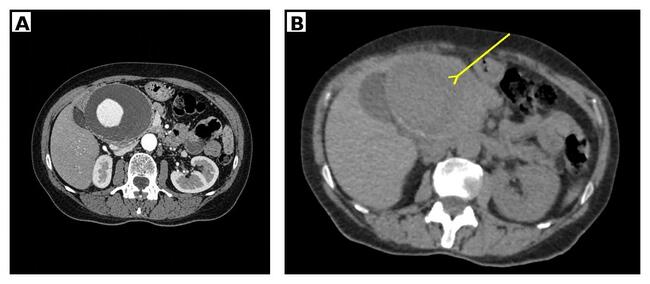
5.1 TMVR vs. TMVr: Is TMVR There Yet? When to do TMVr Instead and With What
Problem Presenter: George Hanzel
Problem Presenter: George Hanzel
These proceedings summarize the educational activity of the 18th Biennial Meeting of the International Andreas Gruentzig Society held January 27 to 30, 2026, in Puerto Ayora, Santa Cruz, Ecuador.
Faculty Disclosures Sponsors
2026 IAGS Summary Document
Statement of problem or issue
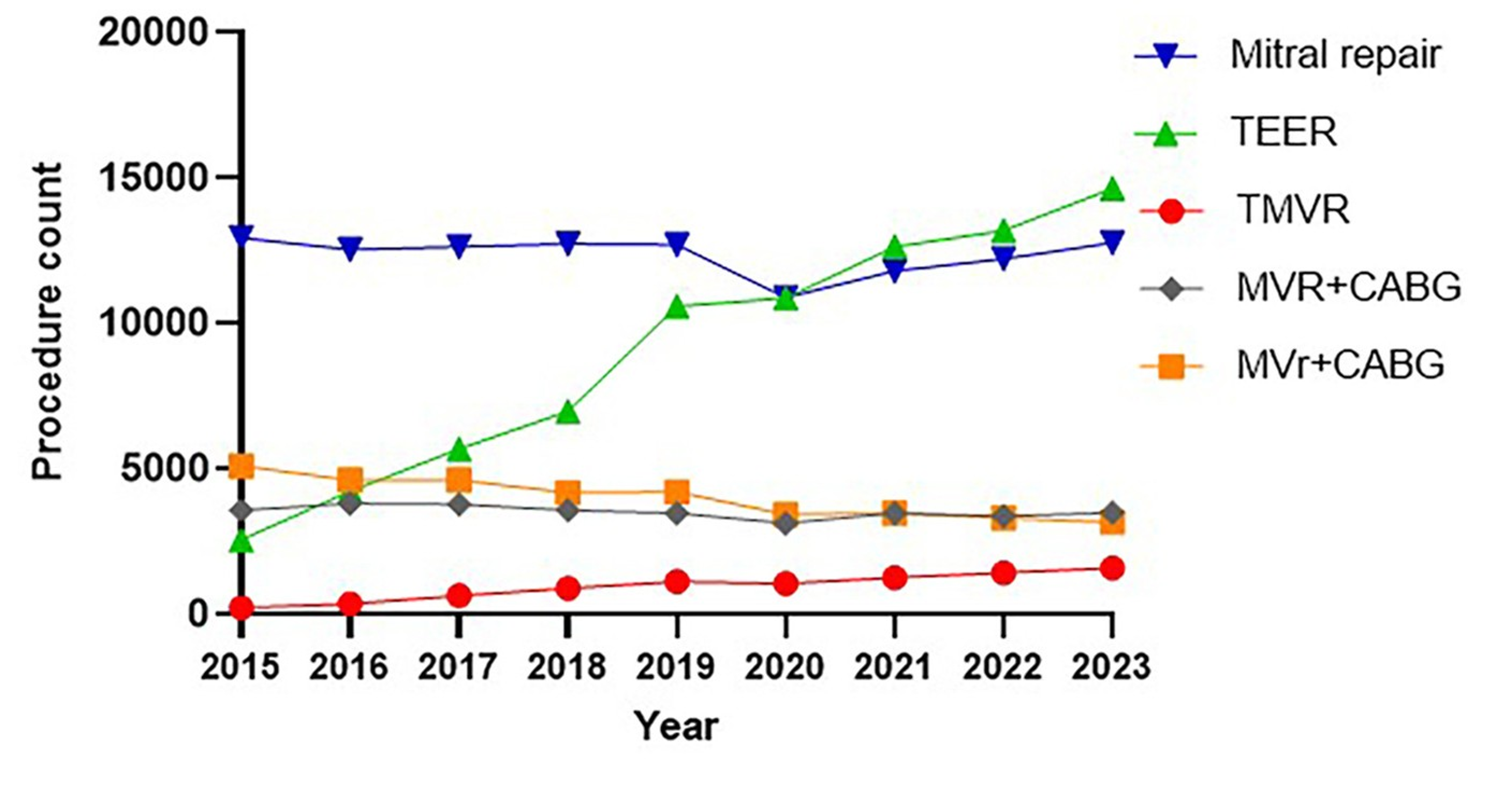
Transcatheter edge-to-edge repair of the mitral valve (M-TEER) has grown steadily over the past decade since its introduction into clinical practice. Transcatheter mitral valve replacement (TMVR) has been introduced more recently but the number of these procedures also is increasing (Figure 1).
One potential problem with M-TEER procedures is the difference between clinical trial results and what we see in clinical practice. For example, the reported rates of MR reduction ≤2 for the MitraClip device is 89-97%, and for the PASCAL device is 90-98%. [2,3] But, is that really what we see in our daily clinical practices? Can we do better with M-TEER?
What are the data for TMVR? Some recent study results are shown below in Table 1. Procedural success seems good, but short-and intermediate-terms outcomes look less favorable.
|
|
|
|
30-days |
1-year |
||
|
Study (Ref) |
Device |
Procedure success |
Mortality |
Stroke |
Mortality |
HF hosp.* |
|
ENCIRCLE (4) |
M3 |
96 |
0.7 |
2.7 |
13.9 |
16.7 |
|
TENDER (5) |
Tendyne |
94.9 |
6.7 |
1.6 |
16.9 |
25.4 |
|
SUMMIT (6) |
Tendyne |
94.2 |
6.8 |
1.9 |
16.8 |
30.1 |
|
INTREPID (7) |
Intrepid |
93.9 |
0 |
0 |
6.7 |
6.7 |
Table 1. Selected clinical results from recent studies of TMVR. All numbers are percents.
Abbreviations: *hosp.=hospitalization; †EFS= early feasibility study.
Further comparisons between M-TEER and TMVR are found in the results of the analysis of the pooled CHOICE-MI and Euro-SMR registries.(8) This was a propensity score-matched analysis of patients undergoing M-TEER (n=411) with MitraClip devices or TMVR (n=235) using one of ten possible valve implants. The primary endpoint comparison of all-cause mortality at 1 year is discussed in detail. Although close, the difference did not reach statistical significance (M-TEER = 18.9% vs TMVR = 25.8%, P=.056).(8) Other differences for the comparison of M-TEER with TMVR included more residual MR≥2 at 1 year (M-TEER = 36.6% vs TMVR=3%, P <.001) and higher NYHA Class I/II (77.8% vs 64.3%, P =.015).
Gaps in current knowledge
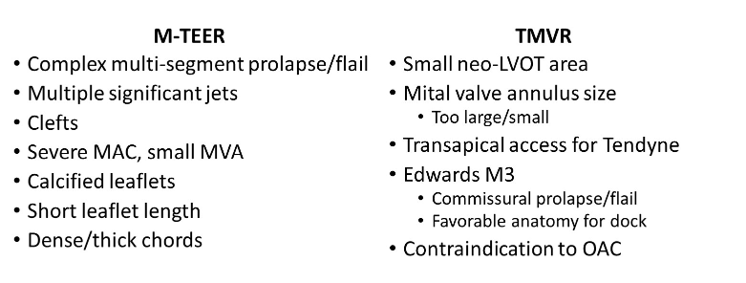
Some of the largest gaps in knowledge involve specific anatomic and clinical factors that could help decide between M-TEER or TMVR. Several of these are shown in Table 2 below.
Possible solutions or future directions
There are quite a few directions for future clinical research. Studies will likely be structured around answering the following questions:
- Which patients are best treated with M-TEER?
- Is MR reduction really as good as reported in trials?
- Which patients are best treated with TMVR?
- Is TMVR ready for prime time?
- When is superiority in MR reduction worth the increased procedural risk?
- Will SESAME/ASA/LAMPOON increase TMVR options for small neo-LVOT?
- Is it possible that valve iterations could reduce risk of LVOTO?
- Transseptal vs transapical?
- How about other transcatheter technologies?
- Leaflet extenders?
- Annuloplasty?
- Others?
- How to deal with M-TEER failures?
References
- Iribarne A, et al. The Society of Thoracic Surgeons Adult Cardiac Surgery Database: 2024 Update on National Trends and Outcomes. Ann Thorac Surg. 2025 Jun;119(6):1139-1150. doi: 10.1016/j.athoracsur.2025.03.011. Epub 2025 Mar 22. PMID: 40127833.
- von Bardeleben RS, et al. 1-Year outcomes with fourth-generation mitral valve transcatheter edge-to-edge repair from the EXPAND G4 Study. JACC Cardiovasc Interv. 2023 Nov 13;16(21):2600-2610. doi: 10.1016/j.jcin.2023.09.029. Epub 2023 Oct 24. PMID: 37877913.
- Waggoner T, et al. Early U.S. Commercial Experience With a Novel Transcatheter Edge-to-Edge Repair System: Insights From Real-World Data. JACC Cardiovasc Interv. 2025;18(16):2036-2046. doi: 10.1016/j.jcin.2025.07.019. PMID: 40866033.
- Guerrero ME, et al; ENCIRCLE Trial Executive Committee and Study Investigators. Percutaneous transcatheter valve replacement in individuals with mitral regurgitation unsuitable for surgery or transcatheter edge-to-edge repair: a prospective, multicountry, single-arm trial. Lancet. 2025 Nov 29;406(10519):2541-2550. doi: 10.1016/S0140-6736(25)02073-2. Epub 2025 Oct 27. Erratum in: Lancet. 2025;406(10519):2540. doi: 10.1016/S0140-6736(25)02380-3. PMID: 41167201.
- Hell MM, et al; TENDER Investigators. Transapical Mitral Valve Replacement: 1-Year Results of the Real-World Tendyne European Experience Registry. JACC Cardiovasc Interv. 2024;17(5):648-661. doi: 10.1016/j.jcin.2023.12.027. Epub 2024 Feb 21. PMID: 38385922.
- Sorajja P, et al. Transcatheter Mitral Valve Replacement for Severe Mitral Annular Calcification: Primary Outcomes From the SUMMIT-MAC Study. J Am Coll Cardiol. 2025:S0735-1097(25)09942-5. doi: 10.1016/j.jacc.2025.10.025. Epub ahead of print. PMID: 41194751.
- Zahr F, et al. 1-Year outcomes following transfemoral transseptal transcatheter mitral valve replacement: Intrepid TMVR Early Feasibility Study Results. JACC Cardiovasc Interv. 2023 Dec 11;16(23):2868-2879. doi: 10.1016/j.jcin.2023.10.001. Epub 2023 Oct 23. PMID: 37902145.
- Ludwig S, et al; the CHOICE-MI and the EuroSMR Investigators (see online Appendix S1). Transcatheter mitral valve replacement or repair for secondary mitral regurgitation: a propensity score-matched analysis. Eur J Heart Fail. 2023 Mar;25(3):399-410. doi: 10.1002/ejhf.2797. Epub 2023 Mar 8. PMID: 36883620.
© 2026 HMP Global. All Rights Reserved.
Any views and opinions expressed are those of the author(s) and/or participants and do not necessarily reflect the views, policy, or position of the Journal of Invasive Cardiology or HMP Global, their employees, and affiliates.