5.3 Best Practices for Closure of Large Bore Arterial and Venous Access Sites for Structural Interventions
Problem Presenter: Itsik Ben-Dor
Problem Presenter: Itsik Ben-Dor
These proceedings summarize the educational activity of the 18th Biennial Meeting of the International Andreas Gruentzig Society held January 27 to 30, 2026, in Puerto Ayora, Santa Cruz, Ecuador.
Faculty Disclosures Sponsors
2026 IAGS Summary Document
Statement of problem or issue
With the development and growth of structural heart interventions, like TAVR requiring large bore arterial access, and TMVR and TTVR both requiring similarly large bore venous access, there are complex issues related to vascular access site closure after completion of the procedure. Several devices are available, and they can be classified as suture-based or plug/patch-based (Figure 1).
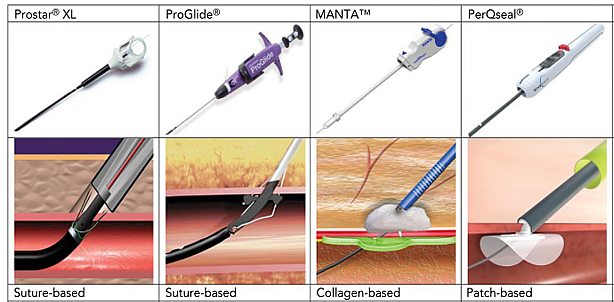
Arterial access site
Studies comparing devices for arterial access site closure are not extensive. Furthermore, techniques used by operators as well as the size and disease state of the arteries vary widely, making results difficult to interpret. Two small randomized trials tested a strategy of using two suture devices (ProGlide/ProStyle) versus one suture device plus one plug device (AngioSeal). The conclusions of both were that the suture plus plug strategy was superior.[1,2]
For the newer MANTA collagen plug device, two small randomized trials compared it to a suture-based device, and concluded that the suture-based device and technique was superior.[3,4] A meta-analysis of these two randomized trials confirmed this.[5]
Ongoing research has shown that simplistic interpretations of current trial results are not warranted. Many other vascular factors must be considered. These include, as a partial list only:
-
- Arterial size (diameter, mm)
- Arterial depth (superficial or deep)
- Calcification (anterior, posterior, circumferential)
Algorithms for device selection and step-by-step management of arterial access site closure have been developed and are undergoing continuous refinement.[6] These algorithms can help improve success and avoid complications.
Venous access site
With large bore venous access, the range of sizes is wider than with arterial access. A representative spectrum of sizes is shown in Figure 2.
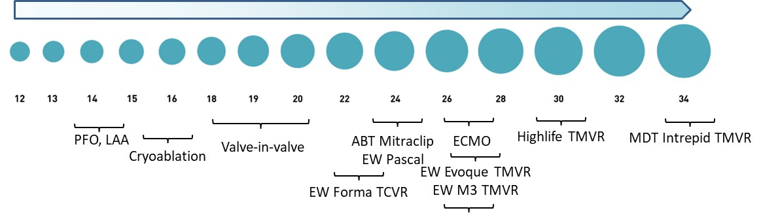
As discussed in the previous session (Session 5.2 – Schwartz), development of new devices for the tricuspid and mitral valves is an extremely active area; so this is a crowded field. More novel devices for large-bore venous access site closure are needed.
Gaps in current knowledge
The gaps in our current knowledge base are enormous and not likely to be filled quickly. A few of these gaps are listed below.
- Can the same device type be used for both artery and vein closures?
- Should surgical cut-downs and closures be used for vessels above a certain French-size?
- Are bail-out options (eg, wire access) always necessary?
- Is consideration of re-entry (ie, absorbable versus permanent) important?
- What is an “acceptable” rate of vascular complications?
Possible solutions or future directions
Many new closure devices and associated techniques are under investigation. We can expect a large number of presentations and publications of the results with these devices in the near future. Five of these closure devices are listed below:
- PerQseal (Vivasure Medical Ltd.) [7]
- Celt ACD (Vasorum Ltd.) [8]
- CLOSER (Rex Medical) [9]
- xCinch (xDot Medical Inc.) [10]
- NOVELRAD VCD (Novelrad – www.novelrad.com)
References
- Yeh CF, et al. Dual ProGlide vs ProGlide and Angio-Seal for Femoral Access Hemostasis After Transcatheter Aortic Valve Replacement: A Randomised Comparative Trial. Can J Cardiol. 2025 Jan;41(1):12-20. doi: 10.1016/j.cjca.2024.09.001. Epub 2024 Sep 6. Erratum in: Can J Cardiol. 2026 Mar 24:S0828-282X(26)00170-4. doi: 10.1016/j.cjca.2026.03.001. PMID: 39245341.
- Rheude T, et al. Comparison of strategies for vascular ACCESS closure after Transcatheter Aortic Valve Implantation: the ACCESS-TAVI randomized trial. Eur Heart J. 2025 Feb 14;46(7):635-645. doi: 10.1093/eurheartj/ehae784. PMID: 39474906.
- van Wiechen MP, et al. Suture- or Plug-Based Large-Bore Arteriotomy Closure: A Pilot Randomized Controlled Trial. JACC Cardiovasc Interv. 2021 Jan 25;14(2):149-157. doi: 10.1016/j.jcin.2020.09.052. Epub 2020 Dec 23. PMID: 33358648.
- Abdel-Wahab M, et al; CHOICE-CLOSURE Investigators. Comparison of a Pure Plug-Based Versus a Primary Suture-Based Vascular Closure Device Strategy for Transfemoral Transcatheter Aortic Valve Replacement: The CHOICE-CLOSURE Randomized Clinical Trial. Circulation. 2022 Jan 18;145(3):170-183. doi: 10.1161/CIRCULATIONAHA.121.057856. Epub 2021 Nov 5. PMID: 34738828.
- Dumpies O, et al. Suture-based versus plug-based closure for large-bore arterial access: an individual patient-level meta-analysis of randomised trials. EuroIntervention. 2025 Oct 20;21(20):e1222-e1233. doi: 10.4244/EIJ-D-25-00001. PMID: 41117657.
- Rosseel L, Montarello NJ, Nuyens P, Tirado-Conte G, Quagliana A, Cornelis K, Floré V, Rosseel M, Bieliauskas G, Sondergaard L, De Backer O. A systematic algorithm for large-bore arterial access closure after TAVI: the TAVI-MultiCLOSE study. EuroIntervention. 2024 Mar 18;20(6):e354-e362. doi: 10.4244/EIJ-D-23-00725. PMID: 37982158.
- Frerker C, et al; Frontier V Investigators. The Frontier V Study: Evaluating the Safety and Clinical Performance of a Large-Bore Vascular Closure Device After Femoral Arterial Access. Catheter Cardiovasc Interv. 2025 Jul;106(1):521-526. doi: 10.1002/ccd.31574. Epub 2025 May 7. PMID: 40343429.
- Wong SC, et al. A multicenter randomized trial comparing the effectiveness and safety of a novel vascular closure device to manual compression in anticoagulated patients undergoing percutaneous transfemoral procedures: The CELT ACD trial. Catheter Cardiovasc Interv. 2017 Nov 1;90(5):756-765. doi: 10.1002/ccd.26991. Epub 2017 Mar 15. PMID: 28296003.
- Wong SC, et al. The CLOSER trial: a multi-center study on the clinical safety and effectiveness of CloserTM VSS, a novel resorbable transfemoral vascular access sealing system. Catheter Cardiovasc Interv. 2017 Nov 1;90(5):798-805. doi: 10.1002/ccd.27241. Epub 2017 Aug 23. PMID: 28833996.
- Sorajja P, et al. Novel, Instantaneous Vascular Closure Solution for Catheter-Based Therapies. J Am Coll Cardiol Basic Trans Science. 2023 Nov, 8 (11) 1416–1418. doi.org/10.1016/j.jacbts.2023.10.002.
© 2026 HMP Global. All Rights Reserved.
Any views and opinions expressed are those of the author(s) and/or participants and do not necessarily reflect the views, policy, or position of the Journal of Invasive Cardiology or HMP Global, their employees, and affiliates.