Breaking Barriers: The Evolving Role of Ultra-High Pressure Balloons for Calcified Lesions
© 2026 HMP Global. All Rights Reserved.
Any views and opinions expressed are those of the author(s) and/or participants and do not necessarily reflect the views, policy, or position of the Journal of Invasive Cardiology or HMP Global, their employees, and affiliates.
Severely calcified coronary lesions remain among the most challenging lesions encountered by interventional cardiologists during percutaneous coronary intervention (PCI). By limiting stent expansion, calcified lesions are associated with higher rates of restenosis, stent thrombosis, and myocardial infarction.1 Optimizing procedural technique, including adequate lesion preparation and optimal stent expansion, is therefore crucial to achieving good long-term results.
Over the past decade, tools for modifying calcium have expanded well beyond conventional noncompliant (NC) balloons, rotational atherectomy, and excimer laser atherectomy. Added to the toolbox are cutting and scoring balloons, intravascular lithotripsy (IVL), and super-high-pressure (OPN NC) balloons, devices that, until recently, had never been compared head-to-head. Randomized data presented at the 2025 Transcatheter Cardiovascular Therapeutics (TCT) conference have begun to close that gap. The Short-CUT trial showed that cutting-balloon angioplasty achieves outcomes comparable with IVL at substantially lower cost,2 while VICTORY demonstrated noninferior stent expansion with the OPN NC balloon compared with IVL, as well as a similar safety profile, addressing one of the main concerns about the device.3
OPN balloons offer several potential advantages. They have a twin layer construction that allows for safe, more uniform expansion to ultra-high pressures, minimizing the dog-bone expansion pattern that can sometimes injure adjacent normal vessels. Recent iterations are lower profile and more deliverable than other devices such as IVL, albeit less deliverable than NC balloons. In addition, OPN balloons offer the option of multiple inflations with the safe device and potentially shorter procedural times than IVL.
Despite these potential benefits, perhaps the most persistent question surrounding the OPN NC balloon has been whether the benefit of its ultra-high inflation pressures come at the cost of a higher complication rate. In the October 2026 issue of the Journal of Invasive Cardiology, Montilla-Garrido et al4 report data from a single-center registry of 275 consecutive patients with complex calcified lesions treated over a 13-year period. The main indication was plaque preparation (68%), followed by stent optimization (32%). Procedural success was 95%, with one-third of lesions requiring inflation pressures of at least 40 atm. Quantitative coronary angiography demonstrated a significant increase in minimal lumen diameter (1.31 ± 0.66 mm to 2.13 ± 0.62 mm, P < .001) and a reduction in diameter stenosis (51% to 24%, P < .001). Importantly, these results came with a low perforation rate of only 0.7%, with no reported periprocedural or in-hospital major adverse events.
These findings reinforce that, with careful technique, the OPN NC balloon's risk profile does not seem to differ meaningfully from that of other calcium-modification tools. Nevertheless, several limitations warrant mention. Beyond its single-center retrospective design, the study lacks a comparator arm, precluding direct comparison with other calcium-modification strategies. There was also surprisingly low use of intravascular imaging (IVI) (25%), which restricts precise characterization of calcium morphology, confirmation of fracture, and objective assessment of final stent expansion. IVI has increasingly become the standard of practice for performing PCI in severely calcified lesions. On the other hand, the author’s registry would support the notion that PCI on calcified lesions can be safely performed with good outcomes without the use of IVI in selected patients.
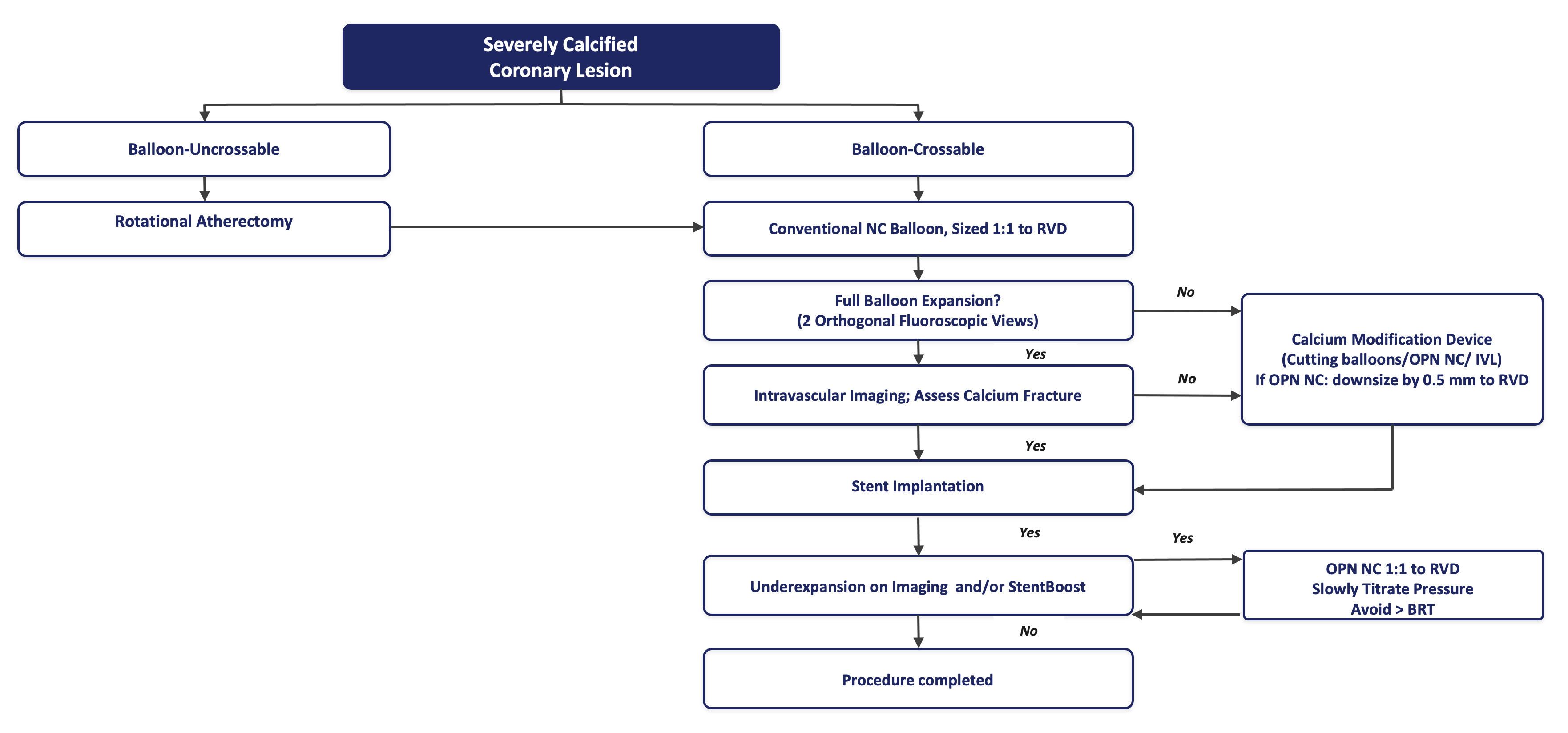
Taking the totality of data for PCI on calcified lesions into account, we propose a simple procedural approach to these lesions. Once the lesion is balloon-crossable, it is reasonable to start with initial dilation with a conventional NC balloon sized 1:1 to the reference vessel diameter. If balloon expansion is adequate and confirmed in 2 orthogonal angiographic projections, the lesion should then be assessed with IVI to evaluate for calcium fracture. If expansion on angiography is asymmetric or insufficient, or if imaging shows no fracture, progression to dedicated calcium-modification devices (cutting/scoring balloons, OPN NC, or IVL) should follow. Once fracture is confirmed and modification is adequate, stenting can be performed; in case of persistent stent underexpansion, postdilation with an OPN NC can be performed (Figure).
Several considerations are important for minimizing complications when using the OPN NC balloon. First, for lesion preparation (predilation), balloon undersizing by 0.5 mm may reduce the risk of vessel injury at ultra-high pressures. Second, for stent postdilation, a balloon sized approximately 1:1 to the stent or reference vessel is preferable. Third, inflation pressure should be titrated progressively according to lesion response, and pressures beyond the balloon’s rated burst threshold should be avoided, as device behavior beyond that point is not reliably predictable. Finally, guidewire choice probably also matters: a workhorse wire with a short spring-coil tip and hydrophobic coating is preferred to reduce the risk of wire entrapment and friction on withdrawal. If a polymer-jacketed wire is used instead, the operator should consider preemptively placing a second buddy wire alongside, in case the OPN NC balloon sticks during withdrawal.
These data add to the growing literature highlighting the safety profile of the OPN NC balloon when used appropriately, with careful sizing and progressive pressure uptitration. Given its favorable safety profile even at ultra-high pressures, consistent procedural success, and versatility spanning both predilation and stent optimization, the OPN NC balloon has earned a place in every catheterization laboratory’s standard armamentarium for treating severely calcified coronary lesions.
Affiliations and Disclosures
Mehdi Madanchi, MD, MSc; Shamir R. Mehta, MD, MSc
From the Population Health Research Institute, McMaster University and Hamilton Health Sciences, Hamilton, Ontario, Canada.
Disclosures: Dr Madanchi received a research grant from the Swiss National Science Foundation (SNSF). Dr Mehta has received grants and/or consulting fees from Abbott, Amgen, Janssen, and Novartis.
Address for correspondence: Shamir R. Mehta, MD, MSc, FRCPC, Population Health Research Institute, McMaster University, 237 Barton St. E., Hamilton, Canada. Email: smehta@mcmaster.ca
References
1. Madhavan MV, Tarigopula M, Mintz GS, Maehara A, Stone GW, Généreux P. Coronary artery calcification: pathogenesis and prognostic implications. J Am Coll Cardiol. 2014;63(17):1703-1714. doi:10.1016/j.jacc.2014.01.017
2. Baron SJ, et al. Cutting Balloon Angioplasty Versus Intravascular Lithotripsy for Severely Calcified Coronary Lesions: The Short-CUT Trial. Presented at: Transcatheter Cardiovascular Therapeutics (TCT) conference; October 26, 2025; San Francisco, CA. https://www.tctmd.com/slide/randomized-comparison-intravascular-lithotripsy-vs-cutting-balloon-treatment-calcified
3. Bossard M. A randomized, multicenter, non-inferiority comparison of intravascular lithotripsy and super-high-pressure non-compliant balloons for treatment of calcified and refractory coronary lesions: the VICTORY trial. Presented at: Transcatheter Cardiovascular Therapeutics (TCT) conference; October 26, 2025; San Francisco, CA. https://www.tctmd.com/slide/randomized-multicenter-non-inferiority-comparison-intravascular-lithotripsy-and-super-high
4. Montilla-Garrido MÁ, Camacho-Freire SJ, Izaga-Torralba E, et al. Impact of ultra-high-pressure OPN NC balloons in complex coronary interventions: indications, safety, and efficacy. J Invasive Cardiol. 2026;38(10). doi:10.25270/jic/26.00071