A “Crunching” Heart: Pneumopericardium Following Pericardiocentesis
© 2026 HMP Global. All Rights Reserved.
Any views and opinions expressed are those of the author(s) and/or participants and do not necessarily reflect the views, policy, or position of the Journal of Invasive Cardiology or HMP Global, their employees, and affiliates.
J INVASIVE CARDIOL 2026. doi:10.25270/jic/26.00090. Epub April 17, 2026.
A 70-year-old woman with adenocarcinoma lung presented with acute onset breathlessness. On examination, she was hypotensive with raised jugular venous pressure and muffled heart sounds. Echocardiography revealed a massive pericardial effusion with evidence of cardiac tamponade (right atrial collapse and tricuspid peak velocity variation >40 %).
Fluoroscopy-guided pericardiocentesis was carried out via subxiphoid approach, a pigtail catheter was placed, and 600 mL of straw-colored fluid was aspirated.
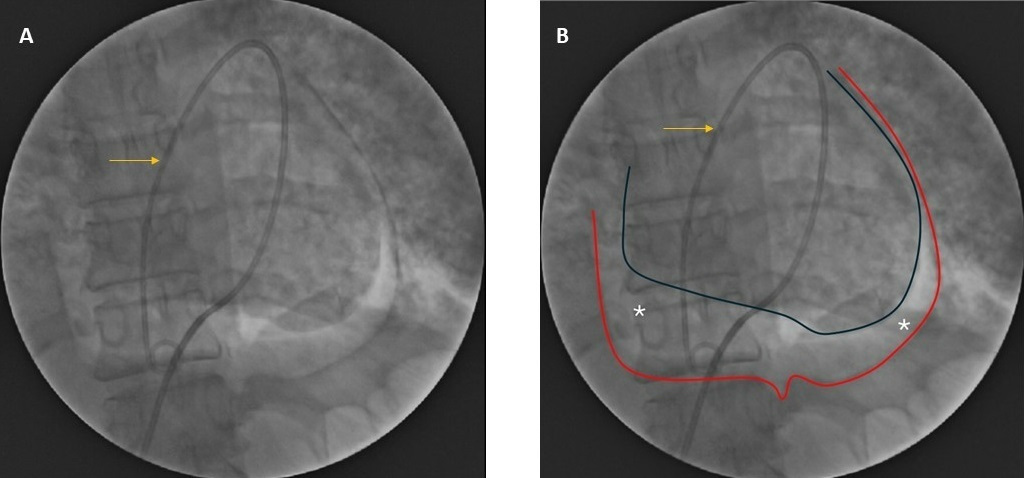
A few hours post-procedure, she developed chest pain and worsening breathlessness. Catheter aspiration yielded air. Echocardiography revealed reverberation artifacts with poor visualization of cardiac structures. Fluoroscopy confirmed pneumo-pericardium (Figure A, Video) with air (Figure B, asterisk) in between the visceral (Figure B, blue line) and parietal pericardium (Figure B, red line); subsequently, the air was aspirated completely. She improved, and the catheter was removed the following day. She was stable at the 1-week follow-up.
Pneumopericardium is a rare complication of pericardiocentesis, which can be promptly recognized and managed using echocardiography and fluoroscopy.
Affiliations and Disclosures
Samman Verma, MD, DM1; Devesh Kumar, MD, MRCP, DM2; Shreya Gupta, MD1; Sanchit Sood, MBBS1; Anil Kumar Choudhary, MD, DM3
From the 1Department of Cardiology, Sadbhavna Medical and Heart Institute, Patiala, Punjab, India; 2Department of Cardiology, Vardhman Mahavir Medical College and Safdarjung Hospital, New Delhi, India; 3Department of Cardiology, National Institute of Medical Sciences and Research (NIMS), NIMS University, Rajasthan, India.
Disclosures. The authors report no financial relationships or conflicts of interest regarding the content herein.
Consent statement: The authors confirm that informed consent was obtained from the patient for the intervention described in the manuscript and for the publication of thereof, including photographs.
Address for correspondence: Anil Kumar Choudhary, MD, DM, Department of Cardiology, National Institute of Medical Sciences and Research, NIMS University, Jaipur, Rajasthan 303121, India. Email: chaudharyanil007.ac@gmail.com