Round 1: Do Current Therapies Biologically Alter Refractory mCRC?
Transcript
Aparna Parikh: Starting out with our first question, do current therapies biologically alter refractory metastatic colorectal cancer?
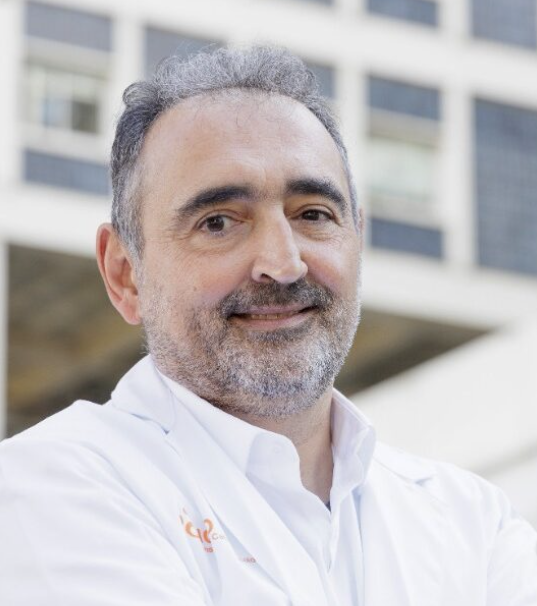
Nataliya Uboha: I'm Nataliya Uboha, I'm a GI medical oncologist and associate professor at the University of Wisconsin, Carbone Cancer Center. Thank you very much for the invitation to participate in this discussion.
So, I'll be arguing the affirmative side of the debate, although I think there are probably a few things that both pro and con arguments have in common. Targeting tumor microenvironment and angiogenic pathways has demonstrated consistent benefit in patients with microsatellite-stable colorectal cancer. We have been using bevacizumab for a long time in the management of this disease, and more recently, we have seen activity of multi-tyrosine kinase inhibitors in heavily pretreated patients as well.
Both CORRECT and FRESCO studies were large Phase III studies that enrolled patients with heavily pretreated microsatellite-stable colorectal cancer. In a CORRECT study, patients were randomized to regorafenib or placebo, and all had prior chemotherapy exposure. In this study, regorafenib showed improved overall survival compared with placebo in this patient population. Overall survival improved from 5 months to 6.4 months, with a hazard ratio of 0.77.
In a FRESCO study, a more recent study, patients are randomized to either fruquintinib, another multitargeted tyrosine kinase inhibitor that specifically inhibits VEGF receptors, or a placebo. And again, we are seeing improved overall survival, from 6.6 to 9.3 months, with a hazard ratio of 0.65. These are incremental gains. Of course, we would like to see a stronger signal, but it is consistent across both studies.
Another important study to bring up is one that uses bevacizumab in a late-line setting. As I mentioned earlier, bevacizumab is used in earlier lines of therapy in combination with chemotherapy. In the SUNLIGHT trial, patients are randomized to either lonsurf alone, which is a chemotherapy agent, or lonsurf in combination with bevacizumab. And yet again, we see that adding an anti-angiogenic agent improves overall survival in this heavily pretreated patient population.
And so, in summary, we are seeing in large, randomized studies that multi-tyrosine kinase inhibition with drugs like regorafenib or VEGFR signaling inhibition with drugs like fruquintinib improve overall survival in a heavily pretreated patient population. And bevacizumab, which has activity across different treatment lines, also in combination with chemotherapy, adds to the benefit of chemotherapy Lonsurf in this patient population as well.
Anti-angiogenic modulation can influence the tumor microenvironment by improving perfusion by reducing tumor hypoxia and altering immune cell trafficking, as Dr Parikh mentioned in her introduction.
Kanwal Raghav: I'm Kanwal Raghav. I'm one of the professors in GI medical oncology here at the University of Texas MD Anderson Cancer Center. And Nataliya, while I understand the appeal of your position, I don't find that data as compelling. You did point out RECOURSE, FRESCO, and CORREC trials. I have to say that we think that these are compelling trials because they're in a highly refractory setting, and we are in a desert for therapies in colorectal cancer. But although the survival has improved modestly at best with these trials, the objective response rate in the unselected refractory metastatic colorectal cancer population remains extremely low. The objective response rate of the RECOURSE, FRESCO, and CORRECT trials were 1.6%, 4.7%, and 1%, respectively. Even for the SUNLIGHT trial, the response rate was significantly low.
Furthermore, while these response rates are low, the durability of these responses, or even of disease control, is extremely poor, as reflected by the progression-free survival in these trials, which remains limited and typically measured in weeks to months. Just as an example, the PFS across the board was about 1.9 months in the CORRECT trial, 3.7 months in the FRESCO trial, and 5.6 months in the SUNLIGHT trial, which includes a chemotherapy agent rather than just a biological agent. Furthermore, the median overall survival in almost all these trials ranged from 6 to 10 months. So, I do feel that, if true biological reprogramming is occurring, it's occurring very transiently, and a more sustained disease stabilization, a deeper response, or biomarker evidence of immune activation would've been expected if this were a significant biological change.
Furthermore, when you look at areas where we have made the change, BRAF V600E mutant KRAS 12C or HER2 amplified tumors, where targeted therapy has made a meaningful difference in the survival for these patients. The BEACON trial showed response rates of about 26% in a patient population that is otherwise very refractory to chemotherapy. KRYSTAL-1 for KRAS-12C showed a response rate of 34%, and MOUNTAINEER showed a response rate of about 39.3%. And when these responses occurred, they had a significant duration, with median PFS increasing to 4, 6, and 8 months, and median overall survival of 9 months in the BEACON trial, 15 months in the KRYSTAL-1 trial, and nearly 23 months in the HER2-amplified MOUNTAINEER trial. So, I do feel that these targeted therapies really do change the biology and the microenvironment, and that's reflected in their outcomes compared to the trials done with salvage lines.
Aparna Parikh: Thank you both so much for this great discussion. I think the important points are being raised on both sides: the ability to truly modulate the tumor microenvironment versus transiently modulate it.
So, in summary, I guess a couple of questions, and I would love to pose them to both of you. So, what we heard from Dr Uboha was that, in heavily pretreated patients, the hazard ratios we see across trials are reproducible. And these reproducible hazard ratios, despite small ORRs, as Dr Raghav commented, may reflect biologically meaningful differences, even if incremental. So, even if incremental, we're still seeing some modulation of vascular and microenvironmental signaling.
On the skeptic side, we see modest survival benefits, limited OR without meaningful tumor shrinkage, suggesting that this immune-excluded TME remains intact in these refractory patients. So, I would love for the two of you to comment a bit on this discrepancy between the hazard ratio and the OR, and ultimately, what we would like to see to believe that we are truly shaping the tumor microenvironment?
Nataliya Uboha: Well, first, I could not agree more with Dr Raghav's comments about the modest activity. Absolutely, we would love to see much stronger activity when we measure short-term overall survival improvement; this is not enough for our patients. But the fact that we are seeing a signal is encouraging. In my opinion, these drugs that modulate the tumor microenvironment should be helper drugs. The hope is that the drugs would be used in combination with another therapy.
Targeted therapies are making strides in colorectal cancer. You have mentioned BRAF—targeted agents go after BRAF-altered tumors, and KRAS. We are developing new KRAS inhibitors. This is amazing. The hope is that these other agents in the ultra-tumor microenvironment could further augment the signal and result in greater durability. And of course, when you start using these agents in less heavily pre-treated patients, the expectation is that we may see stronger durability of responses and longer disease control, but they must be safe enough to combine with other agents.
Kanwal Raghav: Yeah, I mean, I would agree with those statements, except that the safety profile of these drugs does limit combination therapies. And there have been some attempts to move these up the treatment hierarchy without significant gains. I do feel that, largely, these three trials represent the value of continued VEGF inhibition in metastatic colorectal cancer. And while that affects the tumor, the evidence that it significantly affects the tumor microenvironment is limited. And whatever this treatment stress is, it is quite clear that the tumors rapidly develop resistance against these mechanisms, thus limiting the duration of benefit. So, I do feel that we need to tease this out a little bit more and dissect the biology and come up with more rational ways of targeting metastatic colorectal cancer in that setting.
©2026 HMP Global. All Rights Reserved.
Any views and opinions expressed are those of the author(s) and/or participants and do not necessarily reflect the views, policy, or position of Oncology Learning Network or HMP Global, their employees, and affiliates.
Related Content