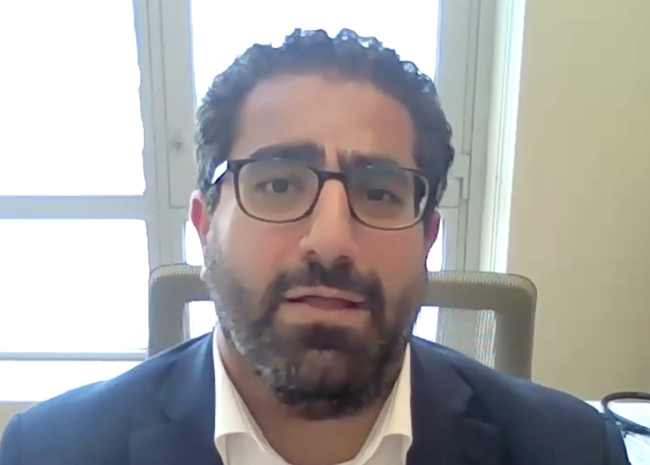
Tony S Mok, MD, FRCPC, FASCO, discusses the 7-year update from the phase 3 CROWN trial evaluating first-line lorlatinib versus crizotinib in patients with advanced ALK-positive non-small cell lung cancer. The study previously demonstrated a...
Tony S Mok, MD, FRCPC, FASCO, discusses the 7-year update from the phase 3 CROWN trial evaluating first-line lorlatinib versus crizotinib in patients with advanced ALK-positive non-small cell lung cancer. The study previously demonstrated a...
Joel Neal, MD, discusses updated results from CHRYSALIS-2 Cohort C evaluating first-line amivantamab plus lazertinib in patients with atypical EGFR-mutated advanced NSCLC.
Joel Neal, MD, discusses updated results from CHRYSALIS-2 Cohort C evaluating first-line amivantamab plus lazertinib in patients with atypical EGFR-mutated advanced NSCLC.
Jamie Chaft, MD, discusses results from the phase 3 EA5142 trial, part of the National Cancer Institute’s ALCHEMIST program, evaluating adjuvant nivolumab in patients with resected EGFR or ALK-negative NSCLC following standard therapy.
Jamie Chaft, MD, discusses results from the phase 3 EA5142 trial, part of the National Cancer Institute’s ALCHEMIST program, evaluating adjuvant nivolumab in patients with resected EGFR or ALK-negative NSCLC following standard therapy.
Lyudmila Bazhenova, MD, discusses updated results from the TRUST-I and TRUST-II trials assessing taletrectinib in TKI-naive patients with ROS1-positive non-small cell lung cancer.
Lyudmila Bazhenova, MD, discusses updated results from the TRUST-I and TRUST-II trials assessing taletrectinib in TKI-naive patients with ROS1-positive non-small cell lung cancer.
Estelamari Rodriguez, MD, discusses the importance of continuing immunotherapy after surgery to maintain immune activation and reduce recurrence risk in patients with early-stage resectable non-small cell lung cancer.
Estelamari Rodriguez, MD, discusses the importance of continuing immunotherapy after surgery to maintain immune activation and reduce recurrence risk in patients with early-stage resectable non-small cell lung cancer.
Corey Langer, MD, presents a case demonstrating how liquid biopsy identified an ALK fusion and guided treatment with alectinib, resulting in durable disease control and preserved quality of life in an older patient with metastatic non-small...
Corey Langer, MD, presents a case demonstrating how liquid biopsy identified an ALK fusion and guided treatment with alectinib, resulting in durable disease control and preserved quality of life in an older patient with metastatic non-small...
David Spigel, MD, discusses the results of the AIM-HIGH trial to evaluating the predictive efficacy of a 14-gene expression profile in identifying stage Ia to IIa patients with non-squamous NSCLC who benefit from adjuvant therapy.
David Spigel, MD, discusses the results of the AIM-HIGH trial to evaluating the predictive efficacy of a 14-gene expression profile in identifying stage Ia to IIa patients with non-squamous NSCLC who benefit from adjuvant therapy.
Based on results from the CHECKMATE-77T trial, the FDA has approved nivolumab plus platinum-doublet chemotherapy followed by surgical resection and single-agent nivolumab for patients with non-small cell lung cancer with no known EGFR...
Based on results from the CHECKMATE-77T trial, the FDA has approved nivolumab plus platinum-doublet chemotherapy followed by surgical resection and single-agent nivolumab for patients with non-small cell lung cancer with no known EGFR...
The phase 3 IMpactMF trial of imetelstat in patients with JAK inhibitor-relapsed or refractory myelofibrosis has been discontinued after an independent Data Monitoring Committee determined that the study was unlikely to meet its primary...
The phase 3 IMpactMF trial of imetelstat in patients with JAK inhibitor-relapsed or refractory myelofibrosis has been discontinued after an independent Data Monitoring Committee determined that the study was unlikely to meet its primary...
Updated NCCN guidelines include cosibelimab as a Category 2A recommended treatment option for patients with locally advanced cutaneous squamous cell carcinoma who are not candidates for curative surgery or radiation, supported by clinical...
Updated NCCN guidelines include cosibelimab as a Category 2A recommended treatment option for patients with locally advanced cutaneous squamous cell carcinoma who are not candidates for curative surgery or radiation, supported by clinical...
Results from the phase 3 LiGeR-HN1 trial demonstrated that petosemtamab plus pembrolizumab significantly improved overall survival and objective response compared with pembrolizumab alone in patients with PD-L1-positive recurrent or...
Results from the phase 3 LiGeR-HN1 trial demonstrated that petosemtamab plus pembrolizumab significantly improved overall survival and objective response compared with pembrolizumab alone in patients with PD-L1-positive recurrent or...
Results from the phase 2 BELLA trial demonstrated encouraging progression-free survival and response with relacorilant plus nab-paclitaxel and bevacizumab in patients with platinum-resistant ovarian cancer, with more pronounced activity among...
Results from the phase 2 BELLA trial demonstrated encouraging progression-free survival and response with relacorilant plus nab-paclitaxel and bevacizumab in patients with platinum-resistant ovarian cancer, with more pronounced activity among...
Updated ASTRO clinical practice guidelines recommend moderate hypofractionated radiotherapy over conventional fractionation across all localized prostate cancer risk groups and expand the role of ultrahypofractionation, including stereotactic...
Updated ASTRO clinical practice guidelines recommend moderate hypofractionated radiotherapy over conventional fractionation across all localized prostate cancer risk groups and expand the role of ultrahypofractionation, including stereotactic...
Results from the phase 4 Jazz EMERGE 402 study demonstrated clinically meaningful antitumor activity with lurbinectedin in previously treated small cell lung cancer, with lower response rates among patients with baseline central nervous...
Results from the phase 4 Jazz EMERGE 402 study demonstrated clinically meaningful antitumor activity with lurbinectedin in previously treated small cell lung cancer, with lower response rates among patients with baseline central nervous...
Results from a large NETSARC+ registry analysis demonstrated a substantial decline in surgical management of desmoid tumors over time and identified tumor size and anatomical location as prognostic factors for progression-free survival,...
Results from a large NETSARC+ registry analysis demonstrated a substantial decline in surgical management of desmoid tumors over time and identified tumor size and anatomical location as prognostic factors for progression-free survival,...
Results from a multicenter, retrospective trial demonstrated that granulocyte colony-stimulating factor prophylaxis was associated with significantly reduced febrile neutropenia rates and fewer related acute-care visits in patients with small...
Results from a multicenter, retrospective trial demonstrated that granulocyte colony-stimulating factor prophylaxis was associated with significantly reduced febrile neutropenia rates and fewer related acute-care visits in patients with small...
Results from the phase 3 TAISHAN-302 trial demonstrated that tambotatug pelitecan significantly improved overall survival, progression-free survival, and objective response compared with topotecan in patients with relapsed small cell lung...
Results from the phase 3 TAISHAN-302 trial demonstrated that tambotatug pelitecan significantly improved overall survival, progression-free survival, and objective response compared with topotecan in patients with relapsed small cell lung...
Results from a multicenter retrospective study found that no statistically significant differences in hematologic toxicity between oral and intravenous hypomethylating agents in patients with myelodysplastic syndromes or acute myeloid...
Results from a multicenter retrospective study found that no statistically significant differences in hematologic toxicity between oral and intravenous hypomethylating agents in patients with myelodysplastic syndromes or acute myeloid...