Resource

A Disease State Update on ALK+ NSCLC

Title
Executive Summary
Body

The most common cause of cancer-related mortality in the United States is lung cancer, about 80-85% of which is non-small cell lung cancer (NSCLC). The management of NSCLC has evolved substantially owing to the discovery of molecular drivers of cancer growth as well as the development of medications that specifically target actionable driver mutations to personalize therapy. Anaplastic lymphoma kinase (ALK) is a tyrosine kinase target implicated in NSCLC, and therapies targeted to- ward ALK have improved disease outcomes for patients with ALK-positive NSCLC. However, unmet needs re-main. It is important to identify patients with ALK rearrangements who may benefit from targeted therapy, but molecular testing to determine ALK status is currently underperformed in real-world practice. Treatment with ALK inhibitors is not curative, owing to a variety of genetic mechanisms of acquired resistance. Next-generation ALK inhibitors have begun to address this challenge, with activity against secondary resistance mutations as well as better control of central nervous system metastases, but optimal sequencing of ALK inhibitor therapy still needs to be determined. This report will help oncology care providers understand the significance of ALK gene rearrangements for NSCLC, the importance of performing molecular testing in patients with metastatic NSCLC to guide treatment decision-making, the drivers of acquired resistance to ALK inhibitors, and the potential benefits of ALK inhibition in relapsed or refractory settings.

This report was developed by HMP with support from Takeda Oncology. Takeda is acknowledged for participating in the writing, review, and editing of this report.


Introduction

Lung cancer is the most common cause of cancer-related mortality in the United States, representing about 20% of cancer mortality as a whole.1 About 234,000 new cases of lung cancer will be diagnoses in the United States in 2018, with an estimated 154,000 deaths from lung cancer the same year.2 About 80% to 85% of lung cancers are non-small cell lung cancer (NSCLC).3 NSCLC's three primary histologic subtypes include squamous cell, adenocarcinoma and large cell, with adenocarcinoma being the most common.4

The management of NSCLC has evolved substantially owing to the discovery of molecular drivers of cancer growth as well as the development of medications designed to specifically target actionable driver mutations to personalize therapy. NSCLC is highly heterogenous, with a number of oncogenes including epidermal growth factor receptor (EGFR), anaplastic lymphoma kinase (ALK), c-ros oncogene 1 (ROS1), Kirsten rat sarcoma viral oncogene (KRAS), and V-raf murine sarcoma viral oncogene homolog B1 (BRAF). One study reported that actionable driver mutations were found in 64% of tumors from lung cancer adenocarcinomas.5 Targeted treatment of oncogenic drivers with tyrosine kinase inhibitors (TKI) have led to better patient outcomes versus chemotherapy and may improve quality of life.5

Next: ALK Rearrangements in NSCLC and Implications for Treatment

,

Title
ALK Rearrangements in NSCLC and Implications for Treatment
Body

ALK is a tyrosine kinase target implicated in NSCLC. The first ALK gene translocation found in a NSCLC tumor was in 2007, where ALK was fused with the echinoderm microtubule-associated protein-like protein 4 (EML4) gene product.1 This EML4-ALK fused oncogene promotes the growth and proliferation of cancer cells via activation of an apoptotic signaling cascade.1,4,6 Though EML4 is the most common partner, accounting for 29-33% of ALK gene fusions, researchers have found more than 20 ALK fusion partners in NSCLC. The most common partners after EML4 include TFG and KIF5B, followed by NPM, TPM3, TPM4, ATIC, CLTC, MSN, MYH9, ALO17, IMT, SEC31A, and SQSTM1.5 Approximately 3-5% of NSCLC tumors are positive for ALK rearrangements,7 correlating to approximately 9,000 new cases in the United States per year.2

Therapies designed to target ALK fusion proteins have improved disease outcomes for patients with ALK-positive NSCLC compared with chemotherapy.8 In 2011, crizotinib was the first oral small molecule inhibitor granted US Food and Drug Administration (FDA) approval; the approval was based on response rate data in the post-chemotherapy setting in phase 1/2 studies.1 FDA approval in the first-line setting was granted based on the PROFILE 1014 study, in which crizotinib demonstrated a superior response rate and improved progression-free survival (PFS) compared with standard chemotherapy.8

Other ALK inhibitors have also been introduced since then for first-line treatment, including ceritinib and alectinib. Both drugs had previously been approved in patients with ALK-positive metastatic NSCLC whose disease progressed on or who were intolerant of crizotinib.9 In the first-line setting, ALK inhibitors have significantly improved median PFS versus prior standards of care, demonstrating a median PFS of up to 26 months.10,11 Based on these studies, the current NCCN Clinical Practice Guidelines in Oncology (NCCN Guidelines®) recommend using ALK inhibitors for first-line treatment in patients with advanced-stage/metastatic NSCLC identified as positive for ALK rearrangements.12 These category 1 recommendations include crizotinib, ceritinib, and alectinib, with alectinib preferred, based on data from a phase 3 randomized study.12

Given the clinical outcomes of targeted therapy versus chemotherapy in metastatic ALK-positive patients, it is critical to identify patients who may benefit from treatment with ALK inhibitors. Patients with ALK-positive NSCLC have distinct demographics (Table), including a younger median age than most patients with EGFR mutations or in unselected NSCLC populations.5 Approximately 70% are never smokers.8 Most ALK-positive NSCLCs are adenocarcinomas and tend to be aggressive, perhaps explaining why most ALK-positive patients have advanced disease at diagnosis.5 These clinical characteristics are not shared by all patients with ALK rearrangements, however, and molecular testing is necessary to determine ALK status.13

Next: The Importance of Testing for ALK Rearrangements in NSCLC

,

Title
The Importance of Testing for ALK Rearrangements in NSCLC
Slide Image
Body

The NCCN Guidelines® recommend ALK testing (category 1) in all patients with nonsquamous histology or NSCLC not otherwise specified.12 Testing may also be considered (category 2A) for those with squamous histology if patients are never smokers, had small biopsy specimens used for testing, or had mixed histology.12 Guidelines from the College of American Pathologists, the InternationalAssociation for the Study of Lung Cancer, and the Association for Molecular Pathology recommend performing ALK testing on all patients with advanced stage lung cancers with an adenocarcinoma component.14 Additionally, physicians may use molecular biomarker testing in tumors with histologies other than adenocarcinoma when clinical features indicate a higher likelihood of a targetable mutation, such as young age and absence of tobacco exposure.14

Despite guidelines, real-world practices show a wide variation in testing rates, which may lead to underdiagnosis of patients who are candidates for targeted therapy. In data from 16,316 patients across 206 clinics, EGFR/ ALK testing was performed in 78% of non-squamous patients, with testing rates at practices ranging from 0% to 100%. Clinicians showed lower testing rates for patients with squamous histology, with an average of 21% tested overall and a range of 0-100% across practices. Only 42% of ALK-positive patients tested after starting first-line therapy received the appropriate targeted therapy, versus 77% of ALK-positive patients who were tested prior to initiation of first-line therapy.This illustrates the need for greater adherence to genetic testing guidelines.15

1

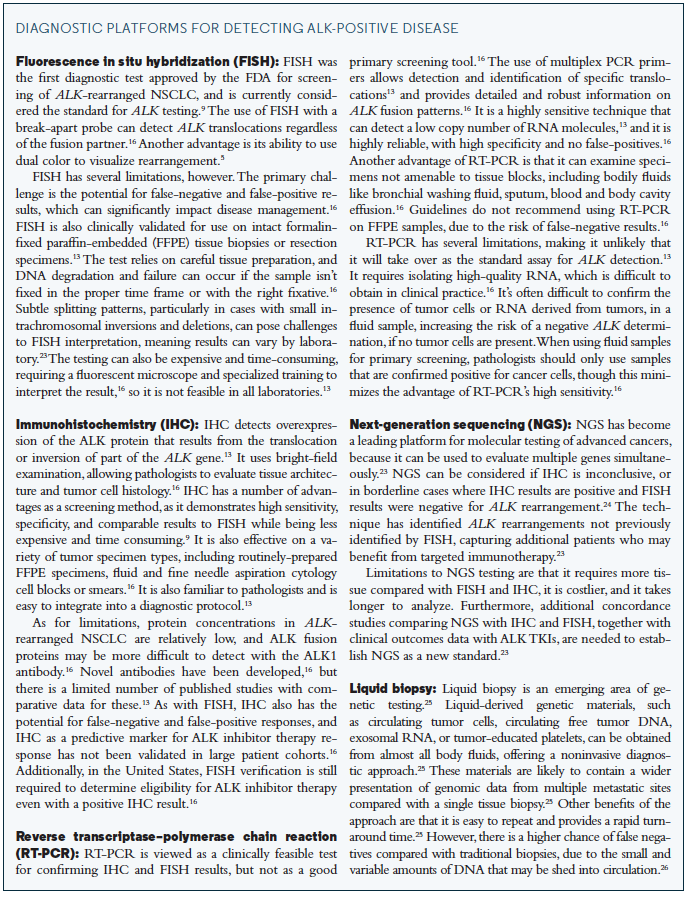
One challenge to providers is a lack of standardization with regard to diagnostic testing. Several diagnostic platforms have been developed to detect ALK-positive disease (See Sidebar). Assays need to be performed with reliability and reproducibility, so standardization is imperative.16

Regardless of the methodology used, tissue sampling for diagnostic testing is a challenge. In most cases, ALK testing is performed on a small tissue specimen obtained by biopsy or cytology, and it may not contain the tumor tissue due to the heterogeneity of NSCLC tissue.16 There also may not be enough tissue to perform a histologic diagnosis, immunohistochemistry for tumor classification, and molecular testing. Additionally, there is only one opportunity to fix and process the tissue.16

For these reasons, metastases are recommended as a preferred site of sampling.This maximizes the tissue sample size and ensures that the more important fraction of total tumor cell burden is collected.This approach also avoids potential heterogeneity problems within the primary tumor.13

Next: Acquired Resistance: A Major Clinical Challenge for Patients With ALK-Positive NSCLC

,

Title
Acquired Resistance: A Major Clinical Challenge for Patients With ALK-Positive NSCLC
Slide Image
Body

Although the advent of new ALK inhibitors has improved disease outcomes, unmet needs remain.Treatment is not curative, as disease progression eventually occurs in almost all patients.8 In clinical trials, patients treated with first-line ALK inhibitors progressed after approximately 7 to 26 months.10,17

There are three major mechanisms of acquired resistance to targeted treatment with an ALK inhibitor:8

ALK genetic alterations. Alterations in the drug receptor target can reintroduce oncogenic signaling.18 Target alteration, either as ALK mutations or amplification of the rearranged ALK, occurs in about 30-45% of crizotinib-resistant tumors.8,18 ALK mutations are a predominant mechanism of resistance to next-generation ALK inhibitors as well. In a study of post-progression biopsies from patients that received different first-line ALK inhibitors, including ceritinib, 56% of tumor samples showed ALK mutations, with distinct frequency and patterns of mutations depending on the drug.9 Approximately one-third of secondary resistance mutations occurs in the tyrosine kinase domain of ALK, with the most common mutation being L1196M.5 However, the remainder of acquired resistance mutations are not ALK-dominant.

Activation of bypass tracks. Acquired resistance can also result from the emergence of bypass tracks that render ongoing inhibition of ALK insuficient to preserve tumor control.18 These include EGFR or KRAS mutations, KIT or MET amplification, or changes in downstream signaling such as activation of IGF-1R.5,9,19

Multiple mechanisms of ALK-inhibitor resistance may occur in one tumor.19 Additionally, ALK mutations that confer resistance to ALK inhibitors may be heterogeneous at tumor sites. In one study, researchers re-biopsied patients on second-line ALK inhibitor after disease progression, and they identified two different treatment-resistant mutations within two different biopsy sites in the same patient.9 Another study identified the coexistence of ALK fusions with EGFR mutation in some patients, with the presence of both oncogenes varying between tumor cells.20 Thus, the oncogenic driver profile may not be the same in all tumor cells within the same primary tumor, posing serious challenges to diagnosis and treatment selection.20

Even with acquired resistance and disease progression on a prior ALK inhibitor, ALK inhibition remains an important mechanism for treatment in the second-line setting and after.

Limited sanctuary site penetration. Limited penetration of crizotinib through the blood brain barrier makes the CNS a sanctuary site, as evidenced by low concentrations of crizotinib detected in CNS samples from treated patients.19 This may be why the CNS is a common site of progression in patients treated with ALK-inhibitors, with 70% of patients treated with crizotinib developing brain metastases, though it could be the result of acquired resistance to the agent as well.8 In a retrospective analysis of trials involving crizotinib, researchers found that 20% of patients who did not have CNS disease at the beginning of treatment developed CNS metastasis while on therapy.19 Additionally, with targeted therapy improving outcomes for this patient population, as many as 60% to 90% of patients with ALK-positive NSCLC will ultimately develop brain metastases later in their disease course.21

Understanding these mechanisms of disease progression can help direct future drug development, treatment selection, and sequencing. It is important to determine if mechanisms of acquired resistance are pharmacological or biological and what driver genetic alterations are present, including from molecularly diverse tumors.18 It is also important to recognize the relevance of CNS activity for evaluating the ability of novel treatments to prevent disease progression in ALK-positive patients.18

Next: Treatment Strategies for ALK-Positive NSCLC That Has Progressed After ALK Inhibitor Treatment

,

Title
Treatment Strategies for ALK-Positive NSCLC That Has Progressed After ALK Inhibitor Treatment
Slide Image
Body

Upon progression after treatment with firstline crizotinib, NCCN Guidelines® recommend that patients with ALK-positive metastatic disease be switched to another ALK inhibitor—ceritinib, alectinib, or brigatinib—and consider adding local therapy (see next paragraph).12 These newer ALK inhibitors have begun to address some of the unmet needs in ALK-positive NSCLC, exhibiting activity against secondary mutations of the ALK gene,9 which are estimated to occur in 29% of cases of resistance to first-line ALK inhibitors,19 and response rates of 50-55% in patients who have crizotinib-refractory disease.8 These agents have demonstrated higher potency as well as improved CNS penetration.8,9 Thus, even with acquired resistance and disease progression on a prior ALK inhibitor, ALK inhibition remains an important mechanism for treatment in the second-line setting and after.9

Per NCCN Guidelines®, another alternative for patients with ALK-positive metastatic disease who progress on first-line ALK inhibitor therapy is to continue their treatment but consider adding local therapy.12 Those with brain metastases can undergo radiotherapy (RT), with stereotactic ablative RT recommended for those with a single isolated lesion and whole-brain RT recommended for those with multiple metastases.12 Because whole-brain RT is associated with a risk of neurocognitive deficits, NCCN recommends that switching to a different ALK inhibitor should be considered first.12

Recommended therapy for patients with progressive disease after two lines of ALK inhibitor therapy is not well defined.8 Emerging data suggest that some of these patients may respond to a third ALK inhibitor. NCCN Guidelines® recommend chemotherapy as a later line treatment alternative.12

There had been interest in immunomodulatory drugs in managing advanced NSCLC with checkpoint pathway antagonistic antibodies targeting PD-1 and its ligand (PD-L1). Indeed, previous versions of the NCCN Guidelines® recommended using PD-1/PD-L1 immunotherapy after progression on a second-line ALK inhibitor in PD-L1 expression–positive patients. However, the most recent version (V.2.2018) eliminates PD-1/ PD-L1 immunotherapy as a recommended treatment alternative for ALK-positive patients.12 Clinical data suggests that patients with ALK rearrangements have lower response rates to PD-1/PD-L1 immunotherapy compared with ALK-negative patients, irrespective of PD-L1 expression.22 Additionally, studies have shown that PD-1 directed therapy is less likely to be beneficial in patients who are never smokers, which ALK-positive patients tend to be.8

Next: Summary and References

,

Title
Summary
Body

ALK gene rearrangements are a significant consideration for treatment decision-making in NSCLC. Performing molecular testing in patients with NSCLC is important to identify patients that may benefit from ALK inhibitor therapies, which have demonstrated improved outcomes compared with chemotherapy. Screening rates for ALK- positive disease continue to be suboptimal and may result in underdiagnosis of patients who are candidates for treatment with ALK inhibitors. For ALK-positive patients, acquired resistance to ALK inhibitors poses a challenge, largely driven by the heterogeneity of secondary tumor mutations and CNS disease progression. Next-generation ALK inhibitors have begun to address this unmet need, as they have demonstrated effectiveness against acquired resistance mutations as well as CNS activity in patients previously treated with ALK inhibitors.

As treatment options continue to improve, optimal treatment sequencing will need to be better defined, particularly as more ALK inhibitors are approved for the first-line setting. Going forward, genetic analysis of the progressing tumor has the potential to play a greater role in guiding treatment decision-making to personalize therapy and improve outcomes for patients.8


References

1. Chan BA, Hughes BGM. Targeted therapy for non-small cell lung cancer: current standards and the promise of the future. Transl Lung Cancer Res. 2015;4(1):36-54.

2. American Cancer Society. Cancer Facts & Figures 2018. Atlanta: American Cancer Society; 2018.

3. American Cancer Society. About Non-Small Cell Lung Cancer. https://www.cancer.org/cancer/non-small-cell-lung-cancer/about.html. Accessed September 1, 2017.

4. Nix NM, Brown KS. Ceritinib for ALK-rearrangement-positive non-small cell lung cancer. J Adv Pract Oncol. 2015;6(2):156-160.

5. Chia PL, Mitchel P, Dobrovic A, John T. Prevalence and natural history of ALK positive non-small-cell lung cancer and the clinical impact of targeted therapy with ALK inhibitors. Clin Epidemiol. 2014;6:423-432.

6. Guerin A, Sanane M, Zhang J, et al. Brain metastases in patients with ALK+ non-small cell lung cancer: clinical symptoms, treatment patterns and economic burden. J Med Econ. 2015;18(4):312-322.

7. Gainor JF, Varghese AM, Ou SH, et al. ALK rearrangements are mutually exclusive with mutations in EGFR or KRAS: an analysis of 1,683 patients with non-small cell lung cancer. Clin Cancer Res. 2013; 19(15):4273-81.

8. Gadgeel SM. Sequencing of ALK inhibitors in ALK+ non-small cell lung cancer. Curr Treat Options in Oncol. 2017;18(6):36.

9. Santarpia M, Daffina MG, D’Aveni A, et al. Spotlight on ceritinib in the treatment of ALK+ NSCLC: design, development and place in therapy. Drug Des Dev Ther. 2017. doi:10.2147/DDDT.S113500.

10. Peters S, Camidge R, Shaw AT, et al. Alectinib versus crizotinib in untreated ALK-positive non-small-cell lung cancer. N Engl J Med. 2017;377:829-838.

11. Soria J, Tan DSW, Chiari R, et al. First-line ceritinib versus platinum-based chemotherapy in advanced ALK-rearranged non-small-cell lung cancer (ASCEND-4): a randomised, open-label, phase 3 study. Lancet. 2017;389(10072):917-929.

12. Referenced with permission from the NCCN Clinical Practice Guidelines in Oncology (NCCN Guidelines®) for Non-Small Cell Lung Cancer V.2.2018. © National Comprehensive Cancer Network, Inc. 2018.  All rights reserved.  Accessed January 25, 2018.  To view the most recent and complete version of the guideline, go online to NCCN.org. NCCN makes no warranties of any kind whatsoever regarding their content, use or application and disclaims any responsibility for their application or use in any way.

13. Thunnissen E, Bubendorf L, Dietel M, et al. EML4-ALK testing in non-small cell carcinomas of the lung: a review with recommendations. Virchows Arch. 2012;461(3):245-257.

14. Lindeman NI, Cagle PT, Aisner DL, et al. Updated Molecular Testing Guideline for the Selection of Lung Cancer Patients for Treatment With Targeted Tyrosine Kinase Inhibitors. Guideline From the College of American Pathologists, the International Association for the Study of Lung Cancer, and the Association for Molecular Pathology (published ahead of print January 22, 2018). Arch Pathol Lab Med. doi: 10.5858/arpa.2017-0388-CP.

15. Ruggiero J, Rughani J, Neiman J, et al. Real-world concordance of clinical practice with ASCO and NCCN guidelines for EGFR/ALK testing in aNSCLC. Poster presented at ASCO Quality Care Symposium. Orlando, Florida. March 3-4, 2017.

16. Tsao MS, Hirsch FR, Yatabe Y, eds. IASLC Atlas of ALK Testing in Lung Cancer. Aurora, CO: IASLC Press; 2013.

17. Shaw AT, Kim D, Nakagawa K, et al. Crizotinib versus chemotherapy in advanced ALK-positive lung cancer. N Engl J Med. 2013;368(25):2385-2394.

18. Camidge DR, Pao W, Sequist LV. Acquire resistance to TKIs in solid tumors: learning from lung cancer. Nat Rev Clin Oncol. 2014;11(8):473-481.

19. Wu J, Savooji J, Liu D. Second- and third-generation ALK inhibitors for non-small cell lung cancer. J Hematol Oncol. 2016;9:19.

20. Cai W, Lin D, Wu C, et al. Intratumoral heterogeneity of ALK-rearranged and ALK/EGFR coaltered lung adenocarcinoma. J Clin Oncol. 2015;33(32):3701-3709.

21. Rusthoven CG, Doebele RC. Management of brain metastases in ALK-positive non-small cell lung cancer. J Clin Oncol. 2016;34(24):2814-2819.

22. Gainor JF, Shaw AT, Sequist LV, et al. EGFR mutations and ALK rearrangements are associated with low response rates to PD-1 pathway blockade in non-small cell lung cancer (NSCLC): a retrospective analysis. Clin Cancer Res. 2016;22(18):4585-93.

23. Dagogo-Jack I, Shaw AT. Screening for ALK rearrangements in lung cancer: time for a new generation of diagnostics? Oncologist. 2016;21(6):662-663.

24. Pekar-Zlotin M, Hirsch FR, Soussan-Gutman L, et al. Fluorescent in situ hybridization, immunohistochemistry, and next-generation sequencing for detection of EML4-ALK rearrangement in lung cancer. Oncologist. 2015;20(3):316-322.

25. Mellert H, Foreman T, Jackson L, et al. Development and clinical utility of a blood-based test service for the rapid identification of actionable mutations in non-small cell lung carcinoma. J Mol Diagn. 2017;19(3):404-416.

26. Sequist LV, Neal JW. Personalized, genotype-directed therapy for advanced non-small cell lung cancer. UpToDate. https://www.uptodate.com/contents/personalized-genotype-directed-therapy-for-advanced-non-small-cell-lung-cancer. Accessed September 1, 2017.