Standard Immuno-Oncology Options for the Melanoma Landscape and Unmet Needs for Patients
Experts review the evolving immuno-oncology landscape in melanoma and discuss considerations that influence treatment selection beyond efficacy alone.
Transcript
Roxana Dronca, MD (00:11): Thank you for joining us. Our session is “Subcutaneous Immuno-Oncology for Metastatic Melanoma, Clinical Contacts, Patient Value and Practice Implementation.” My name is Roxana Dronca. I'm a medical oncologist. I practice at Mayo Clinic in Jacksonville, Florida. My area of expertise is cutaneous oncology. I also at Mayo Clinic serve as the deputy director for the Mayo Clinic Comprehensive Cancer Center in Florida and also as the director of our Cancer Care Beyond Walls program. I am joined today by 3 of my colleagues, and I will ask them to introduce themselves as well.
Sam Guild, JD (00:54): Hi, my name is Sam Guild. I'm the president of AIM Melanoma. We are an international nonprofit organization focused on finding a cure for melanoma.
Dronca (01:06): Thank you. Lucia.
Lucia Nolan, PharmD, BCSP (01:08): Hi, I'm Lucia Nolan. I am the home infusion pharmacy coordinator at Mayo Clinic, Florida campus. We support the Cancer Care Beyond Walls initiative, providing oncology-directed therapy in patients' homes. I have a fairly robust background in both oncology and home infusion delivery, so very excited to be here today.
Dronca (01:32): Thank you very much, Lucia. And Jen?
Jennifer Hunze, MSN, RN (01:35): Hello. My name is Jennifer Hunze. I am a nurse by background with most of my 20-year career being in the hematology-oncology area. I have a background where I specialize in infusion therapy, and I currently am the nurse manager for our Mayo Clinic Cancer Care Beyond Walls program. Nice to be here. Thank you.
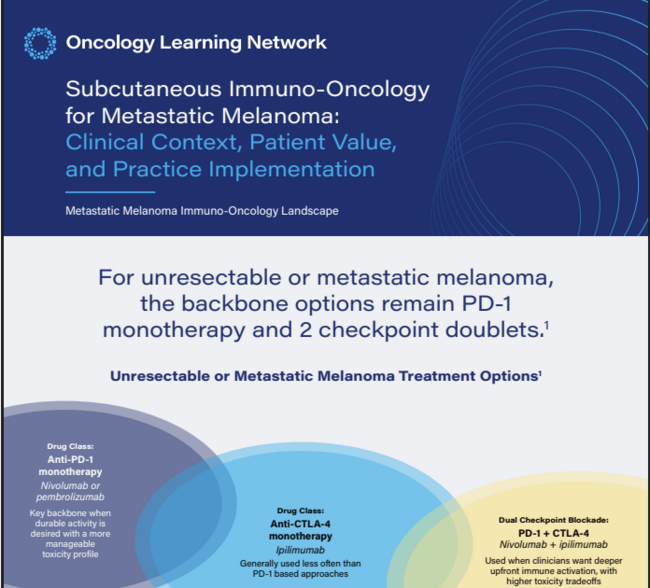
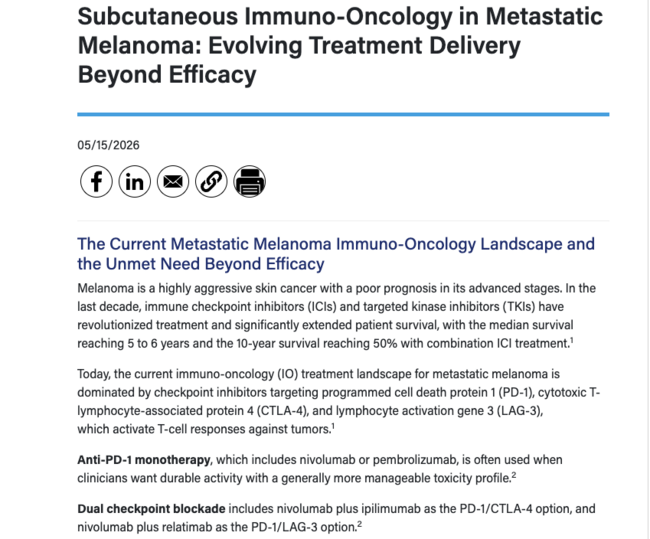
Dronca (01:59): Thank you all and really excited to kick off with our first chapter for discussion, which is standard IO immunotherapy options for the melanoma landscape and the unmet need for patients. So, as a practicing oncologist focusing on melanoma treatment, since I've trained in fellowship in the early 2000s, I really saw the field evolve and move forward for patients very rapidly and with a huge impact on patients. The average survival of patients with metastatic melanoma prior to 2010 was probably about a year or less, and now we see that 50% of patients, close to 50% of patients, are really alive and doing well 10 years and beyond, even for patients with stage 4 melanoma.
I think this is mainly due to the significant impact that immunotherapy has had on patients. Both patients with BRAF mutated disease as well as patients with BRAF wild-type disease benefit from immunotherapy and are candidates for immunotherapy from that perspective. And many studies have shown actually that even patients with BRAF mutated disease do a lot better long-term and have better clinical outcomes if they're initiated on immunotherapy as first-line. So, wanted to just touch upon a bit as to where the field is now in terms of immunotherapy options for our patients with either early stage or metastatic melanoma.
Back about in 2014, 2017, as we know, many trials have shown the benefit of adjuvant immunotherapy for patients with resected stage 3 disease. Initially, both patients with microscopic as well as macroscopic lymph nodes diagnosed either after sentinel lymph node biopsy or following a lymph node dissection benefited or were shown to have improved outcomes with adjuvant immunotherapy. Ipilimumab was the very first drug approved, but that has really was replaced by anti-PD-1 based therapies given the better safety profile for these agents. So, currently both nivolumab and pembrolizumab are approved for adjuvant treatment of patients with stage 3 melanoma.
However, recent trials have also shown benefit in patients with stage 2B and 2C disease. Benefit is mainly seen in terms of improvement in progression-free survival. Overall survival, I would say in this day and age of having multiple sequential treatment options that are beneficial and impact survival in melanoma is a little bit harder to prove, especially in the adjuvant setting. However, based on the relapse-free or progression-free survival benefit and improved safety profile of anti-PD-1-based therapy, nivolumab and pembrolizumab in stage 2B, 2C and 3 patients, these agents are currently approved and very much used in the adjuvant setting.
In the last few years, the neoadjuvant treatment I would say has significantly shifted the management of patients with macroscopic or clinically apparent disease. So, now for patients who are diagnosed with clinically apparent lymph node or in-transit metastasis, we have learned from recent trials, NADINA trial with ipilimumab and nivolumab and the SWOG-1801 trial with neoadjuvant and adjuvant pembrolizumab that using these immunotherapies when the tumor is still in place, leads to an enhanced antitumor immune response and better longer long-term clinical outcomes for patients.
So, in the context of neoadjuvant treatment, ipilimumab and nivolumab, either as 2 treatments or pembrolizumab as 3 treatments prior to surgery, have shown to really lead to improved clinical outcomes than compared to adjuvant therapy alone. I won't go into unnecessarily discussing the entire treatment paradigm in the neoadjuvant setting, but what we know now is that patients who have a robust pathologic response following a few courses of neoadjuvant treatment, 95% of those patients tend to maintain these responses long-term, even sometimes in the absence of completing or doing more adjuvant therapy.
In the context of metastatic disease, patients benefit from immunotherapy, whether they are diagnosed with small burden, medium burden or high burden disease, clinical judgment I think here is mainly the balance between risks versus benefits and choosing the right combination of agents in first-line. For patients who present with high tumor burden where a deep response and deep immune activation is needed, we tend to use a combination of ipilimumab and nivolumab for 4 cycles followed by maintenance nivolumab to complete 2 years of therapy.
For patients who are diagnosed with moderate burdened disease or small burden disease, either single agent anti-PD-1 reserved for, I would say small burden disease patients, more frail patients, or a combination of nivolumab and relatlimab in the first line has shown to be really leading to a deep clinical benefit for these patients as well. So, I think this is all to say that the field has moved from having almost no treatment options to having many treatment options for our patients diagnosed with melanoma, whether it's early stage or metastatic disease, that more than half the patients even with stage 4 disease do very well on these therapies and really benefit from them.
So, this is, I think, to say that maybe the main gap nowadays is not necessarily efficacy or needing more treatment options for patients, even though of course there are patients who progress on these treatments or do not respond to frontline therapies. But also, I think the need for patients is to find options that are more patient-friendly, patient-centered, maybe having better tolerability and better toxicity profiles.
So, I would like to invite my colleagues also to comment from their point, and especially from maybe a patient standpoint as well as our nurses and pharmacists as to what do you think from your perspective, the biggest unmet needs remain for our patients diagnosed with metastatic or early-stage melanoma?
Guild (09:31): So, I'll jump in first if that's okay. So, now that we have treatment options that are available, I agree it is about quality of life. I was thrust into the melanoma space about 20 plus years ago when my sister was 25 and diagnosed with stage 4 melanoma. Certainly, at that time, it was about extending her life beyond the traditional 9 months, which was expected at the time. So, we have come a long way and now the patients are living many years out, but we want them to enjoy their life.
Sometimes, it does require continuing treatment, so we need to do a better job to make sure that the life that they are working so hard to have by going to treatments, traveling long distances, that we do everything that we can to make sure that the treatments and the care that they are given supports them.
Dronca (10:38): Thank you, Sam. How much of the burden I think is about the treatment itself, maybe the repeated number of infusions or injections or visits and the logistics of getting these treatments?
Guild (10:57): So, it's very difficult. So, for some patients, they have to travel 2, 3 hours to receive their treatment. As you pointed out, this could go on for a couple of years. These individuals and caregivers, loved ones who are traveling with them have to sacrifice their times with their family. Often they incur financial toxicity as a result of that travel.
So, it is quite arduous in order for them to do this, but it's about making sure that the toxicity that they are exhibiting, that we do a better job at recognizing and managing them, but giving them the option as well to hopefully do many of these things away from the cancer center or other major hospital system that they are currently going to.
Dronca (12:00): Thank you. I agree. And I think 2 years is sometimes the good case scenario, some patients may end up being on treatment or having different therapies that they need to move from one treatment to another for even longer than that. So, Lucia, I saw that you came off mute. From your perspective, where do you feel like maybe the current intravenous medications or the current treatments create workflow challenges both for patients as well as for oncology practices?
Nolan (12:32): Yeah, so workflow challenges are pretty significant, especially from the pharmacy perspective. If you work at a large institution, you're seeing hundreds of patients a day. And so, being able to facilitate patients in and out of your infusion center takes up a considerable amount of time, even if it is quote unquote, an easy therapy to provide, you're still trying to fit those patients into quite a large system. And to Sam's earlier point, I think it was really beneficial to hear her comment about meeting each individual patient where they're at, identifying whether or not it's time traveling or their caregiver support that's required.
As we look to see these treatment options develop, you're noticing some of the accrediting agencies pick up on some of this. And as we're looking to develop our care plans, even within our own institutions and our own delivery mechanisms, we've started to see some accrediting agencies build that requirement into their plans of care, ensuring that we are addressing each of the patient's individual needs from a holistic point of view and understanding what is important to that individual patient.
And so, I think that's something that's really important to recognize is that holistically we're starting to see a little bit of a shift towards that perspective, but it's obviously taking some time for us to get there and be able to effectively implement it.
Dronca (14:06): Thank you, Lucia. So, do you think that then the route of delivery can become part of the treatment value itself for patients?
Guild (14:19): Absolutely. I mean, again, it's about them having as normal as a life as possible while they're going through this journey. It may not be something that everybody wants. I mean, we have to keep that in mind. Maybe for some people it's about having connections during treatment with other people who are going through a similar situation, but that's an individual choice for each patient and it should be something that we share with them and let them to decide how they best want to deal with that situation.
Dronca (14:56): Thank you. Lucia or Jen, do you have anything else you would like to add before we transition to the next topic?
Hunze (15:02): Yeah, I think I always think about the fact that our baby boomers are aging and our early diagnostics are improving and our treatments are becoming more vast. We have more to offer people. So, people are living longer and there's more of them at this age that is most common for cancer. So, it's also important for our organizations. Our healthcare system is going to go through some struggles and we need to make sure that we're being creative with how we can see the patients that really need to be in the clinic and make sure that we have that capacity to be able to care for them. And this is just one way.
There's so many other things that exciting things that we're doing that will hopefully offload some of the burden from the actual brick and mortar, but this is just one very, I think, effective way to decrease the volumes that we're seeing in our healthcare organizations to ensure that we have the capacity to manage things that need to be seen maybe quickly or more acutely. So, that's just one thing I wanted to say.
Dronca (16:16): That's a great point. Absolutely true. Lucia.
Nolan (16:21): I was just going to point out too that I do think route of delivery is an important tool to be able to have, to Sam's comment. It might not be for everyone, but similar to our treatment options within the agents that we're selecting in and of themselves, it's important to be able to diversify our product offerings both for the healthcare institution but also for the patient so that way they can select what truly works for their own lives best. So, I would absolutely agree that it is certainly a factor in the patient's holistic treatment journey.
Dronca (16:57): Thank you very much to all of you, and thank you to the audience for listening. We invite you to join us for the next chapter, which is subcutaneous immunotherapy options available for melanoma.
© 2026 HMP Global. All Rights Reserved.
Any views and opinions expressed are those of the author(s) and/or participants and do not necessarily reflect the views, policy, or position of Oncology Learning Network or HMP Global, their employees, and affiliates.
Related Content