Subcutaneous Immuno-Oncology Options Available for Metastatic Melanoma
Experts review the evidence supporting subcutaneous immunotherapy options for melanoma and discuss how pharmacokinetic, efficacy, and safety data inform their use in clinical practice.
Transcript
Roxana Dronca, MD (00:11): Good evening, everyone. Welcome to chapter 2 of our discussion today. The topic is subcutaneous immunotherapy options for patients with melanoma. And wanted to start by really introducing the 2 options that we have now for patients that are relevant to patients with melanoma, 2 subcutaneous options that were recently approved. And those are nivolumab and hyaluronidase and pembrolizumab and berahyaluronidase.
So these 2 agents were recently approved, based on 2 trials that looked at the equivalent bioavailability of these agents compared to their IV formulations. The trial that led to nivolumab approval, CheckMate 67T was a phase III open label, randomized non-inferiority trial in patients with clear cell renal cell carcinoma that were randomized to receive either subcutaneous flat dose nivolumab, 1200 milligrams, co-formulated with recombinant human hyaluronidase 20,000 units every 4 weeks, or IV nivolumab 3 milligrams per kilogram every 2 weeks. The co-primary endpoints of this trial of non-inferiority were based on pharmacokinetics, time averaged, serum concentration of nivolumab over the first 28 days and the minimum serum concentration at steady state.
The trial reached the non-inferiority pharmacokinetic endpoints and also a non-inferior objective response rate of subcutaneous versus IV nivolumab was also demonstrated. The safety profile was consistent between the subcutaneous and the IV groups, including the rates of all cause adverse events, treatment related adverse events, as well as those leading to treatment discontinuation. The approval for subcutaneous pembrolizumab was supported by a similar trial MK-3475A-D77, which was a phase 3 open-label randomized non-inferiority trial this time in patients with metastatic non-small cell lung cancer receiving platinum doublet chemotherapy with either subcutaneous pembrolizumab 790 milligrams every 6 weeks versus IV pembrolizumab 400 milligrams every 6 weeks by vein for 18 cycles. Similarly to the nivolumab trial, overall exposure and trough concentration of subcutaneous pembrolizumab were non-inferior to dose of IV pembrolizumab and similarly efficacy and safety profiles were consistent. So these 2 trials really led to approval of these agents not based on, again, we don't have to demonstrate efficacy of these agents in multiple tumor types again, but really demonstrate that from a bioavailability standpoint, the formulations achieve similar concentrations and similar safety profiles for patients.
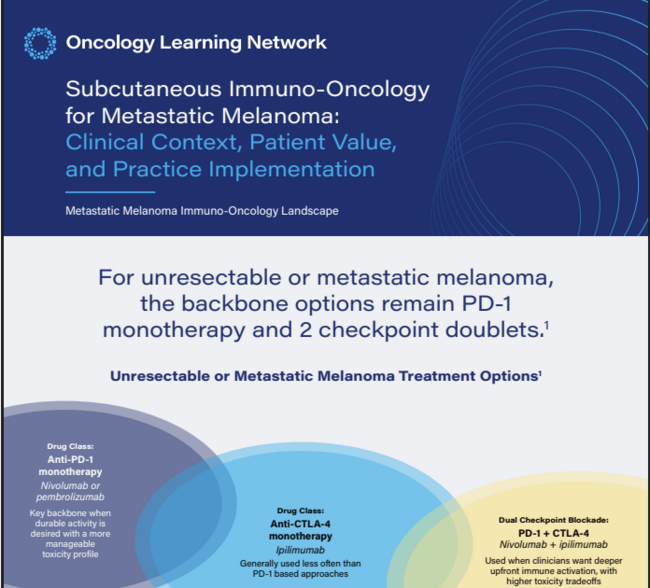
So for melanoma, I think relevant to melanoma, these agents are now approved for nivolumab for all adult and pediatric more than 12 years of age populations solid tumor indications except for combination with ipilimumab. So subcutaneous nivolumab is not currently approved in combination with IV ipilimumab, but it is approved as a maintenance therapy following induction with ipilimumab and nivolumab. It is also approved as monotherapy for adjuvant treatment of stage 2B, 2C and 3 and 4 melanoma again in adult and pediatric patients. For pembrolizumab, the FDA has approved this formulation for the solid tumor indications currently approved for IV pembrolizumab. So in the context of melanoma, it is indicated again as monotherapy for adjuvant treatment of stage 2B, C or stage 3 melanoma in adult and pediatric patients or as monotherapy for unresectable or metastatic melanoma in adult patients. So I think with these data in review, I would like to pose this question for you all, what gives patients and providers the confidence that the subcutaneous immunotherapy options are credible options in the treatment of patients with melanoma, whether it's the adjuvant, neoadjuvant, or metastatic stage?
Lucia Nolan, PharmD, BCSP (05:33): So I can go ahead and take that one. I think it's really looking at the data and demonstrating that those trough levels were achieved with sufficient confidence intervals. And so the context of the conversation really can go down to a bioavailability perspective of not only, yes, we have to look at maybe slightly different doses, but when you're talking about the distribution within the body system, you are achieving the same concentrations, which should ultimately in the end receive the same effects. And if I'm not mistaken, we have data going out several years to show that the overall survival rates are fairly similar or progression-free survival rates are fairly similar between the IV and subcutaneous formats. And so I think framing the context in that manner really helps to lay the groundwork and to level set what is expected of these agents and how they can transfer between disease states even if it wasn't explicitly studied in one particular disease state.
Dronca (06:43): Thank you, Lucia. I think this is very important from a pharmacist standpoint to explain. Patients often ask, I think, especially in the very beginning, I think more and more now patients are following the literature and reading and educating themselves. But in the early days after approval, the very first question that I would receive from patients would be, "Is it effective? Is the efficacy the same? And why am I getting a higher dose? Does that mean that I will have more drug in the system?" So I think explaining to patients that the higher dose relates to the route of administration but ultimately leads to same concentrations in the blood and that this was studied rigorously I think really was important for patients to hear. Jennifer or Sam, do you want to add anything?
Sam Guild, JD (07:39): So I actually was hoping we could talk a little bit about the toxicity and the side effects, because in addition to the efficacy of these new drugs, again, going back to what we discussed previously, the quality of life is incredibly important to patients. And so if you could help maybe share some insight on that as well.
Dronca (08:01): Thank you. I think that's a great point. And the fact that the subcutaneous formulation doesn't have any elevated risk of immune-related adverse events compared to the IV formulation and it has a similar safety profile that I think it needs the same close monitoring. For immune-related adverse events, it's important for patients to know, but at the same time it does have some benefits, I think in terms of having a lower rate of infusion reactions per se, the local site injection reactions that were seen in the trials, I think were mostly mild grade one or grade 2, and easily managed, I think for patients and maybe Jen can help us from a patient perspective and a nurse perspective talk about this a little bit more. But in general, patients have, if they experience any local site reactions in terms of redness or slight discomfort at the injection site, usually those are very short-lived and managed conservatively.
Jennifer Hunze, MSN, RN (09:10): Yes, definitely. I was thinking as you were speaking about this, how the injection site, maybe there'd be a little discomfort is no worse than an IV start. So the patients are still having maybe a little bit of an adverse effect, but it's nothing more than what they were having with the IV.
Dronca (09:33): Sam, would you like to expand a little bit, maybe from a patient perspective?
Guild (09:39): So as I indicated earlier, many of these patients are on these therapies for a very long time. And so although particularly for the more advanced cases, the overall survival is of higher importance. And of course it's always very important for all patients. But for those who have advanced disease, the fear of a treatment not working is much greater, but just because you are living a longer life, it's about having a life worth living. And so these toxicities can be very difficult to deal with, to recognize and then manage them. And we know that they could potentially last for many years to come. And so we need to keep all of these things in context that we don't want to be giving treatments to patients where the efficacy is the same, but the toxicity is going to be worse. And so we want to make sure that that issue is always being addressed.
Dronca (10:47): Absolutely. So I think the reassuring fact that in various trials, looking at different routes of administration, the safety profile was comparable across IV and subcutaneous, including, as you mentioned, the long-term toxicities, the immune-related toxicities, the treatment discontinuation side effects. I think this is important for patients to know. I think it's important also for us to communicate that just because the drug is given faster and in a patient-friendly way, it requires absolutely the same monitoring for side effects, the same oversight, clinical oversight for treatment clearance, et cetera.
But I have heard from patients that have transitioned from IV to subcutaneous and a few patients actually come to mind who've really been on treatment for a long time saying that for the first time they're not feeling like a cancer patient, that they went to the infusion unit and got a quick injection from a nurse that came in, smiled, gave them an injection and they were able to go. That it was truly the first few treatments, I think, unbelievable to them after being with the IV, this particular patient requires an ultrasound place IV every time. So yes, I think from that perspective, many patients do feel that this treatment has less toxicity or less side effects because it's the effect, as Jen mentioned, associated with the IV itself.
Hunze (12:26): I was going to mention too, Dr Dronca, you had said that that was one of the questions patients ask is, "Is it as effective?" And as a infusion nurse, I remember getting that exact question. And as much as it's important for us to share what we know from the data, it's also important for us nurses at the bedside to put it in a language they understand. And so often that those questions would come back to us and they would say things like, "I don't know that I feel comfortable. I'm nervous."
Honestly, us nurses would share with them that we trust the research, number one, that it has been well researched, but also we've seen this in other drugs. We've seen it go from IV to SubQ and be very effective, just as effective and this isn't the first time. And I feel like that always would put them at ease knowing that this isn't the first time that we've transitioned a drug from IV to SubQ. It's been done very successfully in the past and patients have reported such a improved quality of life because of the time that they save from the clinic time to life.
Dronca (13:39): I think this is a very important point because in other tumor types and breast cancer comes to mind, multiple myeloma, where patients are on treatment for a long time. Pretty similarly, a number of drugs have transitioned from IV to SubQ. And in the infusion unit, the nurses have seen this transition happen, have seen the impact on patients' quality of life and time that they receive treatment, shortening of that time and improvement in that quality of life. So Lucia, how should we better as providers talk about the interchangeability or the substitution, I think without overstating the evidence, without going into too much detail in patient-friendly ways to reassure patients?
Nolan (14:30): One of the things I like to do is to compare it to something that they've seen similarly. So in many cases, I think talking about it in terms of things like insulin can be really beneficial, where you've seen patients receiving injections and having very immediate, very effective doses that they can see the results of in real time. I think comparing it to something like that that they can tangibly understand really helps to drive home that point.
As you and Jen have mentioned, we've seen this in other disease types and we've seen great responses in it and being able, I think to expand upon the data and the literature just enough for them to be able to really comprehend, as you've mentioned it previously, patients are doing more research themselves and understand why that this makes it a little bit different than the IV formulation, but just enough to make their lives a little bit easier per se or give them another option can really help empower them to make their own decisions about what is best for them. I think always tying it back to something that is tangible and relatable for something that is so commonplace and I tend to default to insulin as my point of reference there.
Dronca (15:54): That's a great point. Sam, from a patient perspective, do you feel that the fact that these trials have been done in other tumor types and not melanoma, but again, with the endpoint being a pharmacokinetic or a bioavailability endpoint, do you think that this is reassuring for patients once we explain how these trials were done?
Guild (16:21): I think patients want to be given information that reassures them that they are not necessarily quote "Guinea pigs." Make them feel as if there is a strong foundation for these types of treatments and that helps reassure them that what they are using is something that is very common in treating cancer and that they are not out there being the first to use them.
Dronca (16:50): Thank you. Last point I want to make is I think that from a provider standpoint, it's also important that we are familiar and understand the approved indications because again, these agents are not approved in certain combinations. It's not approved with ipilimumab. Pembrolizumab is approved in context of some chemotherapies in other tumor types. So really understanding the label indication and where these agents are appropriate to use as opposed to different combination agents that include SubQ, oral or others. So I don't know, Lucia, if from a pharmacist standpoint you see anything important here that we should be mindful of.
Nolan (17:39): Well, to your point, I was going to speak to the fact that it is also beneficial to highlight the downfalls too. I think if we only talk to certain positive features of a medication, there's the level of skepticism that can arise in patients. And so being able to point out that this is applicable in this particular instance, but maybe not this one, the reason is because there is insufficient data, also I think helps instill that level of confidence within patients knowing that we have looked at them comprehensively and are not just pushing this new thing, we're not just trying to make them the guinea pig, I think is very important part of the conversation as well.
Dronca (18:26): I think that this is a very important point. Also discussing the potential local site reactions. I think if we don't mention it to patients and they experience this type of reactions, I think that also to your point, I think raises a level of skepticism in patient. I think understanding that maybe not everybody is a candidate for subcutaneous therapy. Jen, from a nursing perspective, I know it's not too many patients that we would exclude, but for instance, patients who are very thin or patients who have certain skin conditions that potentially make them not the best candidates for subcutaneous therapy, I think this is also important to keep in mind and discuss with patients if they ask about these options, but we feel it may not necessarily be appropriate for them.
Hunze (19:12): I completely agree. I think sometimes we, as the provider, feel like it's such a win, and we don't always consider the patient's perspective as to what they may be changing. Like Sam said earlier about some patients I have had patients say, "I really just want to see other people. This is my social interaction for the month, and I don't want to miss out on that time with the nurses and with other patients." So that does play a big part in wellbeing as well. And like you said, the local site reaction, that is sometimes some people they may have more concerns about that when they always have an easy IV start. "What if I start having more pain than I had when I got my infusion?" So I do think it's something to definitely consider so to have very clear conversations and like Lucia said, outline the good and maybe the more negative, not necessarily negative, but a little more negative side effects is important.
Guild (20:23): If I can just follow up on that, I think it's incredibly important to be honest with patients because it doesn't just impact what's happening now, but also further down the road. If you need to change to a different treatment or maybe another, try maybe a different schedule, you want patients to trust you. And if you leave out some of the things that may happen, the negative impact, then why would they believe you down the road when you make another suggestion or you want to do something different? They may question whether or not what you are suggesting to them is in their best interest.
Dronca (21:04): Thank you all. So I think it's important for us as a conclusion is to understand that the non-inferiority trial data for both nivolumab and hyaluronidase and pembrolizumab and berahyaluronidase have established that the SubQ delivery of these agents is safe and as effective as it is for IV with their IV forms, that this offers an alternative for patients, especially for patients with melanoma that we are discussing today. But it is important to be able to present to patients both the data from the studies that were done with these agents as well as discussing the other aspects of care as you all mentioned, both the time but also the potential side effects of IV versus SubQ and how this integrates in the overall plan of care and in their overall in their life. So thank you all for joining us for this chapter and we hope that you will join us for our next chapter talking about advantages of subcutaneous immunotherapy for patients.
© 2026 HMP Global. All Rights Reserved.
Any views and opinions expressed are those of the author(s) and/or participants and do not necessarily reflect the views, policy, or position of Oncology Learning Network or HMP Global, their employees, and affiliates.
Related Content